
Your ads are working. The forms are coming in. The phone rings.
But at the end of the month, the calendar isn’t full and the bank account doesn’t show it.
When that happens, most owners blame the leads: “They’re junk.” Sometimes that’s true. Often it isn’t. The leak can be anywhere between the click and the signed job, and buying more leads before you find it just pours more water into a bucket with a hole in it.
The good news: you can find the leak in about an hour with your last month of inquiries and a spreadsheet.
A lead isn’t a customer: name the stages
Most confusion starts with one word. “Lead” can mean a click on your phone number, a form fill, a real conversation or a signed contract. If your ad platform, your office and your bookkeeper each mean something different, the numbers will never add up.
Google draws the same line in its own lead tracking. It separates qualified leads, which have been vetted outside the ad platform, from converted leads, which have reached a step you define, such as a sale. Your records should too.
| Stage | What it means | Who confirms it |
|---|---|---|
| Inquiry | A real person called, filled out a form or messaged you | Your inbox or phone log |
| Qualified | You can serve them: right area, right service, real need | Whoever answers the inquiry |
| Estimate or appointment | You’ve quoted or scheduled them | Your office or salesperson |
| Customer | They said yes and booked or paid | Your invoice or calendar |
The five places sales leak
| Leak | What you’ll notice | Where to look first |
|---|---|---|
| 1. Counting | The ad platform reports far more “leads” than your office remembers | Duplicates, spam, and call clicks that never connected |
| 2. Delivery | Customers say “I filled out your form” and nobody saw it | The form’s email settings and who checks that inbox |
| 3. Response | Leads arrive, but callbacks happen hours or days later | Who owns each channel, and who covers when they’re out |
| 4. Fit | Lots of requests from outside your area or for work you don’t do | Your ad targeting and your page wording |
| 5. Decision | Good prospects get estimates and then go quiet | Your estimate, your follow-up and your price |
We’ll walk through each one using a single example.
Meet Example Landscaping
Example Landscaping is a made-up landscaping company in Washington Township, Gloucester County. (The company, its inquiries and its results are fictional. They’re here to show the method.)
It’s April. Spring cleanup ads are running, and the owner got 20 inquiries last month. Only 4 became customers. That’s a 20% close rate, and he’s ready to fire his ad person.
Before he does, he pulls all 20 into a spreadsheet and walks through the five leaks.
Leak 1: You’re counting the wrong things
His ad dashboard said 31 leads. His spreadsheet found 20 real people.
| Where the other 11 “leads” went | Count |
|---|---|
| Same person submitted the form twice | 4 |
| Spam form fills | 3 |
| Tapped the phone number but the call never connected | 4 |
This matters because his real cost per lead was about 55% higher than the dashboard showed (31 ÷ 20). Before you judge your leads, make sure you’re counting people, not events.
Leak 2: The request never arrives
This one is invisible until you test it. He submits a test request through his own website, marked “TEST,” and times it.
| Test | Result |
|---|---|
| Thank-you message appears | Yes |
| Email arrives in the office inbox | Yes, in 2 minutes |
| Text alert to his phone | No. The alert was still set to a former employee’s number. |
| Weekend inquiries | Sat unread until Monday |
Two of his “unreachable” leads had come in on a Saturday. By Monday, they’d hired someone else.
Leak 3: Nobody owns the response
Speed matters. Research published in Harvard Business Review, The Short Life of Online Sales Leads by Oldroyd, McElheran and Elkington, found that most companies are not responding to online leads nearly fast enough.
The fix isn’t “respond faster.” It’s one named person per channel, with a backup.
| Channel | Owner | Hours | Backup | Goal |
|---|---|---|---|---|
| Phone | Office manager | Mon to Fri, 8 to 5 | Owner’s cell after hours | Answer live or return within 1 hour |
| Web form | Office manager | Mon to Fri | Owner checks Saturday morning | Reply the same business day |
| Facebook messages | Owner | Daily | Office manager | Reply within 4 hours |
Fictional example. Set goals your team can actually meet every week, not just on a good day.
Leak 4: The wrong people are asking
Now he sorts all 20 real inquiries by what actually happened.
| What happened | Count | What it points to |
|---|---|---|
| Outside his service area | 4 | Ad targeting and page wording |
| Never reached (wrong number, no answer, weekend miss) | 4 | Delivery and response |
| Qualified, got an estimate, didn’t buy | 8 | The offer and the follow-up |
| Became customers | 4 | What’s working |
| Total | 20 |
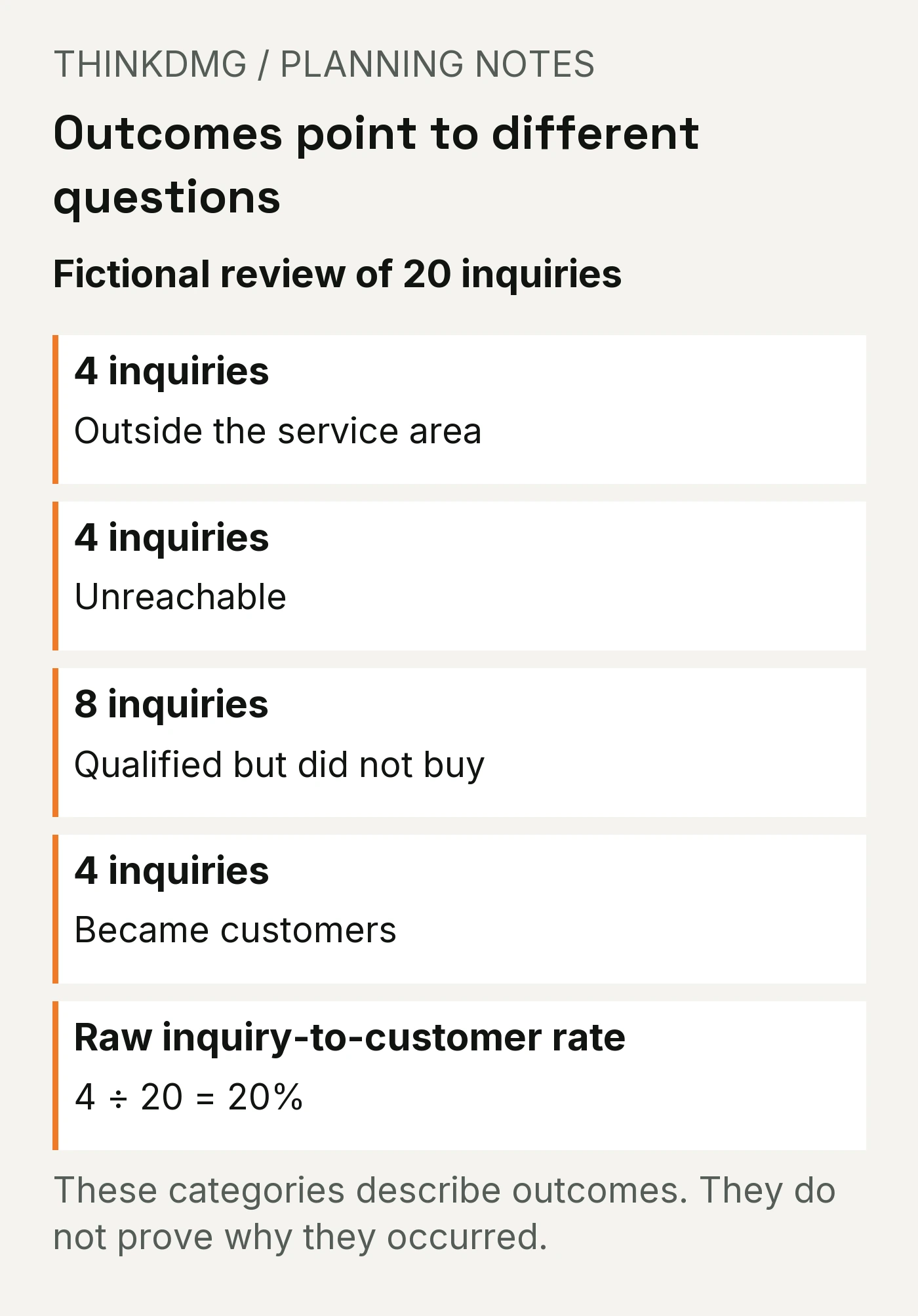
Look at what the single 20% close rate was hiding. It wasn’t one problem. It was three:
- 4 out-of-area requests mean his ads were showing in towns he doesn’t serve, and his page didn’t list the towns he does.
- 4 unreachable people were the delivery and weekend gaps from Leaks 2 and 3.
- 8 lost estimates need a different conversation entirely.
Firing his ad person would have fixed, at most, one of the three.
Leak 5: Good prospects say no
Eight people got estimates and didn’t buy. He calls or texts each one with a simple question: “Mind telling me what you decided?” Six answer.
| Reason they gave | Count |
|---|---|
| Went with someone who could start sooner | 3 |
| Price was higher than expected | 2 |
| Decided to do it themselves | 1 |
| No answer | 2 |
The biggest reason wasn’t price. It was timing. In spring, he was quoting three weeks out. A competitor was quoting one.
That points to a scheduling fix (book cleanups earlier, or add a crew in April), not a cheaper ad.
Example Landscaping’s completed lead review
Here’s his finished worksheet. One hour of work turned “the leads are bad” into four specific fixes.
| Leak | What he found | Fix | Owner |
|---|---|---|---|
| Counting | 31 reported leads were really 20 people | Track real inquiries in one shared sheet | Office manager |
| Delivery | Text alerts went to a former employee | Update alerts; test monthly | Owner |
| Response | Weekend inquiries waited until Monday | Owner checks forms Saturday morning | Owner |
| Fit | 4 requests from towns he doesn’t serve | Tighten ad locations; list served towns on the page | Ad manager |
| Decision | Lost 3 jobs to faster start dates | Open spring booking in February; consider an April crew | Owner |
He didn’t change his ad budget at all. He changed what happens after the ad works.
What we check first
Here’s our approach at ThinkDMG. When a business tells us its leads aren’t turning into customers, we check three things before we touch the ads:
- Send a test form and make a test call. Does a real person get both, quickly?
- Count last month’s real inquiries by hand. Does the number match the ad dashboard?
- Ask who answers on Saturday. If nobody knows, that’s often the leak.
If any of these fails, fixing it is cheaper than any ad change.
Five mistakes that keep leads from becoming customers
| Mistake | What it costs you | The fix |
|---|---|---|
| Trusting the ad dashboard’s lead count | You judge your marketing on duplicates and spam | Count real people in one shared list |
| Never testing the form | Leads disappear and nobody knows | Send a test request every month |
| No owner for each channel | Everyone assumes someone else called back | Name one person and one backup per channel |
| Blaming every lost job on price | You cut prices when the real problem was timing or follow-up | Ask lost prospects why, and write it down |
| Buying more leads first | More leads pour through the same leak | Fix the earliest leak, then spend |
Your blank lead review worksheet
Pull last month’s inquiries and fill this in. It takes about an hour.
| What happened | Count | What it points to | Fix | Owner |
|---|---|---|---|---|
| Duplicates and spam | Counting | |||
| Outside your area or wrong service | Targeting and page | |||
| Never reached | Delivery and response | |||
| Qualified, didn’t buy | Offer and follow-up | |||
| Still deciding | Leave open; don’t count as lost | |||
| Became customers | What’s working |
Then use the Lead Follow-Up Planner to write down who owns each fix.
What to do next
Once the leaks are fixed, work out how many leads you actually need with our guide to reaching your customer goal. Then find out what you can afford to pay for each one.
Want to know whether a fix is really working? Test one change at a time so you know which one made the difference.
When should you ask a marketing agency for help?
You can run this review yourself. Get a second set of eyes if:
- Your ad dashboard and your office can’t agree on how many leads came in
- Leads come through several channels and nobody owns all of them
- You’ve tested your form, but calls are still going missing
- You keep getting requests from outside your area
- You’re about to raise your budget and aren’t sure the leads are the problem
Digital Marketing Group works with home services and local businesses across South Jersey and Greater Philadelphia on paid advertising, conversion tracking and lead follow-up.
Frequently asked questions
Why am I getting leads but no sales?
Usually because of a leak between the inquiry and the sale, not the ads themselves. Check five places in order: whether you’re counting real people, whether every request reaches someone, how fast a named person responds, whether the inquiries fit your business, and why qualified prospects say no.
How fast should I respond to a new lead?
As fast as you can reliably manage, every time, including weekends. Research published in Harvard Business Review found most companies don’t respond to online leads nearly fast enough. Set a response goal your team can actually meet, name an owner and a backup for each channel, and check that it’s happening.
How do I know if my leads are bad or my follow-up is bad?
Sort last month’s inquiries by what happened. If many came from outside your area or asked for work you don’t do, it’s a targeting or page problem. If many were never reached, it’s delivery or response. If qualified people got estimates and still said no, it’s the offer or follow-up.
Should I spend more on ads to get more customers?
Not until you’ve found the leak. More leads pour through the same gaps. Fix the earliest problem first, whether that’s counting, delivery or response, then decide whether more budget makes sense.
What should I do with leads who are still deciding?
Leave them open. Someone who asked for an estimate last week isn’t a lost customer yet. Count them when they actually decide, and set a follow-up date so they don’t slip through the cracks.
Sources
- Google Ads Help: About qualified and converted leads. Defines qualified leads as leads vetted outside Google Ads, such as in a CRM, and converted leads as leads that reach a step you define, such as a sale.
- Oldroyd, McElheran and Elkington, “The Short Life of Online Sales Leads,” Harvard Business Review, 2011 (citation record). Finds that most companies are not responding to online leads nearly fast enough.
About the numbers: Example Landscaping and every figure in this article are fictional, used to show the method. They are not benchmarks or ThinkDMG client results.
