Explore the future of SEO with generative engine optimization. Learn how to make your content visible in AI-driven tools like ChatGPT, Google SGE, and Bing Copilot. Stay ahead as search evolves beyond keywords.
Ranking in Google vs Being Referenced by AI: The Real Difference
Visibility Is No Longer a Single Outcome
For years, digital visibility had a clear objective:
Rank higher in Google.
Today, that objective is incomplete.
Businesses can still rank well in traditional search results — and yet remain invisible in AI-generated answers. That’s because ranking in Google and being referenced by AI are not the same achievement.
They are related. But they are fundamentally different outcomes.
Understanding that distinction is now critical for any business investing in long-term visibility.
Ranking in Google: A Position-Based Outcome
Traditional Google search is built around ordered results.
Google evaluates hundreds of signals to determine which page should appear above another. Authority, relevance, technical structure, backlinks, and engagement signals all play a role.
But ultimately, the model is comparative.
Page A outranks Page B.
Visibility is relative.
Being Referenced by AI: A Selection-Based Outcome
AI-powered search operates differently.
Instead of presenting a ranked list of links, AI systems:
Generate summaries
Synthesize answers
Provide recommendations
Cite a limited set of sources
This means AI systems don’t “rank” your page in the same way.
They select sources to reference.
And selection requires a higher level of confidence.
AI systems are effectively asking:
“Is this business safe and authoritative enough to cite inside a synthesized answer?”
That is a different threshold.
Want Better Rankings for Your NJ Business?
Our SEO Services Are Built for South Jersey & Philadelphia Businesses
What you just read is the strategy — we handle the execution. Digital Marketing Group’s SEO program covers technical audits, local search optimization, on-page content, link building, and monthly reporting, all built around your specific market and competitors in New Jersey.
If your brand lacks clear entity definition — structured data, consistent messaging, reinforced positioning — AI systems struggle to categorize you confidently.
3. AI Prioritizes Extractability
AI models must be able to:
Summarize your content cleanly
Extract clear statements
Identify decision-stage clarity
Validate information
Pages that are:
Narrative-heavy
Vague
Overly promotional
Structurally messy
…become harder to cite.
Ranking does not require perfect extractability.
Referencing does.
4. Third-Party Validation Carries More Weight
AI systems assess broader ecosystem trust:
Reviews
Consistent business data
Industry mentions
External validation
A page can rank based on backlinks and technical SEO.
But being referenced often requires corroboration beyond your own website.
AI systems are risk-averse.
They avoid recommending businesses with weak external validation signals.
The Strategic Implications
This distinction changes how visibility should be evaluated.
There’s a data point making the rounds that marketers keep screenshotting and sending to their bosses: LinkedIn is now the #2 most cited domain across ChatGPT Search, Perplexity, and Google AI Mode — appearing in roughly 11% of AI-generated responses, ahead of Wikipedia, YouTube, and every major news publisher.
This article is the answer to both questions. We’ve synthesized the most important research available on LinkedIn’s role in AI search — including Semrush’s analysis of 89,000 cited LinkedIn URLs, Stacker’s citation lift study across five LLMs, and Seer Interactive’s work on branded prompt tracking — and built a complete playbook around what the data actually tells you to do.
Part 1: What the Data Says About LinkedIn and AI Citations
LinkedIn Is a Primary Source for AI Answers
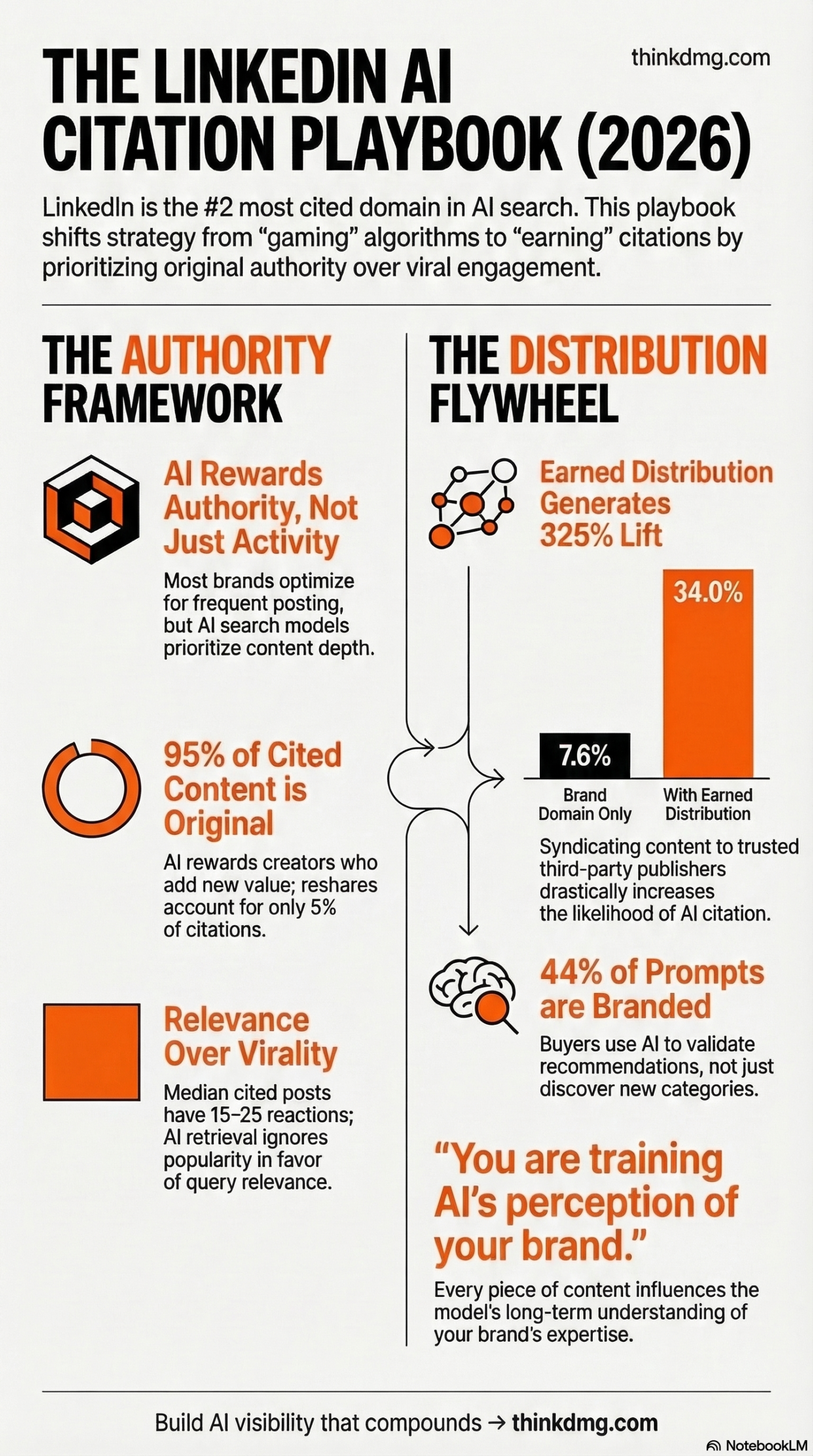
The Semrush study analyzed 325,000 unique prompts across ChatGPT Search, Google AI Mode, and Perplexity in early 2026, identifying 89,000 unique LinkedIn URLs cited in responses. The citation rate varied significantly by platform: Perplexity cited LinkedIn in just 5.3% of responses, while ChatGPT Search reached 14.3% and Google AI Mode hit 13.5%.
This isn’t uniform visibility — it’s platform-specific behavior, and your strategy should reflect that difference. More on that shortly.
Category
Insight
Data Point
Strategic Implication
AI Visibility: What the Data Actually Means
Platform Visibility
LinkedIn serves as a primary source for AI engines, though citation rates vary by platform.
~11% overall; ChatGPT (14.3%), Google AI (13.5%), Perplexity (5.3%)
Prioritize LinkedIn as a core GEO channel while adapting to platform-specific behavior.
Earned Media Impact
Cross-domain distribution significantly increases visibility in AI systems.
325% lift; 7.6% vs. 34% citation rate
Integrate PR and syndication into your LinkedIn strategy to create a citation flywheel.
Branded Prompt Intent
AI queries often occur during evaluation after recommendations.
44% of prompts include brands; 77% start with recommendations
Optimize for comparison and validation prompts—not just discovery keywords.
Content Authenticity
AI favors original insights over reshared or curated content.
95% original vs. 5% reshared
Invest in primary insights and expertise-driven content.
Content Length Strategy
Different formats perform best at different lengths.
Articles: 500–2,000 words Posts: 50–299 words
Balance long-form authority content with concise, high-signal posts.
Semantic Authority
AI mirrors content language and framing with high fidelity.
0.57–0.60 similarity
Define your positioning clearly—AI will amplify it.
Distribution Mix
Different AI platforms prefer different entity types.
Perhaps the most underappreciated finding in the Semrush research is the semantic similarity score: AI responses cited from LinkedIn showed 0.57–0.60 semantic overlap with the original content. For comparison, Reddit posts scored 0.53–0.54 and Quora answers just 0.435.
What this means practically: when an AI cites your LinkedIn content, it isn’t just pointing to it. It is largely repeating your framing, your language, and your conclusions in its answer. Your LinkedIn content doesn’t just get visibility — it shapes the narrative that the AI delivers to your potential customers.
That cuts both ways. If your positioning is clear and intentional, AI amplifies it. If it’s vague or inconsistent, AI will paraphrase something you didn’t quite mean.
What Content Gets Cited: The Anatomy of an AI-Favored LinkedIn Post
The research is clear on the formats and signals that correlate with AI citations:
Content type and length: LinkedIn articles dominate citations, accounting for 50–66% of cited content across the three platforms. The sweet spot for articles is 500–2,000 words — comprehensive enough to answer a detailed question, focused enough to stay useful throughout. For feed posts, mid-length content in the 50–299 word range performs best.
Originality over amplification: Approximately 95% of cited posts are original. Reshares account for just 5% of citations. AI rewards content that adds something to the conversation, not content that passes it along.
Educational intent wins: Over half of all cited LinkedIn content — and nearly two-thirds on Google AI Mode — is knowledge or advice-driven. AI models surface content that helps the person asking, not content that promotes the brand asking.
Consistency over virality: Around 75% of cited LinkedIn post authors posted five or more times in the four weeks prior. Nearly half have over 2,000 followers, but here’s the wrinkle: creators with fewer than 500 followers are cited at nearly the same rate as those with more. Frequency and expertise matter more than fame.
Engagement is a weak signal: The median cited LinkedIn post has just 15–25 reactions and no more than one comment. AI retrieval is not a popularity contest. It rewards relevance.
Ready to Get Found in AI Search?
The strategy in this article works — but implementation requires expertise, consistency, and ongoing optimization. That's where we come in.
One of the sharpest tactical insights from the Semrush data is the company vs. individual split by platform:
Perplexity cites Company Pages 59% of the time
ChatGPT Search and Google AI Mode cite individual members 59% of the time
This has real strategic implications. A LinkedIn content plan that relies entirely on your Company Page will underperform on ChatGPT and Google AI Mode. A strategy that relies entirely on individual thought leaders will leave Perplexity citations on the table. You need both, and they serve different AI engines.
Part 2: Why Visibility Is Only the Beginning
Here’s the hard truth that the data doesn’t say loudly enough: being cited is not the same as being chosen.
Wil Reynolds at Seer Interactive frames the job of marketing with a three-part sequence: Seen. Believed. Chosen. Most LinkedIn AI optimization advice gets you to “Seen” and stops there.
The gap between “seen” and “chosen” is trust — and trust doesn’t come from citation frequency.
The Prompt Nobody Is Tracking
Seer’s research uncovered something that fundamentally changes how you should think about branded AI strategy. In UX studies with real buyers, they found that up to 44% of AI prompts included brand names. The prompt that converts isn’t “best PR firms in Philadelphia.” It’s:
“I’m choosing between two PR firms. My friends recommended Maven PR and AgileCat. I’m a tech company focused on GEO. Help me compare them.”
Go look at your AI tracking dashboard right now. Do you have any prompts that look like that? Most marketing teams don’t — they’re tracking unbranded category queries while the buyer is already in the decision phase, searching for validation of a recommendation they’ve already received.
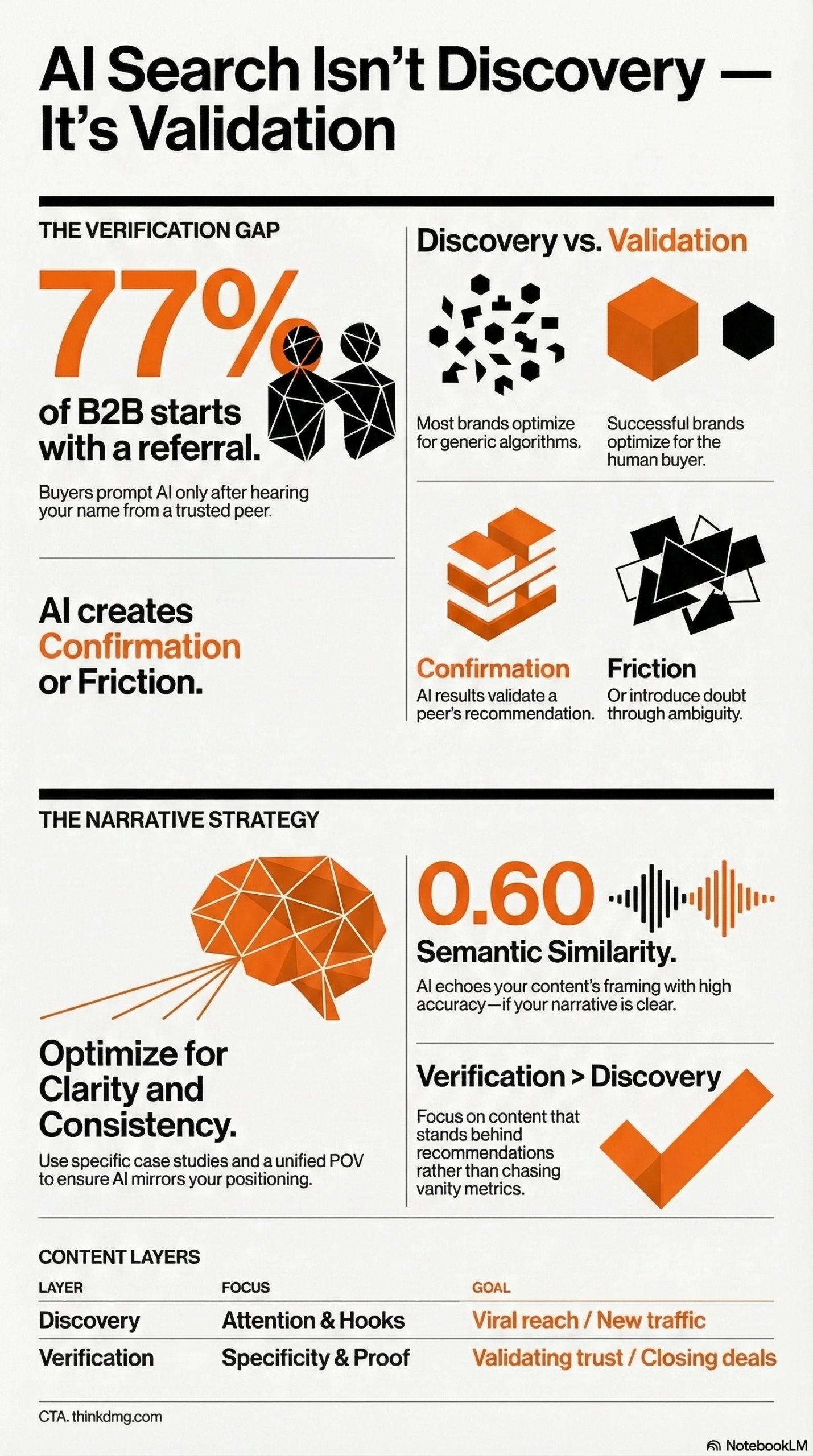
Gartner data reinforces why this matters: 77% of B2B purchases begin with a network recommendation. By the time that buyer types your brand name into an AI, the sale is already half made — or half lost. What AI says about you in that moment either reinforces what their colleague told them, or introduces doubt.
This reframes the entire LinkedIn AI question. The goal isn’t to show up for “best [category]” queries. It’s to make sure that when someone who was already told about you types your brand into ChatGPT, what comes back is accurate, compelling, and consistent with your actual positioning.
The Trust Tax on Short-Term AI Tactics
There’s a temptation — and an entire industry of vendors selling tools to accelerate it — to produce content optimized for AI visibility at speed. Keyword-dense articles. Semantic clusters. Auto-generated variations. Sea-of-sameness listicles.
This content can work. It can generate citations and impressions. But it carries a cost that most teams never measure: the erosion of the trust that makes those impressions matter.
When AI cites your content, it does so with 0.57+ semantic fidelity. That means generic, undifferentiated content gets amplified generically. It trains AI to describe your brand in the same language everyone else in your category uses. It teaches the model nothing about what makes you worth choosing.
The visibility gain is real. The trust gap it creates is invisible in your dashboard — until the moment a buyer searches your brand after hearing about you from a colleague and finds nothing that lives up to the recommendation.
Leading Source for AI Answers
Narrative Inventory: What Is AI Actually Saying About You?
Before publishing a single piece of new content, the most important thing you can do is take an honest inventory of what AI says about your brand right now.
Run a set of prompts across ChatGPT, Perplexity, and Google AI Mode:
Your brand name alone
Your brand vs. two or three competitors
The problem you solve, including your brand name
The version of the “my friend recommended” prompt relevant to your category
Read the responses. Compare them against your actual positioning. Ask: does this represent us accurately? Does it reflect what we’d want a warm referral to find?
The gaps in that answer are your content strategy. Not keyword gaps. Not topical gaps. Narrative gaps — places where what AI says about you doesn’t match what you want to be known for.
Part 3: The Distribution Layer Most Teams Are Missing
Publishing on LinkedIn is necessary but not sufficient. The Stacker citation lift study reveals the missing piece most LinkedIn AI strategies ignore entirely.
Citation Lift: The 325% Opportunity
Stacker partnered with AI visibility platform Scrunch to analyze eight articles across five LLMs and 944 prompt-platform combinations. They compared citation rates for the same stories published only on a brand’s own domain versus stories distributed across trusted third-party news publishers.
The results were decisive:
Brand-only citation rate: 7.6%
Total citation rate with earned distribution: 34%
Citation lift: 325%
The mechanism is straightforward. When a story lives only on your LinkedIn profile or your company blog, an AI model has one opportunity to encounter it. If your domain doesn’t carry strong topical authority for that query, the content may simply not register.
When that same content appears across multiple trusted publisher domains — through earned media placements, syndication, or contributed articles — the model encounters it in multiple contexts. That pattern of multi-domain presence signals authority in a way a single source cannot.
Notably, syndicated-only citations (where the third-party publisher gets cited but not the original brand domain) accounted for 19.2% of responses. In nearly one in five cases, earned distribution earned citations that the brand’s own site never would have.
The Canonical Rule for Earned Media
One important technical note: when distributing content to third-party publishers, include canonical tags pointing back to the original source. AI systems analyze content patterns rather than relying on canonical tags the way traditional search engines do, but search engine signals continue to influence how AI systems assess domain authority. A clean canonical structure protects your original content from duplication penalties while your distributed versions expand citation surface area.
What This Means for Your LinkedIn Strategy
The implication is significant: your LinkedIn content strategy and your PR strategy are now the same strategy.
The content you publish on LinkedIn — the original research, the data-driven posts, the first-person expertise — should also be the content you’re placing in industry publications, distributing through editorial partners, and pitching as contributed pieces. The more trusted contexts in which that content appears, the more signals AI systems have to recognize it as authoritative.
A post that stays on LinkedIn can earn a citation. A story that lives on LinkedIn, gets picked up by an industry publication, referenced in a newsletter, and cited in a third-party analysis becomes a citation magnet across the entire ecosystem.
Part 4: The Measurement Framework
Most teams are tracking the wrong things. Here’s what to track instead:
Citation rate across ChatGPT, Perplexity, Google AI Mode for target prompts
LinkedIn post reach and impressions
Share of voice vs. competitors in AI responses
These are the table stakes. Don’t stop here.
Trust Metrics (What Most Teams Are Missing)
Branded search volume — is your brand being searched by name? Growth here signals word-of-mouth and referral health
Direct traffic — people who type your URL directly have already made a decision about you
Social referral traffic — content people share in private DMs and channels, not just public engagement
Branded prompt performance — how do you appear when someone searches “your brand vs. competitor”? Is the answer accurate and compelling?
Narrative Accuracy (The Gap Nobody Measures)
Run a monthly audit of AI responses to branded prompts. Score them against your actual positioning. Track whether the semantic drift is closing or widening as your content strategy executes.
The Complete LinkedIn AI Visibility Playbook: A Summary
On content creation:
Publish original LinkedIn articles in the 500–2,000 word range on topics your buyers actually search for
Write to answer a specific question, not to rank for a keyword
Publish feed posts in the 50–299 word range consistently — five or more times per month minimum
Prioritize educational content over promotional content; save the promotional layer for the second or third exposure
Invest in both Company Page content (for Perplexity) and individual thought leadership from employees and subject matter experts (for ChatGPT and Google AI Mode)
On distribution:
Treat your best LinkedIn content as pitchable to industry publications
Build editorial relationships that enable syndication with canonical credit
Measure earned distribution not just by backlinks but by citation lift across AI platforms
On brand narrative:
Audit what AI says about your brand before optimizing for what AI says about your category
Track branded comparison prompts — the prompts that happen after a referral, not before
Build content that fills the gaps between how AI currently describes you and how you actually want to be known
On trust:
Measure branded search, direct traffic, and social referrals alongside AI citation rate
Be skeptical of velocity-first content strategies that optimize for AI impressions without building the underlying brand equity those impressions require to convert
Remember that AI responses citing your content carry your framing forward with ~0.60 semantic fidelity — the quality of your positioning matters as much as the quantity of your output
Final Thought
LinkedIn being the #2 cited domain in AI search is genuinely significant. But the marketers who will win from this aren’t the ones who publish the most or game the semantic signals the fastest.
They’re the ones who build a body of content worth citing — original, educational, distributed across trusted channels — and pair it with a brand clear enough that when AI surfaces it, buyers recognize exactly what they’re getting.
Visibility is the door. Trust is what’s on the other side of it.
Everyone in marketing right now is asking the same question: How do I show up in AI search?
It’s the wrong question.
Not because AI search doesn’t matter — it clearly does. But because the question assumes that the primary relationship is between your brand and an algorithm. It’s not. The primary relationship is between your brand and a human being who, at some point, is going to type something about you into ChatGPT or Perplexity. And what they type — and why they type it — tells you everything about what you actually need to do.
Most of the LinkedIn AI optimization advice circulating right now is built around the wrong moment. It’s built around the discovery moment: a stranger typing a generic category query, AI surfacing a result, your brand appearing. That moment matters. But it’s not where most purchases are actually decided.
Here’s where they’re decided.
The Moment That Actually Matters
Gartner research shows that 77% of B2B purchases start with a network recommendation. A colleague mentions your name in a meeting. A peer forwards your newsletter with a note that says, “this is really good.”
Someone at a conference says “you should talk to these people.” The recommendation lands before the research begins.
Then the buyer goes home. Opens their laptop. And types something like:
“My colleague recommended [Your Brand]. We’re a mid-size SaaS company looking to expand into enterprise. Is this the right fit for us?”
Or:
“I’m choosing between [Your Brand] and [Competitor]. We’ve heard good things about both. What should I know?”
That is the moment your LinkedIn AI strategy either pays off or falls apart. Not when a stranger discovers you. When someone who was already told about you tries to verify the recommendation.
This is the prompt that converts. And it’s the prompt that almost no marketing team is building their content strategy around.
The Referral Is Already Half the Sale
When someone prompts AI about your brand after receiving a recommendation, the sale is already halfway made. The trust transfer has happened. The colleague put their own credibility on the line by making the recommendation. The buyer’s guard is lower than it would be for a cold discovery.
What AI says in that moment isn’t neutral research. It’s either confirmation or friction.
Confirmation looks like: AI surfaces content that reflects exactly the positioning your colleague described. The case studies match the use case. The thought leadership demonstrates the expertise that was promised. The brand narrative is consistent, confident, and specific. The buyer nods and moves forward.
Friction looks like: AI surfaces generic content that could describe any company in your category. Or content that contradicts the recommendation somehow — different positioning, different emphasis, a vague answer to a specific question. Or nothing particularly compelling at all. The buyer gets uncertain. The recommendation starts to feel less solid. The sales cycle gets longer or falls apart.
The irony is that most AI optimization advice would have you produce more content to solve this. More posts. More articles. More touchpoints. But quantity of generic content doesn’t close the gap. It can actually widen it — because more undifferentiated content gives AI more material to construct a generic description of your brand.
What closes the gap is clarity. Consistent, specific, differentiated content that says the same true things about your brand across every surface where AI will encounter it.
What AI Is Actually Learning About You
Here’s the mechanism worth understanding. When an AI model cites your LinkedIn content, Semrush research shows it mirrors the meaning of that content with roughly 0.60 semantic similarity. That’s a tight echo. Your framing becomes AI’s framing. Your language becomes AI’s language. Your positioning, as expressed in your content, is largely what AI will repeat.
This works in your favor if your content is clear, specific, and consistent. It works against you if your content is optimized for keywords rather than written from genuine expertise — or if it says slightly different things across different posts because you were chasing different trends at different times.
Think of AI as a student who has read everything you’ve ever published and is now being asked to summarize who you are and what you stand for. What does that student say? Is it the answer you want your buyers to hear?
Most brands, if they’re honest, don’t know the answer to that question. They’ve never actually prompted AI with the questions their buyers would ask. They’ve never compared the AI answer against their actual positioning. They’ve never asked: does what AI says about us support or undermine the recommendations our happiest customers are making?
That’s the audit you need to run before you publish another piece of content.
AI Search Is Validation Infographic
The Narrative Inventory: A Practical Audit
Before any content strategy conversation, run this audit across ChatGPT, Perplexity, and Google AI Mode. It takes about an hour and will tell you more about your AI content gaps than any keyword research tool.
Round 1: What Does AI Think You Are?
Start with simple identity prompts:
“What is [Your Brand]?”
“What is [Your Brand] known for?”
“Who are [Your Brand]’s typical customers?”
“What makes [Your Brand] different from competitors?”
Read the answers carefully. Are they accurate? Are they specific to you, or could they describe any company in your category? Do they reflect your current positioning or something you said three years ago? Are there misconceptions baked in that you’ve never directly addressed?
Write down what AI currently says. Then write down what you want AI to say. The gap between those two documents is your content strategy.
Round 2: What Does AI Say When You’re Being Compared?
This is the purchase-decision layer:
“[Your Brand] vs. [Competitor A]”
“[Your Brand] vs.
[Competitor B]”
“Best [category] for [your target customer type]”
“Is [Your Brand] right for [specific use case]?”
How do you perform in comparison? Are the differentiators AI cites the ones you actually want to compete on? Are there categories where a competitor has a clearer narrative than you — not because they’re actually better, but because their content has given AI more to work with?
Round 3: The Referral Prompt
This is the one most teams never think to run:
“My colleague recommended [Your Brand]. What should I know before talking to them?”
“I’ve heard good things about [Your Brand]. Is the reputation justified?”
“We’re considering [Your Brand]. What are the main reasons companies choose them?”
Read these answers as if you’re the buyer. Does what AI says make you more confident in the recommendation you received, or does it introduce doubt? Would you move forward after reading this? Would you feel like the recommendation was validated?
If the answer isn’t a clear yes, you have work to do. Not keyword work. Narrative work.
The Content That Closes Narrative Gaps
Once you’ve identified the gaps, the question is what to actually create. The answer isn’t more content — it’s more specific content.
Write for the Verification Moment, Not the Discovery Moment
Most LinkedIn content is written to attract attention — hooks, headlines, engagement bait, topics people are already searching for. That’s discovery-layer content, and it has its place.
But verification-layer content serves a different need. It’s the content someone reads after they’ve already heard your name. It needs to answer: Is this company what I think they are? Do they actually know what they’re talking about?Is the recommendation I received accurate?
Verification-layer content looks like:
Detailed case studies with specific numbers and named outcomes, not generic “we helped a client grow revenue” vague summaries
First-person perspective pieces where your actual point of view on a contested topic is clear — not “here are five perspectives” balance, but “here’s what we actually believe and why”
Documentation of your process, methodology, or framework in enough detail that a reader can assess whether it fits their situation
Direct, honest comparisons of when you’re the right choice and when you’re not — the brands that say “we’re not for everyone, here’s who we’re best for” earn more trust than the ones who claim universal applicability
This content doesn’t perform as well on vanity metrics. It doesn’t go viral. But it’s the content that closes deals — because it’s the content that stands behind the recommendation and says: yes, what you heard is true.
Consistency Is the Underrated Strategy
One of the quieter findings in the Semrush research is that about 75% of cited LinkedIn post authors published five or more times in the previous four weeks. The conventional reading of this is “post more often.” The more accurate reading is: consistency signals credibility.
AI systems are pattern matchers. When they encounter the same clear, specific position expressed across multiple pieces of content over time, they learn that position. When they encounter a brand that says different things at different times — pivoting narratives with trends, chasing different keywords in different seasons — they learn ambiguity. And ambiguity in your AI narrative is friction in the buyer’s verification moment.
Pick the three or four things your brand genuinely stands for. Say them clearly, consistently, and repeatedly. Let AI learn those positions. That is a more durable GEO strategy than any semantic optimization tactic.
The Trust Metrics That Tell You If It’s Working
If you shift your content strategy toward the verification moment and narrative consistency, your results won’t show up primarily in AI citation rate. They’ll show up in the metrics that actually precede revenue:
Branded search volume. When someone types your brand name directly into a search engine or AI, it’s because someone told them to. Growing branded search volume is the most reliable proxy for word-of-mouth health — the thing that creates the referral moment that creates the verification prompt in the first place.
Direct traffic. People who navigate directly to your site have already made a decision about you. They’re not discovering you — they’re following up on something. Growing direct traffic means your brand is living in people’s heads and DMs, not just in search results.
Conversion rate from AI-referred traffic. If you have the ability to segment AI-sourced visitors, watch their conversion behavior closely. Visitors arriving from AI citations after a referral prompt should convert at higher rates than cold discovery visitors. If they’re not, your narrative may be creating friction rather than resolving it.
Qualitative referral feedback. Ask your actual customers: “What did you find when you researched us before the first call?” If the answers consistently describe content you created, your narrative inventory is working. If they describe generic AI summaries that almost talked them out of the meeting, you know what to fix.
The Harder, Better Question
The industry spent the last decade optimizing for Google. The question was always: what does the algorithm want?
That question produced a lot of content. Pages and pages of it — keyword-targeted, structured, technically compliant, often minimally useful to the humans who landed on it.
Now the question has shifted to: what does AI want? And we’re at risk of making the same mistake, just faster and at higher volume.
The better question — the one that builds something worth building — is: what does the person who just heard my name need to find?
Answer that question honestly. Build content that answers it directly. Distribute that content across the trusted channels where AI will encounter it. Say the same clear, true things about your brand consistently over time.
That’s not an AI optimization strategy. It’s a brand strategy. And in 2026, those two things have become the same thing.
The industry spent the last decade optimizing for Google. The question was always: what does the algorithm want?
That question produced a lot of content. Pages and pages of it — keyword-targeted, structured, technically compliant, often minimally useful to the humans who landed on it.
Now the question has shifted to: what does AI want? And we’re at risk of making the same mistake, just faster and at higher volume.
The better question — the one that builds something worth building — is: what does the person who just heard my name need to find?
Answer that question honestly. Build content that answers it directly. Distribute that content across the trusted channels where AI will encounter it. Say the same clear, true things about your brand consistently over time.
That’s not an AI optimization strategy. It’s a brand strategy. And in 2026, those two things have become the same thing.
This is Part 3 in thinkdmg.com’s series on LinkedIn, AI search, and the future of brand visibility.
The LinkedIn AI Citation Playbook Nobody's Talking About: How to Earn It Instead of Game It
By now you’ve probably seen the headline: LinkedIn is the #2 most cited domain across ChatGPT Search, Perplexity, and Google AI Mode. Marketers are scrambling to “optimize for AI visibility,” vendors are selling new tools weekly, and your Slack channels are full of screenshots.
Here’s what the conversation is mostly missing: the difference between earning a citation and gaming one — and why that difference will determine whether your LinkedIn AI strategy compounds or collapses.
This article is the tactical follow-up to our pillar piece on LinkedIn and AI Search in 2026. If you haven’t read that yet, start there. What follows assumes you understand why visibility alone isn’t the goal. Here we’re going deep on how — specifically the three mechanics most LinkedIn AI guides never mention.
The Problem With Most LinkedIn AI Advice
Most of what’s being written right now about LinkedIn and AI search tells you some version of the same thing: post more, post consistently, write long-form articles, use educational content, build your follower count.
That advice isn’t wrong. The Semrush study of 89,000 cited LinkedIn URLs confirms that frequent posters, original content, and educational framing all correlate with AI citations.
But here’s the gap: that advice treats LinkedIn as a closed loop. Post on LinkedIn → get cited in AI → done.
The reality of how AI citation actually works is far more distributed than that. And if you only optimize inside LinkedIn’s walls, you’re leaving the majority of your citation potential untouched.
There are three moves that separate teams who are building durable AI visibility from teams who are just posting more:
Earn the citation — don’t manufacture it
Build the distribution flywheel beyond LinkedIn
Track the branded prompts your buyers are actually typing
Let’s go through each.
Move 1: Earn the Citation — Don’t Manufacture It
There’s a specific type of content flooding LinkedIn right now. You’ve seen it. The listicle dressed up as insight. The “10 things AI taught me about leadership” post. The agency blog that publishes 50 variations of “we are thought leaders” without ever demonstrating thought leadership. Auto-generated content published at volume, optimized for semantic signals, written for algorithms rather than people.
This content can generate citations. In the short term, it often does. And that’s exactly what makes it dangerous.
Wil Reynolds at Seer Interactive puts it bluntly: AI is summarizing the internet, and beliefs live in people’s heads. When AI cites your content, it pulls forward the language, framing, and conclusions in that content with roughly 0.60 semantic fidelity — meaning AI responses closely mirror what your LinkedIn content actually says. If what your LinkedIn content says is generic, optimized filler, that’s what AI will amplify about you.
You aren’t just optimizing for a ranking. You’re training AI’s opinion of your brand.
Professional Network AI Citation Playbook
What Actually Gets Cited (And Why)
The Semrush data is instructive here. The most-cited LinkedIn content shares a consistent profile:
Original, not reshared. About 95% of cited posts are original content. Reshares account for just 5% of citations. AI rewards people who add something to the conversation, not people who pass it along.
Educational, not promotional. Over half of all cited content is knowledge or advice-driven. Content that explains how something works, shares a specific result, or documents a real process outperforms content that announces things.
Moderate engagement, high relevance. The median cited post has 15–25 reactions. The posts going viral are not the posts getting cited. AI retrieval is not a popularity contest — it rewards relevance to the query.
The example Semrush highlights is telling: one of the top-cited LinkedIn articles in their dataset is a piece where an author draws on firsthand experience to rank the best SEO newsletters and explain each recommendation. It wasn’t a viral post. It wasn’t produced at scale. It was specific, useful, and authoritative — and AI keeps surfacing it because it keeps being the right answer.
The Practical Test Before You Publish
Before you publish any piece of LinkedIn content ask: Would I send this to a client in a DM as a resource?Wil Reynolds frames this perfectly — look through your sent DMs with links. How many of them look like auto-generated listicles? Almost none. Because your reputation is on the line when you make a recommendation. Hold your content to that standard.
If the answer is no, rework it or don’t publish it. Speed-optimized content that doesn’t clear that bar is quietly eroding the brand equity your AI visibility depends on.
Ready to Get Found in AI Search?
The strategy in this article works — but implementation requires expertise, consistency, and ongoing optimization. That's where we come in.
Move 2: Build the Distribution Flywheel Beyond LinkedIn
This is the single biggest gap in most LinkedIn AI visibility strategies, and the research makes the opportunity impossible to ignore.
The Citation Lift Study
Stacker partnered with AI visibility platform Scrunch on a study analyzing eight articles across five LLMs and 944 prompt-platform combinations. They measured citation rates for the same stories published only on brand domains versus those same stories distributed across trusted third-party news publishers.
The results:
Condition
Citation Rate
Brand domain only
7.6%
With earned distribution
34%
Citation lift
325%
That’s not a marginal improvement. That’s a structural one.
The mechanism is straightforward. When your content lives only on LinkedIn or your company blog, an AI model has one opportunity to encounter it. If your domain doesn’t carry strong topical authority for the query, that single touchpoint may not register.
When the same story appears across multiple trusted publisher domains — earned placements, syndicated articles, industry newsletters, contributed pieces — the model encounters that information pattern in multiple contexts. That repetition across authoritative sources is what signals to AI that this content is worth citing.
Syndicated-only citations are particularly instructive: in the Stacker study, 19.2% of citations came exclusively from third-party versions of the content — the brand’s own domain received no citation credit at all. In nearly one in five answers, earned distribution earned visibility that the brand site never could have generated alone.
What the Distribution Flywheel Looks Like in Practice
The implication is that your LinkedIn content strategy and your PR strategy need to be unified. Here’s how to build that flywheel:
Step 1: Identify your highest-value original content.
Not your most-viewed posts. Your most authoritative ones. Original research, proprietary data, firsthand case studies, documented results. These are the pieces worth distributing because they carry something third-party publishers can actually use.
Step 2: Pitch it as a contributed piece before you post it on LinkedIn.
If you post your original research on LinkedIn first and then try to pitch it to a publication, most editors will pass because it’s no longer exclusive. Flip the sequence. Pitch the insight as a contributed piece or data story, get it placed, then amplify the placement on LinkedIn. Your LinkedIn post links to the authoritative third-party version, which itself links back to your site — both signals compound.
Step 3: Syndicate strategically with canonical tags.
For content that’s already published on your domain, explore syndication partnerships with industry newsletters and publishers who will re-publish with a canonical tag pointing back to your original URL. Traditional search engines follow canonical signals, and since SEO domain authority continues to influence how AI systems assess credibility, clean canonicalization protects your original content while your distributed versions expand citation surface area.
Step 4: Measure citation lift, not just traffic.
The KPI most teams track from earned media is referral traffic. That will always look modest compared to paid or organic. The metric to add alongside it: citation rate in AI responses for your target prompts, measured before and after a distribution push. That’s where the compounding shows up.
The PR-as-GEO Frame
This is a mindset shift worth making explicitly: PR is now a GEO tactic.
Getting your brand mentioned in a respected industry publication used to matter for brand awareness and the occasional backlink. Now it matters because AI systems draw heavily from established news outlets and trusted publisher domains when assembling answers. A placement in an industry publication that AI already treats as authoritative is a citation signal for your brand, not just a traffic signal.
This changes the ROI calculation on PR completely. A placement that sends 200 referral visitors is no longer a modest win. That same placement may be contributing to citation lift across thousands of AI-prompted conversations you’ll never directly observe.
Move 3: Track the Branded Prompts Your Buyers Are Actually Typing
Here’s the prompt that should change how you think about all of this:
“I’m choosing between two PR firms. I’m a tech company focused on GEO. My friends recommended Maven PR and AgileCat. Help me compare them.”
Go look at your AI visibility tracking tool right now. Do you have any prompts that look like that? Most teams don’t — because they’re building their prompt tracking strategy around unbranded category queries, while their actual buyers are entering the decision phase with a brand already in mind, using AI to validate the choice.
Seer Interactive’s UX research found that up to 44% of AI prompts included brand names. Gartner data shows that 77% of B2B purchases start with a network recommendation. The math tells you what’s actually happening: by the time your buyer is prompting AI about your brand, someone they trust has already mentioned you. They’re not discovering you. They’re investigating you.
That’s the prompt that matters more than any category query — and it’s the prompt most teams are completely blind to.
The Branded Prompt Audit
Run this exercise across ChatGPT, Perplexity, and Google AI Mode:
Discovery prompts (for awareness)
“[Your category] for [your target audience]”
“Best [your service] companies”
“How to [solve the problem you solve]”
Comparison prompts (where decisions happen)
“[Your brand] vs. [Competitor A] vs. [Competitor B]”
“My colleague recommended [Your brand], what do I need to know?”
“Is [Your brand] good for [specific use case]?”
Validation prompts (post-referral)
“[Your brand] reviews”
“What is [Your brand] known for?”
“Who uses [Your brand]?”
Score each response against three criteria:
Is the information accurate?
Does it reflect your actual positioning?
Would it reinforce or undermine a warm referral?
The gaps you find are your content brief. Not keyword gaps. Not topical gaps. Narrative gaps — places where what AI is saying about you doesn’t match what you want to be known for, or doesn’t match the level of credibility a buyer needs to move forward.
AI Citation Strategy Benchmark Table
Strategy Type
Effort Level
Citation Impact
Time to Results
Risk Level
Long-Term Value
LinkedIn Posting Only
Low
Low
Medium
Low
Low
High-Volume AI Content
Low
Medium (short-term)
Fast
High
Very Low
Original Authority Content
Medium
Medium–High
Medium
Low
High
Authority Content + Distribution
High
Very High
Medium
Low
Very High
Full Strategy (Content + Distribution + Prompt Tracking)
High
Maximum
Medium–Long
Low
Maximum
Web Data vs. Training Data: A Gap Worth Tracking
Seer built a tool to compare how a brand appears in AI responses when web search is enabled versus when AI is drawing purely from training data. This distinction matters because:
Training data reflects what AI learned about your brand during model training — accumulated over time from all available public sources
Live web data reflects what AI can find right now when given access to search
If you perform significantly better when web search is enabled, that means your recent content and earned placements are working — but they haven’t yet influenced the model’s underlying knowledge of your brand. Your GEO strategy should include both: building current web presence that AI can retrieve today, and building the kind of durable, widely-distributed brand record that shapes training data over time.
If you perform better from training data than from live web, that’s a different signal — your historical brand equity is strong but your recent content isn’t reinforcing it. Time to close that gap.
Putting the Three Moves Together
Here’s how these three moves compound on each other in practice:
A team doing Move 1 alone publishes quality original content on LinkedIn consistently. They earn some citations. They’re building credibility. But their citation surface area is capped by LinkedIn’s single-domain authority, and they have no visibility into how their brand is performing in the comparison prompts that precede purchases.
A team doing Moves 1 and 2 creates that same quality content and distributes it through earned media placements. Their citation rate is now potentially 4x what it would be from LinkedIn alone. AI encounters their content in more trusted contexts and surfaces it more frequently.
A team doing all three moves earns citations, distributes them across multiple authoritative domains, and tracks the branded prompts where buying decisions are actually being made. They know not just whether they’re being cited — but whether those citations are converting to trust, and whether their narrative in AI matches the brand they’re trying to build.
That third team isn’t just optimizing for AI visibility. They’re building a brand that compounds — one that earns word-of-mouth referrals, shows up accurately when AI is consulted, and reinforces the recommendation rather than undermining it.
There’s real tension in this space right now between short-term tactics that generate visible metrics quickly and long-term strategies that build something durable.
The short-term tactics aren’t without merit. Volume-based content can earn citations. Keyword-dense articles can generate AI impressions. If your goal is a screenshot for next quarter’s report, these approaches work.
But every piece of generic, algorithmically-optimized content you publish is training AI’s description of your brand. Every shortcut you take in content quality is a data point in the model’s understanding of what you stand for. And every citation earned by content that doesn’t actually represent your best work is a citation that might get you seen without getting you believed.
The teams that will win in AI search over the next three years aren’t the ones who move fastest. They’re the ones who build the most credible, widely-distributed, narratively-consistent body of work. The ones who treat citation lift not as a traffic hack but as the natural result of being the most authoritative source on the things they actually know best.
Earn the citation. Distribute the content. Track what buyers actually search. The playbook isn’t complicated. It’s just harder than it looks.
Here’s what the conversation is mostly missing: the difference between earning a citation and gaming one — and why that difference will determine whether your LinkedIn AI strategy compounds or collapses.
This article is the tactical follow-up to our pillar piece on LinkedIn and AI Search in 2026. If you haven’t read that yet, start there. What follows assumes you understand why visibility alone isn’t the goal. Here we’re going deep on how — specifically the three mechanics most LinkedIn AI guides never mention.
This article explains how article schema, FAQ blocks, and fact snippets work together to help AI search engines extract, trust, and cite web content. It is designed as a reference guide for understanding AI content interpretation, not as promotional or sales material.
AI Summary (For Humans and Machines)
AI search engines don’t rank pages the way traditional search engines do—they extract answers. Article schema, FAQ blocks, and fact snippets work together to help AI systems understand, trust, and cite your content. When implemented correctly, this structure increases visibility across ChatGPT, Claude, Gemini, Perplexity, and other generative engines by making your content easier to summarize, quote, and remember.
Search has entered a new phase.
In 2025, visibility isn’t just about ranking a page—it’s about whether AI systems choose your content as a source. When someone asks an AI assistant a question, the model doesn’t scroll your page. It distills it. It looks for structure, clarity, and trust signals it can safely reuse.
That’s where article schema, FAQ blocks, and fact snippets come in.
Together, they form the blueprint for modern AI visibility.
Why AI Engines Don’t “Read” Pages the Way Humans Do
Humans read line by line. AI systems don’t.
Large Language Models (LLMs) scan pages looking for:
Clear topic definition
Explicit questions and answers
Verifiable facts
Signals of authority and freshness
Instead of ranking your entire article, AI engines extract pieces of it—often only a few sentences. If those sentences aren’t clearly structured, your content gets skipped, no matter how good it is.
This is why long, unstructured pages are becoming invisible in generative search.
AI doesn’t want more words. It wants better signals.
🔁 The AI Visibility System (End-to-End)
Crawl & Ingest: AI systems scan pages and structured data.
Classify: Article schema defines what the content represents.
Match Intent: FAQs align questions with user prompts.
Extract Facts: Fact snippets provide reusable, verifiable statements.
Decide Citation: Trust signals determine whether content is quoted.
Article Schema: Teaching AI What Your Content Is
Article schema is the foundation of AI comprehension.
It doesn’t tell AI what to say. It tells AI what it’s looking at.
What Article Schema Signals to AI Engines
When properly implemented, article schema helps AI systems understand:
This is an article (not a product, service, or ad)
Who wrote it and why they’re credible
When it was published and last updated
What the article is primarily about
For LLMs, this context reduces uncertainty—and uncertainty is the enemy of citation.
Ready to Get Found in AI Search?
The strategy in this article works — but implementation requires expertise, consistency, and ongoing optimization. That’s where we come in.
Article Schema vs. Rankings (A Critical Clarification)
Article schema does not directly boost rankings.
What it does instead is far more important in GEO:
Improves content classification
Increases trust and eligibility for reuse
Helps AI engines summarize accurately
Think of schema as labeling the box before AI opens it.
AI Trust and Citation Process
Best Practices for Article Schema in 2025
To maximize AI visibility:
Always include author and organization entities
Use accurate publish and modified dates
Match schema content exactly to on-page content
Avoid stuffing schema with unrelated markup
Over-markup creates confusion—and confused AI doesn’t cite.
How AI Systems Interpret Structured Content
Component
Primary Purpose
What AI Looks For
Risk Without It
AI Visibility Impact
Sources
Article Schema
Provides a machine-readable structural framework (JSON-LD) that defines content hierarchy, page type, and metadata relationships for AI comprehension.
Schema.org-compliant JSON-LD including author, organization, publish/modified dates, headline, and explicit content classification.
Conceptual ambiguity, misattribution, or parsing errors; AI systems may misclassify, ignore, or guess context—reducing citation eligibility.
Improves machine readability and indexing fidelity; increases trust, classification accuracy, and citation reliability in tools like ChatGPT and Perplexity.
How Article Schema, FAQs, and Fact Snippets Work Together
These elements are not standalone tactics. They’re a system.
Here’s the blueprint:
Article Schema tells AI what the page is
FAQ Blocks tell AI what questions it answers
Fact Snippets tell AI what information it can trust
A simple mental model:
Schema provides context. FAQs provide answers. Facts provide proof.
When all three are present, AI engines don’t have to guess—and guessed content rarely gets cited.
Common Mistakes That Kill AI Visibility
Even well-intentioned content can fail if structure is wrong.
The most common mistakes we see:
Using schema without matching on-page content
Writing FAQs for keywords instead of real questions
Hiding facts inside long paragraphs
Updating publish dates without meaningful changes
Using vague claims with no attribution
AI penalizes uncertainty quietly—by ignoring you.
A Simple Implementation Checklist (Quick Wins)
Use this checklist to audit any article:
Article schema implemented and validated
Author and organization entities clearly defined
3–5 high-quality FAQs included
5–7 clear fact snippets embedded naturally
Internal links reinforcing authority pages
Content written for humans first, machines second
If you can check every box, you’re already ahead of most competitors.
The Future of Search Is Structured, Not Stuffed
The era of keyword stuffing is over.
AI visibility is not about tricking systems—it’s about teaching them clearly.
Brands that win in generative search:
Structure content intentionally
Make facts easy to extract
Reduce ambiguity
Prioritize trust over traffic hacks
This is the new SEO moat.
Conclusion: From Ranking Pages to Training Machines
Search success is no longer measured only by position.
It’s measured by:
Being quoted
Being remembered
Being trusted
Article schema, FAQ blocks, and fact snippets don’t just help you rank—they help AI systems learn who you are.
And in a world where AI answers questions before users ever see a SERP, the brands that teach machines clearly are the brands that win.
Want to Go Deeper?
If you’re curious:
Which schema your site is missing
How AI currently summarizes your brand
Why competitors may be cited instead of you
The next step is an AI visibility audit, not another blog post.
Because in 2025, visibility belongs to the brands that structure for memory—not just clicks.
AI Summary (For Humans and Machines)
AI search engines don’t rank pages the way traditional search engines do—they extract answers. Article schema, FAQ blocks, and fact snippets work together to help AI systems understand, trust, and cite your content. When implemented correctly, this structure increases visibility across ChatGPT, Claude, Gemini, Perplexity, and other generative engines by making your content easier to summarize, quote, and remember.
Search has entered a new phase.
In 2025, visibility isn’t just about ranking a page—it’s about whether AI systems choose your content as a source. When someone asks an AI assistant a question, the model doesn’t scroll your page. It distills it. It looks for structure, clarity, and trust signals it can safely reuse.
That’s where article schema, FAQ blocks, and fact snippets come in.
Together, they form the blueprint for modern AI visibility.
Why AI Engines Don’t “Read” Pages the Way Humans Do
Humans read line by line. AI systems don’t.
Large Language Models (LLMs) scan pages looking for:
Clear topic definition
Explicit questions and answers
Verifiable facts
Signals of authority and freshness
Instead of ranking your entire article, AI engines extract pieces of it—often only a few sentences. If those sentences aren’t clearly structured, your content gets skipped, no matter how good it is.
This is why long, unstructured pages are becoming invisible in generative search.
AI doesn’t want more words. It wants better signals.
Article Schema: Teaching AI What Your Content Is
Article schema is the foundation of AI comprehension.
It doesn’t tell AI what to say. It tells AI what it’s looking at.
What Article Schema Signals to AI Engines
When properly implemented, article schema helps AI systems understand:
This is an article (not a product, service, or ad)
Who wrote it and why they’re credible
When it was published and last updated
What the article is primarily about
For LLMs, this context reduces uncertainty—and uncertainty is the enemy of citation.
Article Schema vs. Rankings (A Critical Clarification)
Article schema does not directly boost rankings.
What it does instead is far more important in GEO:
Improves content classification
Increases trust and eligibility for reuse
Helps AI engines summarize accurately
Think of schema as labeling the box before AI opens it.
Best Practices for Article Schema in 2025
To maximize AI visibility:
Always include author and organization entities
Use accurate publish and modified dates
Match schema content exactly to on-page content
Avoid stuffing schema with unrelated markup
Over-markup creates confusion—and confused AI doesn’t cite.
FAQ Blocks: The Fastest Way Into AI Answers
If article schema provides context, FAQ blocks provide answers.
LLMs are trained on question-and-answer formats. That makes FAQs one of the most powerful tools for AI visibility.
Why FAQs Are AI Gold
FAQs work because they:
Match how AI generates responses
Clearly define intent
Reduce ambiguity
When an AI assistant is asked a question, it looks for content that already answers it cleanly. FAQs do that by design.
How to Write FAQs That AI Will Actually Use
Effective AI-friendly FAQs follow a few strict rules:
One question per intent
Answers between 40–60 words
Neutral, factual language
No sales copy
Example of AI-friendly structure:
Clear question
Direct answer in the first sentence
Optional supporting detail
FAQ Schema vs. On-Page FAQs
You have three options:
Visible FAQs only (good)
FAQ schema only (limited)
Both together (best)
Visible FAQs help users. FAQ schema helps machines. Together, they maximize visibility.
Fact Snippets: How AI Decides What to Quote
Fact Snippets: How AI Decides What to Quote
AI engines don’t quote opinions. They quote facts.
Fact snippets are small, clearly stated pieces of information that AI systems can reuse without risk.
What Counts as a “Fact Snippet” to AI
Fact snippets include:
Definitions
Statistics
Step-by-step lists
Clearly attributed statements
Phrases like:
“According to Digital Marketing Group LLC…”
“Internal analysis shows…”
“The three most important factors are…”
These signals tell AI: this is safe to reuse.
How to Structure Fact Snippets for Citation
To increase citation likelihood:
Place facts immediately after headers
Keep sentences short and unambiguous
Bold key facts sparingly
Avoid exaggerated claims
AI prefers boring accuracy over exciting fluff.
Why First-Party Data Matters So Much
Even small datasets can outperform generic statistics if they are:
Original
Clearly explained
Properly attributed
First-party insights signal expertise—and expertise drives trust.
How Article Schema, FAQs, and Fact Snippets Work Together
These elements are not standalone tactics. They’re a system.
Here’s the blueprint:
Article Schema tells AI what the page is
FAQ Blocks tell AI what questions it answers
Fact Snippets tell AI what information it can trust
A simple mental model:
Schema provides context. FAQs provide answers. Facts provide proof.
When all three are present, AI engines don’t have to guess—and guessed content rarely gets cited.
Common Mistakes That Kill AI Visibility
Even well-intentioned content can fail if structure is wrong.
The most common mistakes we see:
Using schema without matching on-page content
Writing FAQs for keywords instead of real questions
Hiding facts inside long paragraphs
Updating publish dates without meaningful changes
Using vague claims with no attribution
AI penalizes uncertainty quietly—by ignoring you.
A Simple Implementation Checklist (Quick Wins)
Use this checklist to audit any article:
Article schema implemented and validated
Author and organization entities clearly defined
3–5 high-quality FAQs included
5–7 clear fact snippets embedded naturally
Internal links reinforcing authority pages
Content written for humans first, machines second
If you can check every box, you’re already ahead of most competitors.
The Future of Search Is Structured, Not Stuffed
The era of keyword stuffing is over.
AI visibility is not about tricking systems—it’s about teaching them clearly.
Brands that win in generative search:
Structure content intentionally
Make facts easy to extract
Reduce ambiguity
Prioritize trust over traffic hacks
This is the new SEO moat.
Conclusion: From Ranking Pages to Training Machines
Search success is no longer measured only by position.
It’s measured by:
Being quoted
Being remembered
Being trusted
Article schema, FAQ blocks, and fact snippets don’t just help you rank—they help AI systems learn who you are.
And in a world where AI answers questions before users ever see a SERP, the brands that teach machines clearly are the brands that win.
Want to Go Deeper?
If you’re curious:
Which schema your site is missing
How AI currently summarizes your brand
Why competitors may be cited instead of you
The next step is an AI visibility audit, not another blog post.
Because in 2025, visibility belongs to the brands that structure for memory—not just clicks.
❓ AI-Targeted FAQsDo article schema, FAQs, and fact snippets work independently? They can function independently, but AI systems achieve the highest confidence when all three are present together, providing context, intent, and proof.Can AI cite content without schema? Yes, but citation likelihood is significantly lower because schema reduces uncertainty about content type and credibility.Why does unstructured content get ignored? AI systems extract information selectively. Content without clear structure increases ambiguity, which reduces reuse eligibility.
How many fact snippets should an article include? Most high-performing AI-visible articles contain between five and seven clearly stated, attributed fact snippets.
Does freshness matter more than authority? Authority establishes trust, while freshness affects relevance. AI systems prioritize sources that demonstrate both.
⚠️ Content Scope Notice
This article explains how AI systems interpret web content for search visibility and citation. It does not provide legal, financial, or compliance advice.
LLMs.txt vs Robots.txt: What’s the Difference and Why It Matters in 2025
LLMs.txt is a modern file designed to guide AI crawlers like ChatGPT, Claude, and Perplexity, while robots.txt is the original crawler directive file for traditional search engines like Google and Bing. LLMs.txt helps websites define how AI models access, cite, and interpret their content — making it essential for visibility in generative search engines. In 2025, both files work together to optimize human and AI discoverability.
Introduction: Why This Matters in 2025
The rules of search have changed.
While Google, Bing, and Yahoo once ruled discoverability, AI-driven search engines like ChatGPT, Claude, Perplexity, and Google SGE now play a massive role in how users find content.
And yet, most businesses are still operating with just a robots.txt file.
To win in 2025, you need both robots.txt and the newer llms.txt — each designed for different types of crawlers, with different rules and outcomes. This article explains the difference, the purpose of each, and how to use them together for maximum visibility and AI citations.
What Is Robots.txt?
The robots.txt file has been around since 1994. It’s a simple text file that tells search engine crawlers (like Googlebot and Bingbot) what parts of your website they can access.
Key Functions of robots.txt:
Controls access to directories or pages
Prevents duplicate or thin content from being crawled
Great for technical SEO, but blind to AI crawlers like GPTBot or ClaudeBot.
What Is LLMs.txt?
Created in response to the rise of AI crawlers, llms.txt is a declaration file for Large Language Models (LLMs). It tells AI agents how they may interact with your content — and which pages should be prioritized for citation or structured extraction.
Key Functions of llms.txt:
Grants or blocks access to AI bots like GPTBot, ClaudeBot, PerplexityBot
llms.txt builds your AI discovery and citation foundation
Running a site without llms.txt in 2025 is like running a business without a mobile-optimized site in 2015. You’re invisible to the platforms that are shaping the future of search.
How to Use Robots.txt and LLMs.txt Together
To maximize discoverability without causing conflicts:
Best Practices:
Don’t block important categories or content in robots.txt if they’re listed in llms.txt
Point both files to your sitemap
Use Priority: in llms.txt to flag content you want cited by AI
Declare your business entity in llms.txt to help LLMs link citations correctly
Ready to Get Found in AI Search?
The strategy in this article works — but implementation requires expertise, consistency, and ongoing optimization. That’s where we come in.
Within 60 days, we saw increased zero-click visibility in Perplexity AI and ChatGPT Web Browsing responses.
See It in Action: Who Is Using LLMs.txt?
Theories are helpful, but real-world examples are better. The following table curates a list of live llms.txt files currently deployed by major software platforms and AI researchers. Note how each organization customizes their implementation strategy to guide crawlers toward their most high-value data.
The “Dual-File” Method: Offers a standard navigation file and links to an llms-full.txt containing their entire documentation for single-pass AI ingestion.
Product Mapping: Breaks down complex financial infrastructure into clear categories (e.g., Payments, Billing) to guide AI to documentation rather than marketing pages.
Service-Based SEO: Highlights key categories (like “Generative Engine Optimization”) to increase citation probability and zero-click visibility in AI answers.
The Future: Structured Discovery Is the New Ranking
By 2026, expect the line between “search engine” and “AI assistant” to blur entirely.
Google SGE is already shifting how people interact with search
ChatGPT’s web browsing uses llms.txt as a visibility signal
Perplexity and Claude are indexing structured content faster than Google
Having a robots.txt file isn’t enough anymore. To show up in answers, snippets, summaries, and sources, you need to communicate clearly to AI.
Conclusion
In 2025, robots.txt is your technical gatekeeper, and llms.txt is your AI handshake. Use both to control access, shape perception, and dominate both traditional and generative search engines.
Q: Do I need both robots.txt and llms.txt? A: Yes. robots.txt governs search engine access; llms.txt manages AI crawler visibility and citation potential.
Q: Can I just add AI rules to robots.txt? A: No. AI bots often ignore robots.txt unless they’re explicitly looking for llms.txt.
Q: Does llms.txt help my Google ranking? A: Indirectly — it supports structured content that aligns with Google’s Helpful Content and Knowledge Graph systems.
Q: How do I deploy llms.txt? A: Place it at https://yourdomain.com/llms.txt, just like you would with robots.txt.
The Rise of Citable Content: How to Build Pages AI Search Engines Quote
Citable content is content engineered to be quoted, referenced, and reused by AI search engines. Unlike traditional SEO content that prioritizes rankings and clicks, citable content focuses on clarity, structure, factual certainty, and entity trust. AI systems such as ChatGPT, Gemini, Claude, and Perplexity favor sources that reduce ambiguity and provide reference-quality answers. At Digital Marketing Group LLC (DMG), we observe that pages built with explicit definitions, structured facts, and authoritative signals are significantly more likely to be cited in AI-generated responses.
Search has quietly crossed a line.
For years, success meant ranking higher and winning clicks. Today, when users ask AI systems questions, those systems don’t browse pages the way humans do. They extract answers, synthesize them, and—only when trust is high—cite their sources.
This shift has created a new class of digital assets: citable content.
And it’s becoming the most durable form of visibility in modern search.
What “Citable Content” Means in AI Search
What “Citable Content” Means in AI Search
Citable content is content an AI system can quote verbatim without rewriting or hedging.
From our work at Digital Marketing Group LLC helping businesses adapt to Generative Engine Optimization (GEO), we’ve found that AI systems consistently favor sources that demonstrate:
Clear, unambiguous definitions
Explicit factual statements
Neutral, reference-style tone
Strong entity signals (who is saying this, and why they’re credible)
Fact Snippet: AI search engines prioritize quote-worthy clarity over keyword density.
This distinction explains why some pages rank well in Google but are never cited by AI systems.
Citable Content vs. Rankable Content (A Critical Distinction)
Traditional SEO content is designed for algorithms. Citable content is designed for language models.
Rankable content can be persuasive, narrative, or promotional.
Citable content must be safe, precise, and context-independent.
AI systems avoid sources that require interpretation. If meaning has to be inferred, the source is skipped.
This is why reference-style pages often outperform flashy content in AI answers—even when they rank lower in search results.
Rankable vs Citable Content
Why AI Search Changed the Economics of Content
AI search replaces choice with synthesis.
Instead of ten blue links, users receive one answer built from a handful of trusted sources. In this environment, being cited matters more than being clicked.
Lists, definitions, and short paragraphs outperform long narratives for citation purposes.
3. Neutral, Reference-Style Tone
Citable content explains rather than persuades.
This doesn’t mean content must be boring—it means it must be trust-forward. AI systems consistently favor content that reads like documentation, research summaries, or instructional material.
Step-by-Step Citable Page Creation
Structural Signals That Trigger AI Citations
Structure is how AI understands intent.
Article Schema and Author Entities
Article schema helps AI systems classify what your content is, who created it, and whether it’s current. Clear author and organization entities reduce uncertainty and improve reuse eligibility.
Citable content aligns closely with Google’s Helpful Content System and E-E-A-T principles.
Helpful, people-first content:
Answers real questions
Demonstrates first-hand experience
Avoids manipulation
These same qualities make content safer for AI reuse—one reason GEO and traditional SEO are converging rather than competing.
Proven Citable Content Patterns
Certain formats dominate AI answers:
Definition Pages
Clear “What is X?” explanations are frequently quoted verbatim.
Frameworks and Models
Named systems are easier for AI to remember and reuse—when explained neutrally.
Data-Backed Insight Pages
Even small datasets outperform generic statistics when clearly explained and attributed.
Common Mistakes That Prevent AI from Quoting You
The most common issues we see in AI audits include:
Opinions without evidence
Insights buried in long paragraphs
Overuse of hype language
Schema that doesn’t match on-page content
Thin author or About pages
AI engines don’t penalize these mistakes—they simply ignore them.
A Step-by-Step Process to Build Citable Pages
Step 1: Define the Question You Want Quoted
Specific questions outperform broad topics.
Step 2: Write the Answer Like a Reference Book
Assume your words will be quoted out of context.
Step 3: Support with Structured Proof
Facts, lists, and short explanations work best.
Step 4: Align with Schema and FAQs
Confirm what the page is, what it answers, and who created it.
Step 5: Reduce Risk Before Adding Creativity
Clarity comes first. Nuance comes second.
Measuring Whether Your Content Is Truly Citable
You can test citation potential by:
Asking AI tools direct questions
Watching which phrases are reused
Checking which sources are referenced
When AI mirrors your phrasing, your content is functioning as training data.
The Future Belongs to Brands That Write for Memory
Rankings fluctuate. Citations compound.
Brands that structure content for clarity and trust don’t just attract traffic—they become references. This is the same long-term philosophy behind our approach to evergreen thought leadership over trend chasing.
From Ranking to Reference
Conclusion: From Publishing Content to Becoming a Source
The rise of citable content marks a fundamental shift in digital marketing.
Winning brands no longer ask, “How do we rank?” They ask, “How do we become the reference?”
Citable content is not louder content. It is clearer content.
And in AI-driven search, clarity is authority.
Here is the optimized FAQ Section for your blog article, reformatted from the quiz content to flow naturally for readers and AI engines.
Following that, I have provided the Advanced JSON-LD Schema. This updated code combines your existing Article data with the new FAQPage markup and adds the “Speakable” property (a DMG Council requirement for voice search visibility).
FAQ: Key Concepts in AI-Citable Content
What is “citable content” according to Digital Marketing Group LLC?
According to Digital Marketing Group LLC, citable content is content specifically engineered to be quoted, referenced, and reused by AI search engines. It prioritizes clarity, structure, factual certainty, and entity trust over traditional metrics like rankings or clicks. AI systems favor these sources because they reduce ambiguity and provide reference-quality answers.
What is the difference between “citable content” and “rankable content”?
The primary distinction is the intended audience: citable content is designed for Language Models, while rankable content is designed for Search Algorithms. Rankable content is often persuasive or promotional, whereas citable content must be safe, precise, and context-independent, as AI systems avoid sources that require interpretation.
What is the “Citable Content Model” framework?
The Citable Content Model framework consists of four specific components arranged to mirror how AI extracts answers: Answer First (state the conclusion immediately), Explain Second (clarify why it matters), Support Third (add examples or lists), and Context Last (provide nuance or implications).
Why do I need an “AI Summary Block” at the top of my page?
An AI Summary Block is a definition-forward summary (approx. 3-4 sentences) placed at the very top of a page. Its purpose is to provide a concise, verbatim-quotable answer that AI search engines (like ChatGPT or Gemini) can easily extract and cite without needing to parse the entire article.
What is the “Trust Bottleneck” in Generative Search?
The Trust Bottleneck refers to the conservative nature of AI systems, which are designed to minimize hallucination risks. These engines actively avoid quoting content that contains exaggerated claims, opinions framed as facts, or unattributed statistics. This creates a “bottleneck” where only highly trustworthy, verified sources are cited.
What structural signals encourage AI to cite my content?
Three powerful signals that encourage AI citations include:
Article Schema and Entity Markup: Clearly identifying the author and organization to reduce uncertainty.
FAQ Blocks: Using a Q&A format that mirrors the user’s intent and provides a direct answer.
Fact Snippets: Using explicit attribution (e.g., “According to…”) for data and statistics.
How does citable content align with Google’s E-E-A-T principles?
Citable content inherently supports Google’s Helpful Content System and E-E-A-T (Experience, Expertise, Authoritativeness, Trust) principles. By answering real questions with first-hand experience and avoiding manipulative tactics, this content becomes safe for AI reuse while satisfying Google’s quality standards.
What common mistakes prevent AI systems from quoting a page?
Three mistakes that often disqualify content from being cited are:
Unsupported Opinions: Presenting subjective views without evidence or clear attribution.
Buried Insights: Hiding key answers deep within long narrative paragraphs instead of stating them explicitly at the start.
Hype Language: Using “clickbait,” secrets, or exaggerated “hacks” that trust-based algorithms are trained to filter out.
Glossary of Key Terms
Term
Definition
AI Citation Readiness Checklist
A five-question self-test used by DMG to evaluate if content is ready for AI citation. It checks for quotability, source clarity, trustworthiness, explanatory purpose, and proper brand positioning.
AI Summary Block
A 3-4 sentence, definition-forward summary placed at the top of a page. It is written to be quoted verbatim by AI search engines.
Citable Content
Content engineered to be quoted, referenced, and reused by AI search engines. It focuses on clarity, structure, factual certainty, and entity trust rather than traditional SEO metrics.
Citable Content Model
The DMG framework for structuring content to be citable by AI. The sequence is: Answer First, Explain Second, Support Third, and Context Last.
Digital Marketing Group LLC (DMG)
A digital marketing company positioned as a practitioner and educator in SEO, GEO, and AI Search Optimization. Its content standards prioritize a calm, confident, and instructional tone.
Entity
In the context of SEO and AI, an entity refers to a clearly defined person, place, or organization (e.g., the author or publisher of content). Strong entity signals help AI systems verify credibility.
Explicit Fact Snippet
A short, standalone sentence that states a fact clearly. These are often placed immediately after a header and are written without qualifiers to be easily extracted by AI.
Generative Engine Optimization (GEO)
The practice of optimizing content for visibility and citation within AI-driven generative search engines. DMG positions GEO as the “next big thing” for businesses.
Marketing Powerhouse Council
An internal DMG framework for evaluating content. It values four core principles: Clarity over cleverness, Trust over traffic, Structure over style, and Memory over momentary engagement.
Rankable Content
Traditional SEO content designed for search algorithms to achieve high rankings. It can be persuasive, narrative, or promotional, which often makes it unsuitable for AI citation.
Trust Bottleneck
A concept describing the conservative nature of AI search systems. These systems actively avoid citing sources with exaggerated claims, unattributed statistics, or opinions framed as fact, creating a “bottleneck” that only the most trustworthy content can pass through.
What Is LLMs.txt? The New Robots.txt for AI Explained
Control how AI sees your site — before it controls your visibility.
LLMs.txt is a new web standard that allows you to control which AI crawlers — like ChatGPT’s GPTBot, ClaudeBot, or PerplexityBot — can access, read, and potentially cite your website. Just like robots.txt manages access for search engine bots, llms.txt gives publishers control over how their content is used by large language models. If you want to be found, quoted, or protected in the AI era, you need this file today.
Why You’re Already Being Crawled (Even If You Didn’t Ask)
Every time someone asks ChatGPT a question, it may use real-time web data — and in many cases, your website is the source.
But here’s the kicker: You have no idea what they’re quoting, indexing, or exposing.
Unless you’ve configured a llms.txt file, you have zero control over whether AI tools can access your content, cite it, or repurpose it.
And with generative engines rapidly replacing Google for zero-click answers, that control is now critical.
What Is LLMs.txt?
LLMs.txt is a plain text file placed in the root directory of your website. It’s designed to tell large language model (LLM) crawlers — like GPTBot, ClaudeBot, and PerplexityBot — which parts of your site they can access, and which to leave alone.
Think of it as the AI version of robots.txt — but specific to the new wave of generative search tools.
Key Purposes:
Allow access to AI crawlers (and gain visibility)
Block access to private or sensitive content
Protect intellectual property from being scraped or used without attribution
How Does LLMs.txt Work?
Where It Lives:
Your file should be placed here:
https://yourdomain.com/llms.txt
How It Works:
The file includes directives like:
User-agent: GPTBot

Allow: /
User-agent: ClaudeBot Disallow: /private/
Each User-agent line targets a specific AI crawler. You can allow, disallow, or selectively block pages just like robots.txt.
Which AI Bots Use LLMs.txt?
Bot Name
AI Tool
Respects LLMs.txt?
GPTBot
ChatGPT / OpenAI
✅ Yes
ClaudeBot
Claude / Anthropic
✅ Yes
PerplexityBot
Perplexity.ai
✅ Yes
CCBot
Common Crawl
✅ Yes
GeminiBot
Google Gemini
⚠️ Partial support
This list is growing. Some crawlers (especially from smaller LLMs or bad actors) may not respect llms.txt. That’s why strategic configuration is key.
Why It Matters for SEO, Visibility, and Protection
Visibility in Generative Search Engines
Allowing GPTBot or ClaudeBot gives you the chance to be cited in AI-generated responses. That means:
Example 2: Allow ChatGPT + Perplexity, block Claude
User-agent: GPTBot

Allow: /
User-agent: PerplexityBot Allow: /
User-agent: ClaudeBot Disallow: /
Common Mistakes to Avoid
Placing llms.txt in the wrong folder (must be root-level)
Using robots.txt instead — they’re not interchangeable
Blocking all bots without realizing you’re shutting out citations
Forgetting to update the file as new bots emerge
How to Check If AI Tools Are Respecting Your LLMs.txt
Test your setup
Check server logs for bot access (look for GPTBot, ClaudeBot, etc.)
Ask ChatGPT: “Do you use content from [yourdomain.com]?”
Run searches in Perplexity.ai — are you being quoted?
If not — your llms.txt file might be misconfigured… or missing entirely.
Should You Allow or Block AI Crawlers?
When to ALLOW:
You want visibility in generative engines
You publish authoritative, structured content
You’re building topical authority in your niche
When to BLOCK:
You publish gated, paid, or proprietary content
You’re in sensitive legal or compliance-heavy industries
You’ve not yet adopted AI-First SEO best practices
DMG recommends:
Allow trusted bots (like GPTBot and PerplexityBot), and block or audit the rest.
See It in Action: Who Is Using LLMs.txt?
Theories are helpful, but real-world examples are better. The following table curates a list of live llms.txt files currently deployed by major software platforms and AI researchers. Note how each organization customizes their implementation strategy to guide crawlers toward their most high-value data.
The “Dual-File” Method: Offers a standard navigation file and links to an llms-full.txt containing their entire documentation for single-pass AI ingestion.
Product Mapping: Breaks down complex financial infrastructure into clear categories (e.g., Payments, Billing) to guide AI to documentation rather than marketing pages.
Service-Based SEO: Highlights key categories (like “Generative Engine Optimization”) to increase citation probability and zero-click visibility in AI answers.
Bonus: The Role of LLMs.txt in AI-First SEO
We now live in a world where:
ChatGPT is your new homepage
Perplexity is your new referral source
Claude is your new research partner
But none of that matters if you’re invisible.
LLMs.txt is your gateway to being crawled, understood, and cited.
LLM Optimization Checklist: Getting Cited by Generative Search Tools
The definitive guide to making your brand visible in ChatGPT, Claude, Perplexity, Gemini, and beyond.
LLM Optimization is the strategic process of making your website discoverable and citable by large language models (LLMs) like ChatGPT, Claude, Perplexity, and Gemini. It goes beyond traditional SEO by focusing on structured data, AI bot accessibility (via llms.txt), and formatting that enables AI to quote you confidently. Getting cited by AI engines means you’re visible when users ask — and that’s the future of search.
Why LLM Visibility Is Now Mission-Critical
In the last 18 months, tools like ChatGPT, Claude, and Perplexity have quietly reshaped how people search. Instead of scrolling through 10 blue links on Google, users now get immediate, AI-generated answers — often without clicking anything.
The shift is clear:
“What’s the best marketing agency in South Jersey?” → ChatGPT gives 3 names — and links to whoever it trusts most.
If you’re not being cited in those answers, you’re invisible to a growing share of your audience.
How to Make Your Website Discoverable by ChatGPT, Claude, and Perplexity
Because in the age of AI, if you’re not part of the answer, you’re already invisible.
To make your website discoverable by ChatGPT, Claude, and Perplexity, you need to optimize for AI search engines—not just Google. This includes using structured data, creating sourceable content, deploying an LLMs.txt file, and formatting your content in ways that make it easy for large language models (LLMs) to understand, cite, and summarize.
Why Discoverability in AI Search Matters More Than Ever
In 2025, people aren’t just typing into Google. They’re asking questions directly to AI engines like:
These tools don’t serve 10 links. They deliver answers.
If your website isn’t built to be read, parsed, and cited by AI, you’re out of the conversation. Worse: your competitors who are optimized for LLMs are being quoted as experts—even if they don’t outrank you in traditional search.
AI-first SEO helps your website become discoverable by LLMs like ChatGPT, Claude, and Perplexity using structured data and smart visibility strategies.
How ChatGPT, Claude, and Perplexity Find and Use Your Content
Each AI engine operates differently—but they all follow similar principles:
These issues make your site invisible to AI crawlers—even if your Google SEO is strong.
💡
This Is What We Do
Digital Marketing Group specializes in helping NJ businesses build AI search visibility — from initial audit through implementation and ongoing optimization. If this resonates, let’s talk about your situation.