Categories
Conversion Optimization Digital Marketing for Small Business Digital Marketing Trends

Digital Marketing ROI Benchmarks for NJ Small Businesses (2026)

Digital marketing ROI measures the revenue return a business earns relative to its marketing investment, expressed as a ratio or percentage, across channels including SEO, paid search, content, email, and social media.

That definition is simple. The reality of applying it to a specific business in a specific market is considerably more nuanced, which is exactly why so many New Jersey small business owners either overpay for channels that aren’t suited to their situation or abandon strategies before they have enough time to produce a return.

This post exists to give you a realistic, honest reference point. Not projections designed to sell you something, but actual industry-reported benchmark ranges, the factors that move those numbers up or down in the New Jersey market specifically, and a framework for deciding which channels deserve your budget in 2026.

One important framing note before we go further: these are industry-aggregated benchmarks drawn from publicly available research across multiple studies and platforms. Your actual results will vary based on your industry, average transaction value, competitive environment, and how well the strategy is executed. Any marketing partner that quotes you a specific ROI guarantee before understanding your business in detail is not being straight with you.
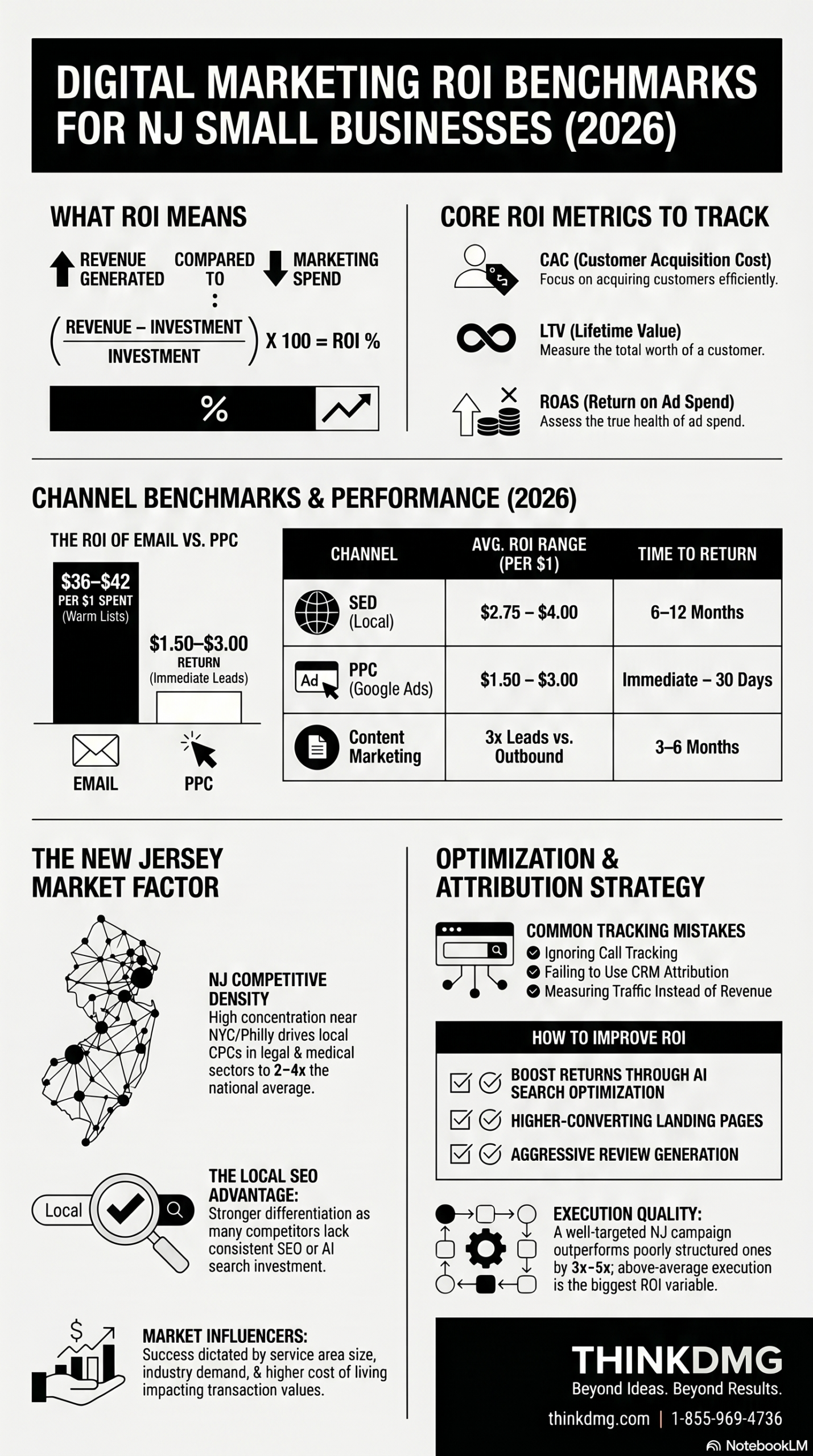
2026 NJ Marketing ROI Benchmarks


Why ROI Benchmarks Look Different in New Jersey

Before the numbers, some market context.

New Jersey is one of the most competitively dense business environments in the country. The cost of living is high, the population is concentrated, and the proximity to both Philadelphia and New York City means NJ businesses in many categories are competing not just locally but against metro-area players with significantly larger marketing budgets.

That has two effects on ROI benchmarks.

First, cost-per-click in competitive NJ verticals, particularly legal, healthcare, home services, and financial services, runs meaningfully higher than national averages. A South Jersey personal injury firm or HVAC company can expect to pay two to four times the national average CPC in Google Ads. That compresses paid search ROI for smaller budgets if campaign structure and targeting are not managed precisely.

Second, organic channels, especially SEO and content, tend to produce stronger competitive differentiation in NJ because many local competitors have not invested in them consistently. A South Jersey home services business with a well-built local SEO foundation can own a meaningful share of organic and AI-generated search results in categories where three or four larger competitors are relying almost entirely on paid advertising.

This dynamic shapes how we structure channel recommendations for our clients across digital marketing in New Jersey. The channel mix that works in a lower-competition rural market does not translate directly to the NJ context.


CTA — 25% Scroll

Wondering how your current marketing spend stacks up against these benchmarks? We work with NJ small businesses across home services, legal, healthcare, automotive, and e-commerce. Get a free consultation and we’ll benchmark your current channel performance against what we’re seeing across the market right now.


2026 Digital Marketing ROI Benchmarks by Channel

The table below represents industry-aggregated benchmark ranges from sources including WordStream, HubSpot, Demand Gen Report, Litmus, and Google’s own published advertiser data. Where NJ-specific context adjusts the national picture, that is noted.

Channel Reported Average ROI Range Time to First Return NJ Small Business Context
SEO (Local) $2.75–$4.00 per $1 invested 6–12 months Higher competition in legal/medical elevates time to return; home services and trades see faster gains in South Jersey
PPC / Google Ads $1.50–$3.00 per $1 invested Immediate to 30 days NJ CPCs in competitive verticals run 2–4x national averages; smaller budgets require tighter campaign management to stay profitable
Content Marketing 3x leads vs. outbound at ~62% lower cost 3–6 months Strong differentiation opportunity in NJ because local content production is low across most service categories
Email Marketing $36–$42 per $1 invested 30–90 days Requires a warm list to realize these returns; cold list performance is significantly lower
Social Media (Organic) Difficult to quantify directly; brand lift and referral traffic primary value Ongoing Organic social ROI for NJ service businesses is generally poor as a standalone channel; strongest as a support layer
Social Media (Paid) $1.00–$2.50 per $1 invested 7–30 days Meta Ads perform better for B2C service businesses (home services, healthcare) than B2B; requires creative refresh every 4–6 weeks
AI Search Optimization (GEO) Emerging; citation-driven brand lift and referral traffic currently primary value 3–9 months One of the highest-opportunity channels in 2026 for NJ businesses willing to build the right foundation now while most competitors have not

A few clarifications on how to read this table:

ROI range variability is significant. The difference between the low and high end of each range is not noise. It reflects the gap between a well-executed strategy and a poorly executed one, not just market conditions. A local SEO engagement run by a team that understands the NJ market and builds correctly delivers meaningfully different outcomes than a templated national agency approach.

These are revenue-to-investment ratios, not profit margins. An SEO ROI of $3.50 per $1 invested means $3.50 in revenue attributed to organic search for every dollar spent on SEO services. Profit margin on that revenue depends on your business model and is not captured in the marketing ROI figure.

Time horizons matter as much as the ratio. Email marketing shows the highest ROI per dollar, but it requires an existing warm audience. SEO shows lower peak ROI than email but generates a compounding asset. PPC is the only channel that produces leads the same day you turn it on, but returns to zero the day you stop paying.


A Closer Look at Each Channel

SEO: The Compounding Channel

For most NJ small businesses, SEO services represent the highest long-term ROI of any marketing channel, with a critical caveat: the timeline. The six-to-twelve month window before meaningful organic traffic builds is a real barrier for businesses that need near-term revenue. But for businesses willing to fund that initial investment period, the return is durable in a way that paid channels are not.

In the South Jersey market specifically, we consistently see that local service businesses, particularly in home services, trades, and legal, are underserved by SEO. Many have thin, outdated websites with no structured data, no location-specific content, and no Google Business Profile strategy. That means the competitive bar for organic visibility is lower than it appears from the outside, and businesses that do invest in SEO early build a position that becomes very difficult for late movers to displace.

The emergence of AI search adds another dimension to this calculation. Businesses that build strong local SEO foundations in 2026 are simultaneously building the structured data, content specificity, and entity signals that AI search tools use to make recommendations. Those two objectives have a shared foundation, which is why we treat AI search optimization as an extension of local SEO rather than a separate channel.

PPC: The Revenue Tap

Paid search is the only channel in this list that produces leads before the end of the month you start it. That makes it the right answer for businesses that need volume now, are launching a new service, or want to test a market before committing to a longer-term organic strategy.

The ROI challenge with PPC advertising in New Jersey is straightforward: the market is expensive. A home services company bidding on “emergency plumber South Jersey” or “HVAC repair Marlton” is competing against national lead aggregators, franchise operators, and established local players who have been bidding on those keywords for years. Without precise targeting, strong landing pages, and a disciplined negative keyword strategy, a modest PPC budget in a competitive NJ vertical will produce poor returns quickly.

The businesses we see generating consistent 2.5x to 3x returns from paid search in this market share three traits: they have a defined average transaction value that justifies the cost per click, they have landing pages that convert rather than just inform, and they manage their campaigns actively rather than letting them run on autopilot.

Content Marketing: The Differentiation Engine

Content marketing is the most underutilized channel among NJ small businesses relative to its potential ROI. Most local competitors are not producing it at all, which means a business that builds a consistent library of useful, specific content in its category and geography creates a competitive moat that compounds over time.

The “62% lower cost, 3x leads” figure from Demand Gen Report is widely cited, but it describes the relative cost advantage of inbound content over outbound prospecting, not a guaranteed result from writing a few blog posts. The ROI from content marketing services depends on whether the content is built around real search demand, structured for AI extraction, and linked into a coherent site architecture.

Content that is not being found is not producing a return. Content that is being found but not converting is not producing a return. The ROI comes from the combination of discoverability, credibility, and conversion, all three working together.

Email Marketing: The Relationship Multiplier

The $36–$42 per $1 invested figure for email is accurate as an industry average, but it is one of the most frequently misapplied benchmarks in marketing. That return assumes an existing, permission-based list of people who have a prior relationship with your business. A purchased list or a cold outreach campaign at volume will not get near those numbers.

For NJ small businesses with an existing customer base, email is consistently one of the most cost-effective channels for re-engagement, repeat business, referral generation, and seasonal promotions. The ROI is high precisely because the infrastructure is simple and the audience is already warm.

Social Media: The Support Layer

Organic social media ROI for local service businesses is genuinely difficult to justify as a primary channel in 2026. Reach without paid amplification is declining on every major platform, and the time investment required to produce consistent organic content rarely pays back in direct lead generation for service businesses.

That does not mean social media has no role. It functions well as a trust and credibility layer: potential customers who find you through search often check your Facebook or Instagram before calling. A well-maintained presence with recent posts and reviews supports conversion even if it is not generating it independently.

Paid social, particularly Meta Ads for consumer-facing service businesses, is a different story. With the right creative and audience targeting, it can produce solid returns as a companion to organic search rather than a replacement for it. We cover the channel comparison in more depth in our post on social media vs. SEO vs. paid ads for South Jersey businesses.


CTA — 75% Scroll

Benchmarks are useful. A plan built around your actual numbers is better. We work with NJ small businesses to build channel strategies that are sized to their budget, industry, and timeline. Schedule a strategy call and let’s look at what the right mix looks like for your business specifically.


The Four Factors That Move Your ROI Above or Below the Benchmark

Understanding the averages is step one. Understanding what pushes your results above or below them is where the real planning happens.

1. Average transaction value. A plumber with an average job value of $400 needs a different ROI threshold than a bathroom remodeler with an average project value of $18,000. The higher your transaction value, the more you can afford to spend on customer acquisition before a channel becomes unprofitable. Low-ticket service businesses need tighter cost-per-lead management and faster payback cycles.

2. Competitive density in your specific category. A landscaping company in a suburban South Jersey township with no organized local competitor SEO presence is in a fundamentally different position than a personal injury law firm competing for the same Google first page as a dozen well-funded practices. Benchmark ROI ranges assume an average competitive environment. Adjust your expectations based on how contested your specific category actually is.

3. Execution quality. This is the single largest variable. A technically sound, well-targeted SEO campaign in a competitive NJ market will outperform a poorly structured one by a factor of three to five, not ten percent. Channel ROI benchmarks reflect average execution quality across all participants in the data set, including a lot of underperforming campaigns that drag the average down. Above-average execution consistently produces above-average returns.

4. Attribution accuracy. Many small businesses undercount the ROI from organic channels because they do not have proper tracking in place. If your phone calls, form submissions, and walk-ins are not being attributed to their source, you are making budget decisions based on incomplete data. Before concluding that a channel is underperforming, confirm that you are actually measuring it. The mistakes that cost NJ businesses the most are often tracking failures, not channel failures.


How to Calculate ROI for Your Specific Situation

The standard formula is straightforward:

Marketing ROI = (Revenue Attributable to Marketing – Marketing Investment) ÷ Marketing Investment × 100

For a local service business spending $2,000 per month on SEO and generating $8,500 in attributed revenue from organic search:

($8,500 – $2,000) ÷ $2,000 × 100 = 325% ROI, or $3.25 returned per $1 invested

The harder part is the attribution. Revenue attributable to marketing requires knowing the source of every lead that converted. At a minimum, that means:

  • Call tracking numbers specific to each channel
  • UTM parameters on every paid and email link
  • Goal tracking in Google Analytics 4 for form submissions
  • A simple CRM or lead log that records source alongside transaction value

Without those pieces in place, ROI calculation becomes an estimate rather than a measurement. If you want to take your marketing budget further, start by auditing what you’re already spending and whether you’re accurately measuring what it’s producing. Our post on turning your NJ marketing budget into a lead machine walks through the budget allocation side of that process.


Frequently Asked Questions

What is a realistic ROI expectation for a small business spending $1,500–$3,000 per month on digital marketing? At that budget level in the NJ market, realistic first-year expectations depend heavily on channel mix and industry. A business allocating the majority of that budget to local SEO and content should expect to see meaningful organic traffic growth within six to nine months, with ROI building from there as rankings and visibility compound. A business using that budget primarily for PPC in a competitive vertical may see faster lead volume but tighter margins. The most durable outcome at that budget level typically comes from a hybrid approach: a smaller paid search investment to generate near-term leads while SEO builds in the background. Businesses that expect a 5x return in month two at a $2,000 monthly investment are going to be disappointed regardless of channel.

How does AI search optimization fit into this ROI picture? AI search optimization, also called generative engine optimization or GEO, does not yet have the same depth of ROI benchmarking data that traditional channels do, because the channel is too new. What we observe in practice is that AI search optimization currently produces ROI primarily through brand lift, increased citation authority, and referral traffic from AI-generated answers. Businesses that build the right foundation now are positioning themselves ahead of a shift in how discovery queries are handled, and the cost of doing so remains relatively low because most competitors have not started. The ROI case is forward-looking rather than based on current volume.

Are these ROI benchmarks the same across industries? No, and significantly so. Legal and healthcare typically have higher cost per acquisition but also much higher lifetime client value, which sustains ROI even at elevated acquisition costs. Home services businesses tend to see faster ROI from local SEO and Google Business Profile optimization because the search-to-call conversion path is short. E-commerce ROI is structured differently altogether, with customer acquisition cost, average order value, and repeat purchase rate as the primary variables. The benchmarks in this post represent composite ranges across industries; your category will sit somewhere within or outside those ranges depending on your specific economics.

How long should I run a channel before concluding it is not working? The answer differs by channel. PPC should show directional signal within 60–90 days: if you are generating clicks but not converting leads, the issue is the landing page or offer, not the channel. If you are not generating clicks at a reasonable CPC, the account structure needs attention. SEO requires a minimum of six months before any meaningful performance judgment, and twelve months for a more reliable baseline. Content marketing is similar. Making a channel-level decision based on less than three months of data for any organic channel will almost always produce a false negative.


The Bottom Line

Digital marketing ROI for NJ small businesses in 2026 is real, measurable, and achievable at budgets that most small businesses can fund. The key variables are channel fit, execution quality, and time horizon: not magic tactics, not volume, and not the platform with the most buzz in a given quarter.

The businesses that consistently outperform their competitors in this market are not spending more. They are spending more precisely. They know what each channel is producing, they reinvest in what works, and they do not abandon strategies before they have had enough time to demonstrate a result.

If you want help benchmarking where you stand right now or building a channel plan that fits your budget and timeline, get a free consultation with our team. We have been working with small businesses on digital marketing in New Jersey since 2011 and we will give you a straight assessment, not a pitch.

Categories
Conversion Optimization Digital Marketing for Small Business SEO SEO Strategies

Law Firm SEO in 2026: What Actually Drives Signed Cases

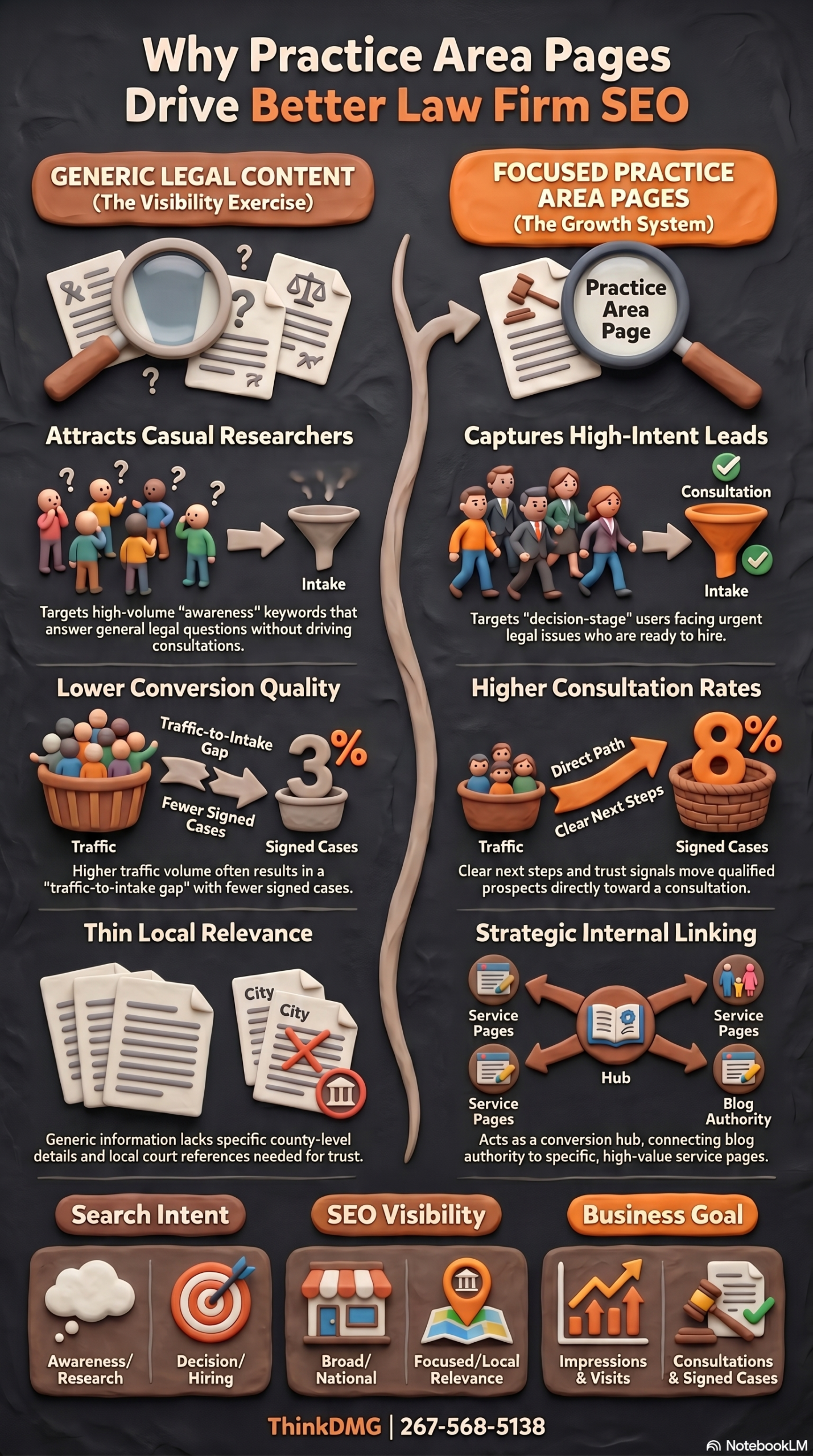
Many law firms have the same uncomfortable marketing problem: the traffic report looks better than the intake report. Rankings improve, impressions rise, and the site gets more visits, but the firm does not see the same lift in qualified consultations or signed cases.

That gap is where law firm SEO either becomes a growth system or stays stuck as a visibility exercise. In 2026, the firms that win organic search are not simply publishing more legal content. They are building a search experience that matches how real people evaluate attorneys before they ever schedule a consultation.

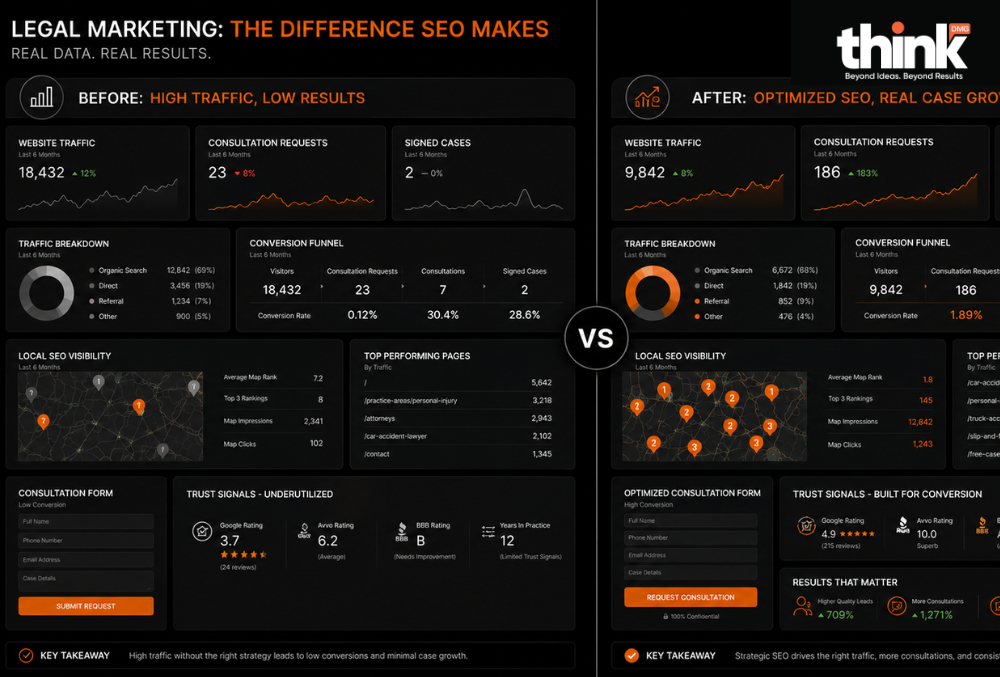
Legal Marketing - SEO Difference
Legal Marketing – SEO Difference

Law Firm SEO Has to Be Measured Against Signed Cases

Organic traffic matters, but it is not the business outcome. A family law firm, personal injury firm, estate planning attorney, or business litigation practice does not need random pageviews. It needs qualified people in the right geography, with the right legal problem, at the right moment of urgency.

That means the SEO strategy has to be evaluated by questions like:

  • Which practice area pages produce consultation requests?
  • Which local searches bring in people the firm can actually serve?
  • Which content topics attract buyers instead of casual researchers?
  • Which pages create enough trust for someone to call, submit a form, or book a consultation?

If a campaign cannot answer those questions, it is probably optimized for reporting instead of revenue.

Why Rankings Alone Do Not Create New Clients

A person searching for legal help is usually making a high-trust decision under pressure. They may be injured, facing a dispute, planning for a major life event, or trying to protect their business. They are not just comparing keywords. They are looking for confidence.

That creates a disconnect for many law firm SEO campaigns. A page can rank and still fail if it does not quickly answer the visitor’s real concerns:

  • Does this firm handle my exact type of case?
  • Does this attorney work in my state or local court system?
  • Can I trust them with something personal, expensive, or urgent?
  • What happens after I contact them?

Search visibility gets the visitor to the page. The page still has to earn the next step.


The Highest-Value Pages Are Usually Practice Area Pages

For most firms, the strongest SEO assets are not blog posts. They are practice area pages built around services people are actively looking to hire for. A blog post can support authority, answer questions, and build topical depth, but the practice area page is usually where the conversion happens.

A strong practice area page should do more than define the legal issue. It should clarify who the firm helps, what situations the firm handles, why the issue requires experienced guidance, and how the consultation process works. The tone should be clear and reassuring rather than stuffed with legal language.

For example, a personal injury page should not simply explain negligence. It should speak to medical bills, insurance pressure, missed work, case evaluation, timelines, and what the client can expect after contacting the firm. An estate planning page should not just define wills and trusts. It should help people understand the risks of delay, the difference between common planning tools, and how the process reduces confusion for the family.

This is where SEO services, conversion strategy, and website structure have to work together.

Local Relevance Is More Than Adding City Names

Local SEO for attorneys is often misunderstood. Thin pages that swap one city name for another rarely build durable visibility or trust. Search engines and prospective clients both need substance.

A stronger local strategy connects the firm’s services to the real market it serves. That may include county-specific pages, office location pages, local court references where appropriate, attorney availability by region, local review signals, and content that reflects the legal questions people in that area actually ask.

For New Jersey law firms, that might mean developing clear content for the firm’s strongest counties, not pretending to serve every town equally. A focused local footprint is usually more believable than a bloated location-page network.

Content Should Match the Client Journey

Content Should Match the Client Journey

Good legal content has a job. Some content builds awareness. Some helps a person compare options. Some moves a qualified prospect toward a consultation. A balanced content plan should include all three.

  • Awareness content: answers early questions, such as what to do after an incident or when a legal issue may require help.
  • Consideration content: helps people evaluate whether to hire an attorney and what to look for in a firm.
  • Decision content: supports conversion through practice pages, attorney bios, case result pages, consultation pages, and trust-building proof.

Many firms overproduce awareness content because it is easy to brainstorm. The better opportunity is often in consideration and decision content, where the audience is smaller but closer to hiring.

That is why content marketing for law firms should be planned around intake quality, not just publishing cadence.

Trust Signals Should Be Built Into the Site

Prospective clients compare law firms quickly. They look for reviews, attorney credentials, case experience, clear contact options, and signs that the firm understands their situation. Those signals should not be buried.

Useful trust elements include:

  • Specific attorney bios that explain relevant experience, not just credentials.
  • Practice area pages with clear next steps and realistic expectations.
  • Recent reviews and professional responses where allowed by ethics rules.
  • Case studies or representative matters when appropriate and compliant.
  • Fast mobile contact options for people ready to call now.

The website should make it easy for a visitor to feel, “This firm handles my problem, understands the stakes, and gives me a clear next step.”

Technical SEO Still Matters

Technical issues can quietly limit an otherwise strong campaign. Slow mobile pages, confusing site architecture, missing internal links, duplicate content, crawl problems, and weak schema can all reduce the performance of legal SEO assets.

For law firms, technical SEO should support three priorities: search engines can crawl the important pages, users can move through the site easily, and conversion paths work cleanly on mobile. If a page ranks but loads slowly or hides the contact option, the campaign is leaking opportunity.

When the site itself needs work, a focused web design improvement can produce more value than publishing another batch of generic blog posts.

What a Strong Law Firm SEO Plan Looks Like

A practical legal SEO plan should begin with the firm’s business goals, not just a keyword list. The strongest campaigns usually include:

  • A review of intake data and the firm’s most profitable case types.
  • Practice area page improvements for high-value services.
  • Local SEO around the strongest service areas.
  • Content mapped to awareness, consideration, and decision-stage searches.
  • Technical cleanup and internal linking improvements.
  • Review generation and reputation support.
  • Measurement that connects organic traffic to qualified consultations and signed matters.

The important shift is simple: do not ask whether SEO is creating more traffic. Ask whether it is creating more of the right conversations.

FAQ: Law Firm SEO in 2026

How long does SEO take for a law firm?

Most firms should expect meaningful movement over several months, with stronger compounding gains over a longer horizon. The timing depends on competition, location, site quality, content depth, reviews, and how aggressively the firm improves conversion assets.

Should a law firm focus on SEO or Google Ads first?

It depends on timeline and budget. Ads can create faster visibility, while SEO builds durable authority over time. Many firms use both, but the website and intake process should be strong before scaling either channel.

What is the biggest SEO mistake law firms make?

The biggest mistake is treating traffic as the goal. A law firm SEO campaign should be built around qualified leads, consultation requests, and signed cases.

Build an SEO System That Supports Intake

Law firm SEO works best when it is treated as a client acquisition system. The rankings matter. The content matters. The technical foundation matters. But all of it should point toward the same outcome: helping the right prospect trust the firm enough to take the next step.

Digital Marketing Group helps service-based businesses build organic visibility that supports real growth. If your firm wants to evaluate whether its SEO is producing the right kind of opportunity, contact ThinkDMG and start with a clearer view of what is actually working.

Categories
Conversion Optimization Digital Marketing for Small Business Digital Marketing Trends SEO

Med Spa Marketing: How Cosmetic Clinics Turn Searchers Into Booked Consultations

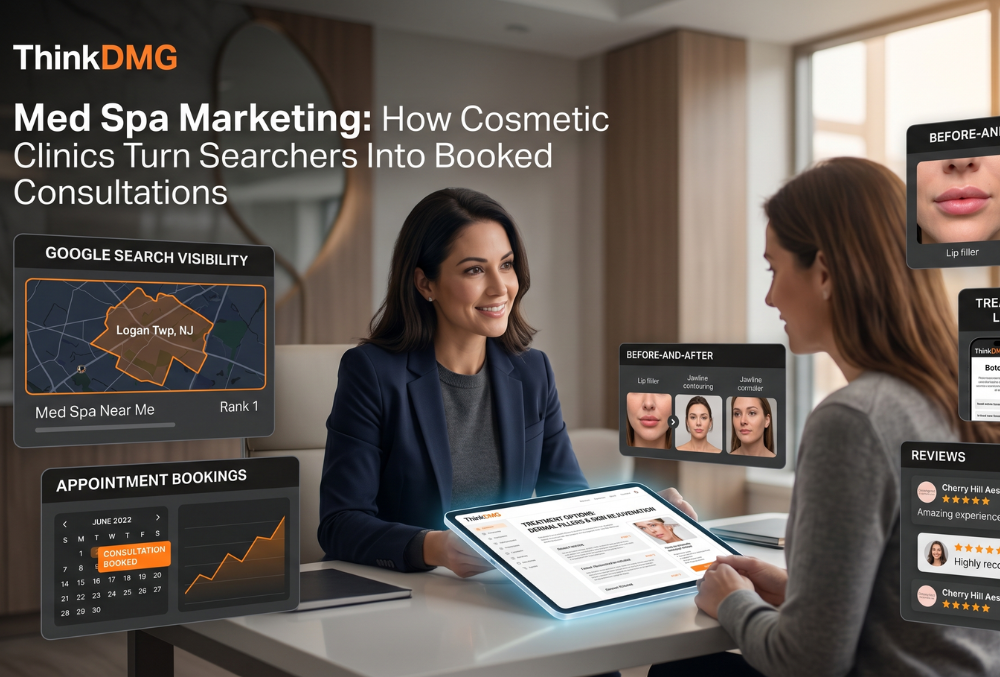
Med spas and cosmetic clinics sell services that are personal, visual, and trust-sensitive. A prospective client may want Botox, filler, laser treatments, body contouring, facials, or skin rejuvenation, but before booking they usually compare providers carefully. They look at photos, reviews, pricing cues, provider credibility, and whether the brand feels polished enough to trust with their appearance.


That is why med spa marketing cannot rely on generic local SEO or occasional social posts. The strongest strategy connects search visibility, visual proof, reputation, educational content, and a booking path that feels effortless.


Med Spa Buyers Research Before They Book

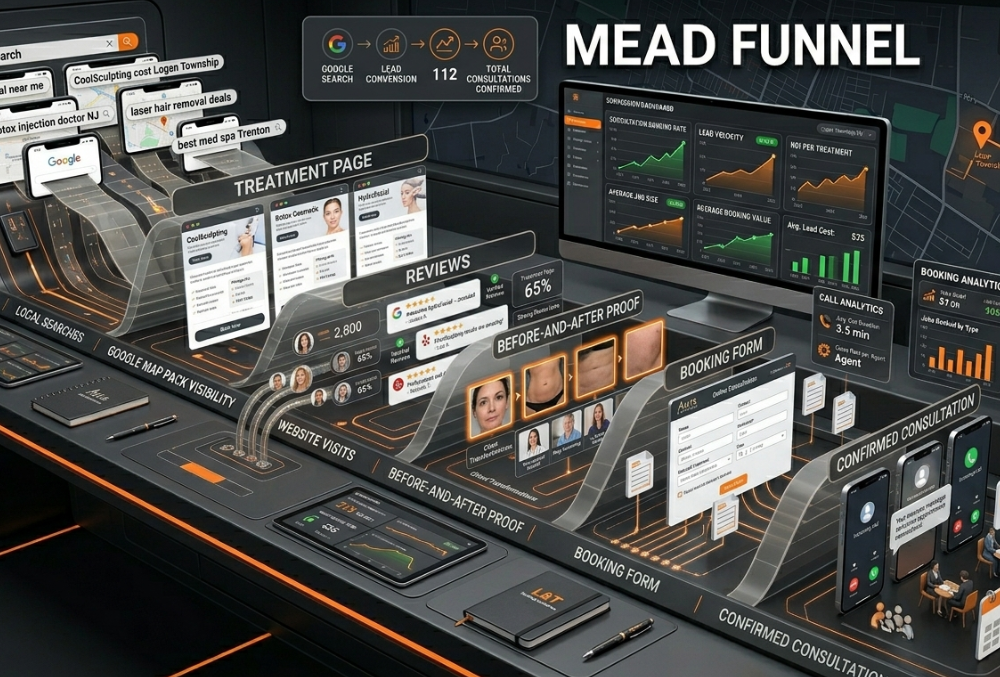
A med spa lead is rarely just a click. It is a confidence decision. The person may search on Google, check Instagram, read reviews, compare before-and-after photos, ask a friend, and return to the website before scheduling.


That means your marketing has to show up across the whole decision path. If one part of the experience feels thin or inconsistent, the prospect may pause or choose another provider.


The most important question is not simply, “Are we visible?” It is, “Do we look like the safest, clearest, most credible choice when someone compares us?”


Local SEO Should Be Built Around Treatments and Intent

People do not search for med spas in only one way. Some search for the provider category. Others search for a specific treatment. Others search by outcome, problem, or location.


A practical med spa SEO strategy should include pages for high-value services such as:

  • Botox and wrinkle relaxers.
  • Dermal fillers.
  • Laser hair removal.
  • Skin rejuvenation treatments.
  • Microneedling or RF microneedling.
  • Body contouring, if offered.
  • Facials and maintenance skincare.

Each treatment page should explain who the service is for, what the appointment involves, what results may look like, how long results may last, and what consultation is needed. The page should avoid exaggerated promises and focus on clear, confident education.


This is where a focused SEO strategy can help the clinic match search intent without turning the site into a wall of keywords.

Visual Proof Matters More Than Generic Claims

Cosmetic buyers want to see evidence. They do not just want to read that a provider is experienced. They want to see whether the brand’s aesthetic matches their own goals.


Useful proof can include:

  • Before-and-after galleries, when compliant with platform and medical advertising rules.
  • Provider bios that explain training and treatment philosophy.
  • Clear service descriptions with realistic expectations.
  • Recent client reviews.
  • Short educational videos or treatment explainers.
  • Social content that shows the clinic environment and provider approach.

The goal is not to overpromise. The goal is to reduce uncertainty before the consultation.


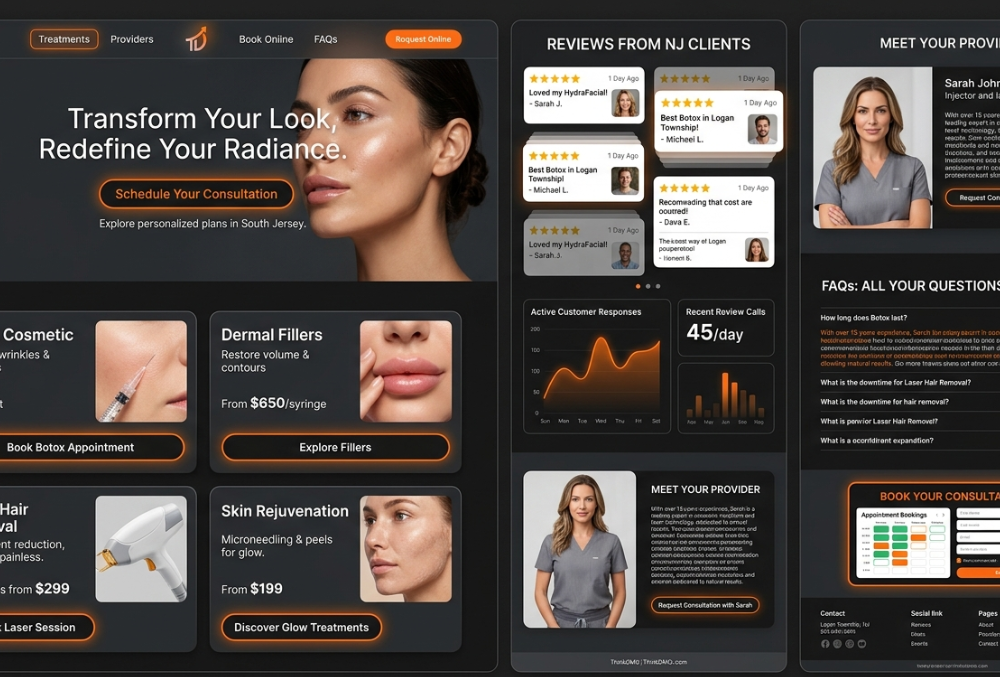
The Website Should Make Booking Easy

Med spa websites often look attractive but fail at conversion. They use polished imagery, but the visitor still has to hunt for pricing context, appointment options, treatment details, or a consultation button.


A stronger website guides the visitor naturally:

  • Choose a treatment or concern.
  • Understand what the service does and who it is for.
  • See proof and provider credibility.
  • Know what to expect during the consultation.
  • Book or request an appointment without friction.

If the site looks beautiful but does not help people take action, it is not doing its job. A good web design plan should combine brand polish with clear conversion paths.

Social Media Should Support Search, Not Replace It

Social media is important for med spas because treatments are visual and trust builds through familiarity. But social content should not be treated as a replacement for search. Many high-intent clients still go to Google when they are ready to compare local providers or book a consultation.


The best med spa marketing plans connect both channels. Social content creates familiarity and proof. Search captures demand when the prospect starts looking for a provider. The website converts that attention into appointments.


A strong social media marketing plan for a med spa should also feed the content strategy: common questions from comments, consultations, and DMs can become website FAQs, blog posts, reels, and email topics.

Reputation Is a Growth Channel

Reviews are not just a credibility badge. They are part of local search performance and one of the strongest conversion signals for med spas. A prospective client wants to know whether other people felt safe, listened to, and happy with their result.


The review strategy should be consistent and ethical. Ask happy clients at the right moment, make the process easy, respond professionally, and look for recurring themes that can improve the client experience. If reviews repeatedly mention that consultations feel rushed or booking is confusing, that is not just a reputation issue. It is an operations issue affecting growth.

Content Should Educate Without Overpromising

Med spa content performs best when it gives prospective clients practical clarity. People want to know what a treatment does, whether it fits their goals, how to prepare, what questions to ask, and when to book maintenance.


Helpful content topics include:

  • Botox vs filler: how to understand the difference.
  • What to ask during a med spa consultation.
  • How to prepare for laser hair removal.
  • How often to schedule maintenance treatments.
  • What makes a cosmetic provider trustworthy.
  • Why treatment plans should be personalized.

This kind of content marketing helps the clinic earn trust before the prospect ever contacts the office.

Paid Campaigns Can Accelerate the Right Offers

Organic visibility is valuable, but many med spas also use paid campaigns to promote consultations, seasonal treatments, events, memberships, or high-margin services. Paid campaigns work best when they send traffic to a focused page, not a generic homepage.


For example, a campaign for laser hair removal should lead to a page about laser hair removal, with service details, consultation information, trust signals, and a clear booking option. Sending that visitor to a general service menu creates unnecessary friction.


Used carefully, PPC advertising can help test offers, identify the strongest treatments, and create faster appointment volume while SEO builds longer-term visibility.

Which Med Spa Marketing Channels Drive the Most Booked Consultations?

A comparison of the marketing channels that generate the strongest consultation intent, trust, and long-term growth for med spas and cosmetic clinics.

Marketing Channel Buyer Intent Timeframe Lead Quality Best For
Paid Search Campaigns High Fast / Immediate High Accelerating consultation bookings and testing high-performing treatment offers quickly.
Email / Membership Campaigns High Fast Very High Promoting seasonal offers, memberships, loyalty programs, and repeat treatment visits.
Review Generation Very High Ongoing Very High Building trust, reducing hesitation, and improving local search conversions.
Treatment-Specific SEO Pages Very High Long-term High Matching high-intent searches for Botox, fillers, laser hair removal, and cosmetic treatments.
Local SEO High Long-term High Improving long-term local visibility, treatment discovery, and search presence.
Google Business Profile Optimization High Medium to Long-term High Building local trust through map visibility, reviews, treatment photos, and provider credibility.
Instagram / Reels Medium Ongoing Variable Building visual trust, treatment familiarity, and provider personality through consistent content.
Educational Blog Content Low to Medium Long-term High Answering FAQs, building authority, improving SEO, and educating research-phase clients before consultations.


FAQ: Med Spa Marketing

What is the best marketing strategy for a med spa?

The strongest strategy combines local SEO, treatment-specific pages, social proof, review generation, visual content, paid campaigns when appropriate, and a website that makes booking simple.

Should a med spa focus on Instagram or Google?

Both matter. Instagram helps build familiarity and visual trust, while Google captures people actively searching for a provider or treatment. The best results usually come from connecting the two instead of choosing one.

How can a med spa get more consultations?

Improve treatment pages, strengthen reviews, show provider credibility, make booking easier, publish educational content, and use targeted campaigns for high-value services or seasonal demand.

Med Spa Marketing Should Build Confidence Before the Consultation

The best med spa marketing does not pressure people into booking. It helps them feel informed, safe, and ready to take the next step. That requires visibility, proof, clarity, and a booking path that respects the client’s decision process.


Digital Marketing Group helps service businesses turn attention into qualified leads and appointments. If your med spa or cosmetic clinic wants a clearer path from search visibility to booked consultations, contact ThinkDMG to review your current marketing foundation.

Categories
Brand Building Content Marketing Conversion Optimization

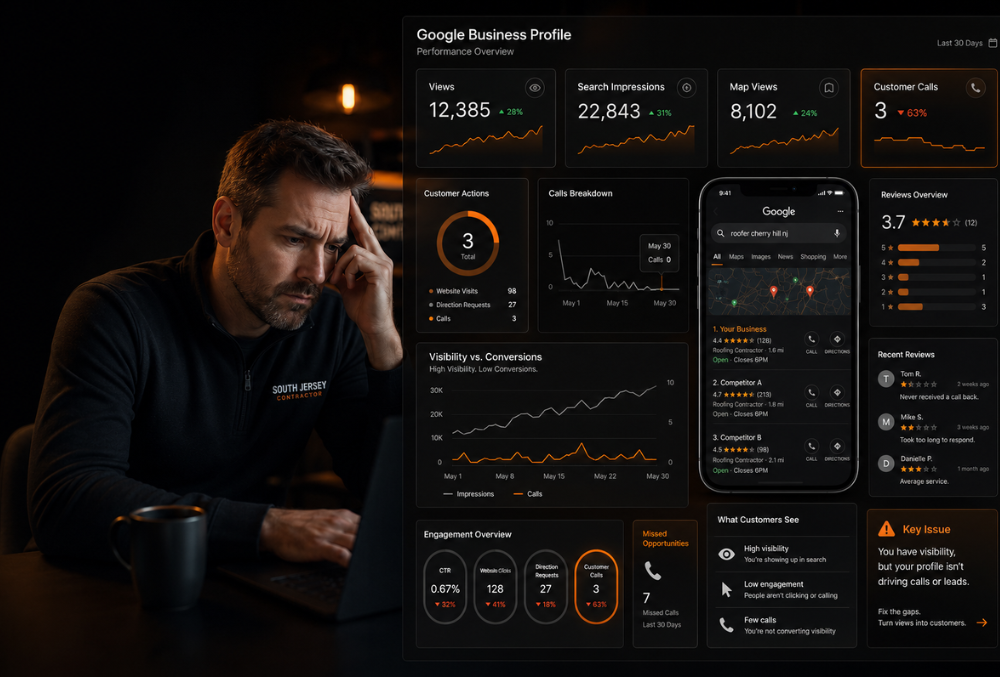
Why Your Business Shows Up in Google But Nobody Calls

A Google Business Profile is a free local listing that helps nearby customers find, compare, and contact your business in Google Search and Maps.


Showing up in Google is only the first step. If your South Jersey business appears in search results but the phone is quiet, the problem is usually not one single setting. It is often a gap between visibility, trust, and action.


A customer may find your profile, scan your reviews, check your photos, compare your website, and still choose another business. That happens when your listing gives them enough information to see you, but not enough confidence to call.


Why Your Business Shows Up in Google But Nobody Calls

Why Google Visibility Does Not Always Create Calls

Google can help people discover your business, but discovery is not the same as conversion. A profile can show up in Maps and still fail if it looks incomplete, outdated, or less trustworthy than nearby competitors.


For example, a homeowner in Marlton may search for a roofing contractor after seeing water stains on a ceiling. If one company has recent project photos, detailed services, strong reviews, and a clear phone option, that company feels easier to call.


If your profile has old photos, few reviews, limited service details, or no recent updates, the customer may keep scrolling. Your business was visible, but it did not create enough confidence.

The DMG Google Calls Conversion Framework

We review Google Business Profile performance through four questions. Each one affects whether a searcher becomes a caller.


  • Visibility: Does your business appear for the right local searches?
  • Trust: Does your profile prove you are active, credible, and local?
  • Action: Is it obvious how to call, visit, or request help?
  • Follow-up: Do you track which profile actions turn into real leads?

Most businesses focus only on visibility. The stronger move is to improve all four parts together.


Quick Question

Is Your Google Business Profile Set Up to Generate Calls — or Just Showing Up?

Most South Jersey businesses have a claimed profile. Very few have an optimized one. The difference comes down to completeness, review velocity, and consistent activity — the exact signals Google uses to decide who gets the call. DMG audits GBP profiles for local service businesses every week.

See Our Local SEO Services →

What Most Businesses Try

What Most Businesses Try

Most business owners claim their Google Business Profile and assume the hard part is done. They add the address, phone number, website, and hours. Some upload a few photos and ask a handful of customers for reviews.


That is a start, but it is not enough in competitive towns like Cherry Hill, Voorhees, Mount Laurel, Deptford, or Haddonfield. Google has many local businesses to choose from. Customers do too.


The common mistake is treating the profile like a directory listing. It should work more like a local trust page. It needs service detail, recent proof, review activity, accurate categories, useful answers, and a clear next step.


The Right Approach

Google wants to show useful local results. Customers want to make a safe choice quickly. Your profile has to serve both needs.


That means your Google Business Profile should explain what you do, where you work, why people trust you, and how to contact you. It should also connect to a website that confirms the same information.


A strong profile does not guarantee top placement. Search results can change based on location, competition, search history, and category. But a complete, active profile gives Google and customers better signals to work with.


Step By Step: How To Turn Google Visibility Into Calls

1. Verify And Complete Every Important Field

Start by confirming that your profile is verified. Then complete the fields that help Google and customers understand your business.


Add accurate hours, primary and secondary categories, service areas, services, appointment links, business description, website URL, and phone number. Make sure your name, address, and phone number match your website and major listings.


A Voorhees plumber should list specific services like water heater repair, drain cleaning, emergency plumbing, sewer line repair, and fixture replacement. A broad phrase like “plumbing services” is too vague by itself.


2. Build A Review System, Not A Review Sprint

Reviews help customers reduce risk before they call. They also show that your business is active and trusted by real people.


Ask happy customers for reviews soon after the work is complete. Make the request simple. Send the direct review link by text or email, and explain that honest feedback helps local customers choose with confidence.


Reply to every review. Thank the customer, mention the service when it sounds natural, and keep the response professional. Do not buy reviews, pressure customers, or ask employees to fake feedback.


3. Post Useful Updates Regularly

Google Posts can show offers, announcements, events, service updates, or seasonal reminders. They help your profile look active and current.


A South Jersey HVAC company might post about spring AC tune-ups. A roofing company might post after a storm about inspection availability. A dental office might post about new patient appointment openings.


Keep posts simple. Use one clear message, one relevant image, and one next step.


💡

This Is What DMG Does for NJ Businesses

Digital Marketing Group specializes in helping South Jersey and Philadelphia-area businesses build real visibility in local search. That means GBP audits, review strategy, citation cleanup, category optimization, and ongoing profile management — all tuned to the signals Google uses to surface local businesses in Maps and the top results.

See our Local SEO services for NJ businesses →

4. Upload Photos That Prove The Business Is Real

Photos help customers picture the experience before they call. Use recent images of your team, work, vehicles, office, service area, completed projects, and before-and-after examples.


A Mullica Hill landscaping company should show finished patios, clean hardscapes, lawn projects, equipment, and team photos. A Camden County law firm might show the office, attorneys, consultation rooms, and community involvement.


Avoid relying only on stock images. They make the profile feel generic and do not help a local customer trust your specific business.


5. Use Questions And Answers To Remove Friction

The Q&A section can answer common concerns before someone calls. Add questions customers ask often, then answer them clearly.


Good questions include service area, emergency availability, appointment timing, payment options, estimates, parking, insurance, warranties, or what to bring to a consultation.


For a Haddonfield law firm, useful questions might cover consultation length, practice areas, and what documents a client should prepare. For a Deptford auto repair shop, questions might cover appointments, diagnostics, inspections, and turnaround time.


Quick Comparison

Feature Basic Google Business Profile Optimized Google Business Profile
Verification Claimed, but often incomplete Fully verified, all sections complete
Photos Few, outdated, or generic Many, high-quality, relevant, recent
Reviews Few, no replies Many, positive, all replies answered
Posts Never used Regular updates, offers, news
Q&A Empty or ignored Common questions answered
Search Visibility Low, hard to find High, shows up for many searches
Customer Engagement Minimal calls or clicks Many calls, website visits, directions

Why Your Website Still Matters

Your Google profile can create the first impression, but your website often confirms the decision. If the profile sends people to a slow, confusing, or thin website, calls may drop.


The website should match the profile. Services, towns, hours, phone number, reviews, and photos should feel consistent. The page should load quickly and make the phone number easy to tap on mobile.


If your website is hard to use, our web design services can help turn local traffic into clearer next steps.


How To Know If Your Profile Is Working

Do not judge the profile only by views. Views can look encouraging while calls stay flat.


Track the actions that connect to revenue. Review calls, website clicks, direction requests, form fills, booked appointments, and lead quality. Compare those actions with your profile updates, review growth, and website changes.


This is where content marketing services can support local SEO. Helpful pages on your website can answer customer questions, support your profile, and build trust before the call.


What Not To Do

Do not stuff city names into your business name. Do not use fake locations. Do not buy reviews. Do not create service claims you cannot support. These shortcuts can damage trust and may create policy issues.


Also, do not expect the profile to fix every lead problem. If calls go unanswered, the website is weak, or the offer is unclear, profile optimization alone will not solve it.


The best results come from a complete profile, a useful website, honest reviews, clear service pages, and fast follow-up.

Fast Wins Checklist

Start with the simple fixes first. These steps are easy to miss, but they can make the profile feel far more useful.


  • Check that your phone number is correct.
  • Add each core service by name.
  • List the towns you truly serve.
  • Post one fresh photo each week.
  • Ask happy customers for honest reviews.
  • Reply to new reviews within one business day.
  • Add answers to the questions buyers ask most.
  • Make sure your website has a clear call button.

These steps will not promise a top ranking. They do make your profile clearer, fresher, and easier to trust.


That is the real goal. Help the right buyer see you, trust you, and call you.


Frequently Asked Questions

How often should I update my Google Business Profile?

Update your profile weekly when possible. Add posts, photos, services, holiday hours, and review replies. Regular updates show customers that your business is active.

Can I remove bad reviews from my Google Business Profile?

You can request removal only when a review violates Google policies. If it is a real customer complaint, respond professionally and work to earn more positive reviews over time.

Does my website link matter for local search?

Yes. Your website helps confirm what your business does, where you work, and whether customers can trust you. A weak website can reduce calls from profile visits.

Why do I get views on Google but not calls?

You may have a visibility problem, trust problem, or conversion problem. Incomplete profiles, weak reviews, poor photos, unclear services, and hard-to-use websites can all reduce calls.


Ready to Turn Google Visibility Into More Calls?

The tactics in this article work — but consistent execution is where most businesses fall short. DMG’s local SEO service handles the GBP audit, profile optimization, review strategy, and ongoing management for South Jersey businesses that want to show up and convert.

See Our Local SEO Services →

Categories
Conversion Optimization Digital Marketing for Small Business Digital Marketing Trends Generative Engine Optimization SEO Strategies

LinkedIn and AI Search in 2026: The Complete Playbook for Visibility, Trust, and Getting Chosen

There’s a data point making the rounds that marketers keep screenshotting and sending to their bosses: LinkedIn is now the #2 most cited domain across ChatGPT Search, Perplexity, and Google AI Mode — appearing in roughly 11% of AI-generated responses, ahead of Wikipedia, YouTube, and every major news publisher.


The screenshotters are right that this matters. But most of the commentary stops there, at the visibility layer, and misses the harder question underneath it: What does it actually mean to be cited in AI search, and does being cited get you customers?


This article is the answer to both questions. We’ve synthesized the most important research available on LinkedIn’s role in AI search — including Semrush’s analysis of 89,000 cited LinkedIn URLs, Stacker’s citation lift study across five LLMs, and Seer Interactive’s work on branded prompt tracking — and built a complete playbook around what the data actually tells you to do.

Part 1: What the Data Says About LinkedIn and AI Citations

LinkedIn Is a Primary Source for AI Answers

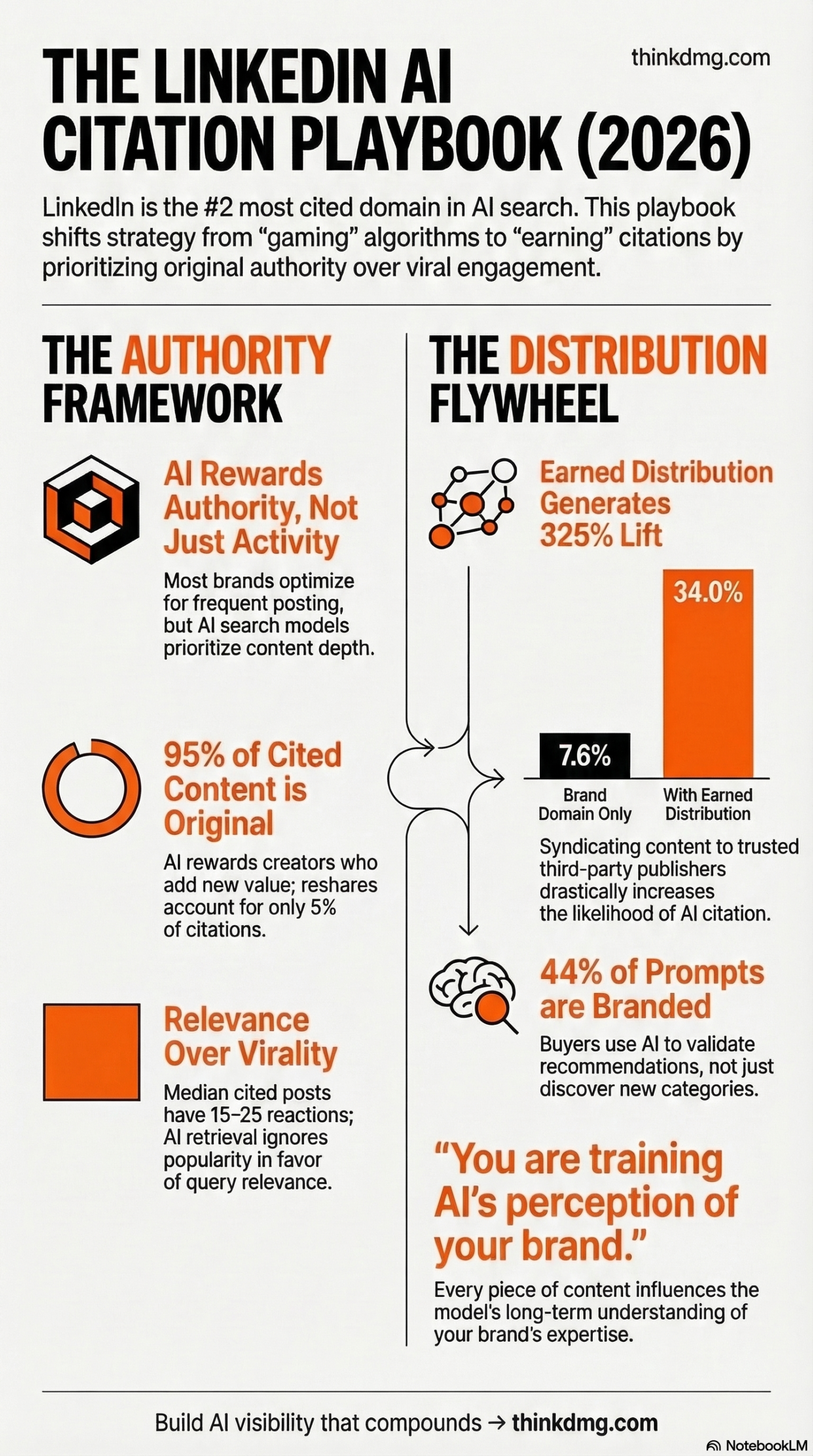
The Semrush study analyzed 325,000 unique prompts across ChatGPT Search, Google AI Mode, and Perplexity in early 2026, identifying 89,000 unique LinkedIn URLs cited in responses. The citation rate varied significantly by platform: Perplexity cited LinkedIn in just 5.3% of responses, while ChatGPT Search reached 14.3% and Google AI Mode hit 13.5%.


This isn’t uniform visibility — it’s platform-specific behavior, and your strategy should reflect that difference. More on that shortly.


CategoryInsightData PointStrategic Implication
AI Visibility: What the Data Actually Means
Platform VisibilityLinkedIn serves as a primary source for AI engines, though citation rates vary by platform.~11% overall; ChatGPT (14.3%), Google AI (13.5%), Perplexity (5.3%)Prioritize LinkedIn as a core GEO channel while adapting to platform-specific behavior.
Earned Media ImpactCross-domain distribution significantly increases visibility in AI systems.325% lift; 7.6% vs. 34% citation rateIntegrate PR and syndication into your LinkedIn strategy to create a citation flywheel.
Branded Prompt IntentAI queries often occur during evaluation after recommendations.44% of prompts include brands; 77% start with recommendationsOptimize for comparison and validation prompts—not just discovery keywords.
Content AuthenticityAI favors original insights over reshared or curated content.95% original vs. 5% resharedInvest in primary insights and expertise-driven content.
Content Length StrategyDifferent formats perform best at different lengths.Articles: 500–2,000 words
Posts: 50–299 words
Balance long-form authority content with concise, high-signal posts.
Semantic AuthorityAI mirrors content language and framing with high fidelity.0.57–0.60 similarityDefine your positioning clearly—AI will amplify it.
Distribution MixDifferent AI platforms prefer different entity types.Perplexity: 59% companies
ChatGPT/Google: 59% individuals
Use both company pages and executive thought leadership.
Posting CadenceConsistency matters more than engagement metrics.75% post 5+ times/month; 15–25 reactions typicalFocus on frequency and expertise, not virality.

AI Doesn’t Just Link LinkedIn — It Echoes It

Perhaps the most underappreciated finding in the Semrush research is the semantic similarity score: AI responses cited from LinkedIn showed 0.57–0.60 semantic overlap with the original content. For comparison, Reddit posts scored 0.53–0.54 and Quora answers just 0.435.


What this means practically: when an AI cites your LinkedIn content, it isn’t just pointing to it. It is largely repeating your framing, your language, and your conclusions in its answer. Your LinkedIn content doesn’t just get visibility — it shapes the narrative that the AI delivers to your potential customers.


That cuts both ways. If your positioning is clear and intentional, AI amplifies it. If it’s vague or inconsistent, AI will paraphrase something you didn’t quite mean.


What Content Gets Cited: The Anatomy of an AI-Favored LinkedIn Post

The research is clear on the formats and signals that correlate with AI citations:


Content type and length: LinkedIn articles dominate citations, accounting for 50–66% of cited content across the three platforms. The sweet spot for articles is 500–2,000 words — comprehensive enough to answer a detailed question, focused enough to stay useful throughout. For feed posts, mid-length content in the 50–299 word range performs best.


Originality over amplification: Approximately 95% of cited posts are original. Reshares account for just 5% of citations. AI rewards content that adds something to the conversation, not content that passes it along.


Educational intent wins: Over half of all cited LinkedIn content — and nearly two-thirds on Google AI Mode — is knowledge or advice-driven. AI models surface content that helps the person asking, not content that promotes the brand asking.


Consistency over virality: Around 75% of cited LinkedIn post authors posted five or more times in the four weeks prior. Nearly half have over 2,000 followers, but here’s the wrinkle: creators with fewer than 500 followers are cited at nearly the same rate as those with more. Frequency and expertise matter more than fame.


Engagement is a weak signal: The median cited LinkedIn post has just 15–25 reactions and no more than one comment. AI retrieval is not a popularity contest. It rewards relevance.

Ready to Get Found in AI Search?

The strategy in this article works — but implementation requires expertise, consistency, and ongoing optimization. That's where we come in.

Get Your AI Visibility Audit →

The Platform Divide: Companies vs. Individuals

One of the sharpest tactical insights from the Semrush data is the company vs. individual split by platform:

  • Perplexity cites Company Pages 59% of the time
  • ChatGPT Search and Google AI Mode cite individual members 59% of the time

This has real strategic implications. A LinkedIn content plan that relies entirely on your Company Page will underperform on ChatGPT and Google AI Mode. A strategy that relies entirely on individual thought leaders will leave Perplexity citations on the table. You need both, and they serve different AI engines.


Part 2: Why Visibility Is Only the Beginning

Here’s the hard truth that the data doesn’t say loudly enough: being cited is not the same as being chosen.

Wil Reynolds at Seer Interactive frames the job of marketing with a three-part sequence: Seen. Believed. Chosen. Most LinkedIn AI optimization advice gets you to “Seen” and stops there.

The gap between “seen” and “chosen” is trust — and trust doesn’t come from citation frequency.

The Prompt Nobody Is Tracking

Seer’s research uncovered something that fundamentally changes how you should think about branded AI strategy. In UX studies with real buyers, they found that up to 44% of AI prompts included brand names. The prompt that converts isn’t “best PR firms in Philadelphia.” It’s:

“I’m choosing between two PR firms. My friends recommended Maven PR and AgileCat. I’m a tech company focused on GEO. Help me compare them.”

Go look at your AI tracking dashboard right now. Do you have any prompts that look like that? Most marketing teams don’t — they’re tracking unbranded category queries while the buyer is already in the decision phase, searching for validation of a recommendation they’ve already received.

Gartner data reinforces why this matters: 77% of B2B purchases begin with a network recommendation. By the time that buyer types your brand name into an AI, the sale is already half made — or half lost. What AI says about you in that moment either reinforces what their colleague told them, or introduces doubt.

This reframes the entire LinkedIn AI question. The goal isn’t to show up for “best [category]” queries. It’s to make sure that when someone who was already told about you types your brand into ChatGPT, what comes back is accurate, compelling, and consistent with your actual positioning.

The Trust Tax on Short-Term AI Tactics

There’s a temptation — and an entire industry of vendors selling tools to accelerate it — to produce content optimized for AI visibility at speed. Keyword-dense articles. Semantic clusters. Auto-generated variations. Sea-of-sameness listicles.

This content can work. It can generate citations and impressions. But it carries a cost that most teams never measure: the erosion of the trust that makes those impressions matter.

When AI cites your content, it does so with 0.57+ semantic fidelity. That means generic, undifferentiated content gets amplified generically. It trains AI to describe your brand in the same language everyone else in your category uses. It teaches the model nothing about what makes you worth choosing.

The visibility gain is real. The trust gap it creates is invisible in your dashboard — until the moment a buyer searches your brand after hearing about you from a colleague and finds nothing that lives up to the recommendation.

Leading Source for AI Answers

Narrative Inventory: What Is AI Actually Saying About You?

Before publishing a single piece of new content, the most important thing you can do is take an honest inventory of what AI says about your brand right now.


Run a set of prompts across ChatGPT, Perplexity, and Google AI Mode:


  • Your brand name alone
  • Your brand vs. two or three competitors
  • The problem you solve, including your brand name
  • The version of the “my friend recommended” prompt relevant to your category

Read the responses. Compare them against your actual positioning. Ask: does this represent us accurately? Does it reflect what we’d want a warm referral to find?


The gaps in that answer are your content strategy. Not keyword gaps. Not topical gaps. Narrative gaps — places where what AI says about you doesn’t match what you want to be known for.


Part 3: The Distribution Layer Most Teams Are Missing

Publishing on LinkedIn is necessary but not sufficient. The Stacker citation lift study reveals the missing piece most LinkedIn AI strategies ignore entirely.

Citation Lift: The 325% Opportunity

Stacker partnered with AI visibility platform Scrunch to analyze eight articles across five LLMs and 944 prompt-platform combinations. They compared citation rates for the same stories published only on a brand’s own domain versus stories distributed across trusted third-party news publishers.


The results were decisive:


  • Brand-only citation rate: 7.6%
  • Total citation rate with earned distribution: 34%
  • Citation lift: 325%

The mechanism is straightforward. When a story lives only on your LinkedIn profile or your company blog, an AI model has one opportunity to encounter it. If your domain doesn’t carry strong topical authority for that query, the content may simply not register.


When that same content appears across multiple trusted publisher domains — through earned media placements, syndication, or contributed articles — the model encounters it in multiple contexts. That pattern of multi-domain presence signals authority in a way a single source cannot.


Notably, syndicated-only citations (where the third-party publisher gets cited but not the original brand domain) accounted for 19.2% of responses. In nearly one in five cases, earned distribution earned citations that the brand’s own site never would have.

The Canonical Rule for Earned Media

One important technical note: when distributing content to third-party publishers, include canonical tags pointing back to the original source. AI systems analyze content patterns rather than relying on canonical tags the way traditional search engines do, but search engine signals continue to influence how AI systems assess domain authority. A clean canonical structure protects your original content from duplication penalties while your distributed versions expand citation surface area.

What This Means for Your LinkedIn Strategy

The implication is significant: your LinkedIn content strategy and your PR strategy are now the same strategy.


The content you publish on LinkedIn — the original research, the data-driven posts, the first-person expertise — should also be the content you’re placing in industry publications, distributing through editorial partners, and pitching as contributed pieces. The more trusted contexts in which that content appears, the more signals AI systems have to recognize it as authoritative.


A post that stays on LinkedIn can earn a citation. A story that lives on LinkedIn, gets picked up by an industry publication, referenced in a newsletter, and cited in a third-party analysis becomes a citation magnet across the entire ecosystem.

Part 4: The Measurement Framework

Most teams are tracking the wrong things. Here’s what to track instead:

Visibility Metrics (What You’re Probably Already Tracking)

  • Citation rate across ChatGPT, Perplexity, Google AI Mode for target prompts
  • LinkedIn post reach and impressions
  • Share of voice vs. competitors in AI responses

These are the table stakes. Don’t stop here.

Trust Metrics (What Most Teams Are Missing)

  • Branded search volume — is your brand being searched by name? Growth here signals word-of-mouth and referral health
  • Direct traffic — people who type your URL directly have already made a decision about you
  • Social referral traffic — content people share in private DMs and channels, not just public engagement
  • Branded prompt performance — how do you appear when someone searches “your brand vs. competitor”? Is the answer accurate and compelling?

Narrative Accuracy (The Gap Nobody Measures)

Run a monthly audit of AI responses to branded prompts. Score them against your actual positioning. Track whether the semantic drift is closing or widening as your content strategy executes.

Download this resource – 2026 LinkedIn AI Authority

The Complete LinkedIn AI Visibility Playbook: A Summary

On content creation:

  • Publish original LinkedIn articles in the 500–2,000 word range on topics your buyers actually search for
  • Write to answer a specific question, not to rank for a keyword
  • Publish feed posts in the 50–299 word range consistently — five or more times per month minimum
  • Prioritize educational content over promotional content; save the promotional layer for the second or third exposure
  • Invest in both Company Page content (for Perplexity) and individual thought leadership from employees and subject matter experts (for ChatGPT and Google AI Mode)

On distribution:

  • Treat your best LinkedIn content as pitchable to industry publications
  • Build editorial relationships that enable syndication with canonical credit
  • Measure earned distribution not just by backlinks but by citation lift across AI platforms

On brand narrative:

  • Audit what AI says about your brand before optimizing for what AI says about your category
  • Track branded comparison prompts — the prompts that happen after a referral, not before
  • Build content that fills the gaps between how AI currently describes you and how you actually want to be known

On trust:

  • Measure branded search, direct traffic, and social referrals alongside AI citation rate
  • Be skeptical of velocity-first content strategies that optimize for AI impressions without building the underlying brand equity those impressions require to convert
  • Remember that AI responses citing your content carry your framing forward with ~0.60 semantic fidelity — the quality of your positioning matters as much as the quantity of your output

Final Thought

LinkedIn being the #2 cited domain in AI search is genuinely significant. But the marketers who will win from this aren’t the ones who publish the most or game the semantic signals the fastest.


They’re the ones who build a body of content worth citing — original, educational, distributed across trusted channels — and pair it with a brand clear enough that when AI surfaces it, buyers recognize exactly what they’re getting.

Visibility is the door. Trust is what’s on the other side of it.

AI Search & LinkedIn Strategy Series

Video Overviews

Downloadable PDF Assets


Sources: Semrush LinkedIn AI Visibility Study (March 2026), Stacker/Scrunch Citation Lift Study (December 2025), Seer Interactive GEO Research (March 2026), Gartner B2B Buying Research.


This article is part of thinkdmg.com’s series on LinkedIn, AI search, and the future of brand visibility.

Categories
Conversion Optimization Digital Marketing for Small Business Digital Marketing Trends Generative Engine Optimization

The LinkedIn AI Citation Playbook Nobody’s Talking About: How to Earn It Instead of Game It

By now you’ve probably seen the headline: LinkedIn is the #2 most cited domain across ChatGPT Search, Perplexity, and Google AI Mode. Marketers are scrambling to “optimize for AI visibility,” vendors are selling new tools weekly, and your Slack channels are full of screenshots.


Here’s what the conversation is mostly missing: the difference between earning a citation and gaming one — and why that difference will determine whether your LinkedIn AI strategy compounds or collapses.


This article is the tactical follow-up to our pillar piece on LinkedIn and AI Search in 2026. If you haven’t read that yet, start there. What follows assumes you understand why visibility alone isn’t the goal. Here we’re going deep on how — specifically the three mechanics most LinkedIn AI guides never mention.

The Problem With Most LinkedIn AI Advice


Most of what’s being written right now about LinkedIn and AI search tells you some version of the same thing: post more, post consistently, write long-form articles, use educational content, build your follower count.


That advice isn’t wrong. The Semrush study of 89,000 cited LinkedIn URLs confirms that frequent posters, original content, and educational framing all correlate with AI citations.


But here’s the gap: that advice treats LinkedIn as a closed loop. Post on LinkedIn → get cited in AI → done.


The reality of how AI citation actually works is far more distributed than that. And if you only optimize inside LinkedIn’s walls, you’re leaving the majority of your citation potential untouched.


There are three moves that separate teams who are building durable AI visibility from teams who are just posting more:

  1. Earn the citation — don’t manufacture it
  2. Build the distribution flywheel beyond LinkedIn
  3. Track the branded prompts your buyers are actually typing


Let’s go through each.


Move 1: Earn the Citation — Don’t Manufacture It


There’s a specific type of content flooding LinkedIn right now. You’ve seen it. The listicle dressed up as insight. The “10 things AI taught me about leadership” post. The agency blog that publishes 50 variations of “we are thought leaders” without ever demonstrating thought leadership. Auto-generated content published at volume, optimized for semantic signals, written for algorithms rather than people.


This content can generate citations. In the short term, it often does. And that’s exactly what makes it dangerous.


Wil Reynolds at Seer Interactive puts it bluntly: AI is summarizing the internet, and beliefs live in people’s heads. When AI cites your content, it pulls forward the language, framing, and conclusions in that content with roughly 0.60 semantic fidelity — meaning AI responses closely mirror what your LinkedIn content actually says. If what your LinkedIn content says is generic, optimized filler, that’s what AI will amplify about you.


You aren’t just optimizing for a ranking. You’re training AI’s opinion of your brand.

Professional Network AI Citation Playbook

What Actually Gets Cited (And Why)

The Semrush data is instructive here. The most-cited LinkedIn content shares a consistent profile:


  • Original, not reshared. About 95% of cited posts are original content. Reshares account for just 5% of citations. AI rewards people who add something to the conversation, not people who pass it along.
  • Educational, not promotional. Over half of all cited content is knowledge or advice-driven. Content that explains how something works, shares a specific result, or documents a real process outperforms content that announces things.
  • Moderate engagement, high relevance. The median cited post has 15–25 reactions. The posts going viral are not the posts getting cited. AI retrieval is not a popularity contest — it rewards relevance to the query.

The example Semrush highlights is telling: one of the top-cited LinkedIn articles in their dataset is a piece where an author draws on firsthand experience to rank the best SEO newsletters and explain each recommendation. It wasn’t a viral post. It wasn’t produced at scale. It was specific, useful, and authoritative — and AI keeps surfacing it because it keeps being the right answer.

The Practical Test Before You Publish

Before you publish any piece of LinkedIn content ask: Would I send this to a client in a DM as a resource? Wil Reynolds frames this perfectly — look through your sent DMs with links. How many of them look like auto-generated listicles? Almost none. Because your reputation is on the line when you make a recommendation. Hold your content to that standard.


If the answer is no, rework it or don’t publish it. Speed-optimized content that doesn’t clear that bar is quietly eroding the brand equity your AI visibility depends on.

Ready to Get Found in AI Search?

The strategy in this article works — but implementation requires expertise, consistency, and ongoing optimization. That's where we come in.

Get Your AI Visibility Audit →

Move 2: Build the Distribution Flywheel Beyond LinkedIn

This is the single biggest gap in most LinkedIn AI visibility strategies, and the research makes the opportunity impossible to ignore.


The Citation Lift Study

Stacker partnered with AI visibility platform Scrunch on a study analyzing eight articles across five LLMs and 944 prompt-platform combinations. They measured citation rates for the same stories published only on brand domains versus those same stories distributed across trusted third-party news publishers.

The results:

ConditionCitation Rate
Brand domain only7.6%
With earned distribution34%
Citation lift325%

That’s not a marginal improvement. That’s a structural one.


The mechanism is straightforward. When your content lives only on LinkedIn or your company blog, an AI model has one opportunity to encounter it. If your domain doesn’t carry strong topical authority for the query, that single touchpoint may not register.


When the same story appears across multiple trusted publisher domains — earned placements, syndicated articles, industry newsletters, contributed pieces — the model encounters that information pattern in multiple contexts. That repetition across authoritative sources is what signals to AI that this content is worth citing.


Syndicated-only citations are particularly instructive: in the Stacker study, 19.2% of citations came exclusively from third-party versions of the content — the brand’s own domain received no citation credit at all. In nearly one in five answers, earned distribution earned visibility that the brand site never could have generated alone.


What the Distribution Flywheel Looks Like in Practice

The implication is that your LinkedIn content strategy and your PR strategy need to be unified. Here’s how to build that flywheel:

Step 1: Identify your highest-value original content.

Not your most-viewed posts. Your most authoritative ones. Original research, proprietary data, firsthand case studies, documented results. These are the pieces worth distributing because they carry something third-party publishers can actually use.

Step 2: Pitch it as a contributed piece before you post it on LinkedIn.

If you post your original research on LinkedIn first and then try to pitch it to a publication, most editors will pass because it’s no longer exclusive. Flip the sequence. Pitch the insight as a contributed piece or data story, get it placed, then amplify the placement on LinkedIn. Your LinkedIn post links to the authoritative third-party version, which itself links back to your site — both signals compound.

Step 3: Syndicate strategically with canonical tags.

For content that’s already published on your domain, explore syndication partnerships with industry newsletters and publishers who will re-publish with a canonical tag pointing back to your original URL. Traditional search engines follow canonical signals, and since SEO domain authority continues to influence how AI systems assess credibility, clean canonicalization protects your original content while your distributed versions expand citation surface area.

Step 4: Measure citation lift, not just traffic.

The KPI most teams track from earned media is referral traffic. That will always look modest compared to paid or organic. The metric to add alongside it: citation rate in AI responses for your target prompts, measured before and after a distribution push. That’s where the compounding shows up.

The PR-as-GEO Frame

This is a mindset shift worth making explicitly: PR is now a GEO tactic.


Getting your brand mentioned in a respected industry publication used to matter for brand awareness and the occasional backlink. Now it matters because AI systems draw heavily from established news outlets and trusted publisher domains when assembling answers. A placement in an industry publication that AI already treats as authoritative is a citation signal for your brand, not just a traffic signal.


This changes the ROI calculation on PR completely. A placement that sends 200 referral visitors is no longer a modest win. That same placement may be contributing to citation lift across thousands of AI-prompted conversations you’ll never directly observe.


Move 3: Track the Branded Prompts Your Buyers Are Actually Typing

Here’s the prompt that should change how you think about all of this:

“I’m choosing between two PR firms. I’m a tech company focused on GEO. My friends recommended Maven PR and AgileCat. Help me compare them.”

Go look at your AI visibility tracking tool right now. Do you have any prompts that look like that? Most teams don’t — because they’re building their prompt tracking strategy around unbranded category queries, while their actual buyers are entering the decision phase with a brand already in mind, using AI to validate the choice.


Seer Interactive’s UX research found that up to 44% of AI prompts included brand names. Gartner data shows that 77% of B2B purchases start with a network recommendation. The math tells you what’s actually happening: by the time your buyer is prompting AI about your brand, someone they trust has already mentioned you. They’re not discovering you. They’re investigating you.


That’s the prompt that matters more than any category query — and it’s the prompt most teams are completely blind to.


The Branded Prompt Audit

Run this exercise across ChatGPT, Perplexity, and Google AI Mode:


Discovery prompts (for awareness)

  • “[Your category] for [your target audience]”
  • “Best [your service] companies”
  • “How to [solve the problem you solve]”

Comparison prompts (where decisions happen)

  • “[Your brand] vs. [Competitor A] vs. [Competitor B]”
  • “My colleague recommended [Your brand], what do I need to know?”
  • “Is [Your brand] good for [specific use case]?”

Validation prompts (post-referral)

  • “[Your brand] reviews”
  • “What is [Your brand] known for?”
  • “Who uses [Your brand]?”

Score each response against three criteria:

  1. Is the information accurate?
  2. Does it reflect your actual positioning?
  3. Would it reinforce or undermine a warm referral?

The gaps you find are your content brief. Not keyword gaps. Not topical gaps. Narrative gaps — places where what AI is saying about you doesn’t match what you want to be known for, or doesn’t match the level of credibility a buyer needs to move forward.


AI Citation Strategy Benchmark Table
Strategy TypeEffort LevelCitation ImpactTime to ResultsRisk LevelLong-Term Value
LinkedIn Posting OnlyLowLowMediumLowLow
High-Volume AI ContentLowMedium (short-term)FastHighVery Low
Original Authority ContentMediumMedium–HighMediumLowHigh
Authority Content + DistributionHighVery HighMediumLowVery High
Full Strategy (Content + Distribution + Prompt Tracking)HighMaximumMedium–LongLowMaximum


Web Data vs. Training Data: A Gap Worth Tracking

Seer built a tool to compare how a brand appears in AI responses when web search is enabled versus when AI is drawing purely from training data. This distinction matters because:


  • Training data reflects what AI learned about your brand during model training — accumulated over time from all available public sources
  • Live web data reflects what AI can find right now when given access to search

If you perform significantly better when web search is enabled, that means your recent content and earned placements are working — but they haven’t yet influenced the model’s underlying knowledge of your brand. Your GEO strategy should include both: building current web presence that AI can retrieve today, and building the kind of durable, widely-distributed brand record that shapes training data over time.


If you perform better from training data than from live web, that’s a different signal — your historical brand equity is strong but your recent content isn’t reinforcing it. Time to close that gap.

Putting the Three Moves Together

Here’s how these three moves compound on each other in practice:


A team doing Move 1 alone publishes quality original content on LinkedIn consistently. They earn some citations. They’re building credibility. But their citation surface area is capped by LinkedIn’s single-domain authority, and they have no visibility into how their brand is performing in the comparison prompts that precede purchases.


A team doing Moves 1 and 2 creates that same quality content and distributes it through earned media placements. Their citation rate is now potentially 4x what it would be from LinkedIn alone. AI encounters their content in more trusted contexts and surfaces it more frequently.


A team doing all three moves earns citations, distributes them across multiple authoritative domains, and tracks the branded prompts where buying decisions are actually being made. They know not just whether they’re being cited — but whether those citations are converting to trust, and whether their narrative in AI matches the brand they’re trying to build.


That third team isn’t just optimizing for AI visibility. They’re building a brand that compounds — one that earns word-of-mouth referrals, shows up accurately when AI is consulted, and reinforces the recommendation rather than undermining it.


Download Available – The AI Citation Playbook


A Note on the Long Game

There’s real tension in this space right now between short-term tactics that generate visible metrics quickly and long-term strategies that build something durable.


The short-term tactics aren’t without merit. Volume-based content can earn citations. Keyword-dense articles can generate AI impressions. If your goal is a screenshot for next quarter’s report, these approaches work.


But every piece of generic, algorithmically-optimized content you publish is training AI’s description of your brand. Every shortcut you take in content quality is a data point in the model’s understanding of what you stand for. And every citation earned by content that doesn’t actually represent your best work is a citation that might get you seen without getting you believed.


The teams that will win in AI search over the next three years aren’t the ones who move fastest. They’re the ones who build the most credible, widely-distributed, narratively-consistent body of work. The ones who treat citation lift not as a traffic hack but as the natural result of being the most authoritative source on the things they actually know best.


Earn the citation. Distribute the content. Track what buyers actually search. The playbook isn’t complicated. It’s just harder than it looks.

This is Part 2 in thinkdmg.com’s series on LinkedIn, AI search, and the future of brand visibility. Read the full foundation in Part 1: LinkedIn and AI Search in 2026 — The Complete Playbook.

Sources: Semrush LinkedIn AI Visibility Study (March 2026), Stacker/Scrunch Citation Lift Study (December 2025), Seer Interactive GEO Research (March 2026), Gartner B2B Buying Research.


Here’s what the conversation is mostly missing: the difference between earning a citation and gaming one — and why that difference will determine whether your LinkedIn AI strategy compounds or collapses.


This article is the tactical follow-up to our pillar piece on LinkedIn and AI Search in 2026. If you haven’t read that yet, start there. What follows assumes you understand why visibility alone isn’t the goal. Here we’re going deep on how — specifically the three mechanics most LinkedIn AI guides never mention.

Categories
Content Marketing Conversion Optimization Digital Marketing FAQs Digital Marketing for Small Business SEO SEO Strategies

Why Med Spa Marketing Feels Broken—And What to Do Before You Waste Another Dollar

Introduction: You Didn’t Open a Med Spa to Spend Nights Fixing Facebook Ads

You opened your med spa to transform lives—boosting confidence, delivering beauty and wellness, and helping your clients feel amazing. But instead of focusing on treatments and growth, you’re caught up in…

  • Unqualified leads ghosting your staff

  • A monthly $2,000 ad bill with no appointments

  • Pretty marketing reports that don’t drive revenue

  • Late nights trying to DIY Instagram posts that get buried

Sound familiar?

If your marketing feels more like a money pit than a patient pipeline, you’re not alone. We’ve studied hundreds of conversations from med spa owners on Reddit, Quora, and in strategy calls—and identified the 6 most painful marketing problems killing your ROI.

This article will walk you through:

  • What’s really wrong (with proof from your peers)

  • What it’s costing your business

  • How to fix it—without wasting another dollar

You’ll also get access to our free Med Spa Pain Point Dashboard, packed with real quotes, emotional triggers, and lead value scores to help you make smarter decisions starting today.

1. The Lead Conversion Paradox

“We’re running $2k/month in Facebook ads and still can’t get people to book.” – Reddit, r/MedSpa

You’ve got leads. But they’re not booking. Why?

  • They’re low quality

  • You follow up too late

  • They’re browsing, not buying

You’re not alone—this is the most common pain point for growing med spas. A disconnected booking system or slow response time can tank your ROI—even if your ads are getting clicks.

Fix It:

  • Use an automated follow-up system (email + text) that responds within 5 minutes

  • Score and tag leads by service interest

  • Use pre-screening questions in your forms to filter out time-wasters

The Lead Conversion Paradox


2. The “Pretty Report” Agency Nightmare

“My agency keeps sending reports with traffic graphs, but I don’t see new clients.” – Reddit
“I feel like I’m paying for smoke and mirrors.” – Quora

It’s not about impressions. It’s about booked appointments.

The #1 complaint about agencies in our research? Lack of transparency. You get charts and reports, but no clarity.

Warning Signs:

  • You don’t own your ad accounts

  • Your agency doesn’t talk about ROI

  • You can’t connect dollars spent to actual patients

Fix It:

  • Demand access to everything: your Google Ads, Meta Ads, and analytics

  • Ask for monthly reporting that shows revenue per campaign

  • Partner with an agency that specializes in patient acquisition, not just traffic

3. The Advertising Money Pit

“$4,000/month for ‘brand awareness’—can’t pay rent with impressions.” – Reddit

Your ads may be beautiful, but beauty alone doesn’t book.

We’ve seen med spas spending thousands monthly on campaigns that drive likes, not leads—and can’t be tracked back to a single client.

Fix It:

  • Run conversion-based ads with click-to-book CTAs

  • Add call tracking and booking conversion tracking

  • Segment by high-value services (e.g., CoolSculpting, filler, laser) instead of boosting every post

4. Content Strategy Confusion

“Do before-and-afters even work anymore, or is it just clutter?” – Quora

Posting randomly won’t get you clients. But over-posting without strategy is just as bad.

The new challenge: Organic reach is down, engagement is low, and everyone’s feed looks the same.

Fix It:

5. The Time Trap

“I’m spending hours every night on marketing that doesn’t work.” – Med Spa Owner

You’re a provider, not a full-time marketer. But you’ve become:

  • The content creator

  • The campaign manager

  • The community responder

That’s a fast track to burnout.

Fix It:

  • Use templates and scheduling tools (e.g., Canva + Later)

  • Delegate strategy to a partner who gets aesthetics

  • Automate your lead flow so you can focus on delivering results, not chasing clients

Daily timeline graphic showing provider vs. marketer role conflict

6. The ROI Mystery

“I feel like I’m throwing money into a black hole and hoping patients come out.” – Med Spa Owner

According to the PDF:

  • 67% of owners don’t know which channels drive actual bookings

  • $3.2K/month is wasted on low-performing campaigns

  • 85% can’t tie their marketing to revenue

That’s not just inefficient—it’s unsustainable.

Fix It:

  • Use a dashboard that connects marketing spend to booked services

  • Track cost per lead, conversion rate, and revenue per channel

  • Adjust campaigns weekly based on appointments, not clicks

Download the Free Med Spa Marketing Pain Point Dashboard

Want to visualize all this in one powerful, sharable format?

We’ve packaged these insights into a PDF dashboard that includes:

  • Real Reddit and Quora quotes

  • Emotional pain level scoring

  • Deal value potential

  • Strategy gaps—and how to close them


Download the Med Spa Pain Point Dashboard Now →

Conclusion: Your Marketing Should Bring You Clients—Not Headaches

You didn’t build your med spa to stress over analytics, chase no-show leads, or decode marketing jargon. You built it to deliver transformation.

ThinkDMG helps you get back to that.

With proven systems, clear ROI reporting, and a team that understands aesthetics—we help med spa owners like you increase bookings by 40% in 90 days.

📞 Book a 15-Min Growth Strategy Call