Categories
Digital Marketing FAQs

Website Redesign Checklist For Home Service Companies

Last updated: July 1, 2026

Quick Answer

A home service website redesign should improve trust, service clarity, local proof, speed, and the path to a call.

For a home service company, a redesign is not just a new look. The website needs to help homeowners understand the service, compare the company, trust the proof, and contact the team without hunting for the next step.


DMG strategy starts with the buyer path. If people cannot understand, trust, or act on the page, more traffic only exposes the weak point faster.


At A Glance

  • A home service redesign should start with lead path, service clarity, local trust, and mobile contact behavior.
  • The redesign plan should protect SEO signals before URLs, headings, internal links, or service pages change.
  • The Home Service Redesign Scorecard helps owners decide whether the site is ready to support inquiries.
  • A better-looking site still fails if homeowners cannot find proof, services, and contact options quickly.

What A Redesign Has To Protect

A home service website redesign should protect the parts of the site that already help people call, book, or compare the company.


The risk is rebuilding the look while weakening the service pages, local proof, mobile contact path, or SEO signals that support real inquiries.


ThinkDMG Definition

A lead-focused redesign is a website rebuild planned around trust, service clarity, and contact actions, not only visual style.

ThinkDMG Home Service Redesign Scorecard

The ThinkDMG Home Service Redesign Scorecard helps owners decide whether a redesign is ready to support real inquiries. It scores the five areas that usually matter most before a homeowner calls.

ThinkDMG Home Service Redesign Scorecard
Scored area Question to ask Points Plain-English next step
Service clarity Can visitors identify the right service in seconds? 20 Give each core service a clear path.
Local trust Does the site show service areas, reviews, and proof of real work? 20 Move trust signals close to decision points.
Conversion access Are phone, form, and scheduling options obvious on mobile? 20 Place contact actions where homeowners naturally decide.
Search readiness Will the redesign preserve and improve important SEO signals? 20 Map URLs, headings, metadata, and internal links before launch.
Operational accuracy Are hours, emergency details, financing, and service limits accurate? 20 Confirm business details before design signoff.

Score interpretation: 80 to 100 means the foundation is strong enough to improve with focused work. 60 to 79 means there are repair priorities that should be handled before heavier investment. Below 60 means the business should fix the foundation before adding more traffic pressure.


Want the issues prioritized before you spend more?

ThinkDMG can review the page, search intent, and business context before recommending the next move.

Explore the related service

Home Service Redesign Flow

Home Service Redesign Flow

Business Goals
Service Pages
Local Proof
Mobile Contact
SEO Safeguards
Launch Decision

The diagram shows how a redesign should move from business goals to a cleaner lead path.

What to decide before redesign work starts

What to decide before redesign work starts

Name the business goal first. A redesign for emergency calls needs different choices than a redesign for larger scheduled projects, financing conversations, or recurring maintenance plans.


Decide which services deserve their own pages. Homeowners search for specific problems, and a single broad services page often makes them work too hard.


Create the URL and SEO preservation plan before launch. A redesign can accidentally weaken visibility if page moves, redirects, headings, and internal links are handled after the fact.


What homeowners need to see quickly

They need to know whether the company handles the problem they have. Use plain service names, short explanations, and clear next steps instead of vague slogans.


They need proof that the company is legitimate and local. Put reviews, service areas, license or credential notes where appropriate, and real project context near conversion points.


They need low-friction contact options. Mobile visitors should not have to pinch, scroll, or search the footer just to ask for help.


Redesign Choices That Affect Leads

Redesign Choices That Affect Leads
Situation Why it matters Better move
New visuals only The site may look fresher but still confuse buyers. Tie design changes to service and contact clarity.
Service-page rebuild The redesign can match more buyer searches. Plan pages around profitable services.
Mobile contact cleanup More visitors can call without friction. Make phone and form actions persistent and obvious.
Launch SEO review The redesign avoids losing important signals. Check redirects, metadata, headings, and links.

ThinkDMG Definition

Local trust signals are page elements that help a homeowner believe the company is active, nearby, and credible.

ThinkDMG Definition

Search readiness means a redesign protects the pages, URLs, content, and signals that help qualified buyers find the company.

ThinkDMG Definition

A conversion path is the route a visitor takes from need, to confidence, to phone call or form submission.

How To Keep A Redesign From Losing Leads

Before design approval, list the pages that already support calls, booked jobs, financing questions, or high-value services.


Protect those pages during the redesign. Keep their intent, improve their proof, check their mobile contact path, and plan redirects before launch if any URL changes are unavoidable.


A redesign should make the sales path easier to use, not just make the site feel newer.


Redesign Risks Home Service Companies Miss

The biggest redesign risk is treating the project like a visual refresh only. Homeowners do not hire a company because the site has newer graphics. They hire when the service is clear, the proof feels real, and the next step is easy.


Another risk is launching before SEO details are mapped. If important URLs, headings, internal links, and service-page content change without a plan, the redesign can weaken the very pages that support leads.


The safest redesign process reviews the current lead path first. Then it improves design, service structure, mobile usability, and local proof without removing what already helps the business get contacted.


For home service companies, the review should include emergency calls, estimate requests, seasonal services, financing questions, and mobile visitors who need help quickly.


Need a practical next step?

The right fix depends on the page, the market, and the service goal, so a short conversation can save wasted effort.

Request a free consultation

Related Services

  • Our web design services include the redesign planning, service-page structure, and mobile contact path covered in this checklist. web design services.
  • Our home services marketing work keeps redesign decisions tied to the way homeowners actually compare providers. home services marketing.
  • Our SEO services help protect search visibility before, during, and after a redesign. SEO services.
  • A free consultation can help prioritize which redesign fixes matter before investing in a rebuild. free consultation.

FAQ

When should a home service company redesign its website?

A redesign is worth considering when the site is slow, unclear, hard to use on mobile, weak on trust, or unable to support important services.

Should SEO be part of a redesign?

Yes. URL changes, headings, internal links, metadata, and service-page structure should be reviewed before launch.

What matters more, design or calls?

The design should serve the call path. A better-looking site still needs clear services, local proof, and easy contact options.

Ready to turn the diagnosis into action?

Bring the website, service goals, and current concerns to ThinkDMG and we will help identify the highest-priority path.

Schedule a free consultation

Categories
Digital Marketing FAQs

How to Choose the Right Digital Marketing Agency

Last updated: June 29, 2026

Quick Answer

The right agency explains the plan clearly, protects your ownership, tracks real leads, and understands your local market.

Many agency proposals look polished. That does not mean the plan is right for your business.


The best agency for a South Jersey business should explain what will happen first, who owns the accounts, how calls are tracked, and how the work connects to revenue-producing services.


This guide gives you a scorecard to use before you sign. It is built for owners who need a practical way to compare strategy, reporting, SEO, web design, paid media, and AI search knowledge.


At A Glance

  • Do not choose an agency only because the proposal looks good.
  • Compare strategy, reporting, ownership, website skill, SEO, paid media, AI search, and tracking.
  • Ask what will happen in the first 30, 60, and 90 days — and ask for that in writing.
  • Pause if an agency promises exact rankings, hides account ownership, or cannot explain the work.
  • Score the agency twice: once after the sales call, once after reviewing the written proposal.

The ThinkDMG 40-Point Agency Evaluation Scorecard

ThinkDMG Definition

An agency scorecard helps you compare providers by what they will do, how they report it, and who owns the accounts.

The ThinkDMG 40-Point Agency Evaluation Scorecard helps you compare agencies with less guesswork. Score each area from 0 to 4. A 0 means the answer was vague. A 4 means the answer was clear, specific, and tied to your goals.


ThinkDMG 40-Point Agency Evaluation Scorecard
Category What to evaluate Strong answer looks like Score
Strategy Goals, market, audience, priorities. The agency explains what matters first and why. 0 to 4
Reporting Metrics, schedule, and interpretation. Reports explain progress, blockers, and next actions. 0 to 4
Transparency Scope, completed work, and approvals. You know what is being done each month. 0 to 4
Ownership Website, analytics, ad accounts, content, and domains. Your business keeps access and control. 0 to 4
SEO Technical, local, content, links, and service pages. The plan connects SEO work to buyer searches. 0 to 4
Paid media Budget, targeting, landing pages, and tracking. Spend is managed against clear business goals. 0 to 4
Website experience Speed, mobile layout, forms, and CTAs. The site is treated as a sales tool. 0 to 4
AI search readiness Clear answers, schema, and consistent business facts. The agency can explain how AI tools may understand your business. 0 to 4
Conversion tracking Forms, calls, CRM, and lead quality. Tracking connects marketing work to real inquiries. 0 to 4
Communication Meetings, response times, and decision process. You know who handles strategy and how decisions are made. 0 to 4

Agency Score Thresholds

32 to 40

Strong fit

Ask for the first 90-day plan and confirm ownership, tracking, and approval terms before signing.

24 to 31

Needs follow-up

Ask for clearer answers in the lowest-scoring areas before comparing price.

Below 24

Pause

Do not sign yet. The plan, ownership, reporting, or strategy is too unclear.

Plain-English next step: Score the agency after the call, then score the written proposal. If the proposal is weaker than the pitch, slow down.


Want to compare agencies without guesswork?

Use this scorecard during the sales process. If you want a second opinion on what your site and marketing actually need, DMG can help you sort the signal from the pitch.

Schedule a strategy call →

Start With Your Business Goal

Before you compare agencies, write down the business problem. Do you need more calls? Better local visibility? A website that converts? Stronger paid search? Better reporting?


If your goal is vague, the proposal will be vague. A good agency should help refine the goal, but it should not sell a package before understanding the business.


The Agency Selection Path Most Owners Should Follow

Choosing an agency should not start with the sales pitch. It should start with the business problem, the website condition, and the numbers that matter most. A strong agency helps you move from diagnosis to strategy before recommending a package. If the first recommendation is a prebuilt bundle, the agency may be selling capacity instead of solving the actual issue.

ThinkDMG Agency Selection Path
Step Question to answer Why it matters before signing
1. Diagnose What is actually blocking growth? The wrong diagnosis leads to wasted spend. The agency should audit before recommending.
2. Prioritize Which issue should be fixed first? Good agencies sequence work by impact. If everything is listed as “high priority,” nothing is.
3. Prove What evidence supports the recommendation? Claims should be backed by your site data, search data, or clear business logic — not assumptions.
4. Execute What will change in the first 30, 60, and 90 days? The proposal should name actual pages, tools, and checks — not just service categories.
5. Measure How will progress be judged? Reporting should connect to calls, forms, rankings, and lead quality — not just activity counts.

ThinkDMG Definition

A strong agency proposal explains the first steps, the reason for each step, and how progress will be judged.

Red Flag Decision Tree

Agency Red Flag Decision Tree

Did the agency give a clear, specific answer about strategy, ownership, and first steps?

NO ↓
YES ↓

Red flag — slow down
Continue evaluating

Promised exact rankings or lead volume? Pause.
Ownership is unclear? Get it in writing.
Reports only show clicks? Ask about calls and forms.

A weak answer should slow the decision before ownership, reporting, or ranking claims become larger problems.

ThinkDMG Definition

Account ownership means your business keeps control of the website, domain, analytics, ads, content, and key logins.

The Account Ownership Test

Before signing any agreement, ask who owns each of the following: the domain name, the website and hosting account, Google Analytics property, Google Ads account, Google Business Profile listing, call tracking numbers, CRM data, creative files, and published content. The safest answer is simple — your business should own the core accounts, and the agency should be granted only the access needed to do the work.

Ask these ownership questions before signing

  • Is the domain registered in my business name or the agency’s?
  • Do I have admin access to my own Google Analytics and Google Ads accounts?
  • Who owns the call tracking number — and can I keep it if I leave?
  • Who owns the website files and the content published on it?
  • If I cancel, what happens to the accounts, data, and creative assets?
  • Can I export my analytics history, ad campaign data, and lead records?

If an agency insists on owning any of these accounts rather than being granted access to client-owned accounts, ask for the reasoning in writing and review the contract carefully before proceeding. Google’s own account structure supports granting manager-level access while keeping ownership with the business — an agency that requires full ownership of accounts is creating dependency, not convenience.


ThinkDMG Definition

Client-owned marketing infrastructure means the business controls the accounts, data, domains, and assets that its marketing depends on — regardless of which agency manages the work.

Sales Call Question Bank

Questions To Ask Before Hiring

  • What would you fix first and why?
  • How do you decide which services or locations get priority?
  • What would the first 90 days look like — and can I see that in writing?
  • Will you review technical SEO before recommending content?
  • How do you connect blog content to service pages?
  • How will phone calls and forms be tracked?
  • Who owns the website, analytics, ad accounts, and content?
  • How do you protect site speed and Core Web Vitals?
  • How do you report lead quality — not just traffic or rankings?
  • Who reviews the data and recommends next steps each month?

What A Strong Proposal Should Include

A strong proposal makes the first phase of work obvious. You should know what will be reviewed, what will be changed, who owns the accounts, and how success will be measured. If any of these are missing, ask for them before signing — not after the first month of work has already started.

Proposal Clarity Checklist
Proposal area Strong proposal Weak proposal
First 30 days Names specific audits, pages, tools, access needs, and first fixes. Says “optimize your website” or “improve visibility” without detail.
Reporting Covers rankings, traffic, calls, forms, and lead quality in a regular cadence. Lists impressions, clicks, or tasks completed — without connecting to real inquiries.
Ownership Confirms you own domain, analytics, ad accounts, content, and website assets. Leaves ownership vague, agency-controlled, or unmentioned.
Strategy Explains why priorities were chosen based on your site, market, and goals. Recommends a standard package before diagnosing the actual problem.
Risk Names tradeoffs, dependencies, and what could slow progress honestly. Makes the plan sound guaranteed or effortless with no caveats.

Your agency should connect services, website, and search

If SEO is part of your plan, compare whether each provider can explain SEO, website experience, and tracking as one connected system.

SEO services →

ThinkDMG Definition

A local agency is valuable when regional search behavior, service areas, local proof, and direct communication affect your sales path.

Local Agency Or National Agency?

A national agency can fit a large, complex campaign. A local agency can fit better when your business depends on regional search behavior, town-level proof, and direct communication.


For South Jersey and Greater Philadelphia businesses, market knowledge matters. Real local context may include the Downtown Haddonfield business district, the Chamber of Commerce Southern New Jersey, or Philadelphia-area buying patterns. Location alone is not enough, but it can help when paired with strong execution.

A Simple Way To Use The Scorecard This Week

Do not wait until the last sales call to use the scorecard. Use it from the first call. Keep the sheet open. Score each answer while it is fresh.


If an agency gives a clear answer, write down the point. If the answer sounds good but does not name the work, leave the score low. Plain answers matter. They show how the team will speak to you after the sale.


Pay close attention to ownership. Your company should keep access to the site, domain, analytics, ad accounts, and content. If the agency keeps control, get the terms in writing before you sign.


Also watch how the team talks about leads. Good reports do not stop at clicks. They help you see calls, forms, lead quality, and next steps.


Ask for a first month plan. It should name the first pages, tools, and checks. It should also name what the agency needs from you. A clear start is a good sign.


When two agencies look close, choose the one that explains tradeoffs. You want a partner who can tell you what matters now, what can wait, and what could create risk.


Use the score twice. Score the agency after the first call. Then score it again after the proposal. If the score drops, that is a clue. The sales talk may have been clear, but the plan may not be. The written plan is what your team will live with.


ThinkDMG Definition

Lead tracking means measuring calls, forms, and lead quality so marketing decisions are based on real business inquiries — not activity counts.

Do Not Ignore Search And Tracking Tools

A useful agency should know how to read Search Console, analytics, call tracking, forms, and CRM data. Google’s Search Console documentation is a good baseline for search performance reporting.


The agency should also know when AI search matters. That does not mean chasing trends. It means clear service pages, helpful answers, schema where appropriate, strong proof, and consistent business information.


One more point worth stating plainly: any agency that promises guaranteed rankings, guaranteed leads, or guaranteed revenue outcomes is making a claim no credible agency can honestly support. The FTC’s guidance on advertising holds that claims must be truthful, not misleading, and backed by evidence. Marketing outcome guarantees do not meet that standard, and a credible agency should not make them.

Need AI search explained in plain English?

If buyers may ask AI tools for local recommendations, ask whether your agency can make your services, locations, and proof easier to understand.

AI search optimization →

Choosing a Marketing Agency Guide


ThinkDMG Insight

One of the most consistent patterns DMG sees when a business is unhappy with a prior agency: the proposal was polished, the pitch was confident, and the first few weeks felt busy. Then reporting shifted from business outcomes to activity metrics — pages published, tasks completed, rankings for keywords nobody was actually searching. By the time the business owner noticed, six months of retainer had passed without a clear picture of whether any of it created calls.


The simplest protection against this is to ask one question before signing: “Can you show me, in plain English, how you will connect this work to real inquiries from real customers?” An agency that can answer that clearly — naming the tracking setup, the reporting cadence, and how results will be tied to your most important services — is a fundamentally different kind of partner than one that responds with impressions, engagement, and rankings for its own sake.

What To Do Next

  1. Score every agency using the 40-point scorecard.
  2. Ask for written answers to ownership and tracking questions before the proposal is finalized.
  3. Compare the first 90 days of work, not just the monthly price.
  4. Review the proposal against the Proposal Clarity Checklist above.
  5. Choose the agency that explains tradeoffs clearly — not the one that makes the plan sound guaranteed.
  6. Do not sign until you understand what will change, who owns the accounts, and how progress will be reviewed.

Sources and local proof used in this guide

Related Services

  • Our SEO services show how an agency should connect technical work, local visibility, content, and lead goals in a clear plan — the same standard described in this scorecard.
  • Our web design services support the website experience, speed, conversion paths, and ownership questions this guide covers.
  • Our AI search optimization helps when your agency comparison includes how clearly AI tools can understand your services, locations, and proof.

FAQ

What should I ask a digital marketing agency before hiring?

Ask about strategy, reporting, ownership, tracking, timelines, communication, and what specific work will happen during the first 90 days. Get the first-month plan in writing, not just in conversation.

Should I hire a local agency or a national agency?

A local agency can help when regional knowledge matters. A national agency can fit broader campaigns. The right choice depends on goals and proof — location alone is not a reason to hire or avoid an agency.

What are red flags when choosing an agency?

Red flags include promised first-page positions or guaranteed leads, vague reporting focused on activity rather than outcomes, unclear account ownership, locked or agency-controlled accounts, weak onboarding, and no plan for tracking calls and forms.

How do I compare agency proposals?

Compare proposals by strategy, scope, reporting, ownership, accountability, and whether the plan matches your market, budget, and goals. Use the Proposal Clarity Checklist above and the 40-Point Scorecard to score each proposal systematically rather than going on gut feel.

What should a strong agency proposal include?

A strong proposal should name the specific work happening in the first 30 days, confirm that you own all key accounts and assets, explain how reporting will connect to real leads and calls, and describe the strategy behind the priorities chosen — not just a list of services.

What happens to my accounts if I stop working with an agency?

If the accounts are owned by your business and the agency has been granted access, you simply remove their access and the accounts remain yours. If the agency owns the accounts, you may lose data, tracking history, ad campaign structure, or the domain itself. Always confirm ownership in writing before signing.

Choosing an agency should feel clearer, not more confusing

If you are comparing agencies and want a second opinion on what your site, search visibility, and tracking actually need before you commit, DMG can help.

Schedule a strategy call →

Categories
Brand Building Digital Marketing FAQs Digital Marketing for Small Business

The Difference Between SEO and Google Ads for Small Businesses

Most South Jersey businesses that call us have a Google Business Profile but aren’t getting new customers from it. A well-managed Google Business Profile helps local businesses get found online and attract new customers directly from Google Search and Maps.

The Real Problem

Many South Jersey business owners don’t get new customers from their Google Business Profile. They set it up once and forget it, expecting Google to do the rest. This leaves their listing stale and invisible when people search for services in places like Cherry Hill or Voorhees. Without active management, your profile loses its power to bring in leads.

What Most Businesses Try

Most businesses simply claim their Google Business Profile and add basic information. They think having a profile is enough, but Google needs more to show you prominently. This approach fails because a static profile doesn’t tell Google you’re active or trustworthy. It’s like putting up a sign and never updating your store window, so customers drive by without stopping.

Many also focus solely on getting reviews, but ignore other important parts of the profile. While reviews are crucial, they are only one piece of a bigger puzzle. A profile with many reviews but no photos or recent posts still looks incomplete to Google. This can hurt your overall visibility in local search results and limit your reach for digital marketing in New Jersey.

The Right Approach

`The right way to use your Google Business Profile is to treat it as an active marketing tool that needs regular attention. In our work with South Jersey contractors, the ones who get this right share one habit: they update their profile regularly. This ongoing effort tells Google you’re a current, relevant business that customers can trust.

Here is what most people miss. A Google Business Profile with 4 photos and a 3.1 star average is invisible no matter how good your SEO is. Google reads those signals as a low trust score and ranks you accordingly. We have seen contractors in Burlington County jump from position 8 to position 2 in under 60 days by fixing their profile quality before touching anything else. The profile is not a checkbox. It is your first impression and Google treats it that way. If you want to improve how your business shows up in Google, check out our SEO services in New Jersey.

WANT MORE CALLS FROM GOOGLE?

Our Local SEO Program Gets South Jersey Businesses More Calls From Google

We handle your Google Business Profile, local citations, and on-page SEO so you show up when customers in your area search for what you offer. South Jersey businesses we work with typically see measurable improvement in calls and profile views within 90 days.

Explore Our Local SEO Services →

Step by Step

Here’s how to make your Google Business Profile a customer-generating tool:

  1. Verify and Complete Your Profile. You must verify your Google Business Profile to gain full control over it and unlock all its features. A dentist in Mount Laurel made sure every section of her profile was filled out, including services, hours, photos, and accessibility options. This completeness signals to Google that you’re a legitimate and helpful business. When you fill out all fields, you give Google more information to match you with relevant searches, making your profile more likely to appear. Make sure your business name, address, and phone number are consistent with your website and other online listings.
  2. Collect and Respond to Reviews. Reviews are your social proof and a strong ranking factor for local businesses. A plumbing company in Haddonfield started asking every satisfied customer for a review right after completing a job. They saw their average rating climb from 3.8 to 4.7 stars in four months. Always respond to reviews, both good and bad, to show you care about customer feedback. This interaction improves your standing with Google and potential customers, building trust and encouraging more engagement.
  3. Post Regular Updates. Treat your Google Business Profile like a mini-social media feed, posting updates about your business. A local restaurant in Collingswood posts weekly updates about specials, new menu items, and upcoming events. These posts keep your profile active and give Google fresh content to show to potential customers. Regular posting can increase your profile views by up to 25 percent within a few months, driving more interest and clicks to your listing.
  4. Add High-Quality Photos and Videos. Visuals make your profile more appealing and trustworthy, drawing in more potential customers. A landscaping business in Mullica Hill added 20 new photos of recent projects and a short video tour of their equipment and team. This led to a 30 percent increase in customer actions on their profile, like website clicks and calls. Show, don’t just tell, what your business offers. Make sure photos are well-lit and represent your business professionally, including your storefront, team, and products or services.
  5. Use Google Messages and Q&A. Engage directly with potential customers through your profile’s messaging features and the Q&A section. An automotive repair shop in Deptford started answering questions through Google’s Q&A feature and responded to messages within an hour. This responsiveness helps you connect with customers faster and shows Google you’re attentive and available. Being quick to answer questions can convert curious searchers into paying customers. You can also get a free consultation to learn more about managing these features effectively.


Quick Comparison

Google Business Profile Success Factors
Factor Basic Approach (Less Effective) Effective Approach (Recommended)
Verification Unverified or partially verified Fully verified and owned
Information Only basic fields filled out All sections completed, accurate, and consistent
Reviews Few reviews, no responses Many recent reviews, all responded to
Photos Only 1-2 old photos Regularly updated, high-quality images and videos
Posts No posts or very infrequent Weekly posts about offers, news, events
Interaction Ignores messages and Q&A Actively uses messaging and answers Q&A

Frequently Asked Questions

Why isn’t my Google Business Profile showing up?

Your Google Business Profile might not be showing up because it’s incomplete, unverified, or inactive. Google prioritizes profiles that are fully filled out, have recent activity like posts and new reviews, and show engagement with customers. If your profile lacks these elements, Google sees it as less relevant or trustworthy. Ensure all your business details are accurate and consistent across the web to improve visibility in local search results.

How often should I update my Google Business Profile?

You should update your Google Business Profile at least once a week, but more often is better. Regular updates, like posting about specials, events, or new products, keep your profile fresh and signal to Google that your business is active. Responding to new reviews and answering questions daily also counts as engagement. Consistent activity helps improve your ranking and brings more attention to your business.

Can I manage my Google Business Profile myself?

Yes, you can manage your Google Business Profile yourself, especially for basic updates. Google provides tools to add photos, post updates, respond to reviews, and edit your business information. However, making your profile truly effective takes time and consistent effort. Many busy South Jersey business owners find it hard to keep up with all the necessary tasks. Working with an agency ensures your profile is always optimized and working hard for you.

Ready to See Real Results?

Let DMG Handle the Work While You Run Your Business

South Jersey businesses work with us because we deliver measurable results, not just reports. Whether you need more calls from Google or better visibility in local search, we build the plan and do the work.

Get a Free Consultation →

Don’t let your Google Business Profile sit idle. It’s a powerful tool for attracting local customers if you use it right. Want to improve how your business shows up in Google? Our local SEO services are built for South Jersey businesses that want more calls, not just more clicks. Get a free consultation.

Categories
Digital Marketing FAQs Digital Marketing for Small Business Digital Marketing Trends Generative Engine Optimization SEO SEO Strategies

Stop Optimizing for AI. Start Optimizing for the Person Who Will Prompt AI About You.

Everyone in marketing right now is asking the same question: How do I show up in AI search?


It’s the wrong question.


Not because AI search doesn’t matter — it clearly does. But because the question assumes that the primary relationship is between your brand and an algorithm. It’s not. The primary relationship is between your brand and a human being who, at some point, is going to type something about you into ChatGPT or Perplexity. And what they type — and why they type it — tells you everything about what you actually need to do.


Most of the LinkedIn AI optimization advice circulating right now is built around the wrong moment. It’s built around the discovery moment: a stranger typing a generic category query, AI surfacing a result, your brand appearing. That moment matters. But it’s not where most purchases are actually decided.


Here’s where they’re decided.

The Moment That Actually Matters

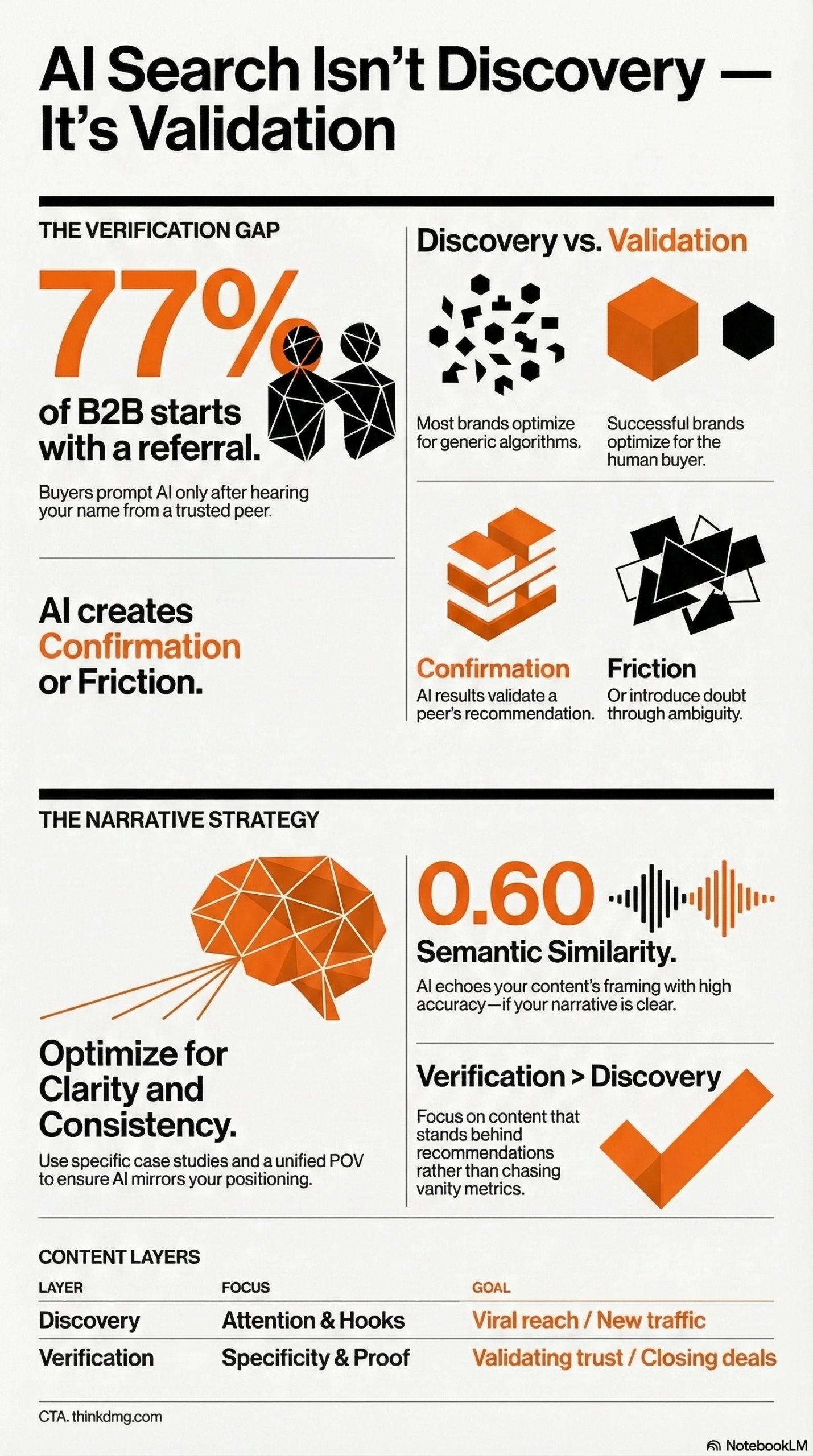
Gartner research shows that 77% of B2B purchases start with a network recommendation. A colleague mentions your name in a meeting. A peer forwards your newsletter with a note that says, “this is really good.”


Someone at a conference says “you should talk to these people.” The recommendation lands before the research begins.


Then the buyer goes home. Opens their laptop. And types something like:


“My colleague recommended [Your Brand]. We’re a mid-size SaaS company looking to expand into enterprise. Is this the right fit for us?”


Or:


“I’m choosing between [Your Brand] and [Competitor]. We’ve heard good things about both. What should I know?”


That is the moment your LinkedIn AI strategy either pays off or falls apart. Not when a stranger discovers you. When someone who was already told about you tries to verify the recommendation.


This is the prompt that converts. And it’s the prompt that almost no marketing team is building their content strategy around.


The Referral Is Already Half the Sale


When someone prompts AI about your brand after receiving a recommendation, the sale is already halfway made. The trust transfer has happened. The colleague put their own credibility on the line by making the recommendation. The buyer’s guard is lower than it would be for a cold discovery.


What AI says in that moment isn’t neutral research. It’s either confirmation or friction.


Confirmation looks like: AI surfaces content that reflects exactly the positioning your colleague described. The case studies match the use case. The thought leadership demonstrates the expertise that was promised. The brand narrative is consistent, confident, and specific. The buyer nods and moves forward.


Friction looks like: AI surfaces generic content that could describe any company in your category. Or content that contradicts the recommendation somehow — different positioning, different emphasis, a vague answer to a specific question. Or nothing particularly compelling at all. The buyer gets uncertain. The recommendation starts to feel less solid. The sales cycle gets longer or falls apart.


The irony is that most AI optimization advice would have you produce more content to solve this. More posts. More articles. More touchpoints. But quantity of generic content doesn’t close the gap. It can actually widen it — because more undifferentiated content gives AI more material to construct a generic description of your brand.

What closes the gap is clarity. Consistent, specific, differentiated content that says the same true things about your brand across every surface where AI will encounter it.

What AI Is Actually Learning About You

Here’s the mechanism worth understanding. When an AI model cites your LinkedIn content, Semrush research shows it mirrors the meaning of that content with roughly 0.60 semantic similarity. That’s a tight echo. Your framing becomes AI’s framing. Your language becomes AI’s language. Your positioning, as expressed in your content, is largely what AI will repeat.


This works in your favor if your content is clear, specific, and consistent. It works against you if your content is optimized for keywords rather than written from genuine expertise — or if it says slightly different things across different posts because you were chasing different trends at different times.


Think of AI as a student who has read everything you’ve ever published and is now being asked to summarize who you are and what you stand for. What does that student say? Is it the answer you want your buyers to hear?


Most brands, if they’re honest, don’t know the answer to that question. They’ve never actually prompted AI with the questions their buyers would ask. They’ve never compared the AI answer against their actual positioning. They’ve never asked: does what AI says about us support or undermine the recommendations our happiest customers are making?


That’s the audit you need to run before you publish another piece of content.

AI Search Is Validation Infographic

The Narrative Inventory: A Practical Audit

Before any content strategy conversation, run this audit across ChatGPT, Perplexity, and Google AI Mode. It takes about an hour and will tell you more about your AI content gaps than any keyword research tool.


Round 1: What Does AI Think You Are?


Start with simple identity prompts:

  • “What is [Your Brand]?”
  • “What is [Your Brand] known for?”
  • “Who are [Your Brand]’s typical customers?”
  • “What makes [Your Brand] different from competitors?”

Read the answers carefully. Are they accurate? Are they specific to you, or could they describe any company in your category? Do they reflect your current positioning or something you said three years ago? Are there misconceptions baked in that you’ve never directly addressed?


Write down what AI currently says. Then write down what you want AI to say. The gap between those two documents is your content strategy.


Round 2: What Does AI Say When You’re Being Compared?


This is the purchase-decision layer:

  • “[Your Brand] vs. [Competitor A]”
  • “[Your Brand] vs.
  • [Competitor B]”
  • “Best [category] for [your target customer type]”
  • “Is [Your Brand] right for [specific use case]?”


How do you perform in comparison? Are the differentiators AI cites the ones you actually want to compete on? Are there categories where a competitor has a clearer narrative than you — not because they’re actually better, but because their content has given AI more to work with?


Round 3: The Referral Prompt


This is the one most teams never think to run:

  • “My colleague recommended [Your Brand]. What should I know before talking to them?”
  • “I’ve heard good things about [Your Brand]. Is the reputation justified?”
  • “We’re considering [Your Brand]. What are the main reasons companies choose them?”

Read these answers as if you’re the buyer. Does what AI says make you more confident in the recommendation you received, or does it introduce doubt? Would you move forward after reading this? Would you feel like the recommendation was validated?


If the answer isn’t a clear yes, you have work to do. Not keyword work. Narrative work.

The Content That Closes Narrative Gaps

Once you’ve identified the gaps, the question is what to actually create. The answer isn’t more content — it’s more specific content.


Write for the Verification Moment, Not the Discovery Moment


Most LinkedIn content is written to attract attention — hooks, headlines, engagement bait, topics people are already searching for. That’s discovery-layer content, and it has its place.


But verification-layer content serves a different need. It’s the content someone reads after they’ve already heard your name. It needs to answer: Is this company what I think they are? Do they actually know what they’re talking about? Is the recommendation I received accurate?


Verification-layer content looks like:

  • Detailed case studies with specific numbers and named outcomes, not generic “we helped a client grow revenue” vague summaries
  • First-person perspective pieces where your actual point of view on a contested topic is clear — not “here are five perspectives” balance, but “here’s what we actually believe and why”
  • Documentation of your process, methodology, or framework in enough detail that a reader can assess whether it fits their situation
  • Direct, honest comparisons of when you’re the right choice and when you’re not — the brands that say “we’re not for everyone, here’s who we’re best for” earn more trust than the ones who claim universal applicability

This content doesn’t perform as well on vanity metrics. It doesn’t go viral. But it’s the content that closes deals — because it’s the content that stands behind the recommendation and says: yes, what you heard is true.

Consistency Is the Underrated Strategy


One of the quieter findings in the Semrush research is that about 75% of cited LinkedIn post authors published five or more times in the previous four weeks. The conventional reading of this is “post more often.” The more accurate reading is: consistency signals credibility.


AI systems are pattern matchers. When they encounter the same clear, specific position expressed across multiple pieces of content over time, they learn that position. When they encounter a brand that says different things at different times — pivoting narratives with trends, chasing different keywords in different seasons — they learn ambiguity. And ambiguity in your AI narrative is friction in the buyer’s verification moment.


Pick the three or four things your brand genuinely stands for. Say them clearly, consistently, and repeatedly. Let AI learn those positions. That is a more durable GEO strategy than any semantic optimization tactic.

The Trust Metrics That Tell You If It’s Working

If you shift your content strategy toward the verification moment and narrative consistency, your results won’t show up primarily in AI citation rate. They’ll show up in the metrics that actually precede revenue:


Branded search volume. When someone types your brand name directly into a search engine or AI, it’s because someone told them to. Growing branded search volume is the most reliable proxy for word-of-mouth health — the thing that creates the referral moment that creates the verification prompt in the first place.


Direct traffic. People who navigate directly to your site have already made a decision about you. They’re not discovering you — they’re following up on something. Growing direct traffic means your brand is living in people’s heads and DMs, not just in search results.


Conversion rate from AI-referred traffic. If you have the ability to segment AI-sourced visitors, watch their conversion behavior closely. Visitors arriving from AI citations after a referral prompt should convert at higher rates than cold discovery visitors. If they’re not, your narrative may be creating friction rather than resolving it.


Qualitative referral feedback. Ask your actual customers: “What did you find when you researched us before the first call?” If the answers consistently describe content you created, your narrative inventory is working. If they describe generic AI summaries that almost talked them out of the meeting, you know what to fix.

The Harder, Better Question

The industry spent the last decade optimizing for Google. The question was always: what does the algorithm want?


That question produced a lot of content. Pages and pages of it — keyword-targeted, structured, technically compliant, often minimally useful to the humans who landed on it.


Now the question has shifted to: what does AI want? And we’re at risk of making the same mistake, just faster and at higher volume.


The better question — the one that builds something worth building — is: what does the person who just heard my name need to find?


Answer that question honestly. Build content that answers it directly. Distribute that content across the trusted channels where AI will encounter it. Say the same clear, true things about your brand consistently over time.


That’s not an AI optimization strategy. It’s a brand strategy. And in 2026, those two things have become the same thing.


Download this PDF Winning the AI Verification Moment

Ready to Get Found in AI Search?

The strategy in this article works — but implementation requires expertise, consistency, and ongoing optimization. That's where we come in.

Get Your AI Visibility Audit →

The Harder, Better Question

The industry spent the last decade optimizing for Google. The question was always: what does the algorithm want?


That question produced a lot of content. Pages and pages of it — keyword-targeted, structured, technically compliant, often minimally useful to the humans who landed on it.


Now the question has shifted to: what does AI want? And we’re at risk of making the same mistake, just faster and at higher volume.


The better question — the one that builds something worth building — is: what does the person who just heard my name need to find?


Answer that question honestly. Build content that answers it directly. Distribute that content across the trusted channels where AI will encounter it. Say the same clear, true things about your brand consistently over time.

That’s not an AI optimization strategy. It’s a brand strategy. And in 2026, those two things have become the same thing.

This is Part 3 in thinkdmg.com’s series on LinkedIn, AI search, and the future of brand visibility.

Sources: Semrush LinkedIn AI Visibility Study (March 2026), Seer Interactive GEO Research (March 2026), Gartner B2B Buying Research.

Categories
Digital Marketing FAQs SEO SEO Strategies

Can LLMs.txt Help You Get Cited by ChatGPT, Claude, and Gemini?

There’s a moment most brands never see—but feel the impact of.

A prospect asks ChatGPT for recommendations.
Claude summarizes the best options.
Gemini explains the space with confidence.

And your brand isn’t mentioned.

No ranking report shows that loss. No traffic graph dips overnight. Yet the buying decision quietly moves forward without you. That’s the anxiety driving interest in LLMs.txt—and the big question behind it:

Can LLMs.txt actually help you get cited by ChatGPT, Claude, and Gemini?

The honest answer is more nuanced—and more useful—than most headlines suggest.

💡

This Is What We Do

Digital Marketing Group specializes in helping NJ businesses build AI search visibility — from initial audit through implementation and ongoing optimization. If this resonates, let’s talk about your situation.

Learn more about our AI Search Optimization program

Why AI Citations Matter More Than Rankings for Many Businesses

AI tools don’t just point users somewhere. They shape perception.

When an AI system names a brand, explains a concept, or recommends a provider, it does three things at once:

  • Establishes trust

  • Shortens the decision cycle

  • Narrows the competitive field

For service businesses, consultants, SaaS companies, and agencies, being cited can outperform ranking—because the buyer arrives pre-sold. In many cases, there’s no second click. The answer is the experience.

That’s why AI citations have become a new form of visibility—and why companies are racing to understand how they’re earned.

How ChatGPT, Claude, and Gemini Decide What to Cite

Here’s where assumptions usually break down.

AI systems don’t cite sources the way search engines rank pages. Instead, they look for signals that answer one core question:

“What source best represents accurate, trustworthy understanding of this topic?”

Those signals typically include:

  • Clear definitions and explanations

  • Consistent positioning across content

  • High-authority pages that reduce ambiguity

  • Structure that’s easy to summarize

They don’t reward:

  • Keyword density

  • Sheer volume of content

  • Clever tricks or hidden prompts

AI citation is less about optimization—and more about clarity plus credibility.

What LLMs.txt Can (and Cannot) Do for AI Citations

Let’s be direct.

What LLMs.txt Can Do

  • Help AI systems identify which pages matter most

  • Reduce confusion caused by thin or outdated content

  • Reinforce canonical explanations of your expertise

What LLMs.txt Cannot Do

  • Force ChatGPT, Claude, or Gemini to cite you

  • Override weak content or low trust signals

  • Act as a shortcut to authority

LLMs.txt is not a citation switch. It’s a clarity amplifier.

If your content is citation-worthy, LLMs.txt makes that easier to recognize. If it isn’t, LLMs.txt can’t manufacture trust.

Where LLMs.txt Fits in the AI Citation Stack


Where LLMs.txt Fits in the AI Citation Stack

Think of AI citation as a layered decision:

  1. Is this topic clear and well-defined?

  2. Is this source trustworthy and consistent?

  3. Is this page easy to summarize accurately?

  4. Does it align with other known signals?

LLMs.txt supports step one and two by:

  • Pointing AI toward authoritative pages

  • De-emphasizing content that muddies the signal

It works alongside—not instead of—other essentials like:

  • Structured data (FAQ, Article schema)

  • Strong internal linking

  • Clear author and brand signals

Why Some Brands Get Cited by AI (and Others Don’t)

Across AI tools, cited sources tend to share patterns:

  • They define concepts clearly

  • They avoid contradictions across pages

  • They explain why, not just what

  • They feel like reference material—not marketing copy

Many sites with “good SEO” still fail here. They rank, but they don’t explain. AI notices that difference immediately.

Key insight:
AI doesn’t cite the loudest brand—it cites the clearest one.

How LLMs.txt Improves Your Chances of Being Cited

This is where LLMs.txt earns its place.

By highlighting:

  • Core service pages

  • Pillar guides

  • Definitive explanations

…and de-prioritizing:

  • Thin blog posts

  • Utility pages

  • Content that no longer reflects your focus

…LLMs.txt helps AI systems answer the question:

“If I had to explain this company, where should I look?”

That alone can materially improve how—and whether—you’re referenced.

AI citation decision tree

LLMs.txt vs Other AI Citation Tactics

LLMs.txt works best when paired with:

  • FAQ schema → makes answers extractable

  • Entity consistency → reinforces brand understanding

  • Content hubs → shows depth without chaos

Used alone, it’s helpful. Used strategically, it’s powerful.

This is why many companies choose to hire an AI SEO or LLMO expert when citations become a revenue issue—not just a visibility experiment.

Real Scenarios Where LLMs.txt Makes the Biggest Difference

Real Scenarios Where LLMs.txt Makes the Biggest Difference

LLMs.txt tends to have the most impact when:

  • You offer complex or nuanced services

  • Your site has grown messy over time

  • AI tools summarize your industry inaccurately

  • You’re competing with better-known brands

If you’ve ever compared pricing, searched for the best AI SEO service near you, or noticed competitors being mentioned by AI while you’re not—this is often one of the missing pieces.

Common Myths About LLMs.txt and AI Citations

“LLMs.txt guarantees citations.”
False. It improves clarity, not authority.

“AI figures it out anyway.”
Sometimes. Often incorrectly.

“Only huge brands get cited.”
Not true. Clear, focused brands frequently outperform bigger names.

Believing these myths is how brands stay invisible while thinking they’re “covered.”

What to Do If AI Citations Are a Business Priority

If citations matter, the strategy looks like this:

  1. Build genuinely authoritative, helpful content

  2. Structure it for summarization

  3. Reinforce clarity with LLMs.txt

  4. Align everything under an LLMO framework

At that point, bringing in a specialist to book a consultation, compare pricing, or get a quote for AI-focused SEO often becomes a practical next step—not a leap of faith.

Key Takeaways: LLMs.txt Helps—but Only If the Foundation Is Right

  • LLMs.txt does not guarantee citations

  • It does reduce ambiguity that blocks citations

  • AI cites what it understands and trusts

  • Brands that guide interpretation outperform brands that hope

If AI systems are shaping how buyers learn about your market, clarity isn’t optional anymore.

Ready to Improve Your Chances of Being Cited?

If you want AI tools to reference your brand accurately—and consistently—now is the time to act.

  • Speak with an AI SEO or LLMO specialist now

  • Get your personalized AI visibility plan

  • Start your project today and protect your brand narrative

The brands AI cites tomorrow are the ones that guide it today.

Categories
Digital Marketing FAQs Digital Marketing for Small Business SEO Strategies

The Digital Marketing Cheat Sheet Every South Jersey Business Owner Needs

Running a business in South Jersey comes with a lot tasks. One day you’re a business owner. The next you’re the marketer, accountant, manager, and IT whiz. But, as an owner, you may end up wearing one too many hats and find yourself unable to focus on what matters most: running your business. If there’s one hat you can cast off, it’s that of the digital marketer. Whether you’re in Cherry Hill, Medford, Voorhees, or right here in Marlton, this digital marketing cheat sheet breaks down the exact digital moves that drive real visibility, engagement, and revenue.


📌 Key Takeaways

  • ✅ South Jersey businesses need unique digital plans that match local demand and regional overlap.
  • ✅ A mobile-friendly website and Google Business Profile are must-haves for local visibility.
  • ✅ Use local SEO with town-specific keywords and service-focused content to rank effectively.
  • ✅ Drive traffic using geo-targeted ads, social content, and email/text campaigns.
  • ✅ Stick to a digital rhythm with weekly, monthly, and quarterly marketing actions.


Why South Jersey Businesses Need Unique Digital Game Plans

We’re not NYC. We’re not Philly. South Jersey businesses live in a “local-but-competitive” zone. Consumers here want local charm, but they expect digital sophistication. Your competitors might not even be in your ZIP code—they could be five miles across the bridge.


South Jersey is a unique community, one that thrives locally and also by commuting to places like Philadelphia, Wilmington, and New York City. In other words, you need to be able to compete on all fronts.


Here’s some other reasons South Jersey businesses need customized digital game plans:


  • Communities are tight-knit, relying on both word-of-mouth and searches
  • Tourists blend with locals during seasonal surges
  • A dense service economy with hyper-local competition


One-size-fits-all marketing? Yeah, that won’t work here.


How to Win at Digital Marketing in South Jersey

Our digital marketing cheat sheet has everything you need to win at digital marketing in South Jersey. Let’s take a look at two key things that need to be done to elevate your rank, getting you seen in the location you want.


1. Build Your Foundation First

You want a website that functions well, providing customers with a good user experience (UX). Think simple web design that’s easy to navigate. A chatbot to answer questions when a real representative can’t be online. FAQs. Testimonials. A fleshed out mission and story to show people that your business is real and working for something.


You also want to prioritize the following:


A Fast, Mobile-Friendly Website

Think of your website like your storefront on Route 73—it needs to load fast and work beautifully on any device. Google favors mobile speed. So do customers. Make sure your website can load in under 3 seconds, is mobile-responsive, and contains clear calls-to-action. “Schedule your consultation today,” “shop now,” and “get an estimate” are all actionable steps that guide a user down the sales funnel.


Google Business Profile (GBP)

It’s the single most valuable free marketing tool you have. An optimized GBP helps you show up in “near me” searches and Google Maps. Make sure you’re using local keywords in your description. Add updated photos monthly. Furthermore, collect and respond to reviews—both good and bad—regularly.

    “DMG transformed our local visibility in under 90 days. We didn’t just rank—we grew.”

— Susan G., Owner, Medford Wellness Center

Ready for real growth? Book your South Jersey audit now.


Local SEO for South Jersey Searches

When someone Googles “plumber in Cherry Hill” or “Marlton hair salon open now,” are you visible? That’s where local SEO comes in. If you want to win at local SEO, make sure you’re publishing South Jersey-focused content, including pages and blogs. Mention places in South Jersey. Attune your content to every location you serve.


You can do this by adding keywords like “digital marketing in Marlton, NJ” or “South Jersey small business SEO.” Lastly, clean internal links and create proper schema markups.


2. Get Found: Traffic-Driving Tactics That Work

Once you have a solid foundation, it’s time to start using local SEO and other tactics to drive people to your website.


Paid Search

The first method is paid search using Google Ads. Run geo-targeted ads that are limited to your town, county, or service radius. Combine with bottom of the funnel keywords like “hire a roofer in Marlton,” for example, to encourage people to convert.


Local Social Media

Facebook and Instagram are powerful tools that help you spread a localized message. Showcase your staff, customer stories and user-generated content, and promotions specific to South Jersey holidays and events.


Email & Text Campaigns

Don’t underestimate SMS or a good old-fashioned newsletter. Offer a seasonal discount, free consultation, or early access.


The Digital Marketing Cheat Sheet for South Jersey Businesses: What to Do and When

This digital marketing cheat sheet gives you insight into what to do and when:


Weekly

  • Post on Google Business—photos, updates, and more
  • Share one local-focused Instagram or Facebook update
  • Respond to reviews and comments


Monthly


Quarterly

  • Analyze ad ROI and website traffic
  • Refresh content with seasonal updates
  • Launch a lead magnet or promo tied to school breaks, holidays, or South Jersey events


💬 Frequently Asked Questions

Do I really need a digital marketing strategy specific to South Jersey?

Yes. South Jersey has its own blend of local charm and regional competition. A one-size-fits-all plan won’t work—your strategy should reflect the community and the surrounding metro areas.

How important is my Google Business Profile?

It’s critical. An optimized GBP helps you show up in “near me” searches and builds trust through reviews, photos, and local information.

How often should I update my website or content?

Weekly posts, monthly blogs, and quarterly content refreshes are ideal. Staying consistent keeps you visible and relevant in search results.

Can I manage my digital marketing in-house?

You can, but it’s time-consuming and requires expertise. Many South Jersey business owners partner with local agencies like ThinkDMG to focus on growth without the stress.

What if my website isn’t mobile-friendly?

You’re likely losing traffic. Over half of all local searches happen on phones. A mobile-optimized site helps you convert visitors into leads faster.


Digital Marketing Cheat Sheet: Partner with ThinkDMG

We’re not a faceless agency across the country. We’re your neighbors. Located in Marlton at Five Greentree Centre, ThinkDMG (Digital Marketing Group LLC) understands what it takes to help South Jersey businesses grow.


From SEO to paid ads, content strategy to CRO, we tailor strategies that actually work in this region—because we live and work here too.


No more guessing. Let’s get you ranked on Google and driving consistent leads ASAP.


Put Your Business on the Local Map

Get a free digital strategy session with South Jersey’s leading local marketing team. We’re here to make you visible—and profitable.

  Book Your Free Audit

Categories
Digital Marketing FAQs Digital Marketing for Small Business Digital Marketing Trends

Can’t Afford a Big Agency? You Shouldn’t Have To

When Marketing Costs Too Much; and Delivers Too Little

Running a business in South Jersey is tough enough. You’re managing clients, employees, and day-to-day operations, yet still expected to master digital marketing. So, you look for help. And what do you find?

Big agencies. Bigger promises. Even bigger price tags.

Here’s the truth: most small and mid-sized businesses don’t need the $5,000/month retainers and bloated teams. What they really need is strategy, focus, and accountability. At Digital Marketing Group LLC, we believe you deserve performance without the premium price—and we’re here to make that possible.

💡 Big Strategy, Small Budget? Yes, It’s Possible.

At Digital Marketing Group LLC, we give South Jersey businesses a better choice: expert marketing strategy without inflated pricing. Our approach is lean, local, and laser-focused on what actually moves the needle.

The Hidden Cost of Hiring Big

You’re Not Paying for Strategy; You’re Paying for Size

Big agencies often charge for:

  • Multiple account managers

  • Fancy offices

  • Endless Zoom meetings

  • A long chain of approvals

That overhead? It shows up on your invoice, not necessarily in your results. You might be one of 80 clients, each getting the same templated approach with different logos slapped on top.

🚩 Signs It’s Time to Rethink Your Big Agency

  • 💰 Paying for services you don’t fully understand
  • 📉 Seeing flat or unclear results after months
  • 📞 Getting passed between account managers
  • 🧾 Receiving vague or inflated invoices

Hint: If you feel like you’re overpaying and underperforming, it’s time to talk to DMG.

The Real Problem? Disconnected, One-Size-Fits-All Tactics

Without personalized attention, small businesses get lost in the shuffle. Messaging feels off. Campaigns feel generic. Worst of all? You’re spending money without seeing real leads, rankings, or revenue.

What Budget-Conscious Businesses Actually Need

Forget the hype. You don’t need to “go big”, you need to go smart.

Here’s what truly moves the needle for South Jersey businesses:

  • Local SEO that gets you on Google Maps for “best [service] near me”

  • Fast websites that load quickly and convert visitors into customers

  • Clear messaging that speaks your customer’s language

  • Integrated strategy, so your SEO, ads, social, and email all work together

That’s what Digital Marketing Group LLC delivers. Strategy without the sales fluff. Precision without the premium.

Meet DMG: The South Jersey Agency Built for Business Owners Like You

At Digital Marketing Group LLC, we know what it’s like to wear multiple hats, and still expect results. That’s why we:

  • Tailor every plan to your budget and goals

  • Communicate clearly, you’ll never wonder what’s happening or why

  • Track everything, so you know exactly what your investment is doing

Our local-first approach means we work with you, not just for you. Whether you’re in Marlton, Medford, Cherry Hill, or Voorhees, you’ll get a team that understands your community, your competition, and your challenges.

DMG in Action: More for Less

Case Study: Cherry Hill Landscaping Company

  • Challenge: Paying $4,200/month to a large Philadelphia agency, with little transparency or ROI

  • DMG Strategy: Rebuilt their website for speed and SEO, integrated local search ads, aligned messaging across web, social, and email

  • Results in 90 Days:

    • 34% increase in leads

    • 48% decrease in cost-per-click

    • Monthly savings of over $2,000

Now, they get more qualified leads and a cohesive brand—at less than half the price.

The Power of Integrated Marketing (Without the Agency Overhead)

Big agencies often treat SEO, PPC, content, and social media like separate services. That means fragmented efforts and wasted ad dollars.

At DMG, we take a full-funnel view. Your blog supports your ads. Your website reinforces your emails. Every channel builds momentum together.

That’s the beauty of integrated strategy, something most big agencies charge extra to even consider. We bake it in from day one.

❓ Frequently Asked Questions

Can small businesses afford real marketing strategy?

Absolutely. With DMG, you get tailored strategies that fit your goals and your budget—no upsells, no fluff.

How does DMG compare to a traditional agency?

We’re leaner, faster, and more personal. Instead of layered teams and long timelines, you get direct access and focused execution.

Will a cheaper service hurt my brand?

Not when it’s done right. Our strategies prioritize results—not bells and whistles. You get performance, not promises.

👋 Talk to a local expert and compare the difference for yourself.

When to Walk Away from a Big Agency

If you’re currently working with a large agency—or considering one—watch out for these red flags:

  • You’re just a number, not a priority

  • You’re locked into long-term contracts with no flexibility

  • You’re confused about what you’re paying for, or why results are stalling

  • You’re paying for services you don’t need (or don’t understand)

Marketing should be clear. It should build your brand. And it should work within your budget, not bury it.

What You Really Get with DMG

  • A custom strategy, not a cookie-cutter package

  • Integrated campaigns that tie together SEO, ads, web, and content

  • Hands-on support from a real team who knows your name, and your goals

  • No red tape, just clarity, execution, and results

Final Word: Big Results Shouldn’t Require Big Budgets

At Digital Marketing Group LLC, we work with small businesses, solo entrepreneurs, and lean teams across South Jersey who want to grow, without being gouged.

We believe you shouldn’t have to choose between affordability and effectiveness.

Let’s prove it.
Book your free strategy session now
Or talk directly with a specialist who understands your market, and how to win in it.

🚩 Signs It’s Time to Rethink Your Big Agency

  • 💰 Paying for services you don’t fully understand
  • 📉 Seeing flat or unclear results after months
  • 📞 Getting passed between account managers
  • 🧾 Receiving vague or inflated invoices

Hint: If you feel like you’re overpaying and underperforming, it’s time to talk to DMG.

Categories
Digital Marketing FAQs Digital Marketing for Small Business Digital Marketing Trends Marketing SEO SEO Strategies

On-Page SEO Tips for South Jersey Businesses: Get Found Locally with Ease

Introduction: The Local SEO Struggle Is Real

You’re the best at what you do in Cherry Hill, Marlton, or Medford, but your competitors keep showing up first on Google. It’s not about luck. It’s about local on-page SEO, the single most powerful lever South Jersey businesses can pull to rank higher, earn clicks, and get found fast by ready-to-buy customers.

📍 Why Local On-Page SEO Matters in South Jersey

When someone searches “best HVAC in Marlton” or “Cherry Hill pet groomer near me,” they’re ready to act. Strong on-page SEO ensures your business is who they find first. Title tags, meta descriptions, image alt text, and internal links all tell Google you’re the trusted local solution.

Why On-Page SEO Matters for South Jersey Businesses

Local Searches Come with High Intent

People searching “HVAC repair in Marlton” or “best pizza near me in Voorhees” are ready to call, visit, or book today. On-page SEO puts your site front and center for these exact, high-converting searches.

You Control the Signal

Unlike backlinks or reviews, on-page SEO is fully under your control. Every word, tag, and image sends a signal to Google that says: We serve South Jersey, and we’re the best at what we do.

✅ On-Page SEO Checklist for South Jersey Businesses

  • 🏷️ Title tag includes service + town
  • 📝 Meta description that builds trust
  • 🔠 H1–H3 headings with local terms
  • 🧩 Schema markup for location & services
  • 📷 Alt text with South Jersey context
  • 🔗 Internal links between core pages
  • 🔍 Clean, keyword-rich URLs

Title Tags & Meta Descriptions: Your First Impression

Your title tag is what shows up in Google’s results—it’s your headline. Your meta description is your 160-character pitch.

Tips:

  • Include town + service: “Affordable Roofing in Medford, NJ”

  • Use power verbs: “Call Now,” “Rated 5-Stars,” “Serving South Jersey”

  • Write for curiosity + trust: “Local plumbers with 24/7 service & real reviews”

📌 Example:
Title: “Best South Jersey Electricians – Fast Service in Cherry Hill & Marlton”
Meta: “Need an electrician you can trust in South Jersey? Get same-day service and see why we’re rated 5 stars in Cherry Hill & Marlton.”

Use Local Keywords in Headings & Content

Headings (H1, H2, H3) guide both readers and search engines. Make them count.

H1: “Expert Landscaping Services in Marlton, NJ”
H2: “Why Homeowners in Medford Trust Us”
H3: “Backyard Renovation Near Greentree Road”

Sprinkle in landmarks, zip codes, or neighborhood names to give Google even more local context.

Master Local Schema & Internal Linking

Add Local Schema

Schema markup tells Google specifics your address, hours, reviews, and more. It helps you appear in local map packs and enhances your business listing.

Link Internally with Strategy

Link your homepage to service pages, your services to testimonials, and all pages to your contact page. It keeps users engaged and shows Google your site structure.

Images, Alt Text, and URL Structure

Alt text example: “Residential deck installation in Marlton by NJ Deck Pros”
File name: marlton-residential-deck.jpg
URL: /deck-installation-marlton/ not /page123/

Image SEO boosts accessibility, mobile speed, and local relevance.

🚀 Want to Dominate Local Search in South Jersey?

Digital Marketing Group LLC specializes in on-page SEO that gets South Jersey businesses found fast—from Cherry Hill to Marlton and beyond.

Book Your Free Local SEO Audit

Avoid These On-Page SEO Mistakes

  • Don’t stuff keywords; you’ll hurt your readability and rankings.

  • Don’t forget mobile optimization—over 70% of local searches come from mobile devices.

  • Don’t duplicate content—each location page needs original content, even if services are similar.

Final Takeaway: Local SEO Isn’t Optional It’s Your Edge

With just a few key on-page tweaks like adding town names to headers, writing real meta descriptions, using internal links, and marking up your location, you can rank above bigger competitors and connect with more local customers.

Let’s Optimize Your Site Together

At Digital Marketing Group LLC, we help South Jersey businesses rank higher and convert better with local-first on-page SEO strategies. Whether you’re in Cherry Hill, Medford, or right here in Marlton, we’re ready to help you rise to the top.

👉 Book your free South Jersey SEO audit today
📞 Or call us now to talk with a local expert who understands your market—and how to win in it.

❓ Common On-Page SEO Questions from South Jersey Business Owners

Do I really need to include my town name in every page title?

Yes. Google prioritizes hyperlocal relevance. Including your town and service name helps you appear for nearby searches.

What’s the difference between on-page and local SEO?

On-page SEO includes everything you control on your website—content, tags, images. Local SEO expands into reviews, citations, and your Google Business Profile.

How can I tell if my current SEO is working?

Check your rankings for “service + town” keywords. Use tools like Google Search Console or get a free audit from DMG to find hidden gaps.

Can I improve SEO myself or do I need help?

You can start the basics, but a pro can unlock bigger wins faster—especially with schema, page structure, and technical SEO.

Need expert insights? Schedule a local SEO consult with DMG.

Categories
Digital Marketing FAQs Digital Marketing for Small Business Digital Marketing Trends Marketing SEO SEO Strategies

How to Speed Up Your Website for Better SEO and User Experience in Marlton

🚀 27% More Conversions with Just 2.4s Faster Load Time

A Marlton-based retail business boosted its conversion rate by 27% after shaving just 2.4 seconds off its page load time. Faster truly means better.

Why Site Speed Is a Silent Business Killer

Imagine this: a local Marlton customer searches “best [your service] near me,” clicks your link… and waits. And waits. In just three seconds, they’re gone—off to your faster competitor.

That pause? It’s costing you leads, revenue, and Google rankings.

Speed isn’t just about user experience anymore—it’s a core part of SEO success. For small businesses in South Jersey, a slow website is like a beautiful storefront with a broken door.

🔍 Quick Summary

How to Speed Up Your Website for Better SEO and User Experience in Marlton

Website speed is critical for both search rankings and user retention—especially in competitive local markets like Marlton, NJ. Slow sites drive potential customers away, hurt SEO, and lower conversions. By optimizing images, using caching and CDNs, cleaning up code, and choosing performance-focused hosting, local businesses can significantly boost site speed.

Digital Marketing Group LLC offers expert speed audits and optimizations tailored for South Jersey businesses.

👉 Book your free audit now and give your website the speed—and visibility—it deserves.

Why Website Speed Matters for Marlton SEO

Speed = Trust in Local Search

Google studies show that 53% of mobile visitors leave if a page takes longer than 3 seconds to load. And in a market like Marlton, where competition is strong and trust is everything, those first impressions are non-negotiable.

Core Web Vitals: Google’s Performance Scorecard

Google’s Core Web Vitals measure:

  • LCP (Largest Contentful Paint) – should load in under 2.5 seconds

  • INP (Interaction to Next Paint) – under 200 milliseconds

  • CLS (Cumulative Layout Shift) – keep it under 0.1

Sites that meet these thresholds are rewarded with higher rankings and visibility in the local map pack.

How to Diagnose Your Website Speed

Use Free Tools Like:

These platforms reveal your load time, mobile issues, and how well you score on Core Web Vitals.

🛠️ Speed Optimization Checklist

  • ✅ Compress all images (prefer WebP format)
  • ✅ Use caching and a CDN like Cloudflare
  • ✅ Minify and defer unused JavaScript
  • ✅ Optimize Core Web Vitals (LCP, INP, CLS)
  • ✅ Choose high-performance hosting

Tip: Test Your Site on Mobile First

Over 70% of local search traffic is mobile. If your Marlton business website loads slowly on a phone, you’re missing your best chance to convert.

How to Fix a Slow Website (No Developer Needed)

1. Compress Your Images

Big images = big delays. Use tools like TinyPNG or Squoosh to shrink file sizes. Use WebP for best performance.

2. Use Caching & a CDN

CDNs like Cloudflare store your content closer to the user. Caching plugins like WP Rocket dramatically cut load times.

3. Clean Up Code

  • Minify HTML, CSS, and JavaScript

  • Defer scripts that aren’t critical

  • Remove unnecessary plugins and themes

4. Choose Smart Hosting

Shared hosting might be cheap, but it’s slow. Consider managed WordPress hosting or a regional provider optimized for South Jersey traffic.

For WordPress and Shopify Sites in Marlton

WordPress Optimization Tips:

Shopify Tips:

  • Optimize homepage image sizes

  • Limit third-party app usage

  • Enable lazy loading in theme settings

Marlton Case Study: Speed Wins

A boutique clothing shop in Marlton had a 7-second mobile load time. After:

  • Compressing images

  • Installing WP Rocket

  • Switching to a better host

…their site loaded in 4.6 seconds. The result? 27% higher conversions and a 32% drop in bounce rate within 30 days.

SEO Benefits of Speed You’ll Actually Feel

  • Lower bounce rate = More visitors stay and explore

  • Faster crawling = Google indexes more of your pages

  • Mobile-first boost = Better performance in “near me” searches

When your site is fast, your traffic sticks. And when traffic sticks, Google notices.

⏱️ Ready to Speed Up Your Site?

Digital Marketing Group LLC helps Marlton businesses improve SEO, reduce bounce, and drive conversions with expert-level site speed audits and fixes.

Get Your Free Speed Audit

Ready to Take Action?

Digital Marketing Group LLC, based right here in Marlton at Five Greentree Centre, specializes in making local business websites faster, leaner, and SEO-supercharged.

Want to get more calls, rank higher, and stop losing leads to slow load times?

Book your free speed audit now
Or call to speak with a Marlton-based website speed expert today.

❓ Website Speed FAQs from Marlton Business Owners

How fast should my website load?

Ideally under 2.5 seconds. Anything above 3 seconds increases bounce rates and hurts SEO rankings.

Does hosting affect site speed?

Absolutely. Local Marlton businesses often struggle on budget shared hosting. Upgrading to managed or cloud hosting can drastically improve performance.

How do I check if my website is slow?

Use free tools like Google PageSpeed Insights or GTmetrix. They show load times, mobile issues, and Core Web Vitals performance.

Is speed a Google ranking factor?

Yes. Google uses Core Web Vitals as official ranking signals. Faster, better-performing sites appear higher in search results.

Want answers personalized to your business? Speak with a speed optimization expert at DMG.

Categories
Brand Building Digital Marketing FAQs Digital Marketing for Small Business Digital Marketing Trends Generative Engine Optimization Marketing

The Role of Local Reviews in Boosting Your South Jersey Business’s Online Presence

You’re investing in your website, social media, and maybe even some local ads, but the calls aren’t coming in. Meanwhile, a competitor down the street with half your experience is blowing up. Why?


The answer might be sitting right under your nose: local reviews.


In Cherry Hill, Medford, Marlton, and across South Jersey, reviews are the new currency of trust. And for small businesses, they don’t just impact credibility, they influence visibility, SEO rankings, and ultimately, revenue.


⭐ 34 Reviews = 21% More Calls

A Cherry Hill HVAC company saw a 21% increase in calls within 90 days after earning just 34 new reviews. Local proof. Real growth.

Why Local Reviews Matter More Than Ever

Word-of-Mouth Has Gone Digital


In communities like South Jersey, where people still rely on neighbors’ recommendations, local reviews have become the modern version of “ask around.” But unlike word-of-mouth, reviews live forever and reach far beyond your immediate network.

  • 73% of customers trust a business more after reading positive reviews.

  • 86% won’t even consider a local business with a low rating.

Google Favors Businesses With Real Reviews

Whether someone searches “best plumber in Voorhees” or “Marlton coffee near me,” Google uses reviews to decide who shows up first in the Local Pack. The more positive, recent, and keyword-rich your reviews are, the better your odds.

📋 Smart Review Strategy Checklist

  • ✅ Ask at the right time (after service or sale)
  • ✅ Use email, text, and QR codes
  • ✅ Focus on Google, Facebook, and Yelp
  • ✅ Respond to all reviews (positive and negative)
  • ✅ Embed top reviews on your website and emails

The SEO Impact of Local Reviews

Keywords and Context = Ranking Signals

When customers naturally include phrases like “great HVAC service in Cherry Hill” or “affordable haircuts in Medford,” they’re feeding Google exactly what it needs—contextual, hyperlocal SEO signals.

Google Maps Prioritizes Recency & Response

It’s not just about volume. Google rewards:

  • Recency (fresh reviews in the last 2–4 weeks)

  • Consistency (steady growth, not sudden bursts)

  • Engagement (owners who respond to reviews)

Every review you earn becomes part of your content strategy—without lifting a finger.

Real South Jersey Review Wins

Cherry Hill HVAC Case

An HVAC company saw a 21% increase in phone calls after earning 34 new reviews in three months, without changing anything else.

Medford Café’s Growth

By simply adding QR codes to receipts asking for reviews, a local café doubled its Google visibility and became a go-to for “best breakfast near Medford.”

The Star Rating Gap

In saturated industries, a 4.7★ business will generate 2–3x more clicks than a 3.8★ listing—even if the lower-rated business ranks higher.

How to Earn & Manage Reviews Like a Pro

Ask Strategically, Not Desperately

Use language like:

“Would you mind sharing your experience on Google? It helps other locals find us.”

Deliver it via:

  • Email follow-ups

  • SMS after service

  • Printed cards or QR codes at checkout

Focus Where It Counts

For South Jersey, the platforms that convert are:

  • Google Business Profile (top priority)

  • Facebook (especially for service and event-based businesses)

  • Yelp (strong in food and healthcare niches)

Respond to Every Review (Yes, Even the Bad Ones)

Responding shows Google you’re active and helps build trust. Keep it professional, empathetic, and human.

Review Mistakes That Hurt Your Presence

  • Ignoring reviews = lost trust

  • Buying fake reviews = Google penalties or suspensions

  • No system in place = random results and lost momentum

Local consumers are savvy. They can smell a fake—and so can Google.

Turn Reviews into Real Conversions

Feature Your Reviews

  • Use Google review embeds on your homepage

  • Create “What Customers Are Saying” sliders or quote blocks

  • Add review snippets to email campaigns and ads

“Best Near Me” Is the Endgame

When someone says, “Hey Siri, find the best dentist near me,” your business needs to be the answer. Reviews help you get there.

Final Takeaway

You don’t need hundreds of reviews—you need the right 30–50 from real locals who trust you. Combined with smart SEO and visibility tactics, those reviews can do what no ad ever could: build real, lasting credibility.

Your Next 5-Star Review Starts Here

Let Digital Marketing Group LLC help you build a review strategy that attracts more local customers and ranks you higher on Google.

Book Your Free Reputation Audit

Want to Own Your Reputation?

Let Digital Marketing Group LLC help you build a review strategy that:

  • Drives real traffic

  • Boosts local rankings

  • Converts browsers into buyers

📍 Serving all of South Jersey from Five Greentree Centre in Marlton, NJ

👉 Book Your Free Local Reputation Audit Now
📞 Or call (856) 242-8278 to speak with a local expert today.

❓ Frequently Asked Questions About Reviews

How many Google reviews do I need to rank locally?

There’s no magic number, but most South Jersey businesses see results with 25–50 quality, recent reviews. Quality and recency matter more than quantity alone.

Should I pay for reviews or offer discounts?

No. Google forbids incentivized reviews and can penalize your listing. Instead, ask genuinely after a great service moment.

Where should I ask for reviews—Google, Facebook, or Yelp?

Start with Google for local SEO impact, then diversify. Facebook works well in retail and services. Yelp is strong in food and healthcare.

How often should I ask for reviews?

Consistently—weekly if possible. Set up systems to ask automatically after transactions or appointments.

Still unsure what’s hurting your local visibility? Speak with a local strategist now.