
The proposal says “$1,000 a month in Google Ads.” Three months later, you’ve paid $6,000.
Nobody lied. The $1,000 was the ad spend. The other $3,000 was management, software and a landing page, and it was on page three of the proposal.
A marketing budget is everything it takes to create, run, measure and answer your marketing, not just what goes to Google or Facebook. Here is how to see the full number before you sign.
Quick answer
Besides ad spend, a marketing budget should include management fees, content and photos, website or landing page work, tracking, software and the time it takes to answer leads. List one-time costs and monthly costs separately. Then compare every proposal by its total, not its ad budget.
The seven costs inside every marketing plan
Every plan has some version of these seven. Not every business needs all of them, but every proposal should tell you which ones are in, which are extra and which you already pay for.
| Cost | What it is, in plain words | Question to ask |
|---|---|---|
| Media (ad spend) | Money that goes straight to Google, Meta or another platform for ads | How much of my monthly payment goes to the platform itself? |
| Management | The person or agency that sets up, watches and adjusts the ads or SEO work | What work is included each month, and what costs extra? |
| Production | Writing, photos, video and ad designs | Who creates them, and how many revisions are included? |
| Website work | New landing pages or changes to your site | Is page work included, a separate quote, or not needed? |
| Measurement | Call tracking, form tracking and reports | How will I know which leads came from this, and what does that cost? |
| Software | Tools for scheduling, email, reviews or lead tracking | Which tools are new, and which do I already pay for? |
| Response | The people who answer calls and forms and follow up | Who answers new leads, and how fast? |
For content marketing work, ask what the first round of content costs and what keeping it current costs after that. For a website project, separate the build from monthly hosting and support. And for every line, ask one more question: what happens to this cost if we pause?
Meet Example Family Dental: a $1,000 plan that costs $2,000
Example Family Dental is fictional: the practice, its proposal and every number. It’s here to show the method, not typical pricing.
Example Family Dental is a two-dentist practice in Cherry Hill. It wants more new patients for cleanings and clear aligner consults. An agency sends a proposal headlined “$1,000 a month in Google Ads.” The office manager reads every page and finds this:
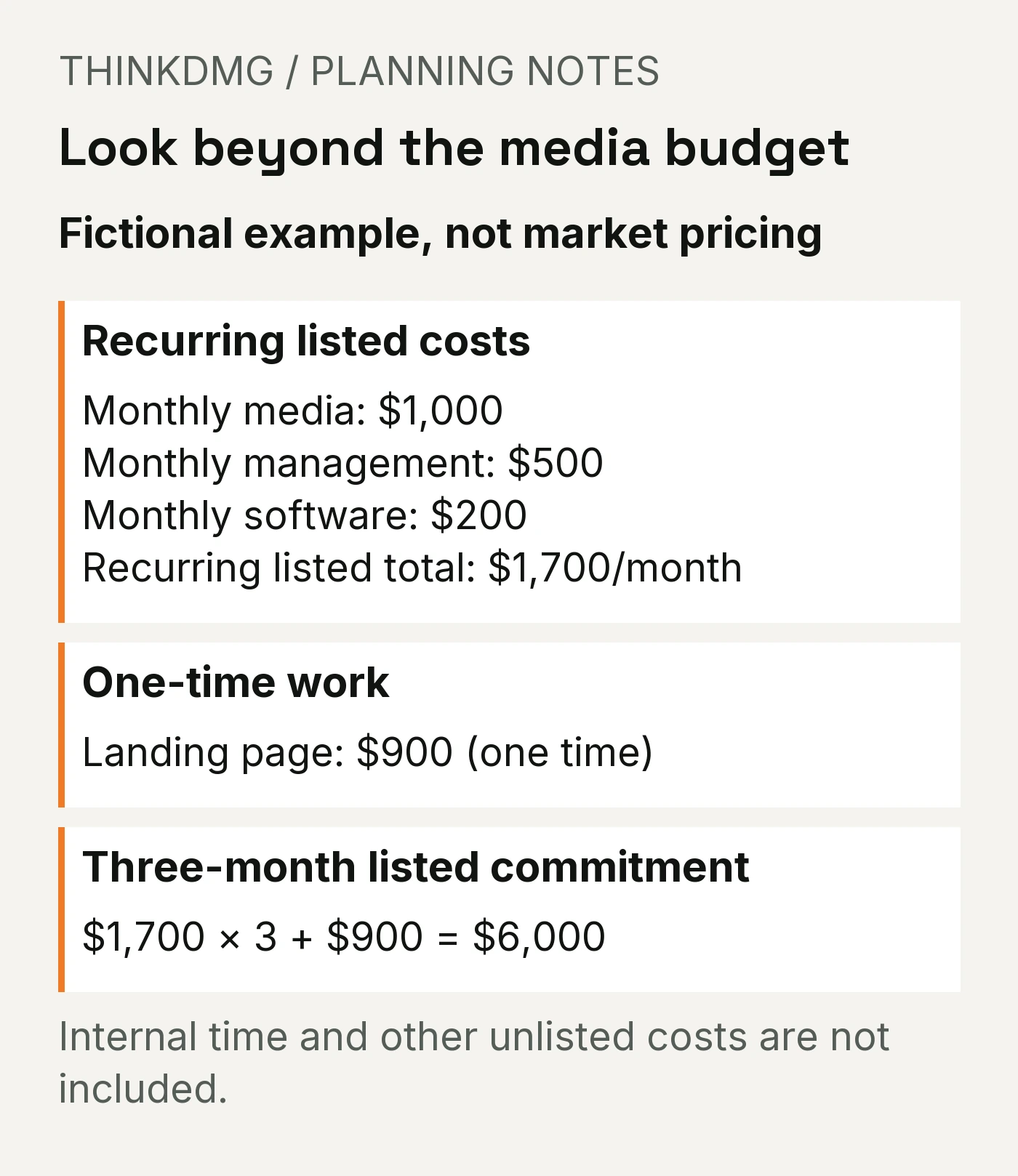
| Line in the proposal | Monthly | One time |
|---|---|---|
| Google Ads spend | $1,000 | |
| Management fee | $500 | |
| Call tracking and reporting software | $200 | |
| New-patient landing page | $900 | |
| Total | $1,700 | $900 |
Over the three-month trial the agency suggests, the math is:
- $1,700 a month × 3 months = $5,100
- Plus the $900 page, paid once = $6,000 total
- Ad spend alone over the same three months = $3,000
The headline number covers half of what the practice will actually pay.

None of this makes the proposal bad. A $900 page built for new patients and real call tracking are both worth having. The problem is only comparing it with another agency’s “$1,000 a month” that doesn’t include them.
The cost that isn’t on the proposal at all
The ads will make the front desk phone ring more. Someone has to answer, book and follow up.
Say the front desk spends five extra hours a week on new-patient calls. Receptionists in the Philadelphia-Camden-Wilmington area earned a mean of $18.81 an hour in May 2025, according to the U.S. Bureau of Labor Statistics. Five hours a week at that rate is about $94 a week, or roughly $408 a month in wages, before payroll taxes.
Here’s the part that matters: if the receptionist is already on the clock and has the time, that’s not a new bill. It’s time you’re already paying for. Track it separately so you don’t count the same paycheck twice. But if the extra calls mean overtime, a part-time hire or missed calls, it becomes a real cost, and it belongs in the budget.
Costs owners forget
These are lines that are easy to miss until after the contract is signed. Check each one: included, extra or already paid? This is ThinkDMG’s planning checklist, and no prices are listed because they vary too much to be useful.
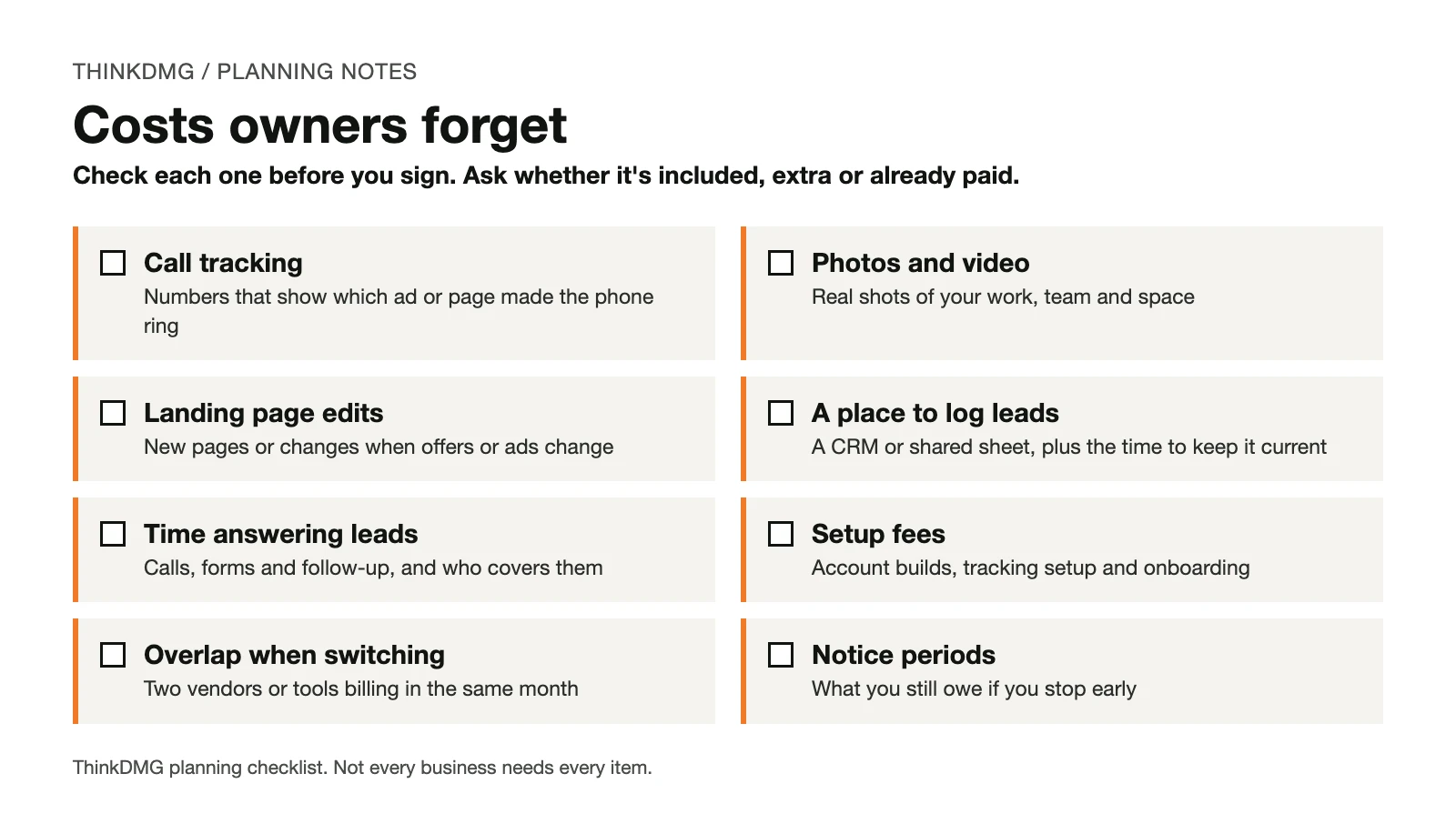
- Call tracking. Special phone numbers that show which ad or page made the phone ring. Without them, you are guessing.
- Photos and video. We recommend real photos of your work, team and space over stock images. That means paying for a shoot.
- Landing page edits. Every new offer or season means page changes. Ask who makes them and whether they are billed by the hour.
- A place to log leads. A CRM (customer tracking software) or a shared spreadsheet, plus the time to keep it updated.
- Time answering leads. See the front desk math above.
- Setup fees. Building ad accounts, installing tracking and onboarding are often billed once, up front.
- Overlap when switching. If you change agencies or tools, you can pay both for a month.
- Notice periods. What you still owe if you stop early. Read the cancellation terms before you sign.
Don’t count the same dollar twice
Here’s a mistake that runs both ways. If your website hosting and current agency fee are already in your monthly costs, and you subtract them again as if they were new, your budget looks smaller than it is. If you forget a cost that really is new, your budget looks bigger than it is.
The fix is to label every line one of three ways:
| Label | Means | Example |
|---|---|---|
| Already paying | It’s in your costs today. Don’t add it again. | Your current website hosting |
| New | A cost you don’t have today | The $200 call tracking software |
| Replacing | Swaps out something you pay now | A new agency replacing your current one |
“Replacing” lines need a second look. Old and new can overlap for a month, and setup work makes the first month cost more than the rest.
Our guide to how much your business can afford for marketing shows how money you already spend on marketing fits inside your ceiling.
One-time costs: spread them out for comparing, not for paying
When you compare two proposals, it helps to spread a one-time cost across the months it serves. Example Family Dental’s $900 page over a three-month trial works out to $300 a month for comparison.
But the bill doesn’t care how you spread it. You still pay $900 in month one. Plan your cash around when bills are actually due.
Keep a cushion for surprises
Something always changes: an extra round of ad designs, a tracking fix, a busy season that needs another page. Decide now who can approve extra work and up to what amount.
A cushion only helps if it’s real money nobody has already promised to something else. For short tests funded by temporary money, read what happens when grant or test money runs out.
Proposal comparison worksheet
Put two proposals side by side. Fill in every row, even if the answer is $0 or “not included.”
| Line | Proposal A | Proposal B |
|---|---|---|
| Ad spend per month | $ | $ |
| Management per month | $ | $ |
| Software and tracking per month | $ | $ |
| Content, photos or video (one time or monthly) | $ | $ |
| Website or landing page work (one time) | $ | $ |
| Setup fees (one time) | $ | $ |
| Extra staff time or hires to answer leads | $ | $ |
| Notice period or minimum term | ||
| Total for the first 3 months | $ | $ |
| Monthly total after setup | $ | $ |
If a vendor can’t fill in a row, that’s the row to ask about before you sign.
What to do this week
- Pull every marketing bill you paid last month. Label each one already paying, new or replacing.
- Take the biggest proposal on your desk and find its total for the first three months.
- Run the costs-owners-forget checklist against it.
- Ask your front desk or office manager how many hours a week they spend on new leads today.
- Fill in the worksheet for your top two options.
Free tool: see your real monthly total
Add your monthly and one-time costs to the Marketing Budget Planner. It shows your full marketing total next to what your business can afford, so the ad budget never hides the rest. No account needed.
Questions owners ask about marketing budgets
Is ad spend the same as a marketing budget?
No. Ad spend is one line. Your marketing budget also covers the people, content, pages, tools and tracking that make the ads work.
Should the management fee be a percentage of ad spend?
Some agencies charge a percentage and some charge a flat fee. Either can be fair. What matters is that you know what work the fee covers and how it changes if your ad spend goes up or down.
Do I have to split shared costs between campaigns?
Only if you’re comparing campaigns against each other. If you do, use the same simple rule every time, like splitting by ad spend, and write it down. Don’t present a guess as an exact number.
What costs keep going if I pause the ads?
Usually software, hosting and any minimum term in your contract. Ask for this in writing before you sign, so a pause actually saves what you expect.
Next step: bring your proposals to a free First-Dollar Review
Bring the proposals you’re comparing, your filled-in worksheet and last month’s marketing bills. In a free First-Dollar Review (our free marketing consultation), ThinkDMG will help you line up the real totals and show you which costs are missing. Request your First-Dollar Review.
Sources
- U.S. Bureau of Labor Statistics, Occupational Employment and Wage Statistics, May 2025, Philadelphia-Camden-Wilmington, PA-NJ-DE-MD. Receptionists and information clerks (43-4171): hourly mean wage $18.81, median $18.29.
About the numbers: Example Family Dental and its proposal are fictional. The wage figure is real; the five hours a week is an example.
