
Last updated: July 2026
Quick Answer
Healthcare marketing in New Jersey must balance visibility, patient trust, intake quality, and HIPAA-aware tracking from the start.
Digital marketing for healthcare practices is the work of helping patients find, trust, and contact a practice without mishandling protected health information.
A New Jersey medical, dental, therapy, or specialty practice needs more than generic SEO. It needs local visibility, clear patient education, accurate directories, compliant forms, trustworthy reviews, and a clean appointment path.
At A Glance
- Healthcare marketing needs compliance review before campaign setup.
- Patients search by specialty, insurance, condition, location, and trust — often across multiple platforms before deciding.
- Practice-area pages and provider bios help both patients and search systems understand what a practice offers.
- Tracking tools can create HIPAA risk if protected health information is captured without the right agreements in place.
- NJ practices compete with major Philadelphia and New York health systems — local credibility and clear intake paths are a direct advantage.
ThinkDMG Definition
Healthcare digital marketing helps patients find, evaluate, and contact a practice through search, content, reviews, directories, and intake paths.
ThinkDMG Healthcare Practice Visibility Score™
The ThinkDMG Healthcare Practice Visibility Score™ is a 100-point check for finding the weakest digital marketing foundation before a practice spends more on SEO, ads, content, or web design.
| ThinkDMG Healthcare Practice Visibility Score™ | |||
|---|---|---|---|
| Score area | Points | What to check | Why it matters |
| Website compliance readiness | 0 to 20 | Forms, analytics, call tracking, pixels, privacy language, and vendors are reviewed for HIPAA-aware setup. | Marketing should not collect or pass PHI without proper agreements. |
| Local search presence | 0 to 20 | Google Business Profile, Healthgrades, Zocdoc, Vitals, WebMD, service area clarity, and review visibility are current. | Patients compare practices across multiple healthcare platforms before choosing. |
| Practice-area page depth | 0 to 20 | Each core specialty has a helpful page with plain-English explanations, FAQs, and next steps. | Patients search by specialty, condition, insurance, and location — not just the practice name. |
| Patient trust signals | 0 to 20 | Provider bios, credentials, insurance information, testimonials used correctly, and patient-friendly proof are visible. | Healthcare decisions require more trust than most local purchases. |
| Digital intake path | 0 to 20 | Booking, forms, phone access, accessibility, mobile clarity, and response expectations are easy to use. | Visibility only matters if patients can take the next step without friction. |
Plain-English next step: Add the five scores, then fix the lowest area that affects visibility, trust, or inquiries first.
Before you spend more on healthcare marketing
DMG can review your practice’s website, tracking, local profiles, and intake path so the first fix is clear.
Healthcare Practice Visibility Pyramid
Healthcare Practice Visibility Pyramid
Compliance is the foundation every other layer depends on. Build from the base up.
ThinkDMG Definition
PHI is health information that can identify a patient and relates to their care, payment, condition, or treatment.
Start With HIPAA-Aware Tracking
HHS guidance says the HIPAA Privacy Rule gives people control over how protected health information is used or disclosed for marketing. Written authorization is generally required for marketing uses of PHI, with limited exceptions.
HHS also has published guidance on online tracking technologies for covered entities and business associates. Standard analytics tools, retargeting pixels, chat widgets, call recording tools, and appointment forms all deserve review before they collect health-related details.
This is not legal advice. A practice owner should consult a compliance advisor. The marketing point is practical: do not install tracking tools first and ask compliance questions later.
A note on NJ-specific advertising rules: Beyond federal HIPAA, the New Jersey State Board of Medical Examiners and equivalent boards for dentistry, physical therapy, and mental health all govern how practitioners may advertise. Claims of superiority, guarantees of outcomes, and certain uses of patient testimonials may violate state professional rules even when they are technically allowed under general marketing guidelines. Content that makes clinical claims should be reviewed by the practice’s compliance or legal advisor before publication.
| Healthcare Marketing Priorities By Practice Type | ||
|---|---|---|
| Practice type | Highest-risk gap | Best first fix |
| Dental practice | Strong reviews but thin service pages for implants, emergency care, cosmetic dentistry, or insurance questions. | Build patient-first service pages and clean booking paths. |
| Physical therapy practice | Good local name recognition but weak specialty pages for injuries, post-surgery rehab, or insurance-driven searches. | Create condition and service pages tied to locations and intake. |
| Specialty medical practice | Provider credentials exist offline but are not visible on the website or healthcare directories. | Improve provider bios, referral signals, and patient FAQs. |
| Urgent care or multi-location group | Location pages and directories are inconsistent across Google and healthcare platforms. | Clean location data before increasing paid or organic campaigns. |
| Mental health provider | Sensitive forms, tracking, and calls may create higher privacy risk than other practice types. | Review forms, vendors, and data flow before any campaign expansion. |
| Telehealth or virtual care practice | Telehealth service pages are missing or buried, so virtual appointment searches return nothing useful. | Create a clear telehealth service page with HIPAA-compliant booking instructions and service-area language. |
New Jersey Healthcare Search Is Local And Specific
Patients do not only search for a city and service. They may search by insurance, specialty, symptom, provider name, distance, office hours, and whether appointments are available soon.
That is why a Cherry Hill, Voorhees, Marlton, or South Jersey practice needs more than one generic services page. Patients need a clear page for the specific care they are researching.
For healthcare, local SEO is about confidence. A patient wants to know the practice is legitimate, nearby, qualified, and easy to contact.
South Jersey’s competitive landscape adds an extra layer. Practices in Camden County, Burlington County, and Gloucester County compete not only with local independent providers but with large regional health systems — Virtua Health and Cooper University Health Care both have large networks serving South Jersey — as well as Philadelphia-based hospital systems that attract patients willing to cross the bridge. A suburban NJ practice that makes its services, location, and patient experience clear online can win patients who would otherwise default to a larger system, simply by being easier to find and easier to contact.
How Patients Move From Search To Scheduled Appointment
Most patients do not begin their search by looking for a specific practice. They begin by searching for answers, symptoms, nearby care, or a provider who accepts their insurance. Each stage of that search requires different content.
| ThinkDMG Patient Search Journey | ||
|---|---|---|
| Patient stage | Typical search | Content that helps |
| Discovery | Physical therapist near Cherry Hill NJ | Location page with service overview, address, and hours. |
| Research | Physical therapy for knee pain after surgery | Practice-area page explaining treatment approach and what to expect. |
| Trust evaluation | Reviews, credentials, insurance accepted | Provider bios, accepted insurance list, patient reviews, and FAQs. |
| Decision | Book appointment / schedule consultation | HIPAA-aware intake form, clear scheduling path, mobile-friendly contact. |
Every page on the practice website has a different job. A page built only for discovery will not close the trust gap. A page built only for conversions will not capture research-stage patients. The strongest healthcare sites guide patients through all four stages.
ThinkDMG Definition
Practice-area content explains a specialty or service in patient-first language so a person researching care can decide whether this practice is the right fit.
Practice-Area Pages Should Help Patients Decide
A good practice-area page explains who the service is for, what the visit may involve, what symptoms or needs it addresses, which provider handles it, and what the next step looks like.
This is where content marketing services can support SEO without sounding like a medical textbook. The content should answer real patient questions in plain English.
Avoid unsupported medical claims. Avoid invented outcomes. Use clear language and let licensed professionals review clinical claims before publication.
Also consider ADA web accessibility. Healthcare websites have faced ADA-compliance legal challenges when forms, image alt text, or interactive elements are not accessible to users with disabilities. Building accessibility into the site from the start is practical risk management, not just a courtesy.
| Weak Practice Page vs. Strong Practice Page | |
|---|---|
| What most practice pages look like | What helps a patient decide to call |
| Generic service name with two sentences of description. | Clear explanation of who the service is for and what the visit involves. |
| No mention of which provider handles this specialty. | Named provider with credentials, photo, and brief bio linked from the page. |
| No insurance or cost information visible. | Insurance list, self-pay options, or financing terms visible on the page. |
| No FAQ section — patient questions go unanswered. | FAQ section answering the real questions patients ask before calling. |
| Contact link buried in the footer. | Phone number and booking button visible without scrolling. |
Healthcare Review Platforms Go Beyond Google
Patients research healthcare providers across multiple platforms before choosing. A practice that manages only Google reviews is leaving trust gaps on the platforms where many patients actually start their comparison process.
| Healthcare Review Platform Priorities | ||
|---|---|---|
| Platform | What it affects | What to do |
| Google Business Profile | Local map rankings and AI answer visibility. | Claim, complete, and respond to all reviews within 48 hours. |
| Healthgrades | Appears prominently in search results for provider name searches. | Claim provider profile, verify credentials, encourage patient reviews. |
| Zocdoc | Functions as a booking platform, not just a review site — patients book directly. | Keep availability calendar current; reviews here are post-appointment. |
| Vitals / WebMD | Older platforms that still appear in provider name searches. | Claim and verify accuracy; update address, specialty, and contact info. |
| Yelp | Relevant for dental, vision, and cosmetic practices where consumer comparison is high. | Respond professionally to all reviews; never offer incentives for reviews. |
Note: When responding to any review on any platform, never reference the patient’s condition, treatment, visit details, or any information that could constitute PHI. Keep all public responses generic, professional, and brief, and move detailed conversations to a private channel.
AI Visibility Adds Another Layer
Patients now ask AI tools for help comparing providers, understanding care options, and preparing questions for an appointment. AI tools may use public facts, reviews, directories, and website content to form their understanding of a practice.
To understand what this means practically: if someone asks ChatGPT “who is a good cardiologist near Voorhees NJ,” the response draws on whatever public information is consistent and verifiable — provider bios on the practice website, Healthgrades profiles, Google reviews, and specialty page content. A practice with no provider bio on its website, an outdated Healthgrades listing, and zero reviews on any healthcare platform may simply not appear in that answer, even if it has strong organic Google rankings for certain keywords. Search rankings and AI citations are connected but not identical.
That makes provider bios, specialty pages, consistent directory data, and patient trust signals more important. The clearer the public information, the easier the practice is for both search systems and AI tools to understand.
For practices ready to check that layer, AI search optimization can review how the practice appears in answer systems and where public facts are inconsistent.
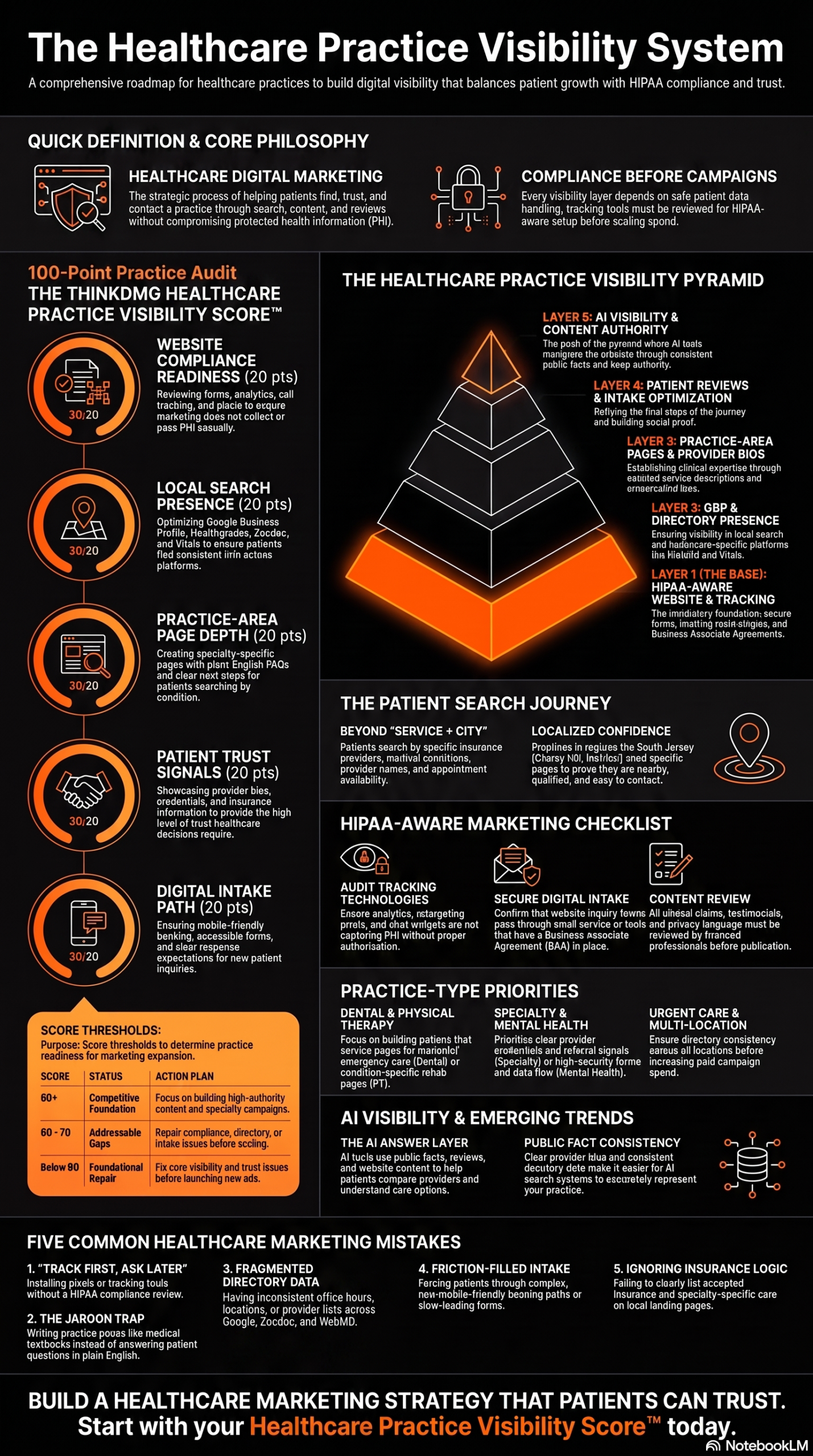
ThinkDMG Healthcare Marketing Priority Order
Many practices begin with paid advertising before strengthening the patient experience that makes advertising worth running. A more durable strategy starts with compliance and trust before expanding visibility.
| ThinkDMG Healthcare Marketing Priority Order | ||
|---|---|---|
| Priority | Focus | Why it comes first |
| 1 | HIPAA-aware website and tracking setup | Protect patient information before collecting new inquiries at any volume. |
| 2 | Practice-area pages and provider bios | Give patients and search systems a clear understanding of what the practice offers and who provides it. |
| 3 | Local visibility and directory presence | Strengthen GBP, Healthgrades, Zocdoc, and other platforms patients use for comparison. |
| 4 | Patient trust and reviews | Build review volume across platforms and make credentials easy to find. |
| 5 | Paid search and growth campaigns | Scale traffic only after the patient journey and intake path are ready to convert it. Google Local Service Ads (the “Google Screened” badge for healthcare providers) can generate faster intake while organic SEO builds over 3–6 months. |
ThinkDMG Insight
The first question DMG asks a healthcare practice prospect is whether appointment inquiries from the website pass through a tool or email service that has the right agreement in place.
Many practice owners do not know the answer. That does not mean the practice has done something wrong on purpose. It means marketing and compliance were treated as separate conversations.
That single gap can often be identified quickly, but it has to be identified before SEO, paid ads, chat tools, retargeting, and call tracking are expanded. Finding it after a campaign is already running creates a harder problem to fix.
ThinkDMG Definition
A Business Associate Agreement (BAA) is a contract that allows a vendor to handle PHI on behalf of a healthcare practice in compliance with HIPAA requirements.
A realistic timeline: Google Local Service Ads and paid search can generate appointment inquiries within the first few weeks once campaigns are set up correctly. Local SEO improvements, specialty page development, and directory work typically take three to six months to mature into consistent organic visibility. AI citation presence builds alongside organic authority over the same period. The fastest path to new patients is usually paid ads running against a website that is already clean, compliant, and clear — not ads running against a website that still has the gaps described above.
Use the Visibility Score before launching campaigns
The Healthcare Practice Visibility Score helps identify whether compliance, local search, content, trust, or intake should come first — before ad spend begins.
Sources used in this guide
- HIPAA marketing guidance: HHS HIPAA marketing guidance.
- HIPAA online tracking guidance: HHS online tracking technologies guidance.
- New Jersey healthcare context: Virtua Health and Cooper University Health Care are the two major South Jersey health systems serving Camden, Burlington, and Gloucester Counties.
Related Services
- Our healthcare marketing services connect visibility work with compliance-aware setup and patient trust — starting with the right questions, not just the right campaigns.
- Our SEO services support practice-area pages, local search, healthcare directory presence, and patient-intent content.
- Our web design services help practices improve mobile intake, ADA accessibility, form compliance, and patient confidence on every device.
- Our content marketing services explain specialties and services in clear patient-first language that search systems and AI tools can understand and cite.
- Our AI search optimization reviews how a practice appears across AI platforms and where public facts are inconsistent or missing.
FAQ
Is digital marketing for healthcare different from normal local SEO?
Yes. Healthcare marketing must consider patient privacy, HIPAA compliance, NJ state advertising rules, provider trust, healthcare-specific directories, specialty pages, and intake quality — none of which apply to most local service businesses.
Can a healthcare practice use Google Analytics or retargeting?
It depends on the setup, data collected, vendors used, and agreements in place. A practice should have compliance review before deploying any tracking that may capture PHI, including standard analytics tools and pixels.
What should a medical practice in New Jersey optimize first?
Start with compliant forms and tracking, accurate local and healthcare directory profiles, clear specialty pages for each service, visible provider bios, and an easy appointment path that works on mobile.
Do healthcare reviews on Healthgrades or Zocdoc affect Google rankings?
Reviews on those platforms do not directly influence Google rankings, but they affect patient trust and the completeness of a practice’s public profile — which AI tools and patients both use to compare providers.
Should healthcare content be reviewed before publishing?
Yes. Clinical claims, privacy statements, testimonials, and compliance-sensitive copy should receive human review — including from a licensed clinician or compliance advisor — before publication.
How long does healthcare digital marketing take to show results?
Paid search and Google Local Service Ads can begin generating appointment inquiries within weeks once set up correctly. Local SEO, specialty pages, and directory work typically take three to six months to produce consistent organic visibility.
Need a practice visibility plan?
DMG can help your New Jersey healthcare practice build a practical marketing plan with compliance questions addressed upfront — before any campaign begins.
