
Introduction: Your Next Client Might Not Be Searching on Google
If you’re a personal injury attorney in Cherry Hill or a family lawyer in Camden County, you know how competitive it is to get found online. But here’s something most law firms haven’t caught up with yet:
Your next client may not even be using Google the way they used to.
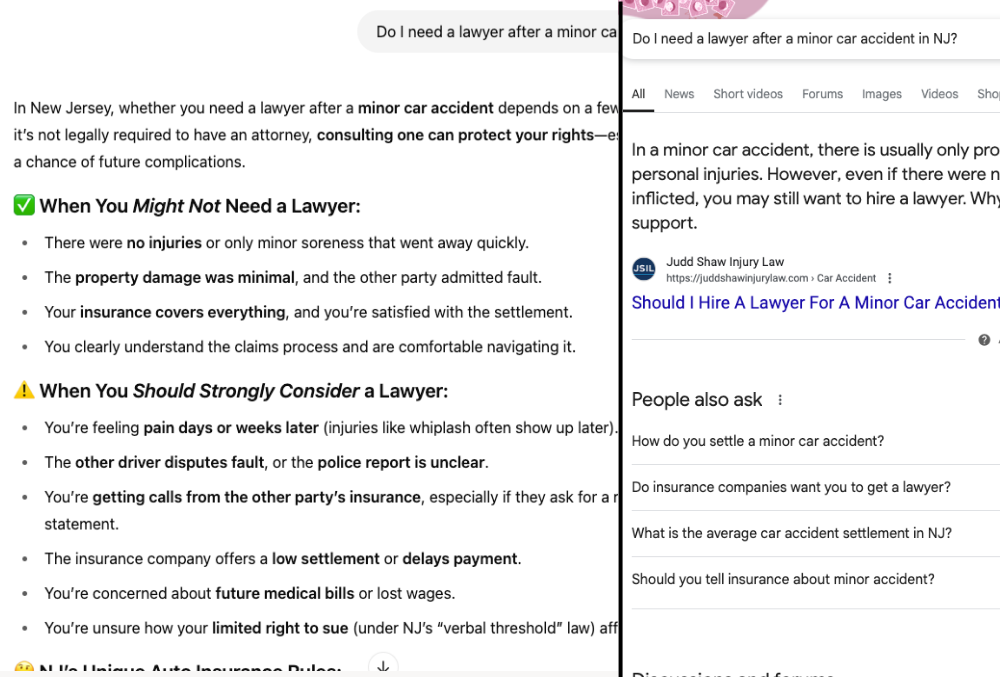
They might be asking ChatGPT to recommend a local attorney… or using Google SGE (Search Generative Experience), which pulls AI-generated answers before users even scroll to websites.
This new AI-powered search world means one thing:
If your website isn’t optimized for both search engines and AI tools, you’re invisible—even if you’re the best attorney in town.
This article will walk you through how to optimize your website so your firm shows up where your clients are actually looking—whether that’s on Google, in a chatbot, or through voice search.
- AI search increasingly summarizes and recommends information, not just “ranks pages.”
- Law firm visibility depends on trust + clarity: who you are, what you do, where you practice, and why you’re credible.
- The goal is risk-aware optimization that supports ethical legal marketing—no hacks, no loopholes, no guarantees.
- Strong entity signals (firm, attorneys, practice areas, locations) help AI systems understand and accurately reference your practice.
- Done correctly, AI-ready SEO improves eligibility for AI answers, citations, and local discovery—while protecting credibility.
1. How Legal Clients Are Searching Has Changed—Here’s What That Means for You
It’s Not About Keywords Anymore—It’s About Questions
Your future clients aren’t typing in “NJ personal injury attorney” and calling the first name on the list. They’re asking full, specific questions like:
- “How much does a personal injury lawyer charge in NJ?”
- “What happens at a bankruptcy consultation in Camden County?”
- “Who’s the best divorce lawyer for custody cases near me?”
These are the types of queries showing up in ChatGPT, Bing AI, and even Google’s AI-generated summaries.
What You Need to Do:
- Create content that answers the exact questions your clients are asking
- Use headlines that sound like real questions
- Keep your tone clear, approachable, and human—as if you’re having a first conversation, not writing a legal brief
- Law firm owners and partners
- Attorneys overseeing marketing decisions
- Practice managers and legal marketers
- Firms focused on long-term credibility and visibility
- “Growth hacks,” loopholes, or spam tactics
- Anyone seeking guaranteed rankings or outcomes
- Marketing that ignores legal advertising standards
- Requests for legal advice (this is marketing guidance)
2. Fix the Foundation: Make Sure Your Website Works Before You Add More
If Your Website Is Frustrating, They’ll Leave
Legal clients are often under stress. If your site is slow, hard to navigate, or doesn’t work well on mobile, they’ll move on to someone else—no matter how great your services are.
What to Fix Right Away:
- Mobile responsiveness: Your site should look great and load quickly on any device
- Page speed: If your homepage takes more than 3 seconds to load, it’s costing you calls
- No pop-up clutter: Make sure your contact info is easy to find, not hidden behind pop-ups
Help Search Engines Understand You
Tools like Google and ChatGPT need a little help understanding what your pages are about. That’s where structured data (also called schema markup) comes in.
Schema is like giving your content a name tag.
Use it to label:
- What your practice areas are
- Who your attorneys are
- What reviews and testimonials are on the page
- Frequently asked questions
🧰 Easy Tools:
Plugins like RankMath or Yoast make this super easy if you’re on WordPress.

3. Prove You’re Not Just an Attorney—You’re the Right Attorney
Trust is Everything—For Clients and Search Engines
When someone lands on your site, they’re not thinking about your law degree. They’re wondering:
“Can I trust this person with my case?”
Google and AI tools ask that same question in their own way.
They look for signs that you have real-world experience, legal credibility, and client satisfaction.
What You Should Show:
- Attorney bios that go beyond your JD—share what types of cases you handle, how long you’ve been practicing, and why clients choose you
- Case summaries or anonymized stories that show how you’ve helped real people
- Trust indicators like Avvo ratings, local bar memberships, or Super Lawyers badges
Don’t Forget Reviews
Put client testimonials (with permission) throughout your site—not just on a dedicated page:
- Include the client’s first name and town if possible
- Share what challenge they faced and how you helped
- Add a “Review Us” link for social proof
4. Format Your Content So AI Tools and Humans Understand It
Skip the Legal Jargon—Be Clear, Direct, and Helpful
Most visitors—and AI tools—scan for quick answers. If your content is buried in long, formal language, you’ll lose their attention fast.
Instead:
- Use headers with real legal questions (e.g., “What’s the difference between Chapter 7 and 13 bankruptcy?”)
- Answer in 2–3 sentences right under the question
- Use bullet points and short paragraphs to break up complex info
Use Natural, Conversational Language
Your tone should feel like a friendly first consultation, not a court transcript.
Use phrases like:
- “Let’s break it down…”
- “Here’s what most people don’t know…”
- “In most cases, New Jersey law requires…”
Ready to Get Found in AI Search?
The strategy in this article works — but implementation requires expertise, consistency, and ongoing optimization. That’s where we come in.
5. Create Content That Answers What People Are Really Asking
Practice Area Pages Aren’t Enough Anymore
Yes, you need pages that say “Personal Injury,” “Bankruptcy,” or “Family Law.” But clients want more.
They want answers to specific, personal questions before they pick up the phone.
Content That Converts:
- Process-focused: “What happens after I file for divorce in NJ?”
- Cost-focused: “How much does a bankruptcy lawyer charge in South Jersey?”
- Outcome-focused: “Can I avoid jail with a first-time DUI in Camden County?”
Where to Find the Right Questions:
- Ask your intake team or think back to consultations: What do people ask first?
- Use tools like AnswerThePublic or ChatGPT to brainstorm ideas
- Create a FAQ page for each service you offer

6. Keep Your Entire Online Presence Clean and Consistent
Your Website Isn’t the Only Thing AI Tools Look At
Google SGE and ChatGPT pull info from:
- Your Google Business Profile
- Online reviews (Google, Yelp, Avvo)
- Directories like Justia, FindLaw, Super Lawyers
- Social media and press mentions
Quick Audit Checklist:
- Is your business name, address, and phone number (NAP) consistent across the web?
- Are your Google and directory listings claimed and updated?
- Do you have at least 10 recent client reviews on your main platforms?
If the answer to any of these is no—start there.
Conclusion: The Future of Search Is Already Here—Is Your Law Firm Ready?
People aren’t just searching. They’re asking. They’re expecting instant, clear answers—from Google, ChatGPT, and anywhere they trust online.
If your law firm’s website isn’t built for that shift, you’re not just behind—you’re invisible.
Here’s your action plan:
- Answer real questions in plain language
- Make your website fast, clear, and mobile-friendly
- Use schema to help Google and AI understand what you offer
- Show your experience with bios, testimonials, and results
- Keep your entire digital presence up to date
🔍 Want help optimizing your legal website for Google, ChatGPT, and beyond? Contact Digital Marketing Group in Marlton, NJ for a free audit tailored specifically for attorneys.
FAQs
Q: Will ChatGPT recommend my law firm?
Only if your content is clear, helpful, and cited across the web. AI tools pull from well-structured, high-trust content.
Q: Is this different from traditional SEO?
Yes. This is SEO plus AI-readiness. You still need keywords and links—but now you also need content that answers questions like a real person would.
Q: What if I’m not technical?
You don’t have to be. Focus on content, clarity, and reviews. A partner like DMG can handle the technical side for you.

3 replies on “AI-Ready SEO for Law Firms: How Attorneys Can Optimize for Google, ChatGPT, and the New Era of Search”
This article nailed it. As a Cherry Hill-based family attorney, we’ve started seeing clients mention ChatGPT and voice search in consultations. The shift is real—and your breakdown of AI-readiness, especially with schema and FAQs, was incredibly actionable. We’re updating our service pages this month to focus on real client questions (like the ones you listed), and your schema tips were spot on. Thanks for making a complex topic digestible and relevant!
This was eye-opening! As a boutique firm in Camden County, we’ve noticed fewer inquiries from organic search—and now it makes sense. We were so focused on old-school SEO tactics that we completely missed the rise of AI-generated answers. The tip about structuring content around real legal questions (instead of just practice area pages) is gold. We’re now working on adding schema and a proper FAQ section to our family law pages. Thanks for making this approachable—even for non-tech attorneys!
This is the most practical breakdown I’ve seen on adapting SEO for AI-driven search. As someone who advises small law firms, I especially appreciated the focus on schema markup and content clarity—two areas most firms overlook. The reminder to optimize not just for Google, but for tools like ChatGPT and SGE, couldn’t be more timely. Great insights for any attorney serious about staying visible in this evolving digital landscape.