
Quick Summary: Why Structured Data Is Essential for Generative Search Optimization (GSO)
- Structured data helps AI “read” your site: Without it, platforms like Claude.ai and Perplexity.ai may overlook you—even with strong SEO.
- What it does: Defines your business, services, reviews, products, events, and FAQs in a machine-readable way (using JSON-LD, Microdata, or RDFa).
- Why it matters: Sites using structured data are 20–30% more likely to appear in rich snippets and AI-generated answers.
- Core schema types: LocalBusiness, Review, FAQ, Product, and Event—all boost visibility and relevance in AI search results.
- Boosts local discovery: Helps AI match your business to local intent searches like “best marketing agency in Marlton.”
- Easy to implement: Use Schema Pro, Yoast, or manual code; test everything using Google’s Rich Results Test.
- Future-proof your visibility: Structured data is powering personalized results, voice assistants, and dynamic featured snippets.

Introduction: Is Your Website Invisible to AI Search? Here’s Why Structured Data Matters
Imagine this: Someone asks Claude.ai, Perplexity.ai, or Gemini, “What’s the best marketing agency in Marlton?”
The AI generates a quick, concise answer—but your business isn’t included, even though your website is optimized for SEO, your content is stellar, and you’ve worked hard on your digital presence.
What went wrong?
It’s likely because your website lacks structured data—the invisible code that helps AI-powered search engines understand, categorize, and recommend your content.
In the world of Generative Search Optimization (GSO), structured data isn’t just a “nice-to-have.” It’s a critical ranking factor that can make the difference between being found or being forgotten in AI-generated search results.
In this article, you’ll learn:
- What structured data is and why it’s essential for GSO
- How AI-driven platforms like Claude.ai and Perplexity.ai rely on it
- Actionable strategies to implement structured data for better visibility
Because if AI search engines can’t “read” your website properly, your potential customers will never even know you exist.
What Is Structured Data?
🗂️ Structured Data Defined
Structured data is a standardized format for organizing and labeling information on your website so that search engines—and now AI platforms—can better understand it. It’s written in code (usually JSON-LD, Microdata, or RDFa) and helps define:
- What your business does
- Your products and services
- Customer reviews, events, FAQs, and more
Think of structured data like a “translator” for AI search engines. Without it, platforms like Claude.ai or Gemini have to guess what your content is about. With it, they know exactly how to categorize and recommend your content.
📊 Why Structured Data Matters for Generative Search Optimization (GSO)
AI-driven platforms like Perplexity.ai and Grok don’t just crawl websites—they generate answers based on context, relevance, and credibility. Structured data helps by:
- Clarifying content purpose: AI knows if a page is a product, service, FAQ, or review.
- Boosting relevance: Structured data improves your chances of being featured in rich snippets or AI-generated summaries.
- Enhancing search visibility: AI can pull key business details (like hours, locations, and contact info) directly from your structured data.
💡 Quick Stat:
“Websites using structured data are 20-30% more likely to rank in featured snippets and AI-generated answers.” (Source: Search Engine Journal)
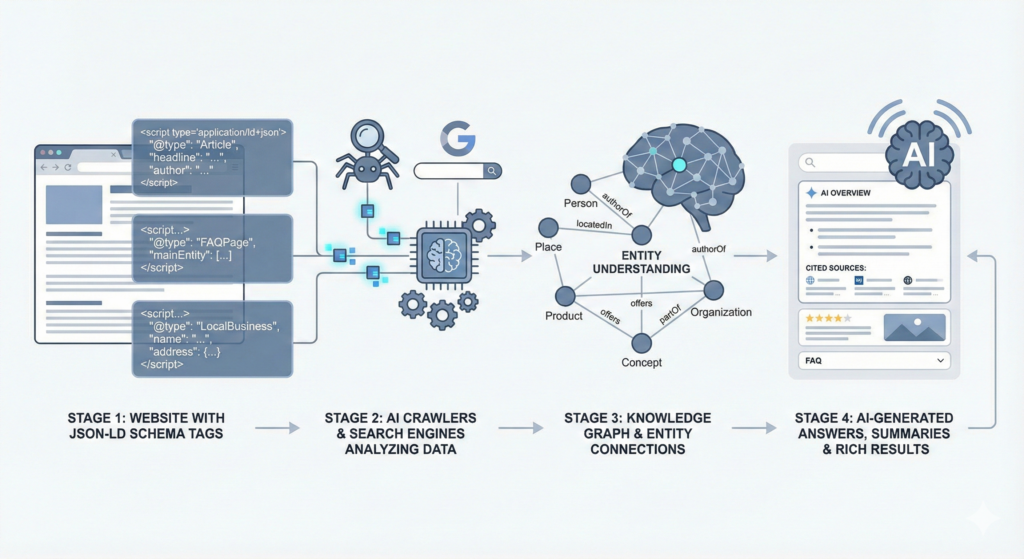
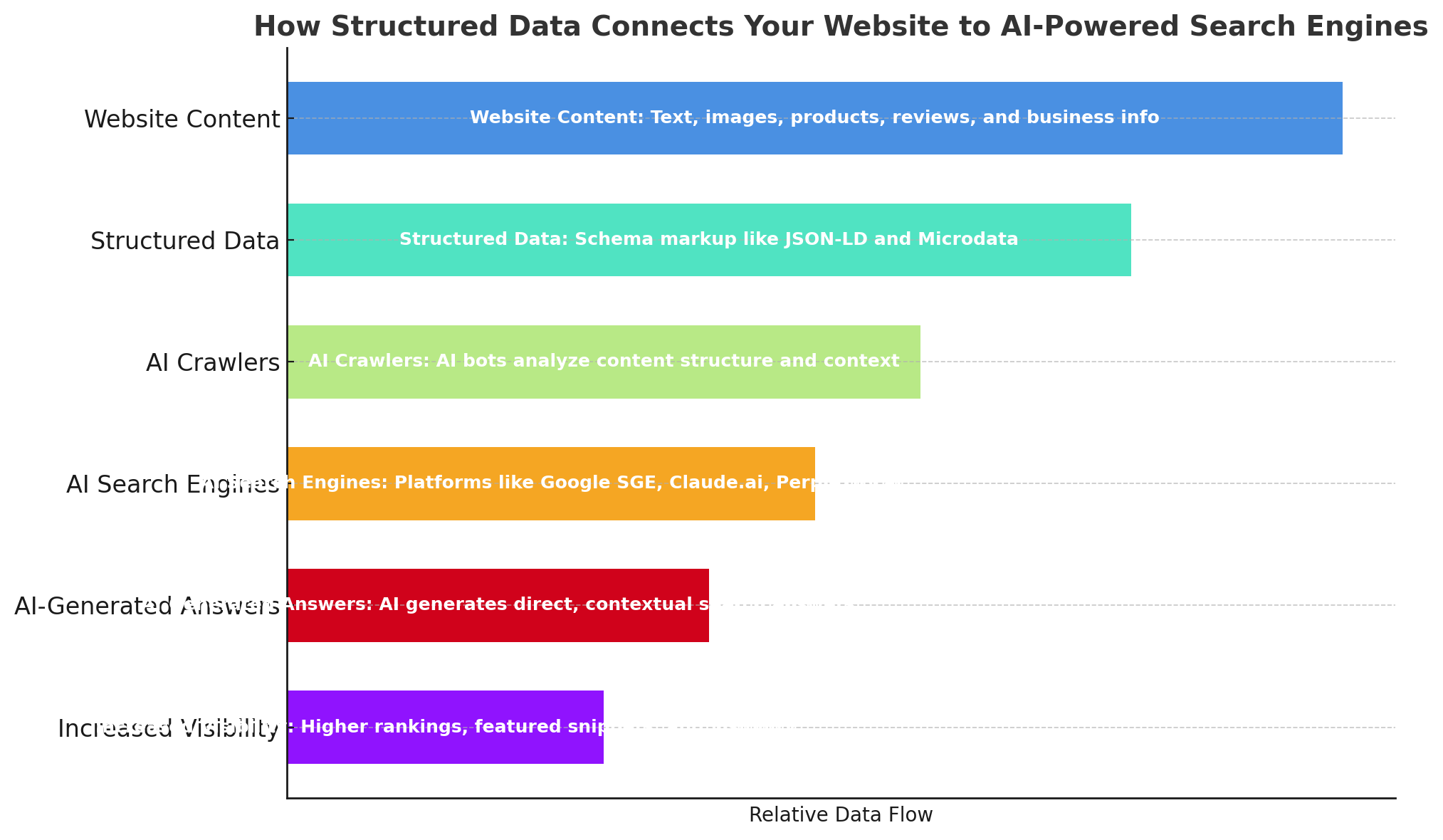
What role does structured data play in generative search optimization?
Structured data enables generative AI search engines to accurately interpret, classify, and cite website content by providing machine-readable context about entities, services, reviews, FAQs, and locations.
Without structured data, AI systems may overlook or misinterpret content—even when traditional SEO signals are strong.
How AI Search Engines Use Structured Data
1. Understanding Content Context
AI platforms like Claude.ai and Gemini use structured data to:
- Identify what type of content is on your page (e.g., product pages, articles, FAQs)
- Understand the relationships between entities (like your business, services, and customer reviews)
- Determine relevance to specific queries
2. Enhancing Rich Snippets and Featured Results
Structured data helps AI generate:
- Rich snippets (enhanced search results with extra info like ratings, images, and FAQs)
- Knowledge panels with business information
- Voice search answers for smart assistants
3. Improving Local Search Recommendations
For local businesses in Marlton, structured data improves how AI:
- Recommends businesses based on location data
- Prioritizes businesses with strong review signals
- Matches local intent queries like “best coffee shop near me”
| Schema Type | Primary Purpose | AI Search Benefit | Source |
|---|---|---|---|
| Organization / Logo / NewsMediaOrganization | Defines a corporate or legal entity's identity, including branding, contact points, founding date, and legal name. | Establishes brand authoritativeness and identity; improves source attribution and reduces hallucinations by providing official provenance for AI systems. | [1] [6] [3] [7] [8] [9] |
| Product / Product Variants | Describes products, their variations (size, color), and attributes like price, model, and availability. | Facilitates feature-based extraction for recommendation engines and supports automated comparisons, pricing analysis, and real-time availability in AI interfaces. | [1] [4] [6] [10] [11] [13] [14] [15] |
| FAQ / FAQPage | Organizes a list of frequently asked questions and their corresponding answers on a specific topic. | Directly supports conversational queries and extraction for featured snippets, "People Also Ask" boxes, and AI-generated answer previews. | [1] [17] [6] [7] [9] |
| Article / BlogPosting / NewsArticle | Provides machine-readable context for written content, including headlines, authors, and publication dates. | Improves interpretability and citation accuracy for LLMs; reinforces authority signals to prevent misattribution in AI summaries and grounding memory. | [21] [6] [9] [17] |
| HowTo / How-To | Outlines a series of logical, step-by-step instructions and visuals required to complete a task. | Provides AI agents with procedural sequences for instructional responses and technical summaries; demonstrates first-hand experience (E-E-A-T). | [17] [6] [1] |
| Person / Author | Identifies individuals or content creators, detailing their credentials, education, and career history. | Supports entity linking in knowledge graphs to establish "Expertise" and "Experience" components of E-E-A-T; associates content with expert entities. | [23] [1] [9] |
| LocalBusiness | Defines details for physical business locations, including opening hours, NAP (Name, Address, Phone), and geolocation. | Enables AI to match businesses to "local intent" queries and generates factual responses regarding operational status and location-based recommendations. | [6] [4] [14] [9] |

Why do AI search engines rely on structured data?
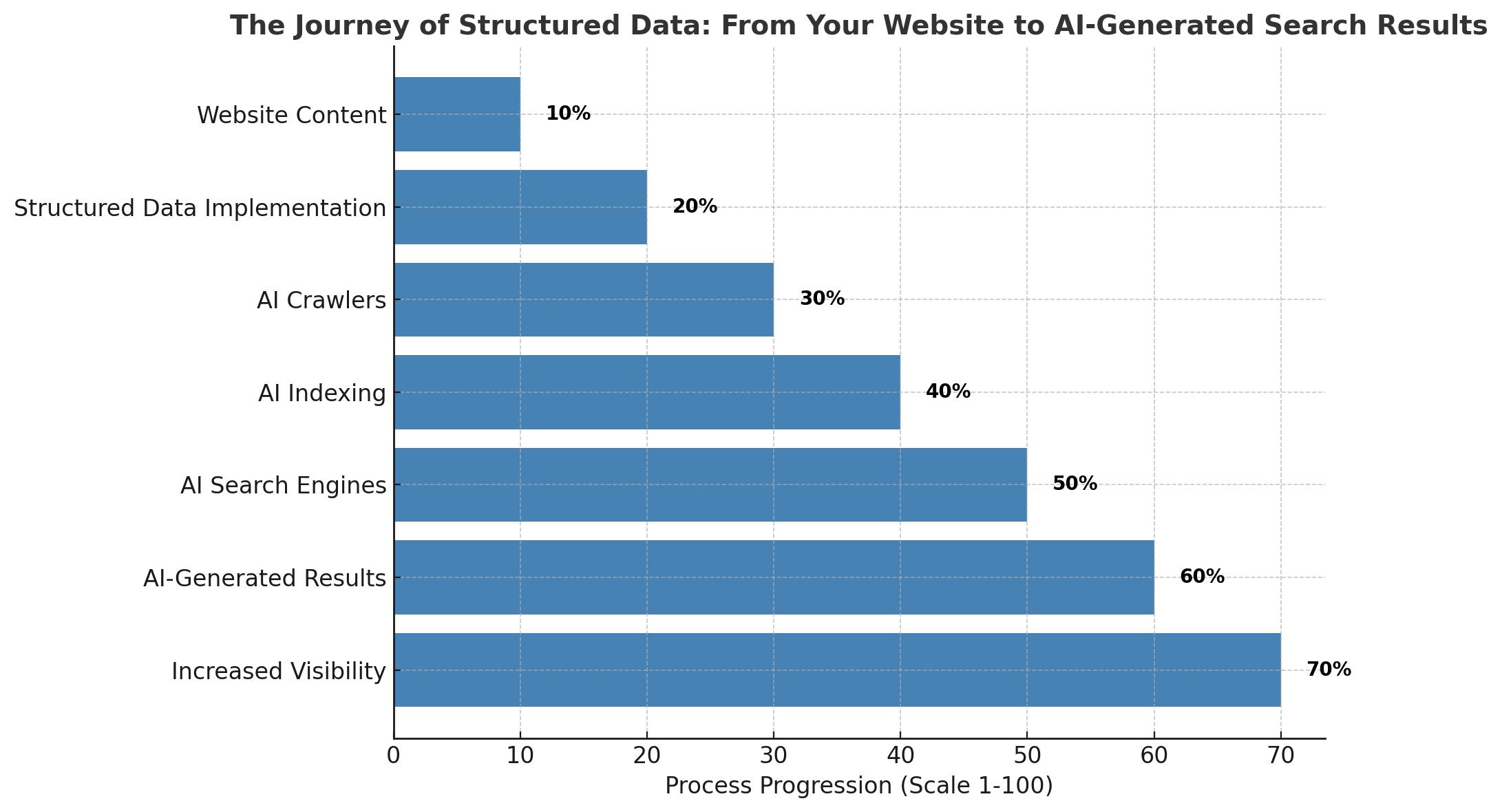
AI search engines rely on structured data because it removes ambiguity. Schema markup explicitly tells AI models what a page represents (article, business, FAQ, product), how entities relate to one another, and which information is trustworthy enough to reuse in generated answers.
Types of Structured Data for GSO
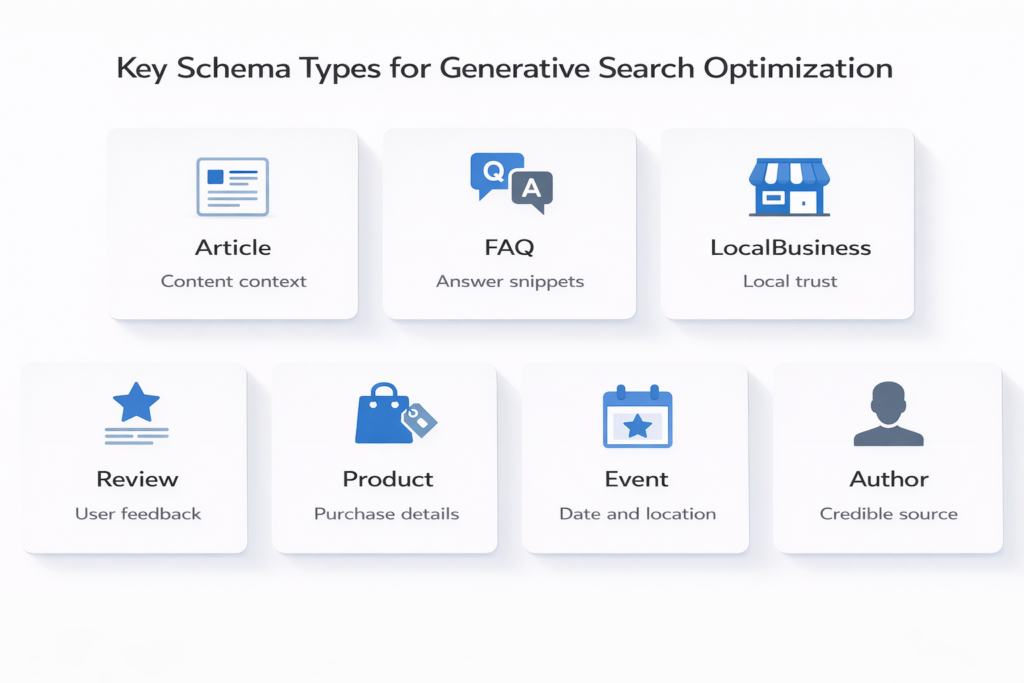
1. Local Business Schema
Highlights key details like:
- Business name, address, phone number (NAP)
- Opening hours
- Geolocation data
2. Review Schema
Helps AI display:
- Customer ratings
- Testimonials
- Product or service feedback
3. FAQ Schema
Optimizes for:
- Voice search queries
- AI-generated Q&A snippets
- “People Also Ask” boxes in search results
4. Product Schema
Showcases:
- Product details
- Pricing information
- Availability status
5. Event Schema
Promotes:
- Local events
- Webinars
- Special offers
How Different AI Search Engines Use Structured Data
Generative search platforms use structured data differently depending on how they generate and validate answers.
- Search-Driven AI Systems
These systems rely heavily on structured data to enhance indexing, surface rich results, and reinforce knowledge graph relationships. Structured data helps confirm what a page is, not just what it says. - Citation-Driven AI Systems
Some AI platforms prioritize sources they can confidently reference. Pages with clean schema, clear authorship, and structured FAQs are more likely to be listed as cited sources. - Conversational AI Systems
Conversational models use structured data to reduce hallucination risk. Schema helps them summarize accurately by anchoring answers to defined entities, attributes, and relationships. - Knowledge-Graph-Driven AI Systems
These systems use structured data to connect your content to broader topic clusters. Proper schema helps your brand and content become part of an AI’s long-term understanding of a subject.
Bottom line: Structured data is not just about visibility — it is about trust calibration for AI systems.
| Structured Data Type | Purpose | Use Cases |
|---|---|---|
| 🏢 Local Business Schema | Provides AI search engines with essential business details. | Helps with local searches like “best marketing agency near me.” |
| ⭐ Review Schema | Displays customer ratings and testimonials in search results. | Enables star ratings in Google results to build trust and credibility. |
| ❓ FAQ Schema | Helps AI understand common customer questions and answers. | Improves visibility in “People Also Ask” boxes and voice search. |
| 🛍️ Product Schema | Highlights product details like pricing, availability, and reviews. | Enhances product listings in e-commerce search results. |
| 🗓️ Event Schema | Provides event details for AI-generated event recommendations. | Promotes webinars, in-person events, and special offers in search results. |

Does structured data help content get cited by AI tools like Perplexity and ChatGPT?
Yes. Pages with clear structured data are more likely to be cited by AI tools because schema provides verifiable context, defined entities, and extractable facts. This makes the content easier for AI systems to summarize, attribute, and reference confidently.
How to Implement Structured Data for GSO
Step 1: Identify the Right Schema for Your Business
- Use Schema.org to find relevant markup for your business type.
- Common options: LocalBusiness, Product, FAQ, Review, Event.
Step 2: Add Structured Data to Your Website
- Use JSON-LD format (recommended by Google).
- Add the code directly to your website’s HTML or through a CMS plugin (like Yoast for WordPress).
Step 3: Test Your Structured Data
- Use Google’s Rich Results Test to check for errors.
- Fix any issues to ensure your data is properly indexed.
Step 4: Monitor Performance
- Use Google Search Console to track how structured data impacts your visibility.
- Adjust as needed based on search performance.
Example Code (Local Business Schema):
{

"@context": "https://schema.org",

"@type": "LocalBusiness",

"name": "DMG Digital Marketing",

"address": {

"@type": "PostalAddress",

"streetAddress": "5 Greentree Centre",

"addressLocality": "Marlton",

"addressRegion": "NJ",

"postalCode": "08053"

},

"telephone": "+1-555-555-5555",

"openingHours": "Mo-Fr 09:00-17:00"

}

Fact: Websites with valid structured data are significantly more likely to appear in AI-generated answers and rich results because LLMs prioritize machine-readable context when selecting sources.
Common Mistakes to Avoid with Structured Data
🚩 1. Incomplete or Inaccurate Markup
- Mistake: Missing key fields (like address or hours)
- Fix: Fill out all relevant fields for your schema type.
🚩 2. Using Outdated Schema
- Mistake: Applying deprecated schema types
- Fix: Regularly check Schema.org for updates.
🚩 3. Not Validating Structured Data
- Mistake: Adding schema without testing for errors
- Fix: Always use Google’s Rich Results Test to verify.
🚩 4. Over-Optimizing with Spammy Markup
- Mistake: Adding irrelevant schema just to manipulate rankings
- Fix: Only include structured data that’s directly relevant to the content.
The Future of Structured Data in Generative Search
Emerging Trends to Watch:
- Personalized Search: Structured data will help AI tailor results based on user behavior.
- Conversational Commerce: Voice assistants will rely on structured data for real-time recommendations.
- AI-Powered Featured Snippets: Expect more dynamic, interactive search experiences driven by structured data.
💡 Expert Insight:
“Structured data isn’t just for search engines anymore—it’s for AI systems that shape how people discover information online.” — [John Palmer, DMG Digital Marketing]
Conclusion: Ready to Boost Your AI Search Visibility?
Structured data is no longer optional. If you want your business to be found, recommended, and trusted by AI-powered search engines like Claude.ai, Perplexity.ai, Grok, and Gemini, you need to make structured data a priority.
Key Takeaways:
- Structured data helps AI understand your website’s content.
- It improves visibility in rich snippets, local recommendations, and voice search results.
- Implementing structured data is easier than you think—and the payoff is huge.
Want to See How Structured Data Can Boost Your Business?
Contact DMG for a FREE Generative Search Optimization Audit. We’ll identify gaps in your current strategy and help you stand out in AI-powered search results.

- Structured data helps AI systems understand what your content represents, not just what it says.
- AI search engines prefer pages with explicit schema because it reduces uncertainty and hallucination risk.
- Schema markup improves eligibility for AI-generated answers, summaries, and citations.
- LocalBusiness, FAQ, Article, and Author schema are foundational for generative search optimization.
- Without structured data, even high-quality content may be ignored by AI platforms.

9 replies on “The Role of Structured Data in Generative Search Optimization”
Insightful piece! Your overview of how schema types like FAQPage, HowTo, and Organization support AI features—like Google AI Overviews and ChatGPT—is spot on. I’ve found that tagging FAQs directly led to richer snippets for voice assistants. Love the practical framework for prioritizing schema usage.
Great primer on structured data markup! The statistics about improved CTR and rich results from sites like Rotten Tomatoes and Food Network really caught my eye. I especially appreciate the section emphasizing JSON-LD as Google’s preferred format—it makes implementation so much smoother. Thanks for sharing these actionable takeaways!
Insightful read! The way you’ve illustrated how structured data improves AI model interpretation aligns with Adcore’s take on ‘answer optimization’. Seeing strategies like JSON‑LD for FAQs and Product schema makes this post a valuable resource for optimizing content for ChatGPT and Gemini.
Great breakdown of schema types for GSO! Like Click Rain emphasizes with AI tools in paid search, structured data is essential for AI to interpret your pages. The local business JSON-LD snippet is a great starting point—definitely sharing this with our team for our next local SEO refresh.
This is an excellent practical guide—especially the emphasis on implementing FAQ and LocalBusiness schema. Neil Patel’s tips on schema markup echo perfectly here. I’ve already seen a boost in voice search visibility after adding JSON-LD based on this article. Thanks for making structured data actionable!
This post is a goldmine for understanding structured data for GSO. I appreciate the clear comparisons of schema types and how LocalBusiness markup boosts voice-search visibility. Click Rain recently shared tips about optimizing for Google Gemini—this fits right in!
[…] like Schema.org provide valuable frameworks for enhancing AI comprehension. A recent guide from ThinkDMG outlines how structured data and content clarity contribute directly to generative search […]
Really insightful breakdown of schema types! The FAQ and Review schema sections really clarify how to structure content for AI-driven platforms like Gemini and Claude.ai. This aligns well with Neil Patel’s tips on AI-powered SEO. Looking forward to testing this on our clients.
Excellent breakdown of structured data’s role in GSO! Your point on how LocalBusiness schema improves local discovery really resonated—we’ve seen better visibility in AI-generated results like Perplexity.ai after implementing it. The example JSON-LD code for Marlton businesses was a great touch. Definitely sharing this with our dev team!”