
Everyone in marketing right now is asking the same question: How do I show up in AI search?
It’s the wrong question.
Not because AI search doesn’t matter — it clearly does. But because the question assumes that the primary relationship is between your brand and an algorithm. It’s not. The primary relationship is between your brand and a human being who, at some point, is going to type something about you into ChatGPT or Perplexity. And what they type — and why they type it — tells you everything about what you actually need to do.
Most of the LinkedIn AI optimization advice circulating right now is built around the wrong moment. It’s built around the discovery moment: a stranger typing a generic category query, AI surfacing a result, your brand appearing. That moment matters. But it’s not where most purchases are actually decided.
Here’s where they’re decided.
The Moment That Actually Matters
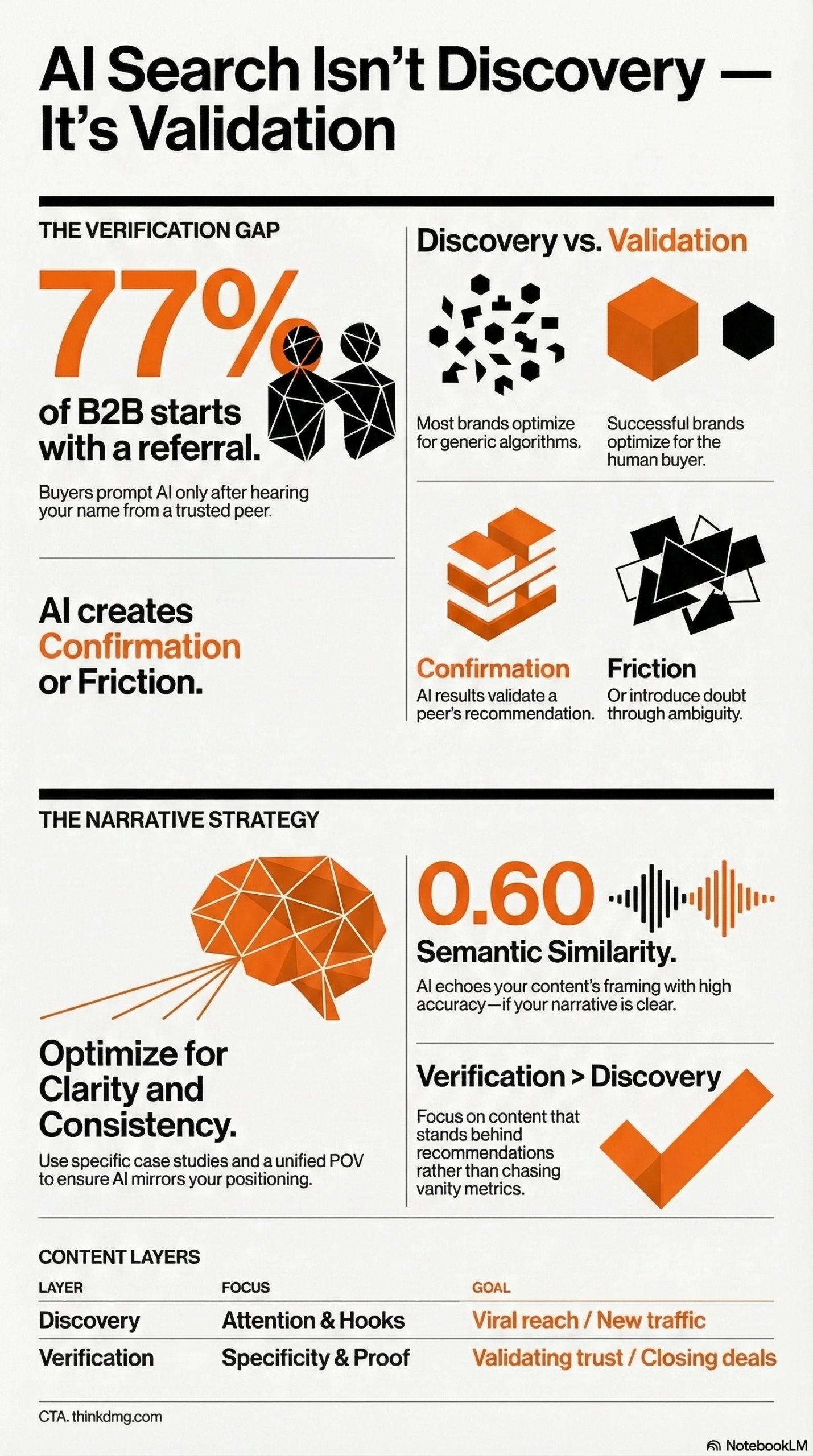
Gartner research shows that 77% of B2B purchases start with a network recommendation. A colleague mentions your name in a meeting. A peer forwards your newsletter with a note that says, “this is really good.”
Someone at a conference says “you should talk to these people.” The recommendation lands before the research begins.
Then the buyer goes home. Opens their laptop. And types something like:
“My colleague recommended [Your Brand]. We’re a mid-size SaaS company looking to expand into enterprise. Is this the right fit for us?”
Or:
“I’m choosing between [Your Brand] and [Competitor]. We’ve heard good things about both. What should I know?”
That is the moment your LinkedIn AI strategy either pays off or falls apart. Not when a stranger discovers you. When someone who was already told about you tries to verify the recommendation.
This is the prompt that converts. And it’s the prompt that almost no marketing team is building their content strategy around.
The Referral Is Already Half the Sale
When someone prompts AI about your brand after receiving a recommendation, the sale is already halfway made. The trust transfer has happened. The colleague put their own credibility on the line by making the recommendation. The buyer’s guard is lower than it would be for a cold discovery.
What AI says in that moment isn’t neutral research. It’s either confirmation or friction.
Confirmation looks like: AI surfaces content that reflects exactly the positioning your colleague described. The case studies match the use case. The thought leadership demonstrates the expertise that was promised. The brand narrative is consistent, confident, and specific. The buyer nods and moves forward.
Friction looks like: AI surfaces generic content that could describe any company in your category. Or content that contradicts the recommendation somehow — different positioning, different emphasis, a vague answer to a specific question. Or nothing particularly compelling at all. The buyer gets uncertain. The recommendation starts to feel less solid. The sales cycle gets longer or falls apart.
The irony is that most AI optimization advice would have you produce more content to solve this. More posts. More articles. More touchpoints. But quantity of generic content doesn’t close the gap. It can actually widen it — because more undifferentiated content gives AI more material to construct a generic description of your brand.
What closes the gap is clarity. Consistent, specific, differentiated content that says the same true things about your brand across every surface where AI will encounter it.
What AI Is Actually Learning About You
Here’s the mechanism worth understanding. When an AI model cites your LinkedIn content, Semrush research shows it mirrors the meaning of that content with roughly 0.60 semantic similarity. That’s a tight echo. Your framing becomes AI’s framing. Your language becomes AI’s language. Your positioning, as expressed in your content, is largely what AI will repeat.
This works in your favor if your content is clear, specific, and consistent. It works against you if your content is optimized for keywords rather than written from genuine expertise — or if it says slightly different things across different posts because you were chasing different trends at different times.
Think of AI as a student who has read everything you’ve ever published and is now being asked to summarize who you are and what you stand for. What does that student say? Is it the answer you want your buyers to hear?
Most brands, if they’re honest, don’t know the answer to that question. They’ve never actually prompted AI with the questions their buyers would ask. They’ve never compared the AI answer against their actual positioning. They’ve never asked: does what AI says about us support or undermine the recommendations our happiest customers are making?
That’s the audit you need to run before you publish another piece of content.
The Narrative Inventory: A Practical Audit
Before any content strategy conversation, run this audit across ChatGPT, Perplexity, and Google AI Mode. It takes about an hour and will tell you more about your AI content gaps than any keyword research tool.
Round 1: What Does AI Think You Are?
Start with simple identity prompts:
- “What is [Your Brand]?”
- “What is [Your Brand] known for?”
- “Who are [Your Brand]’s typical customers?”
- “What makes [Your Brand] different from competitors?”
Read the answers carefully. Are they accurate? Are they specific to you, or could they describe any company in your category? Do they reflect your current positioning or something you said three years ago? Are there misconceptions baked in that you’ve never directly addressed?
Write down what AI currently says. Then write down what you want AI to say. The gap between those two documents is your content strategy.
Round 2: What Does AI Say When You’re Being Compared?
This is the purchase-decision layer:
- “[Your Brand] vs. [Competitor A]”
- “[Your Brand] vs.
- [Competitor B]”
- “Best [category] for [your target customer type]”
- “Is [Your Brand] right for [specific use case]?”
How do you perform in comparison? Are the differentiators AI cites the ones you actually want to compete on? Are there categories where a competitor has a clearer narrative than you — not because they’re actually better, but because their content has given AI more to work with?
Round 3: The Referral Prompt
This is the one most teams never think to run:
- “My colleague recommended [Your Brand]. What should I know before talking to them?”
- “I’ve heard good things about [Your Brand]. Is the reputation justified?”
- “We’re considering [Your Brand]. What are the main reasons companies choose them?”
Read these answers as if you’re the buyer. Does what AI says make you more confident in the recommendation you received, or does it introduce doubt? Would you move forward after reading this? Would you feel like the recommendation was validated?
If the answer isn’t a clear yes, you have work to do. Not keyword work. Narrative work.
The Content That Closes Narrative Gaps
Once you’ve identified the gaps, the question is what to actually create. The answer isn’t more content — it’s more specific content.
Write for the Verification Moment, Not the Discovery Moment
Most LinkedIn content is written to attract attention — hooks, headlines, engagement bait, topics people are already searching for. That’s discovery-layer content, and it has its place.
But verification-layer content serves a different need. It’s the content someone reads after they’ve already heard your name. It needs to answer: Is this company what I think they are? Do they actually know what they’re talking about? Is the recommendation I received accurate?
Verification-layer content looks like:
- Detailed case studies with specific numbers and named outcomes, not generic “we helped a client grow revenue” vague summaries
- First-person perspective pieces where your actual point of view on a contested topic is clear — not “here are five perspectives” balance, but “here’s what we actually believe and why”
- Documentation of your process, methodology, or framework in enough detail that a reader can assess whether it fits their situation
- Direct, honest comparisons of when you’re the right choice and when you’re not — the brands that say “we’re not for everyone, here’s who we’re best for” earn more trust than the ones who claim universal applicability
This content doesn’t perform as well on vanity metrics. It doesn’t go viral. But it’s the content that closes deals — because it’s the content that stands behind the recommendation and says: yes, what you heard is true.
Consistency Is the Underrated Strategy
One of the quieter findings in the Semrush research is that about 75% of cited LinkedIn post authors published five or more times in the previous four weeks. The conventional reading of this is “post more often.” The more accurate reading is: consistency signals credibility.
AI systems are pattern matchers. When they encounter the same clear, specific position expressed across multiple pieces of content over time, they learn that position. When they encounter a brand that says different things at different times — pivoting narratives with trends, chasing different keywords in different seasons — they learn ambiguity. And ambiguity in your AI narrative is friction in the buyer’s verification moment.
Pick the three or four things your brand genuinely stands for. Say them clearly, consistently, and repeatedly. Let AI learn those positions. That is a more durable GEO strategy than any semantic optimization tactic.
The Trust Metrics That Tell You If It’s Working
If you shift your content strategy toward the verification moment and narrative consistency, your results won’t show up primarily in AI citation rate. They’ll show up in the metrics that actually precede revenue:
Branded search volume. When someone types your brand name directly into a search engine or AI, it’s because someone told them to. Growing branded search volume is the most reliable proxy for word-of-mouth health — the thing that creates the referral moment that creates the verification prompt in the first place.
Direct traffic. People who navigate directly to your site have already made a decision about you. They’re not discovering you — they’re following up on something. Growing direct traffic means your brand is living in people’s heads and DMs, not just in search results.
Conversion rate from AI-referred traffic. If you have the ability to segment AI-sourced visitors, watch their conversion behavior closely. Visitors arriving from AI citations after a referral prompt should convert at higher rates than cold discovery visitors. If they’re not, your narrative may be creating friction rather than resolving it.
Qualitative referral feedback. Ask your actual customers: “What did you find when you researched us before the first call?” If the answers consistently describe content you created, your narrative inventory is working. If they describe generic AI summaries that almost talked them out of the meeting, you know what to fix.
The Harder, Better Question
The industry spent the last decade optimizing for Google. The question was always: what does the algorithm want?
That question produced a lot of content. Pages and pages of it — keyword-targeted, structured, technically compliant, often minimally useful to the humans who landed on it.
Now the question has shifted to: what does AI want? And we’re at risk of making the same mistake, just faster and at higher volume.
The better question — the one that builds something worth building — is: what does the person who just heard my name need to find?
Answer that question honestly. Build content that answers it directly. Distribute that content across the trusted channels where AI will encounter it. Say the same clear, true things about your brand consistently over time.
That’s not an AI optimization strategy. It’s a brand strategy. And in 2026, those two things have become the same thing.
The Harder, Better Question
The industry spent the last decade optimizing for Google. The question was always: what does the algorithm want?
That question produced a lot of content. Pages and pages of it — keyword-targeted, structured, technically compliant, often minimally useful to the humans who landed on it.
Now the question has shifted to: what does AI want? And we’re at risk of making the same mistake, just faster and at higher volume.
The better question — the one that builds something worth building — is: what does the person who just heard my name need to find?
Answer that question honestly. Build content that answers it directly. Distribute that content across the trusted channels where AI will encounter it. Say the same clear, true things about your brand consistently over time.
That’s not an AI optimization strategy. It’s a brand strategy. And in 2026, those two things have become the same thing.
This is Part 3 in thinkdmg.com’s series on LinkedIn, AI search, and the future of brand visibility.
AI Search & LinkedIn Strategy Series
- Part 1: LinkedIn and AI Search in 2026 — The Complete Playbook for Visibility, Trust, and Getting Chosen
- Part 2: The LinkedIn AI Citation Playbook Nobody’s Talking About — How to Earn It Instead of Game It
- Part 3: Stop Optimizing for AI. Start Optimizing for the Person Who Will Prompt AI About You
- Part 4: LinkedIn Gets You Seen. Here’s What Actually Gets You Chosen
Sources: Semrush LinkedIn AI Visibility Study (March 2026), Seer Interactive GEO Research (March 2026), Gartner B2B Buying Research.
