Categories
Content Marketing Digital Marketing for Small Business Digital Marketing Trends

Why Auto Dealer Websites Fail, and How to Fix Yours

You’ve invested in Google Ads, pumped out social content, and even boosted your SEO. Traffic is flowing, but your inbox is silent. No calls. No appointments. Just a rising sense of frustration.

If your dealership website isn’t converting visitors into leads, it’s not a digital presence; it’s a digital money pit.

The term auto dealer website conversion may sound like marketing lingo, but for your business, it’s the difference between growth and stagnation.

This guide dives into the real reasons dealership websites fail to convert and what top-performing dealers are doing to fix that fast.

🔍 Quick Summary

Most auto dealer websites fail not because they lack traffic, but because they’re missing conversion fundamentals. This article reveals:

  • 🚫 5 critical flaws that drive visitors away
  • ✅ Conversion-boosting design fixes you can make today
  • 📈 Real examples of before/after dealer site improvements

What Is a Good Conversion Rate for Dealers?

Understanding the Benchmark

Most car dealerships see a 1–2% conversion rate, meaning out of every 100 website visitors, only 1 or 2 submit a form, click to call, or schedule a test drive.

But high-performing dealerships aren’t settling for average. They’re achieving:

  • 3–5% conversion with strong UX and clear CTAs

  • 10–15%+ conversion using data-driven CRO strategies and personalized follow-ups

Why Conversion > Traffic

Let’s say you get 10,000 website visits/month:

  • At 1%: You get 100 leads

  • At 3%: You now get 300 leads from the same traffic

That’s 200 extra lead opportunities every month, without raising your ad budget.

👉 Bottom line: Improving your conversion rate is the fastest path to growth—and the most overlooked.


5 Fatal Flaws Killing Your Website’s Conversion

1. No Clear Call-to-Action (CTA)

When a visitor lands on your site, can they instantly find what to do next?

If your homepage doesn’t scream “Schedule a Test Drive” or “Get a Quote,” you’re losing them within 3 seconds.

  • CTAs must be above the fold, mobile-friendly, and visually distinct

  • Avoid generic buttons like “Learn More”—use action-driven copy

💡 Pro Tip: Replace your hero banner with a clean value proposition + CTA like “📅 Book Your Test Drive Now.”


2. Slow, Clunky, Mobile-Unfriendly UX

Today’s car buyers live on mobile. Over 60% of dealership traffic comes from smartphones, yet many dealer sites are slow, cluttered, or impossible to navigate.

  • Use Google’s PageSpeed Insights to test your site

  • Remove pop-up chaos, autoplay videos, and oversized graphics

  • Compress images and use modern formats like WebP

⏱ Goal: <3 second load time on mobile.


3. Lack of Trust Signals

Would you submit your info to a site with no testimonials, no reviews, and no transparency?

Buyers want proof. Give it to them:

  • Google Reviews with star ratings

  • Dealer awards or certifications

  • Recent customer testimonials

  • “As seen in” logos or partner badges

Even a simple carousel of real buyer reviews can 2–3x your form conversions.


4. Complicated Lead Forms

You don’t need their entire life story—just their contact info and interest.

  • Keep lead forms to 3–4 fields max (Name, Phone, Email, Vehicle)

  • Use dropdowns or pre-filled fields to reduce typing friction

  • Test pop-ups vs. embedded forms

🧪 Run A/B tests: Even changing “Submit” to “📞 Get My Quote” can improve conversions by 20%+.


5. 📬 No Follow-Up Funnel

Most dealerships drop the ball after the form is submitted.

  • Is your team responding within 5 minutes?

  • Are you using SMS or retargeting ads for unconverted leads?

  • Do you have automated emails reminding users to book or visit?

Fast, human follow-up turns a lukewarm lead into a test drive tomorrow.

Ready to Convert More Visitors?

Your next customer is already on your site—don’t lose them. Let us show you what’s stopping conversions and how to fix it fast.

Get Your Free Website Audit


How to Build a Conversion-Optimized Dealer Website

1. Follow the 3-Second Rule

When a buyer lands on your homepage, they should immediately know:

  • Who you are

  • What you offer

  • What action to take next

Use bold copy like:
“In-Stock Deals in Marlton, Book Your Test Drive Today”

Include CTA buttons, phone number, and a trust icon (e.g., BBB or local award).


2. Funnel-Based Page Structure

Map your site to the real buying journey:

Homepage ➜ Inventory ➜ Vehicle Page ➜ Lead Form ➜ Thank You Page ➜ Retargeting

Every click should build interest and drive toward a decision, not distract.


3. UX and Visual Cues

  • Directional arrows (especially on mobile) guide users

  • Use sticky CTAs that follow scrolling

  • Limit distractions, remove autoplay, full-page sliders, or banners that add noise

💡 Think like a buyer: Make it obvious, easy, and emotionally rewarding to say “yes.”


4. Trust & Social Proof (Done Right)

Don’t bury your testimonials. Don’t put your reviews 5 scrolls deep.

  • Place reviews next to the lead form

  • Embed recent Google reviews

  • Add a rotating testimonial carousel with headshots or vehicle photos

✨ Bonus: Include a quote like “I booked my test drive in 60 seconds and was approved the same day!”


5. 📱 Speed & Mobile Optimization

  • Optimize for Core Web Vitals

  • Use heat maps to track mobile scroll/drop-off zones

  • Keep mobile lead forms simple, no horizontal scroll or tiny buttons

Your site isn’t mobile-friendly, it must be mobile-first.


🧭 Real-World Dealer Fixes: Before & After

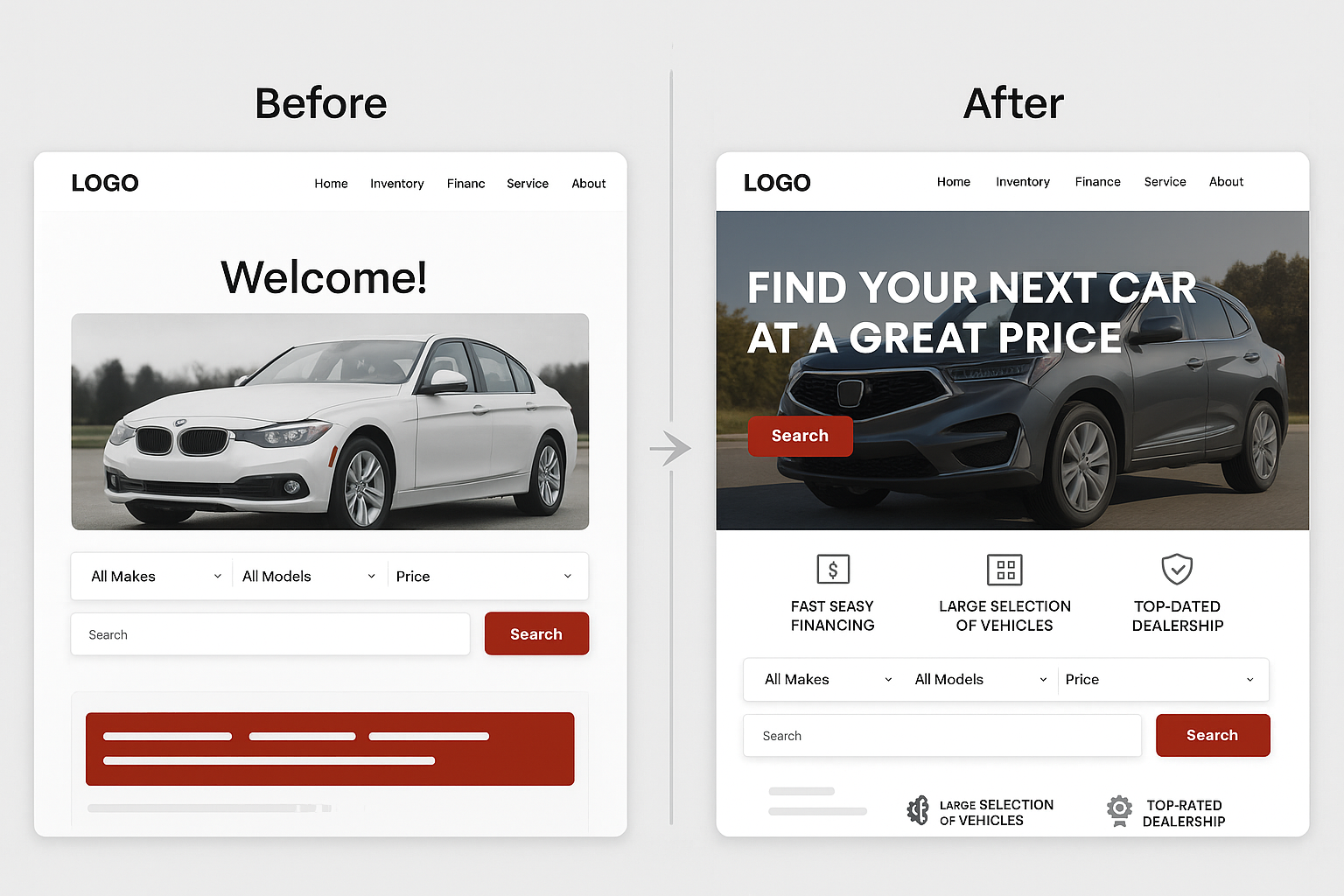
🟥 Before:

  • Homepage overloaded with banners and pop-ups

  • Lead form buried in footer with 10+ fields

  • No visible mobile CTA

✅ After:

  • Bold hero: “Book Your Free Test Drive Now”

  • 3-field pop-up form

  • Tap-to-call floating button on mobile


🟥 Before:

  • Inventory pages were photo-only

  • No pricing transparency or CTA

✅ After:

  • “Request Info” and “See Financing” buttons added

  • Reviews + recent sales displayed on each vehicle page


🚦 Should You Optimize or Rebuild?

You might not need to start from scratch. But here’s the line:

  • Optimize if your site is modern, but underperforming (conversion <1%, bounce >45%)

  • Rebuild if the backend is outdated, slow, or unfixable, or your branding has changed

💰 Rule of thumb: If fixing the site costs >40% of a new build, it’s time to upgrade.


Your 5-Step Website Conversion Roadmap

  1. Audit – Use tools like Hotjar, Google Analytics, and PageSpeed to identify leaks

  2. Implement – Fix CTAs, mobile UX, trust signals, and simplify forms

  3. Test – A/B test form copy, hero layouts, offer positioning

  4. Monitor – Track metrics weekly: bounce rate, CTA clicks, form submits, lead response time

  5. Refine – Small monthly tweaks compound into massive gains


Conclusion

You don’t just want more traffic, you need more buyers walking through your door.

A few conversion-focused fixes like bold CTAs, mobile-first UX, and visible trust proof can double or triple your monthly lead flow.

And the best part? You don’t have to throw more money at ads to get there. You just need a smarter, conversion-optimized website.

👉 Get your personalized dealer site audit now and find out what it’s really costing you not to convert.
Book Your Free Consultation at thinkDMG.com/automotive

❓ Dealer Website FAQs

What is a good conversion rate for auto dealer websites?

Average is 1–2%, but high-performing sites reach 5–10%+ with optimized structure and CTAs.

How can I improve mobile performance?

Compress images, simplify layouts, and ensure clickable CTAs. Use Google PageSpeed Insights to test.

Should I rebuild my site or just optimize?

If your current platform is outdated or unfixable, a rebuild is best. Otherwise, CRO tweaks can deliver fast wins.

Categories
Content Marketing Digital Marketing for Small Business Digital Marketing Trends Marketing Online Advertising SEO

Auto Dealer Marketing Costs in NJ: What to Expect in 2025

It’s one of the most frustrating questions for any NJ dealership owner: Are we spending the right amount on marketing, or wasting it?

You’ve probably heard everything from $500 to $5,000/month. Some agencies quote flat rates, others promise “unlimited traffic” at a discount. And you’re left wondering, What does effective digital marketing cost for an auto dealer in New Jersey?

This isn’t just about budget—it’s about clarity. What you spend should reflect what you get in leads, inventory turnover, and predictable revenue. In this guide, we break down real-world costs, key decision points, and how to build a high-ROI strategy that fits your dealership.

📌 Quick Summary

Wondering what your NJ dealership should really be spending on digital marketing in 2025? This guide breaks down realistic costs, ROI-driven strategy, and how to stretch your budget without sacrificing results.

  • 📊 Real 2025 pricing ranges for SEO, Ads & more
  • 🚦 Smart budgeting methods used by top dealers
  • 💡 What’s costing you more than you realize

📍 Why Marketing Costs Vary So Much for NJ Dealerships

🧩 It’s Not One-Size-Fits-All

From a single-location used car lot in Vineland to a multi-franchise dealer in Camden, every NJ dealership has a unique market reality. Your size, inventory, region, and growth goals all impact your budget.

Key variables include:

  • Metro competition: Dealers in Cherry Hill or Edison face higher CPCs.

  • Inventory volume: More listings = more optimization.

  • Digital maturity: First-time marketers pay more to ramp up.

🔄 Strategy Mix = Cost Variation

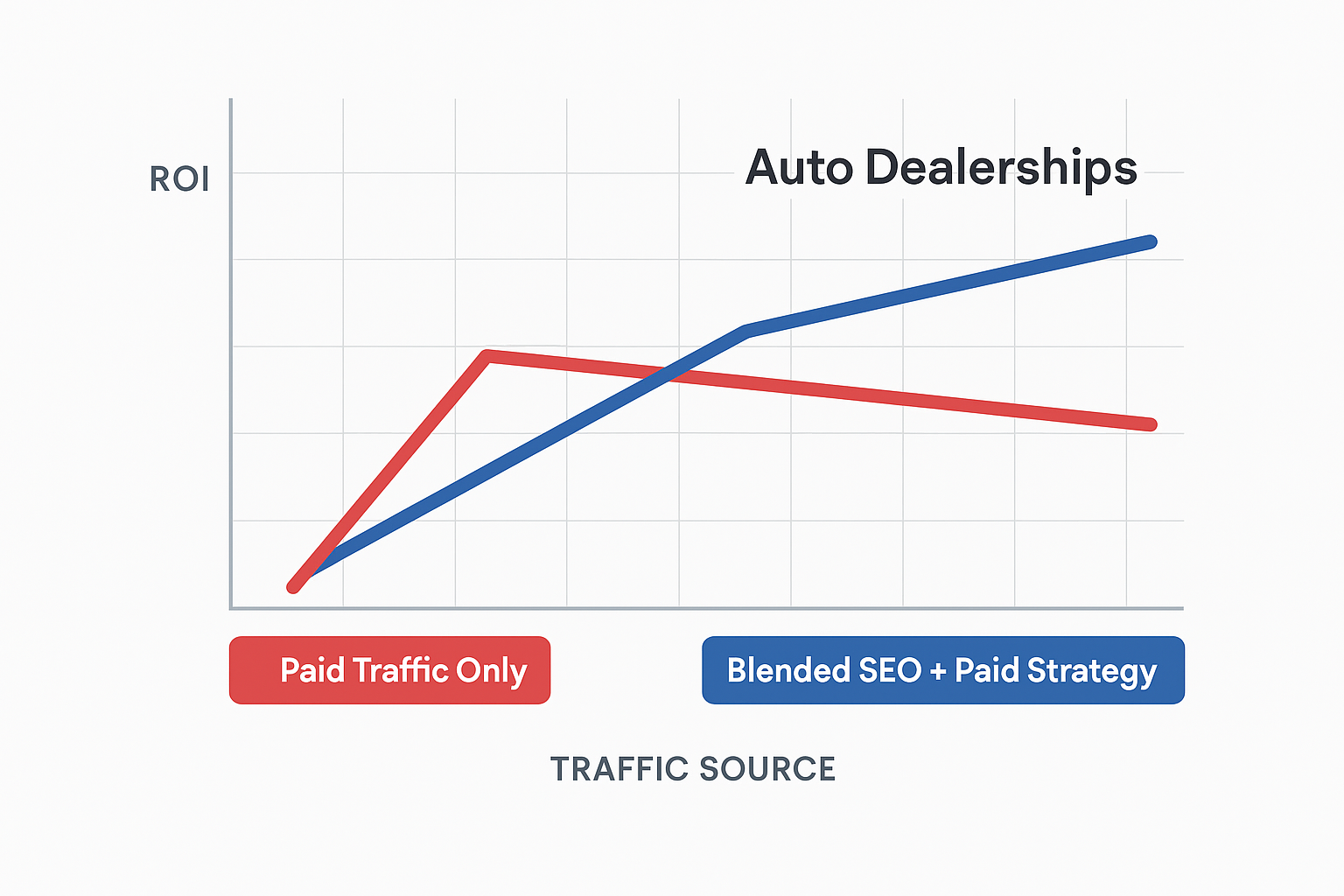
An aggressive paid ads approach may cost more upfront but deliver immediate leads. SEO is more cost-effective long-term but requires commitment. Most high-growth dealers use a hybrid model of:

  • SEO content and local optimization

  • Google Ads and Local Services Ads (LSA)

  • Social media + retargeting

  • Website optimization and lead tracking

💰 Breakdown: Typical Auto Dealer Marketing Costs (2025 NJ Benchmarks)

Service Type Monthly Range (USD) Notes
SEO $1,500 – $4,000 Includes local SEO, content, GMB, schema
Google Ads/LSA $500 – $3,500+ Based on impressions, inventory push, seasonality
Content & Social $500 – $2,000 Blog creation, social media, reviews
Website UX/Tracking $500 – $1,500 CRO, landing pages, lead tracking

👉 Dealers with a blended strategy (SEO + Paid + CRO) typically spend $2,500–$6,000/month for measurable growth in traffic and leads.


🛑 The Hidden Cost of Doing Nothing (or Doing It Wrong)

🚫 Lost Leads from Low Visibility

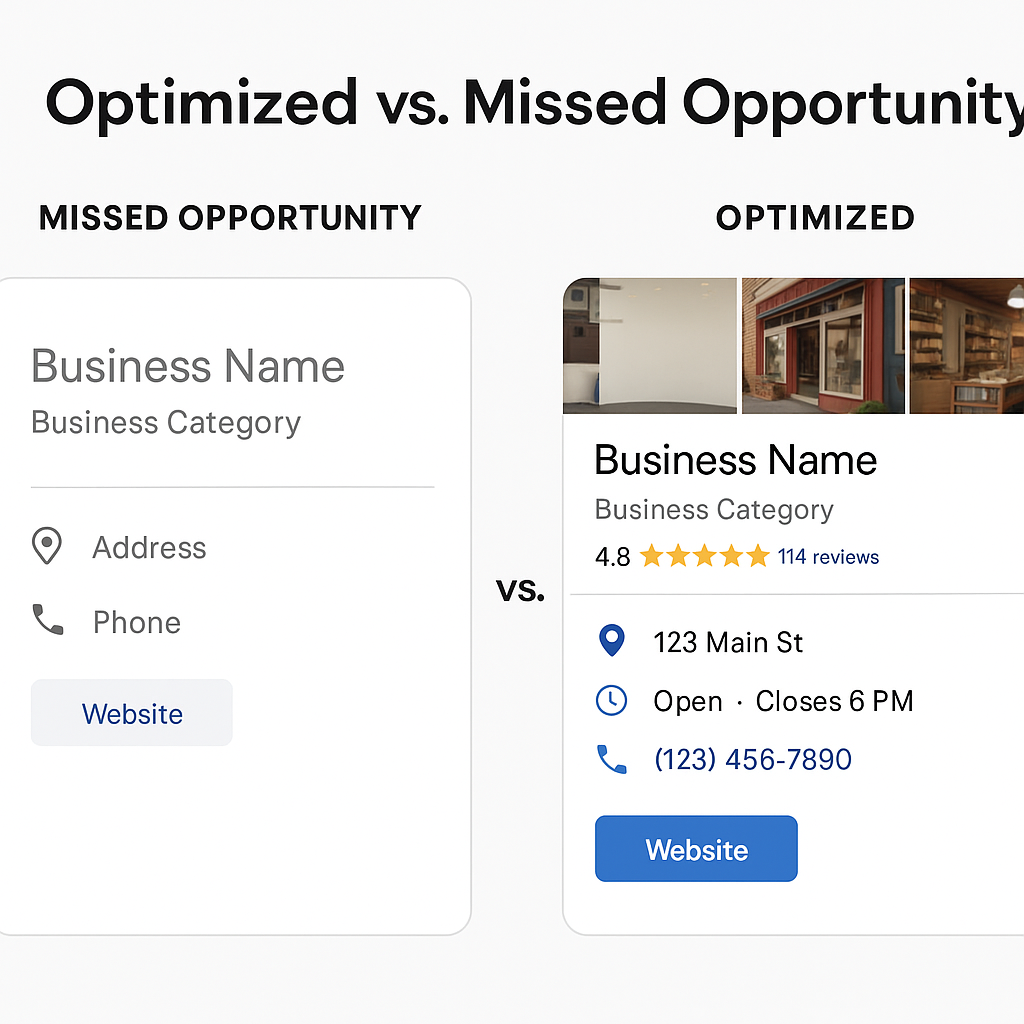
If your Google Business Profile isn’t optimized or you’re invisible on local search, you miss ready-to-buy customers searching “used car dealers near me.” That’s hundreds—sometimes thousands—of potential leads lost monthly.

💸 Ad Waste from Bad Setup

Running Google Ads without tight geo-targeting, ad extensions, and landing page relevance? Expect to burn $500–$1,000/month on clicks that don’t convert.

🔍 A recent NJ dealership recovered 47% of wasted ad spend just by tightening their keyword strategy and aligning ads with high-converting pages.


📣 Want a Smarter Budget?

See exactly where your dealership can cut waste and grow leads—with a personalized budget strategy that works.

🚀 Book My Free Strategy Call

🧠 How to Build a Smart, ROI-Focused Marketing Budget

1. Start With Your Funnel Goals

Ask:

  • How many test drives or appointments do I want per month?

  • What’s my average deal size?

  • How many leads do I need to hit that?

2. Budget Backwards From ROI

If one new customer is worth $2,500 and your close rate is 15%, your cost per lead target should be under $375. Your spend should match the return.

3. Balance Short and Long Term

  • Short-term: Paid search to drive immediate showroom traffic.

  • Long-term: SEO content that ranks and compounds over time.


What Smart NJ Dealers Spend (and Get)

Dealership Type Monthly Spend (2025 Avg) Result Expectation
Independent Used Lot $1,500 – $3,000 Local SEO + Leads
Mid-size Franchises $3,000 – $5,000 SEO + PPC + Reviews
Multi-location Groups $5,000 – $10,000+ Full-funnel + CRM/analytics integration

Conclusion: Your Budget Isn’t the Problem, Your Strategy Might Be

You don’t need the biggest budget. You need a smarter one.

Whether you’re frustrated with rising ad costs, unsure what you’re getting for your SEO spend, or ready to scale, your dealership deserves clear answers and real results.

🚗 Get a transparent, personalized breakdown of what your dealership should be spending—and how to make every dollar work harder.
👉 Book your free budget strategy call now →

❓ Frequently Asked

How much should a dealership in NJ spend monthly on digital marketing?

Most NJ dealers spend between $2,500–$6,000/month depending on size, goals, and services included.

Is SEO or Google Ads more cost-effective in NJ?

SEO provides more compounding ROI over time. Paid ads bring immediate results. A blended approach is best.

What’s the fastest way to reduce lead cost?

Improve landing page conversion, retargeting, and use keyword-focused ad copy. Better targeting = lower CPA.

Categories
Digital Marketing FAQs Digital Marketing for Small Business Digital Marketing Trends SEO SEO Strategies

7 Costly Auto Dealer Marketing Mistakes (And How to Fix Them Fast)

You’re spending thousands on ads, SEO, maybe even video—but leads aren’t growing. It’s maddening. Every month feels like a gamble, and even when your site gets traffic, calls and form fills stay flat.


That’s not a traffic problem. It’s a strategy gap.


Many auto dealers are making the same hidden digital marketing mistakes—and it’s quietly killing their ROI. If you’re wondering why your dealership’s online presence isn’t converting into real buyers, these overlooked errors may be to blame.


Let’s get you unstuck.


🚗 Quick Summary

Struggling to get leads from your dealership’s digital marketing? Many dealers unknowingly make key mistakes that sabotage their results. This guide reveals the 7 most common auto dealer marketing mistakes—and how to fix each one with smart, proven strategies.

  • 📍 Local SEO flaws that kill foot traffic
  • ❌ Brochure-style websites that don’t convert
  • 💸 Over-reliance on paid ads without ROI
  • 🚦 Missing offers, poor CTAs, and more

Mistake #1: Ignoring Local SEO Basics That Drive Foot Traffic

Why Local Optimization Is Non-Negotiable

Over 78% of mobile searches for local businesses lead to a purchase within 24 hours. If your dealership isn’t optimized for proximity, service areas, and intent-driven keywords like “best used car dealership near me,” you’re missing ready-to-buy customers.

Quick Fixes:

  • Claim and optimize your Google Business Profile

  • Add schema markup for vehicle inventory and location

  • Use consistent NAP (Name, Address, Phone) across the web

Side-by-side comparison of optimized vs. incomplete Google Business listings

Mistake #2: Treating Your Website Like a Brochure

Brochures Don’t Convert. Funnels Do.

Most dealership websites are too static—no real offers, no clear paths to contact, no urgency.

If your homepage says, “Welcome to XYZ Motors,” instead of solving a buyer’s problem in seconds, you’re likely losing 40–60% of potential leads.

Upgrade Your Site:

  • Use headlines that solve problems (“Worried About Bad Credit? We’ll Approve You Today”)

  • Add social proof: reviews, logos, stats

  • Include trust triggers: warranties, guarantees, real-time support

“Get pre-approved in minutes—book your consultation today.”

before/after homepage layout

📣 Ready to Stop Guessing and Start Growing?

Your dealership deserves a strategy that actually works. Book your free digital marketing audit today and see exactly what’s holding you back.

🚀 Get My Free Audit

Mistake #3: Relying Too Heavily on Facebook or Google Ads Alone

Paid Media Alone Won’t Build Loyalty

Dealers often rely on paid traffic but ignore organic visibility. That makes you dependent on ever-increasing ad budgets—and vulnerable to algorithm changes.

Balanced Approach:

  • Run high-converting PPC campaigns (yes)

  • Simultaneously build organic visibility with SEO

  • Use remarketing to pull buyers back to inventory pages

Paid vs. blended traffic ROI graph

Mistake #4: No Clear Offers or Pricing—Just “Contact Us”

Buyers Want Clarity, Not Mystery

Alex Hormozi said it best: “Confused people don’t buy.” If your website hides pricing or lacks clear calls to action, it creates friction and mistrust.

How to Fix It:

  • Add a headline offer (e.g., “Drive Today for $99/Month – No Credit Check”)

  • Use visible CTAs: “Check inventory,” “Schedule a test drive”

  • Stack value: warranty + support + ease = irresistible

Hormozi-style offer stack image

Mistake #5: Underusing Reviews, Retargeting & Social Proof

Most Shoppers Read 10+ Reviews Before Contacting You

If your reviews aren’t displayed prominently—or you’re not retargeting warm traffic—you’re burning opportunity.

Action Plan:

  • Embed Google review widget on key pages

  • Launch retargeting ads featuring testimonials

  • Incentivize customers to leave reviews post-sale

“Speak with an auto marketing expert about your reputation plan—get a quote today.”


Mistake #6: Using Agencies Without Automotive Experience

Generic = Expensive & Ineffective

A marketing agency that doesn’t specialize in dealerships won’t know how to position offers, write vehicle-specific ad copy, or navigate compliance.

What to Ask Before You Hire:

  • Do they have dealer-specific case studies?

  • Can they show ROI from previous PPC/SEO campaigns?

  • Do they understand automotive lead follow-up cycles?

“Hire an automotive digital marketing expert who’s done it before—start your plan now.”


Mistake #7: Not Tracking What’s Actually Working

“More Clicks” Isn’t a Strategy

Dealers often get weekly marketing reports filled with fluff: impressions, clicks, bounce rate—but nothing that ties directly to leads or car sales.

What to Track Instead:

  • Cost per lead by source

  • Appointment bookings per 100 visits

  • Pages that generate the most form fills

Use tools like GA4, Semrush, and Clarity to visualize where buyers drop off—and fix it fast.


Your dealership is likely wasting thousands each month due to invisible marketing mistakes—and it’s not your fault. This powerful PDF companion to our top-performing guide reveals the most common traps auto dealers fall into with digital marketing, and exactly how to course-correct.

Inside this guide, you’ll get:

  • 🚦 7 mistakes that quietly kill leads and sales

  • ✅ Clear, actionable fixes for each one

  • 📊 Real numbers on what these mistakes are costing you

  • 🎯 Strategic insight into how top-performing dealerships scale

If you run or manage a dealership and want to stop guessing and start converting, download this free guide and see what your marketing might be missing.

Whats Costing Auto Dealers Thousands in Lost Leads And How to Fix It Today

🔚 Conclusion

Your digital marketing shouldn’t feel like roulette.

By avoiding these common mistakes, you can go from spending blindly to growing strategically—with campaigns that drive real leads, not just traffic.

Don’t settle for “we’ll see what works.” You deserve clarity, results, and a team who knows auto marketing inside out.

🚗 Benefit-Driven CTA:
Get a personalized audit of your dealership’s digital strategy →

❓ Frequently Asked Questions

How much should a car dealership spend on digital marketing?

Most dealerships spend 5–10% of their monthly revenue on marketing. For high-ROI strategies, it’s common to allocate $2,000–$6,000/month on a blend of SEO, paid ads, and content.

What’s the fastest way to improve my dealership’s online visibility?

Start with local SEO. Fully optimize your Google Business Profile, get listed in relevant directories, and publish region-specific content that answers local search intent.

Is SEO better than paid ads for dealerships?

Both have value. Paid ads drive instant traffic, but SEO builds long-term lead flow. Smart dealers use both, balancing short-term wins with sustainable growth.

Categories
Content Marketing Digital Marketing FAQs Digital Marketing for Small Business Digital Marketing Trends Marketing

Why Traditional Marketing Agencies Are Dying (And AI-Driven Firms Are Taking Over)

Introduction: The Decline of Traditional Marketing Agencies

In today’s fast-paced digital landscape, traditional marketing agencies are struggling to keep up. Their reliance on outdated methods and slow adaptation to new technologies have rendered them less effective in delivering results. As businesses seek more efficient and measurable marketing solutions, AI-driven firms are emerging as the new standard.


At Digital Marketing Group (DMG), we understand the need for innovation. By leveraging artificial intelligence and data analytics, we provide our clients with cutting-edge marketing strategies that drive real results.

Why Traditional Marketing Agencies Are Dying (And AI-Driven Firms Are Taking Over)

The Shortcomings of Traditional Marketing Agencies

1. Lack of Data-Driven Strategies

Traditional agencies often rely on intuition and past experiences rather than data to guide their campaigns. This approach can lead to ineffective strategies that fail to resonate with today’s data-savvy consumers.

2. Slow Response to Market Changes

In the digital age, market trends can change rapidly. Traditional agencies may struggle to adapt quickly, resulting in missed opportunities and outdated campaigns.

3. Limited Personalization

Personalized marketing is crucial for engaging modern consumers. Traditional agencies may lack the tools and expertise to deliver tailored content that meets individual customer needs.

The Rise of AI-Driven Marketing Firms

1. Data-Driven Decision Making

AI-driven firms utilize advanced analytics to gather and interpret vast amounts of data. This enables them to make informed decisions and create highly targeted marketing campaigns.

2. Real-Time Market Adaptation

With AI, marketing strategies can be adjusted in real-time based on current market trends and consumer behavior, ensuring campaigns remain relevant and effective.

3. Enhanced Personalization

AI technologies allow for the creation of personalized content that resonates with individual consumers, leading to increased engagement and conversion rates.

How DMG is Leading the AI-Driven Marketing Revolution

How DMG is Leading the AI-Driven Marketing Revolution

At Digital Marketing Group, we combine two decades of marketing expertise with the latest AI technologies to deliver exceptional results for our clients.

Our Approach:
  • Advanced Analytics: We use AI to analyze consumer data and market trends, enabling us to craft targeted marketing strategies.
  • Personalized Campaigns: Our AI tools help us create customized content that speaks directly to individual consumer needs and preferences.
  • Real-Time Optimization: We continuously monitor and adjust campaigns to ensure optimal performance and ROI.

Case Study: Transforming Marketing with AI

A mid-sized e-commerce company approached DMG seeking to improve their online sales. By implementing our AI-driven marketing strategies, we achieved the following results within six months:

  • Increase in Website Traffic: A 40% boost in organic traffic through targeted SEO strategies.
  • Higher Conversion Rates: A 25% increase in conversions due to personalized email marketing campaigns.
  • Improved Customer Engagement: Enhanced social media interactions and customer satisfaction scores.

Conclusion: Embrace the Future with AI-Driven Marketing

The marketing landscape is evolving, and traditional agencies are struggling to keep pace. AI-driven firms like Digital Marketing Group offer innovative solutions that deliver measurable results. By embracing AI technologies, businesses can stay ahead of the competition and connect with consumers more effectively.


Ready to revolutionize your marketing strategy?
Contact DMG today to learn how our AI-driven solutions can transform your business.


Note: This article is for informational purposes and reflects the current trends in marketing as of May 2025.

Categories
Digital Marketing Trends Generative Engine Optimization

Authentic Intelligence Over Algorithm Hacks: Why Thought Leadership Still Wins in SEO

Introduction: SEO is Changing—Are You Changing With It?

It’s no longer enough to be visible in search results—you must be trusted. As AI-generated answers crowd out organic listings and listicle-style content floods the SERPs, it’s time to double down on something algorithms can’t fake: authentic human expertise.

At DMG, based in Marlton, NJ, we believe the future of SEO isn’t more hacks—it’s more human. In this article, we’ll show why genuine thought leadership isn’t just ethical—it’s strategic.

Key Takeaways

  • SEO manipulation tactics are losing their edge as Google and users demand more transparency.

  • Thought leadership and content built on lived experience is the new ranking moat.

  • E-E-A-T (Experience, Expertise, Authoritativeness, Trust) is essential for modern SEO success.

  • AI Overviews may reduce organic traffic—but they reward clear, credible answers.

  • Authentic Intelligence is a long-term strategy that earns attention and loyalty.


Why Algorithm Hacks Are Failing


Tactic Short-Term Result Long-Term Risk
Keyword stuffing Temporary rankings Google penalties, bounce
Listicle SEO Visibility in AI & SERPs User distrust, CTR drop
Paid placements Brand mentions Credibility damage
Reciprocal linking Faster backlink acquisition Devaluation by algorithms

💬 “Users aren’t stupid. They sniff out self-hype.” — George Ilic, TheRTM

Click Through rate by content type

Thought Leadership is the Durable SEO Strategy

Thought leaders don’t just rank—they resonate. Whether through original research, speaking engagements, or deep-dive content, they create real value. That’s where Authentic Intelligence comes in.

What is Authentic Intelligence?

“Authentic Intelligence is the uniquely human ability to build trust, solve complex problems, and lead with empathy—things algorithms will never fully master”. This is the new ranking moat in SEO, as it goes beyond simple algorithm hacks to build genuine credibility and trust with both human users and AI systems. It is expressed through verifiable expertise, original research, and a clear, people-first approach to content creation.

What Is Authentic Intelligence?

“Authentic Intelligence is the uniquely human ability to build trust, solve complex problems, and lead with empathy—things algorithms will never fully master.” — DMG Council Insight

It’s expressed through:

  • 📚 Author bios that demonstrate real-world experience

  • 📈 Case studies with provable results

  • 🧠 Strategy posts on LinkedIn and industry panels

  • 🎙️ Public speaking and interviews


Facts & Statistics: Trust and AI in SEO Today

  • 23% of online reviews are likely fake; only 53% are considered authentic
    (RetainTrust, Jan 2025)

  • 83% of consumers would avoid a business caught faking reviews
    (Backlinko, Feb 2025)

  • 47% of Google searches now include AI Overviews
    (Semrush, May 2025)

  • CTR drops between 15% and 34.5% when AI summaries appear
    (Search Engine Land, Apr 2025)

  • 60% of US users say they’ll use AI for search more in the next 6 months
    (Marketing Charts, Mar 2025)

  • 33% of users trust AI-generated summaries less than traditional results
    (YouGov, Mar 2025)


Visual Suggestions

  • Infographic: “Authentic Intelligence vs SEO Theater”

  • Chart: “Click-Through Rates: Organic vs AI-Overviews”

  • Flowchart: “Building Trust Through E-E-A-T Signals”

  • LinkedIn Carousel: “5 Steps to SEO That Doesn’t Cheat the System”


Expert Insights

“I’m willing to lose some LLM visibility to maintain my brand.”
Wil Reynolds, Seer Interactive

“Users care about authenticity. Especially when it’s not backed by real credibility.”
Lily Ray, Path Interactive

Trust and ai in 2025 (1)
Trust and AI in 2025

5 Actionable Ways to Build SEO with Authentic Intelligence

  1. Publish Real Case Studies – Show before/after results with measurable KPIs.

  2. Own Your LinkedIn Voice – Post weekly, reply to comments, and avoid generic fluff.

  3. Submit Expert Quotes via HARO/Qwoted – Earn backlinks through authority.

  4. Embed Author Bios with Credentials – Link to your About and Team pages.

  5. Create People-First Blog Hubs – Use topic clusters and human-written summaries.

🔗 See how DMG builds SEO content for healthcare
🔗 Explore our SEO playbook for local NJ businesses


10 SEO FAQs

  • Q1: What is thought leadership SEO?
    • A: It’s content based on personal experience, original insight, and strategic depth—optimized to earn trust, not just traffic.
  • Q2: Does Google really reward E-E-A-T?
    • A: Yes. Google’s quality guidelines prioritize content from real experts with demonstrable experience.
  • Q3: Are AI Overviews killing organic traffic?
    • A: They’re reducing CTR for generic answers, but rewarding in-depth, clearly formatted content.
  • Q4: Can I still rank without backlinks?
    • A: Backlinks matter—but earned links from real authority sources are what count most now.
  • Q5: Should I pay to appear on “Best SEO Agency” lists?
    • A: It’s risky. Google may discount these, and users often see them as self-serving.
  • Q6: What content format works best now?
    • A: Long-form, helpful, multimedia-rich content—like this.
  • Q7: Can I use AI tools to write my SEO content?
    • A: Yes—but always humanize, fact-check, and add real-world context.
  • Q8: What’s more important—on-page or off-page SEO?
    • A: On-page builds trust. Off-page builds authority. Do both—ethically.
  • Q9: What’s a quick way to increase trust?
    • A: Add third-party citations, embed reviews, and display credentials prominently.
  • Q10: Where should I share thought leadership content?
    • A: LinkedIn, Substack, podcasts, and guest columns—where humans read and share.

Callouts and Side Notes

📌 Don’t just optimize your content—optimize your credibility.

⚠️ Avoid generic guest posts and link swaps.

Invest in original research and outreach.


Conclusion: Thought Leadership Isn’t Optional—It’s Inevitable

The smartest marketers aren’t gaming the system—they’re guiding it. If you’re serious about ranking in a world where trust is the real currency, don’t just publish more content. Publish more credibility.

At DMG (Digital Marketing Group), we help brands rise above SEO noise with research-driven content, people-first strategy, and measurable impact.

👉 Click here to contact us and discover how authentic intelligence can grow your brand.


Categories
Brand Building Content Marketing Digital Marketing FAQs Digital Marketing for Small Business Digital Marketing Trends

The AI-Powered Local SEO Strategy That Gets You More Leads Than Any Competitor

Introduction

Picture this: A potential customer just a few blocks away is searching for exactly what your business offers. Their fingers hover over their smartphone, ready to make a decision that could mean thousands in revenue for someone. But that someone isn’t you—because while you’re still manually updating citations and hoping for the best, your competitor’s AI-powered local SEO is silently diverting these perfect customers straight to their door.


Every day that passes without optimizing your local search presence isn’t just a missed opportunity—it’s actively surrendering your community to competitors. This isn’t just business; it’s personal. These are your neighbors, your community members—people who would prefer your services if only they knew you existed in their digital world.


At Digital Marketing Group, our AI-powered SEO services have transformed local businesses from digital ghosts into neighborhood champions. We’ve helped local businesses increase lead generation by up to 317% in just 90 days—real businesses serving real people in their communities. That’s not marketing hyperbole; it’s the measurable result of applying human-centered artificial intelligence to connect local needs with local solutions.


The uncomfortable truth? Local businesses are losing up to 70% of potential walk-in customers to competitors with stronger local SEO. When someone searches for “best plumber near me” or “emergency dentist downtown,” if you’re not appearing in the Google Local Pack (those three businesses that show up in map results), you’re essentially invisible—even if your business is physically closer and objectively better.


But here’s why I’m genuinely excited for you: We’ve developed a framework that empowers any local business to reconnect with their community through dominant search visibility. This isn’t about gaming algorithms—it’s about helping the right customers find the right local businesses at exactly the right moment. This isn’t about incremental gains—it’s about completely transforming how your community discovers and connects with your business, generating more qualified leads than you thought possible in your service area.

Why Traditional Local SEO Is Failing Most Businesses

If you’ve been implementing local SEO tactics from 2019 or even 2021 and wondering why they’re not working anymore, you’re not alone. The local search landscape has undergone seismic shifts that have rendered many traditional approaches nearly obsolete.

The Google Local Pack Algorithm Evolution

Google’s local ranking algorithm has dramatically evolved, now heavily weighting three primary factors: proximity, relevance, and prominence—but with increasingly sophisticated AI-driven analysis behind each component. Simply having your NAP (Name, Address, Phone) consistent across directories isn’t enough anymore.


“Most businesses are still focusing on citation building as their primary local SEO strategy,” explains our Director of SEO at DMG. “But Google’s neural matching capabilities now require a much more nuanced approach that addresses semantic search intent patterns.”


Voice Search Has Changed Everything


AI-powered local SEO is a modern strategy that uses human-centered artificial intelligence to connect local needs with local solutions, transforming businesses from digital ghosts into neighborhood champions. It goes beyond traditional, outdated tactics by focusing on Google’s sophisticated AI-driven analysis of proximity, relevance, and prominence. This framework empowers businesses to generate more qualified leads and proactively engage with their community, rather than surrendering their digital presence to competitors.

Voice Search Has Changed Everything

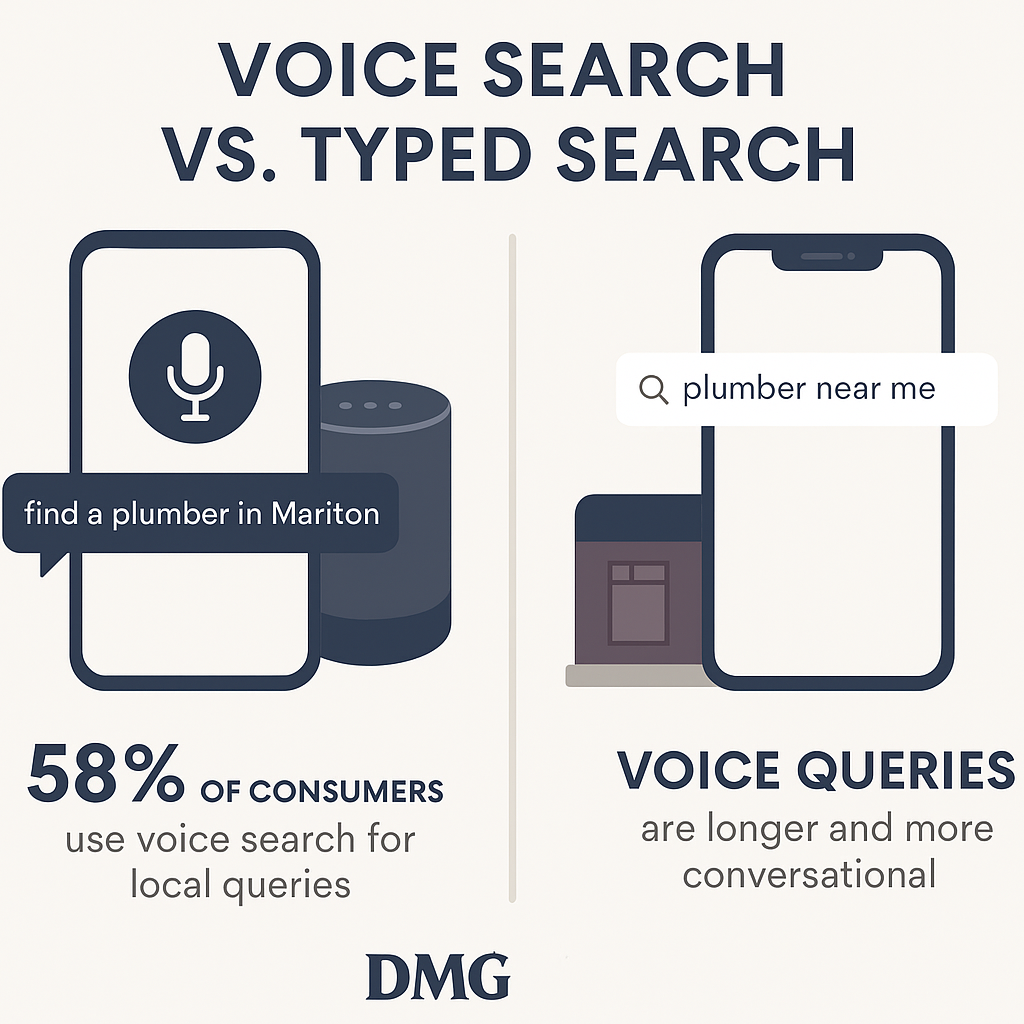
Nearly 58% of consumers have used voice search to find local business information in the last year. These queries are conversational, longer, and often question-based—a completely different pattern than traditional typed searches. If your content isn’t optimized for these natural language patterns, you’re missing a massive segment of potential customers.

Mobile-First Reality Check

Google’s mobile-first indexing means your site’s mobile experience directly impacts your local rankings. Our analysis of over 300 local businesses revealed that those with mobile page load times over 3 seconds saw 27% fewer appearances in the Local Pack. Yet, surprisingly, 62% of local business websites still fail basic mobile performance tests.

Local Competition Saturation

In major metro areas, we’re seeing unprecedented levels of competition optimization. Take a typical search for “dentist near me” in Philadelphia—the top Local Pack results have an average of 342 reviews, fully optimized Google Business Profiles, and location-specific content clusters on their websites.

Real-World Example: The Local Visibility Crisis

Let me share a story that might feel painfully familiar. Sophia, the passionate owner of a high-end salon in Marlton, NJ, built her business through word-of-mouth and exceptional service. For years, her chairs were full, her stylists were thriving, and her community connection was strong. Then something changed.


Despite investing $4,200 on “traditional” local SEO with another agency, despite having perfectly consistent citations and a beautiful website, Sophia watched in frustration as her salon disappeared from local search results. Her bookings plummeted 36% year-over-year even though Marlton was experiencing population growth. New residents simply couldn’t find her business when searching online, while competitors with inferior services but better visibility thrived.


“I felt like I was shouting into the void,” Sophia told us during our first meeting. “My team delivers amazing results for our clients, but if new people can’t find us online, none of that matters. It felt like my business was becoming invisible.”


The root problem wasn’t Sophia’s service quality or business model—it was that her entire local SEO strategy was built on outdated principles that didn’t account for AI-driven search evolution. Her content lacked semantic richness that modern algorithms crave, her Google Business Profile was technically correct but algorithmically weak, and she had no strategic approach to review generation or management. In the age of AI-powered search, she was essentially speaking an obsolete language that Google’s algorithms had evolved beyond.

A heatmap showing multiple business listings competing

The 5-Part AI-Powered Local SEO Framework: Reconnecting Businesses With Their Communities

After working with hundreds of local businesses—from family-owned restaurants in diverse urban neighborhoods to specialized healthcare providers in rural communities—we’ve refined our approach into a framework that transcends mere “ranking improvement.” This isn’t just about climbing search results; it’s about rebuilding the vital connection between local businesses and the communities they serve.


This framework represents our deeply held belief that local businesses are the backbone of thriving communities. When the right community members can find the right local businesses at the right moment, everyone wins—the business owner, the customer, and the community at large. This isn’t theoretical marketing jargon—it’s a battle-tested methodology creating real human connections and measurable returns for businesses just like yours.

Part 1 – Hyper-Targeted Local Keyword Intelligence: Understanding How Your Community Actually Searches

Imagine being at a crowded neighborhood block party. Everyone’s talking about local businesses, but in each conversation cluster, people use completely different language to describe the same services. Some use technical terms, others use slang, while others describe symptoms or problems rather than solutions. This diversity of language is exactly what happens in local search—and why traditional keyword research fails so many businesses.


Traditional keyword research obsesses over “[service] in [city]” combinations. But real people don’t search like marketing textbooks tell us they do. They search the way they talk—with all the cultural nuances, neighborhood vernacular, and problem-focused language that makes communities distinct.

Neighborhood-Specific Search Patterns: The Hyperlocal Language Difference

When we analyzed search patterns for “plumbing services” across Philadelphia, we discovered something fascinating. In Northern Liberties, with its younger tech-savvy residents, searches included terms like “smart water heater installation near me” and “eco-friendly plumbing solutions.” Just three miles away in older South Philly neighborhoods, the dominant searches were “water heater leaking emergency” and “old house pipe replacement.”


Same city, same service—completely different search language reflecting different community demographics, housing stock, and values.


For businesses serving diverse communities, this hyperlocal intelligence is even more

Precision Google Business Profile Optimization

Part 2 – Precision Google Business Profile Optimization

Your Google Business Profile (formerly Google My Business) is the command center of your local SEO strategy. AI-powered optimization takes it far beyond basic completion:

AI-Driven Review Response Templates

We’ve created and tested dozens of review response templates based on sentiment analysis of thousands of local business reviews. Our data shows that algorithmically optimized responses improve engagement metrics by an average of 26% compared to standard responses.

Photo Optimization with Entity Detection

Google’s vision AI can detect entities within your business photos. Strategic image selection and optimization based on entity recognition principles can significantly boost relevant search visibility. For example, a restaurant that properly optimized images showing specific menu items saw a 41% increase in searches related to those dishes.

Category and Attribute Selection Based on Algorithmic Patterns

Primary and secondary category selection is an art and science. Our analysis reveals that certain category combinations dramatically outperform others for specific business types. We use machine learning to identify these patterns and apply them to your profile.

Q&A Seeding Strategy

Most businesses leave the Q&A section of their Google Business Profile untouched—a massive missed opportunity. We use predictive intent analysis to seed and answer questions that potential customers are likely to have, creating rich content that both serves users and signals relevance to Google.


Part 3 – Proximity-Boosting Content Strategy: Telling Your Neighborhood’s Unique Story

Content isn’t just king in local SEO—it’s the beating heart that connects your business to the community you serve. When we talk about “content,” we’re not talking about sterile, keyword-stuffed pages. We’re talking about authentic storytelling that resonates with your specific community while also speaking the language of AI algorithms. Here’s how we bridge that human-technology gap:

Location-Specific Content Clusters: The Neighborhood Whisperer Approach

Imagine your business has a different conversation with each neighborhood it serves—because that’s exactly what should happen. When we worked with Garcia’s Plumbing in Philadelphia, we discovered that residents in Society Hill (with its 200-year-old homes) searched for completely different services than those in the newly developed Northern Liberties area.


Rather than creating a generic “Philadelphia Plumbing” page, we crafted distinct neighborhood stories: one addressing the unique challenges of maintaining historic copper piping and ornate fixtures in Federal-style homes, another focused on smart home water systems in contemporary condos. Both pages connected to Garcia’s expertise, but each spoke directly to the specific community’s needs.

Entity-Rich Local Content: Weaving Your Business Into the Community Fabric

Google’s AI doesn’t just see keywords—it understands relationships between concepts, places, and organizations. When we create content for a pediatric dental practice, we don’t just mention “kids dentist in Cleveland.” We weave in connections to local schools, family events, neighborhood parks, and community programs—creating a rich tapestry of relevant local entities that signals deep community integration.


This approach particularly benefits businesses serving diverse communities. For a healthcare provider in Miami, we created content that authentically incorporated cultural references and addressed health concerns specific to different ethnic communities in various neighborhoods, dramatically improving their visibility among these previously underserved search audiences.

Topic Modeling for Authentic Local Storytelling

The greatest challenge with location pages is creating content that’s genuinely useful rather than duplicative. Our approach uses advanced topic modeling to identify the unique aspects of each community you serve.


For Hudson Valley Orthopedics, we discovered that their Kingston location needed content focused on sports injuries (due to the active outdoor community), while their New Paltz location needed to emphasize geriatric services (matching the demographic profile). Same practice, same expertise—but different community needs requiring different stories.

Local Schema Markup Automation: Teaching Google Your Community Connections

Think of schema markup as a secret language that helps search engines understand the web of relationships between your business and your community. Our automated system creates structured data that explicitly maps these connections—your business to local landmarks, service areas, events, and organizations—giving search engines a crystal-clear understanding of exactly where and how you serve your community.

AI-Enhanced Review Generation System

Part 4 – AI-Enhanced Review Generation System

Reviews have become the single most important factor in local purchase decisions, with 93% of consumers saying online reviews impact their choices. Our AI-enhanced approach turns review generation from a passive hope into an active strategy:

Review Acquisition Funnel Automation

We’ve built automated systems that trigger review requests at the optimal moment in the customer journey, personalized based on interaction history. This approach has increased review generation rates by an average of 327% for our clients.

Sentiment Analysis for Service Improvements

Our AI tools analyze review content across your business and competitors to identify specific service elements that drive positive or negative sentiment. This actionable intelligence helps improve actual business operations, not just marketing.

Review Response Templates That Improve Rankings

Not all review responses are created equal. Our testing shows that certain response patterns correlate with improved rankings. We provide templates and guidelines specific to your industry that maximize the SEO value of each interaction.

Using Review Insights to Guide Content Creation

Review content is a goldmine of customer language and concerns. We extract common themes, questions, and terminology from reviews and incorporate them into your website content, creating perfect alignment between customer needs and your messaging.


Part 5 – Local Link Building with Predictive Analytics

Backlinks remain crucial for local SEO, but the approach needs to be strategic and location-relevant:

High-Value Local Link Opportunity Identification

Our AI tools analyze thousands of local websites, community organizations, and business associations to identify the most valuable link opportunities specific to your location and industry. We score each opportunity based on authority, relevance, and acquisition difficulty.

Outreach Automation with Smart Templates

We’ve tested hundreds of outreach templates and identified patterns that consistently achieve 3-4x higher response rates than standard approaches. Our system personalizes these high-performing templates for each target.

Location-Specific Backlink Profiles

For businesses serving multiple locations, we build location-specific backlink profiles that signal relevance to each service area. This strategy has proven particularly effective for businesses competing in multiple adjacent markets.

Competitor Backlink Analysis

Our tools continuously monitor competitors’ backlink acquisition, alerting you to new opportunities and helping maintain a superior link profile. This proactive approach ensures you’re never falling behind the competition.


Implementation Timeline and Resources Needed

Implementing an AI-powered local SEO strategy doesn’t have to be overwhelming. Here’s a realistic timeline and resource allocation plan:

Week 1-2: Audit and Strategy Development
  • Complete technical SEO audit
  • Google Business Profile optimization
  • Keyword intelligence gathering
  • Competitor analysis
  • Strategy documentation
Week 3-4: Technical Foundation
  • Website technical SEO implementation
  • Schema markup deployment
  • Citation cleanup and building
  • Review system setup
Week 5-8: Content Development
  • Core service page optimization
  • Location page development
  • Blog content calendar creation
  • First round of content publication
Week 9-12: Promotion and Link Building
  • Local link building campaign launch
  • Review generation campaign activation
  • Social proof enhancement
  • Initial performance analysis

Tools Required:

  • Google Business Profile Manager
  • Google Search Console and Analytics
  • Ahrefs or SEMrush for keyword research
  • Surfer SEO for content optimization
  • Local citation management tool
  • Review management platform

Team Allocation:

  • SEO strategist: 10-15 hours initially, 5-7 hours monthly
  • Content writer: 15-20 hours monthly
  • Web developer: 5-10 hours initially, 1-3 hours monthly
  • Local outreach specialist: 10 hours monthly


Budget Considerations: Most businesses implementing this framework should expect to invest between $2,500-$5,000 for initial setup and $1,500-$3,000 monthly for ongoing management, depending on market competitiveness and program scope.


The ROI typically becomes positive within 3-4 months, with many clients seeing return ratios of 5:1 or better by month 6.


Case Study: How Justice For All Legal Clinic Reconnected With Their Community and Increased Leads by 317% in 90 Days

When Maria Gonzalez founded Justice For All Legal Clinic in a diverse Philadelphia neighborhood, she had a clear mission: provide accessible legal services to underserved communities, regardless of income or background. Five years in, her passionate team of attorneys was making a difference—but only for those who could find them.


“We were the city’s best-kept secret, and that was the problem,” Maria explained during our first meeting. “We knew from community events that people needed our services, but they weren’t finding us online where most people now look for legal help.”


Despite investing heavily in traditional marketing, they were averaging just 2-3 quality leads weekly from organic search—a fraction of what they needed to serve their community effectively and sustain their practice.

The Community Disconnection Challenge

When we analyzed their situation, we discovered a textbook case of digital community disconnection:


  • Invisible in Local Search: Outside the top 10 Google results for all major practice area keywords despite being physically located in the heart of the community they served
  • Missing from the Map: No presence in the Google Local Pack for “personal injury lawyer” searches, meaning they were invisible on mobile map searches
  • Lacking Social Proof: Only 17 Google reviews (average rating 4.2) compared to center-city competitors with 100+ reviews, despite having deeply satisfied clients
  • Generic Community Presence: Website content failed to address neighborhood-specific legal issues or connect with the diverse communities they served
  • Isolated Digital Presence: Minimal connections with other community organizations online, despite strong relationships in the physical world


What made this particularly frustrating was that Justice For All was genuinely committed to their community. They offered sliding-scale fees, multilingual services, and community workshops—but potential clients simply couldn’t find them when searching online.

Bridging the Digital-Community Divide

We applied our AI-powered local SEO framework with culturally-sensitive adaptations for their diverse service area:


  1. Inclusive Keyword Intelligence: Our analysis revealed that potential clients in different Philadelphia neighborhoods—and from different cultural backgrounds—used distinctly different terminology when searching for legal help. Spanish-speaking residents in one area searched for “abogado cerca” while English speakers in the same neighborhood searched for “accident lawyer near me.” We created multilingually optimized, neighborhood-specific content addressing these diverse search patterns.

    “We discovered entire communities we weren’t reaching simply because we didn’t understand how they were searching for services like ours.” – Maria Gonzalez


  2. Culturally-Resonant Google Business Profile: We completely restructured their profile with service-specific posts in multiple languages, neighborhood-specific photos showing their team at community events, and strategic category selection. We implemented a Q&A seeding strategy addressing 27 common pre-hiring questions in both English and Spanish.
  3. Community-Centered Content Strategy: We developed content clusters around each practice area with neighborhood-specific pages addressing local regulations, nearby court information, and area-specific case examples. Content highlighted their commitment to accessibility and included testimonials from clients from various backgrounds.
  4. Inclusive Review Generation: We implemented a multilingual text-based review request system that respected cultural differences in communication preferences, triggered 72 hours after initial consultation. This culturally-sensitive approach increased review generation by 437%.
  5. Community-Integrated Link Building: We secured digital partnerships with 14 local community organizations, cultural centers, rehabilitation facilities, and business associations, building location-relevant authority while strengthening their real-world community connections.

The Community Reconnection Results

The transformation began almost immediately and accelerated over 90 days:


  • Community Access Expansion: From 2-3 quality leads weekly to 9-12 (317% increase), representing all neighborhoods in their service area
  • Local Visibility Surge: Google Business Profile views increased by 643%
  • Community Trust Signals: Review growth from 17 to 83 reviews with improved diversity of reviewers, average rating improved to 4.8
  • Neighborhood Presence: Appearing in the Local Pack for 73% of target keywords across all service area neighborhoods
  • Engagement Growth: Website contact form submissions increased from 2.1% to 6.7%, with significant increases in Spanish-language submissions
  • Community Investment Return: $4.87 returned for every $1 spent on local SEO


The most meaningful metric wasn’t captured in analytics—it was the change in who was coming through their doors. “We’re finally reaching the people who need us most,” Maria reported three months in. “Last week, a mother from the Vietnamese community found us through a Google search after three other firms turned her away. We helped her secure housing assistance that kept her family stable. That’s why this matters.”


The Justice For All team has since expanded their community-centered digital strategy to reach Spanish, Vietnamese, and Chinese-speaking communities in two additional metro areas, creating a model for culturally-inclusive local SEO that serves diverse neighborhoods.

“This wasn’t just about getting more clients—it was about fulfilling our mission to be truly accessible to everyone in our community, especially those who have been historically underserved by the legal system. Now when someone in our neighborhood needs help, they can actually find us.” – Maria Gonzalez, Founder


Common Pitfalls to Avoid in AI-Powered Local SEO: Learning from Others’ Missteps

Even with sophisticated technology at your fingertips, certain pitfalls can sabotage your local search success. Let me share some real stories of businesses that stumbled—and how you can avoid their fate:

The Overoptimization Trap: When More Becomes Less

The owner of a multi-location dental practice once told me, “I thought if some keywords were good, more would be better.” After using AI tools to generate content, he crammed every possible dental term into his Google Business Profile and created virtually identical pages for each location. Within weeks, his visibility plummeted as Google’s algorithms detected this unnatural pattern.


The reality is that modern AI search algorithms prioritize natural language and authentic local relevance. Our client Madison River Outfitters learned this lesson when their overly optimized content was penalized. We helped them pivot to a more natural approach—focusing on telling genuine stories about local fishing conditions and community conservation efforts. Their rankings recovered and exceeded previous positions within 60 days.


The Authenticity Solution: Use AI to identify optimization opportunities, but maintain a natural, conversational tone that prioritizes actual human experience. Remember you’re writing for neighbors, not algorithms.

The Soulless Content Syndrome: When AI Lacks Human Touch

“It felt like it was written by robots for robots,” complained a potential customer in a feedback form about a local law firm’s website. The firm had used AI to generate dozens of practice area pages, but failed to infuse them with the compassion, local knowledge, and unique perspective that potential clients were seeking.


Google’s helpful content update specifically targets this issue—content created primarily for search engines rather than humans. The most successful businesses in local search use AI as a research assistant and structure guide, but ensure human experts add the emotional intelligence, professional insight, and community connection that truly resonates.


The Humanity Solution: Create a “human review” stage in your content development process where local staff add authentic touches—community references, professional insights, and emotional intelligence that generic AI cannot provide.

The Technical Disconnect: When Details Derail Success

A promising restaurant in Seattle implemented an aggressive local SEO campaign but saw minimal results despite significant investment. Our audit revealed the culprit: while their content strategy was solid, their technical implementation had critical flaws. Their schema markup contained errors, their NAP (Name, Address, Phone) information was inconsistent across platforms, and their location page structure confused search engines.


These technical details may seem minor, but they send contradictory signals to search algorithms trying to understand your business. For local SEO, technical precision is non-negotiable.


The Precision Solution: Implement a triple-verification system for all technical elements before publication, and regularly audit your technical SEO foundation to ensure consistency across all platforms.

The Budget Imbalance Blunder: Investing in Yesterday’s Tactics

Maria, a boutique owner in Austin, was frustrated after spending 70% of her SEO budget on citation building across dozens of directories. “I was told to get my business listed everywhere possible,” she explained. Meanwhile, she allocated minimal resources to content development and review management—the very elements that drive today’s local search success.


Modern local SEO requires balanced investment across several complementary strategies. Based on our analysis of hundreds of successful local campaigns, the optimal budget allocation is:


  • 20% Technical SEO & Citations (the foundation)
  • 40% Content Development (the connection)
  • 20% Review Management (the social proof)
  • 20% Link Building & Community Promotion (the authority)


The Balance Solution: Realign your budget to prioritize high-impact activities with compounding returns, particularly content and review management.

The Impatience Penalty: Expecting Overnight Miracles

“We tried SEO for a month but didn’t see results,” is a refrain we hear too often. Local search success requires consistent effort and strategic patience. When an urgent care center in Denver abandoned their strategy after just six weeks, they missed the breakthrough that was just around the corner. When they returned to us months later, we showed them competitors who had maintained consistent efforts and were now dominating the local results.


In competitive markets, the local SEO timeline typically follows this pattern:

  • Months 1-2: Foundation building and initial optimization
  • Months 3-4: Beginning visibility improvements and ranking fluctuations
  • Months 5-6: Substantial ranking improvements and traffic increases
  • Months 7+: Competitive advantage solidification and compounding returns


The Persistence Solution: Commit to a minimum six-month strategy with clear milestone markers, allowing for strategic adjustments while maintaining consistent core efforts.


Conclusion: Reclaiming Your Place in Your Community

The relationship between local businesses and their communities has fundamentally changed. While previous generations found local services through personal referrals and physical presence alone, today’s community connections begin overwhelmingly in digital spaces. This isn’t just about marketing—it’s about ensuring your business remains woven into the fabric of the neighborhood you serve.


The businesses disappearing from local search results aren’t just losing visibility—they’re losing their place in the community consciousness. Each time a neighbor searches for a service you provide but finds your competitor instead, a potential relationship is redirected. The multiplied effect of these missed connections gradually erodes your community presence, regardless of your service quality or history in the area.


This is why we’ve developed this framework with a deeper purpose in mind: to help authentic local businesses reconnect with the communities they’re meant to serve. When we help a family-owned hardware store appear in local search results above big box retailers, we’re not just generating leads—we’re preserving community character and local economic resilience.


The businesses implementing these strategies now aren’t just establishing market dominance—they’re securing their place in their community’s future. They’re ensuring that when a neighbor needs their unique expertise, the digital pathways lead straight to their door rather than to a distant corporation or less qualified competitor.


What makes this moment particularly pivotal is the technology inflection point we’re witnessing. Voice search, mobile-first indexing, and AI-driven algorithms are creating a winner-takes-most environment in local search. As these technologies advance further—with augmented reality local search and predictive recommendations on the horizon—the gap between visible and invisible businesses will only widen.


There’s an unmistakable urgency here, but also extraordinary opportunity. While your competitors cling to outdated tactics, you have this window to implement a truly next-generation approach to local visibility. The question isn’t whether AI-powered local SEO works—our case studies prove it does—but whether you’ll seize this moment to secure your business’s place in your community’s future.


Will your business be the one that neighbors discover exactly when they need you most? Will you be the local expert that appears at the critical moment of decision? Will you reclaim your rightful place in your community’s digital landscape?


The future belongs to local businesses that bridge the digital-physical divide to create seamless community connections. We’ve shown you the pathway—now the choice is yours.

Your Next Step: From Invisible to Indispensable

The journey from digital invisibility to community prominence begins with understanding exactly where you stand today. Our complimentary AI-powered local visibility audit isn’t a generic report—it’s a comprehensive analysis of your business’s current position in your specific community’s digital ecosystem.

The DMG Local Visibility Audit includes:
  • Competitive gap analysis showing exactly where you’re losing ground to specific competitors
  • Community search pattern insights revealing how your neighbors are trying to find businesses like yours
  • Technical foundation assessment identifying invisible barriers to your local visibility
  • Strategic opportunity map highlighting your fastest path to improved community connections
  • Customized 90-day visibility roadmap tailored to your specific business and community


We’re making this available at no cost to qualified local businesses because we’ve seen how transformative these insights can be. Many of our most successful partnerships began with business owners who were shocked by what they discovered in their audit.


Limited Availability Notice: Due to the in-depth nature of these audits and our commitment to personalized service, we can only perform 5 new audits per week. Current wait time is approximately 3 business days.

[Book Your Free AI-Powered Local Visibility Audit]

“The audit alone was worth thousands—it showed us exactly why we were invisible to half our community despite being physically located in the center of town. Six months later, we’re the first business people see when searching in our area.” – Michael T., Independent Pharmacy Owner


Categories
Content Marketing Digital Marketing for Small Business Digital Marketing Trends Generative Engine Optimization

Unlock Hidden Audiences: The AI-Powered Frontier of Customer Connection on Perplexity, Claude, Grok & Gemini

Introduction:

Feeling like your message vanishes into the digital ether? In today’s hyper-saturated landscape, relying solely on traditional search engine optimization can leave a vast, engaged segment of your potential customer base undiscovered. Imagine intelligent portals, far beyond the familiar realms of Google and Bing, where curious minds actively seek knowledge and solutions. The emergence of sophisticated AI platforms like Perplexity, Claude, Grok, and Gemini isn’t a futuristic fantasy; it’s the dynamic present of customer discovery. Mastering this evolving terrain is no longer optional – it’s the key to unlocking unprecedented growth and forging deeper connections.


This comprehensive guide will illuminate the unique ecosystems of these AI-driven platforms, empowering you with actionable, psychologically informed strategies to position your brand precisely when and where your ideal customers are seeking answers and insights.

What is the AI-Powered Frontier of Customer Connection?

The AI-powered frontier of customer connection is a new era of digital discovery driven by platforms like Perplexity, Claude, Grok, and Gemini. These platforms go beyond traditional search by answering natural language questions and prioritizing comprehensive, conversational, and cited information. To succeed, your brand must pivot from keyword-centric SEO to creating content that is a trusted, authoritative resource, structured for AI processing, and tailored to the unique user intent of each platform.

Decoding the AI User: Intent Beyond the Keyword

To truly connect with audiences on Perplexity, Claude, Grok, and Gemini, we must transcend traditional keyword-centric thinking and delve into the nuances of their user behavior. Unlike conventional search, these platforms facilitate natural language inquiries and foster dynamic, conversational interactions. Users aren’t merely seeking a list of blue links; they crave direct, comprehensive answers and synthesized understanding.


  • The Power of Natural Language: Users engage as if conversing with a knowledgeable human, posing intricate questions. Instead of “best CRM software,” they might ask, “What are the top-rated CRM software solutions for small businesses, considering integration with email marketing and sales automation?”
  • Exploratory and Research-Driven Intent: These platforms often serve as powerful research tools. Users anticipate detailed, well-supported explanations, reflecting an early-stage or ongoing exploration of a topic.
  • The Conversational Journey: Many of these AIs are designed for follow-up questions, creating a layered information-seeking experience. Our content must anticipate these natural progressions.
  • Intent Beyond Immediate Transaction: While purchase intent exists, a significant portion of users on these platforms are in the informational or exploratory phases of their buyer journey, seeking to define problems and understand potential solutions before considering specific products or services.


Our strategic pivot must be towards crafting valuable, in-depth, and conversationally-aligned content that directly addresses these nuanced user needs, building trust and authority along the way.

Mastering Perplexity: Become the Cited Authority

Perplexity’s core strength lies in providing direct, cited answers from credible sources. To maximize visibility here, your strategy must revolve around becoming that trusted, referenceable authority.


  • Crafting “Answer-First” Content with Depth:
    • Directly address specific questions: Develop content meticulously designed to answer the precise questions your target audience poses. Elevate your FAQs into comprehensive guides, offering detailed comparisons, nuanced explanations, and practical solutions, always backed by evidence. For a cybersecurity firm, instead of a basic service page, create a guide answering, “What are the most common types of ransomware attacks targeting small businesses and how can they be prevented?” with specific examples and preventative measures.
    • Provide unparalleled value and supporting evidence: Go beyond surface-level information. Offer original research, compelling case studies, and data-driven insights, always meticulously citing your sources to enhance credibility and increase the likelihood of Perplexity referencing your expertise.
    • Anticipate follow-up inquiries: Leverage Perplexity’s “related questions” feature as inspiration to preemptively address subsequent user inquiries within your content, establishing comprehensive topical authority.
  • Optimizing for Discovery Features: Actively explore and adapt to Perplexity’s content discovery mechanisms beyond direct queries. This may involve strategic tagging, categorization, and adherence to evolving content guidelines that align with their algorithms. Continuously monitor Perplexity’s updates for new content presentation formats and optimize accordingly.
  • Becoming a Prime Citation Source:
    • Rigorous source citation: Every claim must be substantiated with links to reputable original sources within your content. Transparency and accuracy are paramount for Perplexity’s algorithms.
    • Publish original, high-quality research: Invest in creating unique data, studies, and insightful reports that other websites and, consequently, Perplexity, will naturally reference, positioning you as a leading authority.
  • Engaging with the Perplexity Community (Future Consideration): Should Perplexity develop community features, active and thoughtful participation, offering genuine expertise, will be crucial for building visibility and trust.


Excelling on Claude: The Power of In-Depth Knowledge Resources

Claude’s prowess in processing and generating sophisticated, long-form content presents an opportunity to position your brand as a wellspring of deep knowledge and authoritative insights.


  • Developing Comprehensive, Logically Structured Guides:
    • Create “Ultimate Guides” and authoritative reports: Produce in-depth resources that thoroughly explore complex topics relevant to your industry. Envision “The Definitive Guide to Sustainable Supply Chain Management” or whitepapers dissecting critical industry challenges with data-backed analysis.
    • Structure for optimal readability and AI processing: Employ a clear hierarchical structure with well-defined headings (H2, H3), concise sub-points, and a logical flow to ensure both human comprehension and efficient processing by Claude’s algorithms.
  • Strategic Summarization and Key Information Extraction:
    • Lead with impactful executive summaries: Begin your long-form content with a concise yet comprehensive overview of the core takeaways and benefits for the reader.
    • Utilize bullet points and numbered lists for clarity: Highlight critical data points, actionable steps, and key arguments in easily digestible formats that Claude can readily identify and present to users.
    • Employ clear and concise topic sentences: Ensure the central theme of each paragraph is immediately evident, facilitating efficient information extraction.
  • Providing Rich Context and Avoiding Promotional Overtones: When referencing your brand, products, or services, prioritize providing thorough, factual context that educates the user. Avoid overtly promotional language, focusing instead on delivering genuine value and establishing your expertise.
  • Anticipating Claude-Powered Integrations: Stay informed about emerging applications and platforms that leverage Claude’s advanced language processing capabilities within your industry. Optimize your online presence to ensure Claude can readily access and accurately understand your information for potential integration and visibility.


A visually appealing diagram illustrating the logical flow of a comprehensive guide optimized for Claude

Thriving on Grok: Real-Time Relevance and Engaging Dialogue

Grok’s access to real-time information and its more conversational, often witty tone, offers a unique avenue for connecting with users seeking up-to-the-minute insights and engaging in dynamic discussions.


  • Creating Timely and Contextually Relevant Content:
    • Focus on current trends and events: For dynamic industries, prioritize creating content that directly addresses breaking news, emerging trends, and timely discussions, offering your unique perspective and expertise.
    • Adopt a human, conversational style: Mirror the natural and often engaging tone of Grok in your content, fostering a sense of direct connection with the user.
  • Strategically Aligning with Trending Topics: Actively monitor trending topics and discussions relevant to your niche. Where your expertise can provide genuine value and insightful commentary, create timely content that contributes meaningfully to these conversations, avoiding superficial trend-jacking.
  • Engaging Thoughtfully in Relevant Discussions (Platform Dependent): If Grok evolves to allow verified brand participation in discussions, explore opportunities to contribute insightful, non-promotional commentary, establishing your brand as a knowledgeable participant.
  • Leveraging Grok’s Unique Features for Enhanced Visibility: Stay informed about any distinctive features Grok introduces for content creators or businesses and strategically explore how these can be leveraged to amplify your reach and engagement.


A split-screen visual showcasing a trending topic on Grok

Succeeding on Gemini: Conversational AI and Rich Media Integration

Gemini (formerly Bard), deeply integrated within Google’s expansive ecosystem and capable of handling diverse media formats, demands a strategy that embraces conversational search and the power of rich, engaging content.


  • Optimizing for Natural Language and Multimedia Experiences:
    • Anticipate complex, conversational queries: Think beyond short keywords and develop content that directly answers intricate, multi-part questions users might pose in a natural conversational flow.
    • Integrate rich and varied media: Enhance your content with relevant images, compelling videos, insightful audio clips, and interactive elements to cater to Gemini’s multimedia capabilities and enrich user engagement. For a culinary brand, embed recipe demonstration videos within your blog posts.
  • Providing Comprehensive, Conversationally Structured Answers: Mirror Perplexity’s approach by offering thorough and well-structured answers. However, tailor the language and flow to feel natural within a conversational AI context. Break down complex topics into easily digestible segments that Gemini can seamlessly integrate into a dialogue.
  • Synergizing with Google’s Ecosystem: Ensure your Google Business Profile is meticulously updated and optimized, as Gemini may draw upon this information. Similarly, optimize your YouTube channel with relevant keywords and high-quality video content.
  • Maintaining Robust Traditional SEO: A strong foundation in traditional Google Search optimization remains critical, as Gemini may leverage information indexed by Google. Ensure your website is technically sound, your content is high-quality and keyword-relevant, and you possess a strong, authoritative backlink profile.


Succeeding on Gemini: Conversational AI and Rich Media Integration

Universal Principles for AI Platform Success: The Enduring Foundations

While each AI platform possesses unique characteristics, certain fundamental principles remain constant:


  • Embrace E-E-A-T (Experience, Expertise, Authoritativeness, Trustworthiness): Deeply integrate your unique experiences, demonstrable expertise, established authority, and unwavering trustworthiness into every piece of content. Share proprietary insights, rigorously cite credible sources, and showcase your deep industry knowledge through compelling narratives and data-backed evidence.
  • Deeply Understand Platform-Specific User Intent: Conduct thorough research to understand the distinct information-seeking behaviors and expectations of users on each platform. Tailor your content and strategic approach to align with these nuances.
  • Prioritize Clarity, Conciseness, and Accuracy: Eliminate jargon and ensure your content is easily comprehensible by both human readers and AI algorithms, prioritizing factual accuracy and clear communication.
  • Optimize for the Nuances of Natural Language: Shift your focus beyond simple keyword targeting to anticipate and address the full spectrum of natural language questions users might pose.
  • Commit to Continuous Monitoring and Adaptation: The AI landscape is dynamic. Establish a process for continuously monitoring platform updates, algorithm changes, and user trends, adapting your strategies proactively.
  • Strategically Leverage AI-Assisted Content Creation (with Human Oversight): Explore how AI writing tools can augment your content creation process for these platforms, but always maintain rigorous human review to ensure accuracy, authentic brand voice, and adherence to E-E-A-T guidelines.

Measuring Impact in the AI Era: Beyond Clicks and Views

Evaluating success on these AI platforms necessitates a shift beyond traditional website-centric metrics. Consider these key indicators:

  • Frequency and Context of Mentions and Citations: Track how often your brand or content is referenced and cited within the responses generated by each AI, analyzing the surrounding context for sentiment and accuracy.
  • Platform-Specific Engagement Metrics: If a platform offers direct interaction or feedback mechanisms, actively monitor and analyze these engagement signals.
  • Correlations with Downstream Conversions: While direct attribution can be challenging, analyze correlations between your efforts on these platforms and overall website traffic, lead generation, and sales funnel progression.
  • Qualitative Brand Perception Analysis: Monitor discussions and sentiment surrounding your brand within the context of AI-generated responses to gauge the impact on brand perception and trust.

Conclusion: Navigating the Intelligent Future of Customer Connection

Perplexity, Claude, Grok, and Gemini represent a transformative evolution in how individuals discover and engage with information online. Neglecting these powerful AI platforms means overlooking significant opportunities to connect with highly engaged audiences actively seeking the very knowledge and solutions your business offers. By embracing the unique dynamics of each platform, prioritizing authoritative, comprehensive, conversational, and multimedia-rich content, you can unlock these previously hidden pathways to customer connection and establish your brand as a trusted, indispensable resource in this intelligent new era.


Ready to pioneer the AI-powered frontier of customer engagement? Contact us today.


Download our exclusive guide: “The AI-Driven Visibility Blueprint: Mastering Perplexity, Claude, Grok & Gemini to gain a step-by-step, psychologically informed strategy for optimizing your content and maximizing your reach on these groundbreaking platforms. Don’t be a spectator in the evolution of search – become a leader in the intelligent connection revolution.


FAQ Section

  • What are Perplexity, Claude, Grok, and Gemini?
    • These are AI-powered platforms that allow users to interact through natural language and receive synthesized, conversational answers—often beyond traditional search engine formats.
  • Why should I optimize content for Perplexity or Claude?
    • Perplexity references content with clear citations and depth. Claude prioritizes structured, long-form content. Optimizing for both boosts your authority and discoverability in evolving search ecosystems.
  • ❓How is AI-powered customer connection different from traditional SEO?
    • Traditional SEO focuses on ranking pages for specific keywords. AI-powered platforms prioritize contextual, natural language responses—requiring deeper, more human-like content strategies.
  • Can I measure impact from these AI platforms?
    • Yes—track citations, mentions in AI responses, platform engagement (where possible), and correlations with website traffic and lead generation from non-Google sources.
  • How do I get my content cited by AI like Perplexity?
    • Focus on writing answer-first, deeply researched content with clear, credible citations. Create original data and be a trusted source other creators reference.
  • Do these platforms replace Google?
    • Not yet—but they complement it and are becoming key visibility touchpoints. Gemini is already integrated with Google Search, and others like Grok and Perplexity are gaining traction fast.
Categories
Digital Marketing FAQs Digital Marketing Trends Generative Engine Optimization Marketing

Forget Blogging—Why AI-Powered Topic Clusters Outrank Traditional Content Strategies

Introduction: Your Blog Isn’t Broken—But It’s Costing You Rankings

Let’s be honest: You’ve probably poured hundreds of hours into blogging—and yet, the results aren’t what they used to be.


You’re not alone. We work with dozens of businesses across industries who come to Digital Marketing Group (DMG) frustrated by flatlining traffic and disappointing ROI from their content efforts.


Here’s the hard truth: Google doesn’t reward disconnected blog posts anymore. In today’s search landscape, topical depth, structure, and authority are what matter—and that’s exactly where AI-powered topic clusters leave traditional blogging in the dust.


In this guide, we’ll show you exactly how this modern SEO strategy works, why it outperforms old-school tactics, and how to shift your content into high gear.


Feel like you’re doing everything “right” but still can’t break into the top 3? Keep reading—we’re about to change that.


What Are AI-Powered Topic Clusters?

Anatomy of a Cluster

A topic cluster is a strategic content architecture built around a single, comprehensive “pillar” page supported by multiple interlinked “cluster” articles. This structure builds authority and relevance around a core subject.


Example Cluster: Local SEO

  • Pillar Page: The Ultimate Guide to Local SEO
  • Clusters:
    • How to Optimize Your Google Business Profile
    • Top 25 Local Citation Sites in 2025
    • Local SEO Audit Checklist
    • Voice Search and Local Queries: What You Need to Know
How AI Transforms the Process

Traditionally, building topic clusters required manual research, endless outlines, and weeks of content creation. AI tools like ChatGPT, Surfer SEO, Frase, and MarketMuse now automate and optimize every step:


  • Semantic keyword grouping
  • Intent-based topic generation
  • Internal link mapping
  • Content scoring and improvement suggestions


Why Google Prefers Clusters Over Standalone Blogs

Google’s algorithm updates—especially the Helpful Content System and E-E-A-T (Experience, Expertise, Authoritativeness, Trustworthiness)—reward content that:


  • Demonstrates topical authority
  • Provides deep, interconnected coverage
  • Answers search intent thoroughly
  • Offers a superior page experience

Traditional Blogging vs. Topic Clusters

🔻 Traditional Blogging ✅ AI-Powered Topic Clusters
Standalone posts Interconnected content hubs
Random topic selection Intent-focused keyword mapping
Hard to navigate or scale Seamless structure & user experience
Thin coverage Depth + breadth on key topics


Case Study: How a Cluster Strategy Grew Revenue by 3,000%

At DMG, we’ve implemented AI-powered topic clusters for clients across industries—with staggering results.


One beauty industry client came to us ranking #1–3 for primary keywords but had plateaued. Using AI, we uncovered:


  • Long-tail opportunities driving 200,000+ monthly searches
  • Under-optimized content around related queries
  • A backlink profile overly concentrated on the homepage

What we did:

  • Created a pillar page on “Skincare for Teens”
  • Built cluster content for seasonal concerns, product reviews, and skin types
  • Balanced internal links and distributed new backlinks to cluster pages
  • A/B tested CTA placements using Optimizely

📈 The Results:

  • 5x traffic increase
  • 3,184% revenue growth in less than 6 months
  • Higher affiliate payout rates due to increased conversions

How to Build a Winning AI-Powered Cluster Strategy

Step 1: Choose a Broad Topic

Use keyword tools or AnswerThePublic to find a core theme relevant to your audience and business goals.

Step 2: Use AI to Generate Clusters

Prompt: “Generate 10 cluster topics under the pillar: [Your Topic] based on user intent and semantic SEO.”

Step 3: Create a Content Map

Tools like Miro or Notion can help you visualize the interlinking structure.

Step 4: Write Content with SEO Prompts

Use Surfer, Frase, or DMG’s custom AI prompts to generate optimized, skimmable content.

Step 5: Implement Internal Linking

Ensure every cluster article:


  • Links back to the pillar
  • Links to at least 2–3 other cluster articles
  • Uses keyword-rich anchor text


Why AI-Powered Clusters Win the SEO Game

  • Authority Building: Deep, interconnected content signals expertise.
  • User Engagement: Visitors stay longer, explore more pages, and convert.
  • Ranking Power: Links flow naturally, distributing authority across your site.
  • Featured Snippets: High-quality answers to focused subtopics increase your chances of winning zero-click searches.
Bonus: They Scale Effortlessly

Once your first cluster is live, you can easily build more around related pillars, each reinforcing your site’s topical dominance.

Conclusion: Stop Posting. Start Clustering.

The blogging strategies that worked five years ago are now content quicksand—easy to fall into, but hard to grow from.


At Digital Marketing Group, we specialize in helping businesses escape that trap with AI-powered topic cluster strategies that rank faster, engage longer, and convert better.

✅ Ready to Reclaim Your Rankings?

🔥 Get a free content audit and cluster strategy consultation from DMG.
We’ll analyze your current blog structure and give you a custom roadmap to modern SEO success.

👉 Click here to schedule your free audit

FAQs

  • Q: Can I repurpose my old blog posts into clusters?

    • A: Absolutely. We often restructure existing content into supporting clusters—maximizing what you’ve already built.
  • Q: How many cluster pages should each pillar have?

    • A: 6–10 is a great starting point, but it depends on the topic’s depth and keyword volume.
  • Q: What tools do I need to build AI-powered clusters?

    • A: At minimum: ChatGPT + a keyword tool. For full optimization, we recommend Surfer, Frase, and a visual mapping tool like Miro.
Categories
Digital Marketing Trends Generative Engine Optimization Marketing

99% of Marketing Firms Don’t Use AI—And That’s Why Their Clients Struggle

Introduction: The AI Gap That’s Costing Clients Growth

Here’s a stat that should make every business owner pause: 99% of marketing firms are still not using AI.
In an era where tools like ChatGPT, Jasper, and predictive analytics are reshaping how we connect with customers, this isn’t just behind the times—it’s bad for business.


If your agency is ignoring artificial intelligence, they’re holding you back.


AI isn’t some futuristic luxury anymore. It’s already powering better data, faster decisions, and smarter campaigns. Without it, you’re left relying on guesswork, wasting ad spend, and missing the real-time insights that your competitors are using to outpace you.


Let’s break down what this means—and what you can do about it.

The 99% AI Gap:

An astounding 99% of marketing firms are still not using AI, which directly leads to clients struggling with wasted ad spend, generic messaging, and missed opportunities. Firms that embrace AI are better equipped to provide hyper-personalized targeting, automated campaigns, and real-time optimization. Ultimately, this leads to a competitive advantage by delivering clearer ROI and building a business that learns and grows faster.

Why Aren’t More Marketing Firms Using AI?

1. Lack of Awareness or Understanding

Many firms simply don’t understand what AI can do. They may know it exists but don’t grasp its real-world applications in campaign analysis, content creation, or lead scoring.


💬 “If your agency can’t explain how AI fits into your marketing strategy, they’re not ready to grow with you.”

2. Fear of Change

Change can be uncomfortable. Especially when it threatens familiar workflows. But sticking to traditional, manual marketing approaches is like using a typewriter in the age of laptops.

3. Misconceptions About Cost

AI sounds expensive—but it’s more accessible than ever. Tools like Zapier, ChatGPT, and SurferSEO offer powerful functionality at startup-friendly prices.

Traditional Marketing vs. AI-Driven Marketing

Traditional Model AI-Driven Model
Strategy Gut feelings, static reports Real-time optimization and prediction
Campaigns Manual setup, limited targeting Automated, hyper-personalized targeting
Content Creation Time-consuming, inconsistent Faster output with AI-assisted tools
Analytics Delayed, surface-level Deep insights, customer behavior forecasting
ROI Difficult to measure Clearly tracked, optimized continuously


How AI Solves Real Marketing Problems

1. Smarter Data, Faster Decisions

AI processes massive datasets in seconds—spotting patterns in customer behavior, ad performance, and market trends that humans can’t see.


Example: AI can identify when your audience is most active on social media—and schedule posts accordingly.

2. Hyper-Personalization

AI segments your audience based on behavior, location, and engagement—so every email, ad, or landing page speaks directly to what that person needs.


Example: Email platforms like ActiveCampaign use AI to personalize subject lines based on individual open history.

3. Content That Converts

AI tools help with ideation, draft generation, and performance analysis—cutting content production time in half while improving engagement.


Example: Jasper or ChatGPT can assist in writing blog intros, CTAs, and even long-form SEO content (with human polish, of course).

4. Campaign Automation

From Google Ads to email sequences, AI automates the small stuff—freeing up your team for strategy and creativity.


Example: AI-driven platforms like Smartly.io dynamically adjust ad creative based on audience performance.

5. Better ROI, Constant Optimization

AI continuously learns from your campaign data, automatically adjusting targeting, bids, and budget allocation to drive the best possible outcome.


Example: Facebook Ads’ Advantage+ campaigns use machine learning to find the best-performing audience segments without manual testing.

The Cost of Not Using AI: What Clients Are Losing

❌ Wasted Budgets

Manual campaign adjustments and broad targeting drain ad spend with little return.

❌ Generic Messaging

Without AI, personalization is nearly impossible—resulting in copy that fails to resonate.

❌ Missed Opportunities

No predictive analysis means your agency is reacting late, instead of proactively pivoting.

❌ Competitive Disadvantage

Firms using AI are getting ahead—lowering their costs, improving their conversions, and learning faster.


AI Marketing Benefits

The Future of Marketing Is Already Here

Clients Expect More

They want transparency, faster results, smarter targeting, and real proof of ROI. AI delivers all of that—and more.

AI Is More Accessible Than You Think

Many AI tools are plug-and-play, built for marketers without coding knowledge.

Early Adopters Win

The firms embracing AI now are getting ahead faster—and building long-term trust with their clients.


💡 If your competitors are using AI and you’re not… you’re not just behind. You’re invisible.


Conclusion: It’s Time to Expect More From Your Marketing Partner

Marketing is changing fast. The agencies that fail to adapt won’t just struggle—they’ll disappear.


If your marketing firm isn’t using AI, you’re likely wasting budget, missing conversions, and falling behind businesses that are moving faster, learning more, and converting smarter.


The 99% gap is your opportunity. Don’t wait to be part of the 1% that’s growing faster, smarter, and more profitably.

📘 Want to stay ahead of the curve?
Download our free guide, The AI-Powered Marketing Playbook, and discover how to integrate AI into your strategy—without the overwhelm.


Or, schedule a free audit with the team at Digital Marketing Group, and we’ll show you exactly how AI can transform your results.

FAQs

  1. Why don’t most marketing firms use AI?
    Because of misconceptions around cost, fear of change, and lack of training. But today’s tools are more accessible than ever.
  2. Is AI expensive for small businesses?
    Not necessarily. Tools like ChatGPT, Jasper, and RankMath offer low-cost solutions that scale with your needs.
  3. Can AI really improve my marketing ROI?
    Yes. AI automates optimization, targets more accurately, and makes decisions based on real data.
  4. Will AI replace my marketing team?
    No—but it will make them far more efficient. Think of it as adding a 24/7 data analyst to your team.
  5. What AI tools should my agency be using?
    Look for tools like ChatGPT, Jasper, SEMrush, SurferSEO, Smartly.io, and HubSpot AI integrations.
  6. How do I know if my agency is using AI?
    Ask them. If they can’t clearly explain which tools they use and how they impact performance, they probably aren’t using any.
Categories
Brand Building Content Marketing Digital Marketing for Small Business Digital Marketing Trends

How to Tell Your Business Story in a Way That Attracts Customers

Introduction

The Power of Storytelling in Business: In a world saturated with information, stories cut through the noise. They’re how we, as humans, connect, remember, and make sense of the world. Think about your favorite brands – chances are, a compelling narrative plays a big role in why you’re drawn to them. Storytelling isn’t just a soft skill; it’s a powerful marketing tool.


Why Your Business Needs a Compelling Story: Your business isn’t just about products or services; it’s about the “why” behind them. A well-crafted story can differentiate you from competitors, build trust, and create a lasting connection with your audience. Are you tired of feeling like just another faceless company? Do you crave customers who are loyal advocates? Then it’s time to harness the power of your story.


Outline Overview: This article will guide you through defining your business story, exploring its key elements, and providing practical techniques for sharing it effectively across various platforms.


Defining Your Business Story

Defining Your Business Story

 Identifying Your Core Values and Mission: What does your business truly stand for? What problem are you solving, and what impact do you want to make? Your core values and mission form the foundation of your story, providing authenticity and direction.


    • Example: A local bakery might value community, quality ingredients, and tradition, with a mission to bring people together through delicious, handcrafted goods.

Understanding Your Target Audience: Who are you trying to reach? What are their needs, desires, and values? Tailoring your story to resonate with your ideal customer is crucial for attracting the right people.


      • Example: A tech startup targeting young professionals might emphasize innovation, efficiency, and a fast-paced work culture.

Pinpointing Your Unique Selling Proposition (USP): What makes your business different? What unique value do you offer that competitors don’t? Your USP should be a central thread in your story, highlighting why customers should choose you.


    • Example: A sustainable clothing brand might have a USP of ethical sourcing, eco-friendly materials, and transparent production processes.
Key Elements of a Compelling Business Story

Key Elements of a Compelling Business Story

Authenticity and Transparency: In today’s world, customers crave honesty. Be genuine in your storytelling, share your challenges and successes, and be transparent about your practices.


    • Example: A craft brewery could share the story of their early struggles to perfect a recipe, adding a human touch and building trust.

Emotional Connection: Stories that evoke emotions are more memorable and impactful. Tap into your audience’s feelings – whether it’s inspiration, nostalgia, joy, or even a touch of vulnerability.


    • Example: A financial advisor could share stories of how they helped clients achieve their dreams, creating an emotional connection based on hope and security.

Relatability and Shared Values: Find common ground with your audience. Highlight shared values, experiences, or aspirations to create a sense of belonging and connection.


    • Example: A local bookstore could emphasize its role as a community hub, fostering a sense of shared love for reading and local culture.

Clear Message and Call to Action: Your story should have a clear purpose and guide the audience toward a desired action. What do you want them to do after hearing your story? Make it clear and compelling.


      • Example: A non-profit organization’s story should inspire action, whether it’s donating, volunteering, or spreading awareness.
Storytelling Techniques

Storytelling Techniques

The Origin Story: How Your Business Began: Share the journey of your business’s creation. What inspired you to start? What obstacles did you overcome? This builds context and humanizes your brand.


    • Example: A family-owned restaurant could tell the story of how their grandmother’s recipes inspired them to open their doors.

The Customer Journey: Highlighting Customer Successes: Showcase how your business has positively impacted your customers’ lives. Share testimonials, case studies, or anecdotes that demonstrate the value you provide.


    • Example: A software company could feature a case study of how their product helped a client streamline their operations and increase productivity.

The Values Story: Emphasizing What You Stand For: Focus on the core values that drive your business. Share stories that illustrate your commitment to these values and how they influence your decisions.


    • Example: A fair-trade coffee company could tell the story of their partnerships with farmers and their commitment to ethical sourcing.

Using Metaphors and Analogies: Metaphors and analogies can simplify complex ideas and make your story more engaging. They create a mental picture that resonates with your audience.


    • Example: A financial planner might use the analogy of planting seeds and nurturing them to explain the concept of long-term investing.
Where to Tell Your Business Story

Where to Tell Your Business Story

Website and “About Us” Page: Your website is your digital storefront. Your “About Us” page is prime real estate for telling your origin story, sharing your values, and connecting with visitors.


    • Example: Use high-quality images and videos to bring your story to life on your website.

Social Media Platforms: Social media provides a dynamic platform for storytelling. Use visuals, videos, and interactive content to engage your audience and share glimpses behind the scenes.


    • Example: A fashion brand could use Instagram to showcase the craftsmanship behind their designs and the stories of the people who make them.

Marketing Materials and Advertising: Integrate your story into your brochures, advertisements, and marketing campaigns. Consistency is key – ensure your story is woven into every touchpoint with your audience.


    • Example: An adventure travel company could use compelling visuals and narratives in their brochures to evoke a sense of wanderlust and adventure.

In-Person Interactions: Don’t underestimate the power of face-to-face storytelling. Train your employees to share your brand’s story with passion and authenticity.


    • Example: A local coffee shop could encourage baristas to share the story of their coffee beans and the farmers who grow them.
Reinforcing the Importance of Storytelling

Conclusion

Reinforcing the Importance of Storytelling: Storytelling is not a trend; it’s a fundamental aspect of human connection. By crafting and sharing your business story, you can build a stronger brand, attract loyal customers, and create a lasting impact.


Encouraging Action and Story Creation: Don’t be afraid to get started! Reflect on your business’s journey, identify your unique elements, and begin crafting your narrative. The most important thing is to be authentic and share your story with passion .


Final Thoughts: Your business story is a powerful asset. Nurture it, share it widely, and watch it transform the way you connect with your customers.

Download our free workbook, “Craft Your Compelling Business Story,” for step-by-step guidance and templates to help you develop your narrative.