Categories
Brand Building Content Marketing Digital Marketing for Small Business Digital Marketing Trends

How to Tell Your Business Story in a Way That Attracts Customers

Introduction

The Power of Storytelling in Business: In a world saturated with information, stories cut through the noise. They’re how we, as humans, connect, remember, and make sense of the world. Think about your favorite brands – chances are, a compelling narrative plays a big role in why you’re drawn to them. Storytelling isn’t just a soft skill; it’s a powerful marketing tool.


Why Your Business Needs a Compelling Story: Your business isn’t just about products or services; it’s about the “why” behind them. A well-crafted story can differentiate you from competitors, build trust, and create a lasting connection with your audience. Are you tired of feeling like just another faceless company? Do you crave customers who are loyal advocates? Then it’s time to harness the power of your story.


Outline Overview: This article will guide you through defining your business story, exploring its key elements, and providing practical techniques for sharing it effectively across various platforms.

 

Defining Your Business Story

Defining Your Business Story

 Identifying Your Core Values and Mission: What does your business truly stand for? What problem are you solving, and what impact do you want to make? Your core values and mission form the foundation of your story, providing authenticity and direction.


    • Example: A local bakery might value community, quality ingredients, and tradition, with a mission to bring people together through delicious, handcrafted goods.

Understanding Your Target Audience: Who are you trying to reach? What are their needs, desires, and values? Tailoring your story to resonate with your ideal customer is crucial for attracting the right people.


      • Example: A tech startup targeting young professionals might emphasize innovation, efficiency, and a fast-paced work culture.

Pinpointing Your Unique Selling Proposition (USP): What makes your business different? What unique value do you offer that competitors don’t? Your USP should be a central thread in your story, highlighting why customers should choose you.


    • Example: A sustainable clothing brand might have a USP of ethical sourcing, eco-friendly materials, and transparent production processes.
Key Elements of a Compelling Business Story

Key Elements of a Compelling Business Story

Authenticity and Transparency: In today’s world, customers crave honesty. Be genuine in your storytelling, share your challenges and successes, and be transparent about your practices.


    • Example: A craft brewery could share the story of their early struggles to perfect a recipe, adding a human touch and building trust.

Emotional Connection: Stories that evoke emotions are more memorable and impactful. Tap into your audience’s feelings – whether it’s inspiration, nostalgia, joy, or even a touch of vulnerability.


    • Example: A financial advisor could share stories of how they helped clients achieve their dreams, creating an emotional connection based on hope and security.

Relatability and Shared Values: Find common ground with your audience. Highlight shared values, experiences, or aspirations to create a sense of belonging and connection.


    • Example: A local bookstore could emphasize its role as a community hub, fostering a sense of shared love for reading and local culture.

Clear Message and Call to Action: Your story should have a clear purpose and guide the audience toward a desired action. What do you want them to do after hearing your story? Make it clear and compelling.


      • Example: A non-profit organization’s story should inspire action, whether it’s donating, volunteering, or spreading awareness.
Storytelling Techniques

Storytelling Techniques

The Origin Story: How Your Business Began: Share the journey of your business’s creation. What inspired you to start? What obstacles did you overcome? This builds context and humanizes your brand.


    • Example: A family-owned restaurant could tell the story of how their grandmother’s recipes inspired them to open their doors.

The Customer Journey: Highlighting Customer Successes: Showcase how your business has positively impacted your customers’ lives. Share testimonials, case studies, or anecdotes that demonstrate the value you provide.


    • Example: A software company could feature a case study of how their product helped a client streamline their operations and increase productivity.

The Values Story: Emphasizing What You Stand For: Focus on the core values that drive your business. Share stories that illustrate your commitment to these values and how they influence your decisions.


    • Example: A fair-trade coffee company could tell the story of their partnerships with farmers and their commitment to ethical sourcing.

Using Metaphors and Analogies: Metaphors and analogies can simplify complex ideas and make your story more engaging. They create a mental picture that resonates with your audience.


    • Example: A financial planner might use the analogy of planting seeds and nurturing them to explain the concept of long-term investing.

Where to Tell Your Business Story

Where to Tell Your Business Story

Website and “About Us” Page: Your website is your digital storefront. Your “About Us” page is prime real estate for telling your origin story, sharing your values, and connecting with visitors.


    • Example: Use high-quality images and videos to bring your story to life on your website.

Social Media Platforms: Social media provides a dynamic platform for storytelling. Use visuals, videos, and interactive content to engage your audience and share glimpses behind the scenes.


    • Example: A fashion brand could use Instagram to showcase the craftsmanship behind their designs and the stories of the people who make them.

Marketing Materials and Advertising: Integrate your story into your brochures, advertisements, and marketing campaigns. Consistency is key – ensure your story is woven into every touchpoint with your audience.


    • Example: An adventure travel company could use compelling visuals and narratives in their brochures to evoke a sense of wanderlust and adventure.

In-Person Interactions: Don’t underestimate the power of face-to-face storytelling. Train your employees to share your brand’s story with passion and authenticity.


    • Example: A local coffee shop could encourage baristas to share the story of their coffee beans and the farmers who grow them.
Reinforcing the Importance of Storytelling

Conclusion

Reinforcing the Importance of Storytelling: Storytelling is not a trend; it’s a fundamental aspect of human connection. By crafting and sharing your business story, you can build a stronger brand, attract loyal customers, and create a lasting impact.


Encouraging Action and Story Creation: Don’t be afraid to get started! Reflect on your business’s journey, identify your unique elements, and begin crafting your narrative. The most important thing is to be authentic and share your story with passion .


Final Thoughts: Your business story is a powerful asset. Nurture it, share it widely, and watch it transform the way you connect with your customers.

Download our free workbook, “Craft Your Compelling Business Story,” for step-by-step guidance and templates to help you develop your narrative.


Categories
Content Marketing Digital Marketing for Small Business Digital Marketing Trends SEO Strategies

Why Most Home Service Businesses Waste Their Marketing Budget (And How to Fix It Before More Leads Slip Away)

🔎 Quick Summary: Fixing Your Home Services Marketing Problems

  • Problem #1 – Slow Lead Response: Leads are lost when contractors can’t respond fast enough. If you’re not following up within 5 minutes, you’re likely missing thousands in potential revenue.
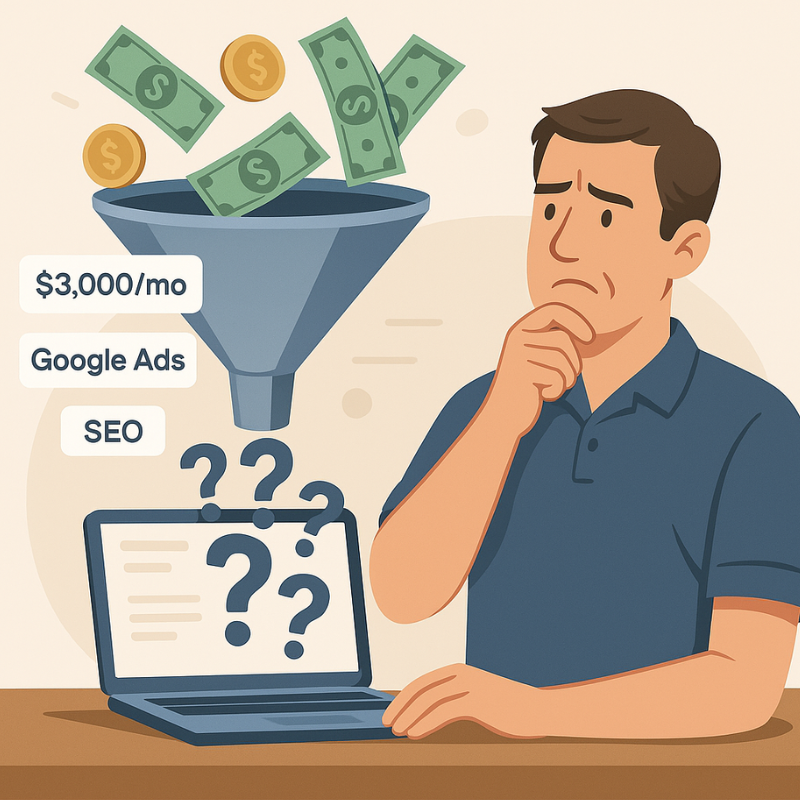
  • Problem #2 – Wasted Marketing Spend: Many home service pros spend $2K–$5K/month on SEO or Google Ads without clear ROI, map pack visibility, or booked jobs to show for it.
  • Problem #3 – Poor Agency Communication: Contractors often get ghosted after signing with a marketing agency—no access, no strategy, and no clear reports.
  • The Fix: Use automation, real-time alerts, call tracking, and partners who show actual results—not vanity metrics.
  • Bonus: Download our free dashboard to audit your current strategy and see exactly where leads (and money) are slipping through the cracks.

Introduction: If You’re Still Chasing Leads, Something’s Off

If you own or manage a home service business—HVAC, plumbing, roofing—you know this pain all too well:

  • The phone rings while you’re knee-deep in a job.

  • You call back… and the lead’s already booked someone else.

  • You’re spending $3,000+ on Google Ads, but still wondering what it’s getting you.

  • You’re ghosted by yet another agency rep right after signing the contract.

Sound familiar? You’re not alone.

At ThinkDMG, we dug into Reddit threads, Quora questions, and real conversations with contractors and service owners just like you to understand what’s really broken in home services marketing—and how to fix it.

This article will walk you through:

  • The top 3 marketing frustrations contractors face

  • What these issues are costing you

  • How to solve them with smarter systems and better partners

  • Plus: a free downloadable dashboard to help you audit your current setup

Let’s dive in before another lead disappears.


1. What’s the #1 Home Services Marketing Problem? Delayed Lead Response

TL;DR: If you don’t respond to a lead within 5 minutes, you’ll likely lose them. Automation and fast follow-up are essential.

“If I don’t call them within 5 minutes, they’ve already booked someone else.”
— Reddit, r/HVAC

The Problem:

Leads come in at all hours. If you’re on a ladder, on a call, or out on a job, you’re likely missing them. And when you miss a lead in this industry, you don’t just miss a phone call—you miss $850+ in potential revenue, on average.

Here’s what’s happening:

  • No automation or alert system for new leads

  • Leads sitting in email inboxes or voicemail

  • No backup if you’re unavailable

  • Delays in follow-up cost trust and bookings

The Fix:

You need a lead management system built for home services—something that:

  • Sends real-time SMS/email alerts

  • Automatically follows up within 2–3 minutes

  • Tracks lead source and call logs for reporting

The Lead Response Time Crisis

2. The Marketing Budget Black Hole

“Google Ads eats $3k/month and I still can’t track if it’s working.”
— Reddit, r/Marketing

The Problem:

Many home service business owners spend thousands a month on SEO, Google Ads, or local marketing—without clear ROI.

We’ve seen cases like:

  • $2.5K/month on SEO with no map pack visibility

  • Agencies that provide click counts, not booked calls

  • Inbound leads that are low quality or outside your service area

In a business where margins matter, this kind of inefficiency can be devastating.

The Fix:

Start by demanding transparency and tracking:

  • Know which dollars brought in which calls

  • Use call tracking and tagging by campaign

  • Focus on ROI, not traffic volume

And if you don’t have map pack visibility, that’s your first priority.

Marketing dollars going in without clear ROI tracking for contractors

3. The Agency Trust Breakdown

“Most marketing companies I’ve worked with ghost after onboarding.”
— Quora

The Problem:

This one cuts deep. Most contractors have been burned at least once by a marketing agency.

Common red flags:

  • Overpromised results in the sales process

  • A flurry of onboarding… and then silence

  • No access to your own Google Ads or website

  • Poor communication and confusing reports

And what happens next? You stop trusting anyone who pitches you. That’s understandable—but also dangerous, because it delays your growth.

The Fix:

Work with partners who offer:

  • Full account access and ownership

  • Clear scopes and call summaries

  • Weekly or monthly check-ins

  • Results tied to real calls—not “impressions”


What Home Service Businesses Actually Want (But Rarely Get)

Based on real owner feedback, here’s what you’re asking for:

  • Fast, reliable follow-up systems

  • A marketing partner who doesn’t ghost

  • Clear, trackable ROI—not vanity metrics

  • Affordable campaigns that actually drive booked calls

  • A system that frees up your time, not eats more of it

At ThinkDMG, we’ve built our solutions around exactly these needs.


Free Resource: Download the Home Services Pain Point Dashboard

Want to see this breakdown in a simple, visual format you can share with your team or evaluate your current agency?

Download our free PDF guide, packed with:

  • Real contractor quotes from Reddit and Quora

  • Deal value + emotion scoring per pain point

  • Strategic solutions for lead gen, SEO, and trust-building

  • What to ask in your next agency call

🎁 Get the Home Services Pain Point Dashboard →


📞 Ready to Get More Calls—Not Just Clicks?

If you’re sick of missing leads, wasting ad dollars, or feeling ghosted by your agency, you don’t need another “guru.”

You need a partner who understands contractor margins, response speed, and ROI clarity.

Let’s talk. No pressure. Just honest guidance and a track record in home services.

Book a 15-minute strategy call with ThinkDMG
Get your free growth audit

FAQ: Home Services Marketing Problems (and Smart Fixes)

What are the most common marketing problems for home service businesses?

The top issues include slow lead response times, unclear ROI from ad spend, lack of map pack visibility, and poor communication from marketing agencies.

How can I get more high-quality leads for my HVAC, roofing, or plumbing business?

Use real-time lead alerts, set up automated follow-up (text/email within 2 minutes), and focus on local SEO for service-based keywords tied to your city.

How do I know if my marketing is actually working?

You should be tracking calls, bookings, and revenue back to specific campaigns. If your agency can’t show you which dollars brought in which leads, you’re wasting money.

Is Google Ads worth it for contractors?

It depends. Google Ads can work well if you’re targeting the right keywords, using call tracking, and optimizing landing pages. Otherwise, it can drain your budget without clear returns.

Why do so many agencies ghost contractors after onboarding?

Many low-tier agencies overpromise and underdeliver. They don’t offer transparent scopes, full account access, or regular reporting—leading to broken trust and stagnation.

What’s the fastest way to fix my home services marketing problems?

Start by auditing your lead response process, tracking ROI per campaign, and working only with partners who prioritize booked jobs—not impressions or clicks.

What’s included in the free Home Services Pain Point Dashboard?

You’ll get a visual breakdown of common marketing failures, revenue loss estimates per issue, and strategic solutions you can share with your team or use to vet your current agency.

Categories
Digital Marketing FAQs Digital Marketing for Small Business E-Commerce Marketing

The $5M Ceiling: What’s Really Holding Back Small E-Commerce Brands

Introduction: Is Your DTC Brand Hitting a Wall?

You’ve done everything right.

Your e-commerce brand is live, your product is getting attention, and you’re generating solid revenue. But somewhere around the $500K–$5M range, things start to stall. Growth slows. Your days are filled with campaign chaos, fulfillment fires, and content overload.

You’re not alone—and you’re not failing.

Most direct-to-consumer (DTC) brands hit the $5M ceiling, not because they’re lazy or unskilled, but because their systems haven’t evolved with their scale. You’re working in your business, not on it.

In this article, we’ll show you:

  • Why most DTC brands under $5M plateau

  • The three hidden frictions that cause stagnation

  • How to fix them with a proven playbook

You’ll also get access to our free resource: The DTC Brand Pain Relief Playbook, packed with insights from real founders and actionable fixes.

Let’s break down what’s really holding you back—and how to reclaim growth without burning out.


Why DTC Growth Gets Messy Under $5M

If you’re running a brand in this range, you know the feeling:

  • One minute you’re writing ad copy, the next you’re answering a customer complaint.

  • You have five platforms open, three deadlines missed, and no time for strategy.

  • You can’t tell if your Shopify revenue bump was due to a new email campaign or luck.

It’s not a marketing problem—it’s a system problem.

Most DTC founders under $5M are trapped in what we call the “chaos phase.” You’re doing too much, your growth stack is duct-taped together, and agency “help” often adds more confusion.

That’s where the three major friction points emerge.


1. Content Creation & Campaign Chaos

“I’m making Canva graphics at 11PM and still can’t keep up with ad deadlines.”
— Reddit, r/ecommerce

The Pain:

Running content for a DTC brand today means juggling:

  • Paid social campaigns

  • Influencer outreach

  • Email automation

  • Website updates

  • Product photography

It’s more than a full-time job—and most teams don’t have a full-time content strategist.

The Fix:

Implement a content engine—a repeatable, streamlined system for ideating, producing, scheduling, and repurposing your creative across channels.

Pro Tip: Tools like Notion or Airtable can become your best friend here—paired with a fractional content team or an agency like ThinkDMG that already knows the DTC rhythm.


2. Operational Backlogs (a.k.a. Fulfillment Fires)

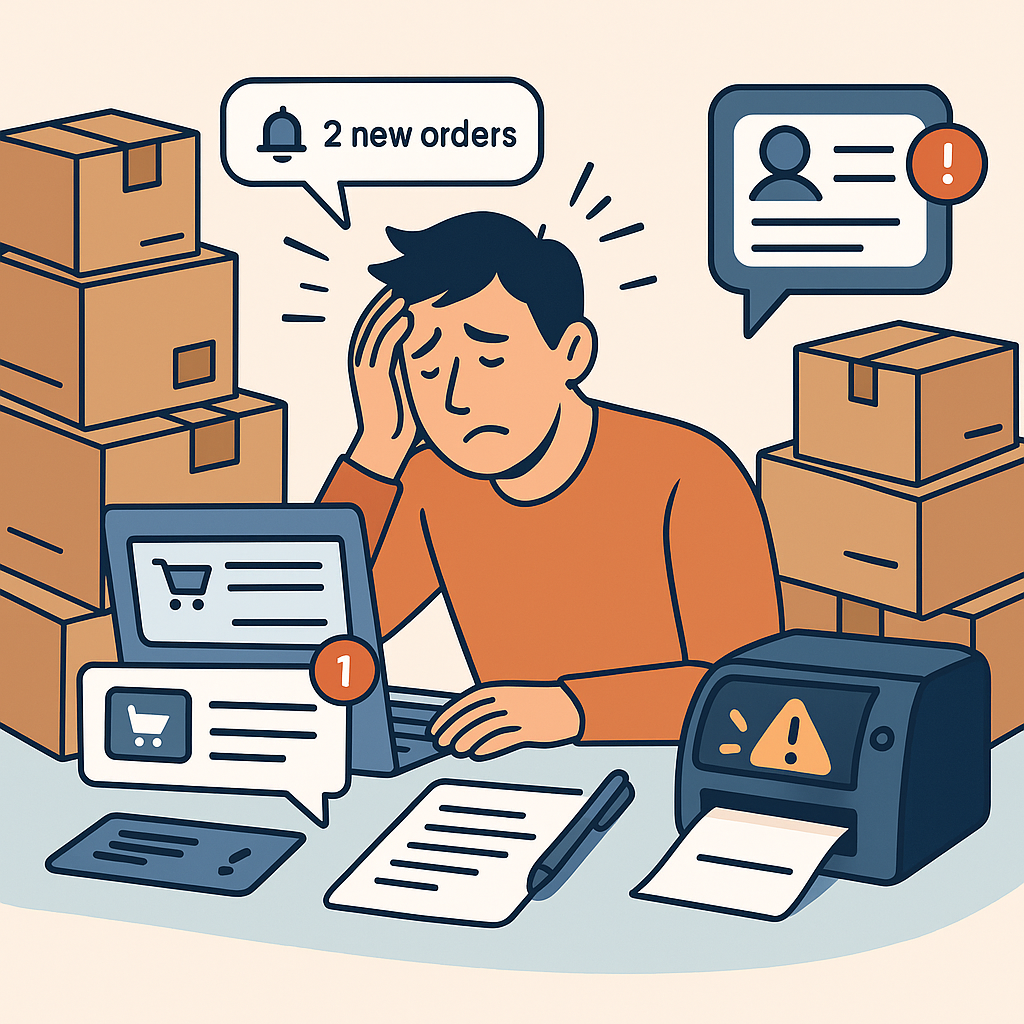
“Every week it’s something—out of stock, returns, late shipments, customer emails piling up.”
— Reddit, r/Shopify

The Pain:

You built this brand to sell great products, not to become a logistics manager. But:

  • Inventory updates are manual

  • Shipping software is unreliable

  • CX tickets eat up hours a day

The marketing side brings traffic, but if your operations can’t handle it, you’re bleeding brand equity.

The Fix:

Start treating operations like marketing—systemize and delegate.

  • Use automated fulfillment platforms (e.g., ShipBob, Loop Returns)

  • Centralize inventory, order, and ticket management

  • Add a fractional COO or lean ops support if needed

Operational challenges with ecommerce fulfillment and support tasks

3. Brand Identity Confusion

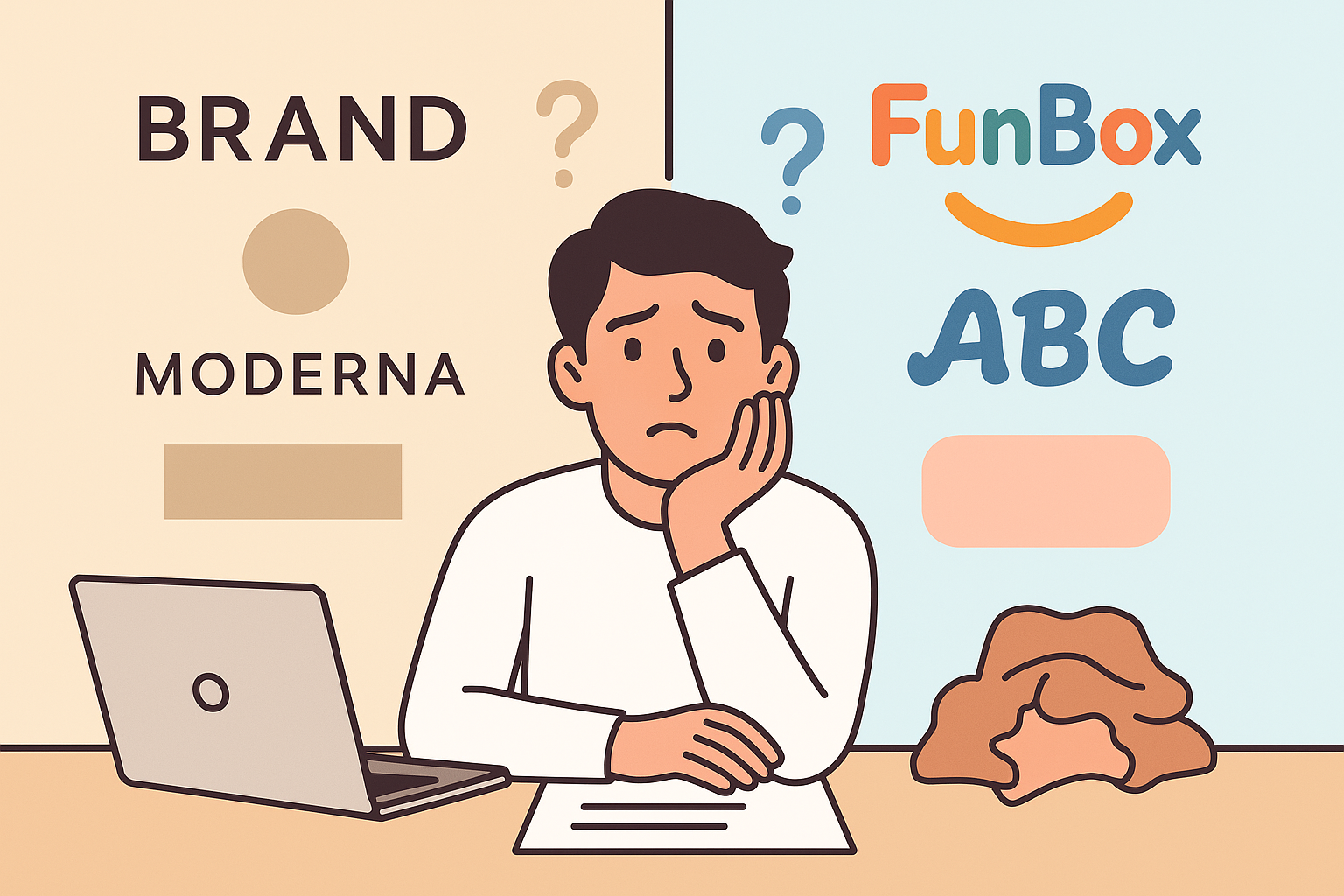
“We’re trying to look premium, fun, and affordable—nobody gets what we sell.”
— Quora

The Pain:

Most brands under $5M evolve reactively:

  • First brand was DIY

  • Second brand had better colors

  • Now your Instagram is inconsistent and your tone doesn’t match your ads

Customers are confused. And confusion kills conversions.

The Fix:

Clarify your brand architecture:

  • Who are you really for?

  • What’s your tone of voice?

  • What does your design say (or not say) about your value?

Even small teams benefit from a quick brand clarity sprint—or partnering with an agency that gets DTC nuance.

DTC brand struggling to find a consistent identity across channels

Get the DTC Brand Pain Relief Playbook

After hundreds of hours studying Reddit threads, Quora conversations, and real client work, we put together the ultimate toolkit for growth-stage DTC brands.

Inside the free PDF, you’ll find:
✅ Real quotes from founders just like you
✅ The 3 friction zones that kill momentum
✅ Deal Value + Emotion Scoring
✅ Actionable fixes to scale smarter

Download it now and stop Googling your way through marketing mayhem.

📥 Grab the DTC Brand Pain Relief Playbook →


Conclusion: You’re Not Failing. You’re Ready for Systems.

If you’re stuck under the $5M ceiling, you’re not doing it wrong—you’re just doing too much manually.

There’s no award for burning out alone. The brands that break through this ceiling don’t just work harder. They build smarter systems and partner with experts who’ve seen what works.

ThinkDMG helps DTC brands:

  • Clarify their voice

  • Run content without chaos

  • Build funnels that actually convert

  • And track ROI down to the dollar

Let’s talk if you’re ready to scale without losing your mind. Or at the very least—grab the free playbook and take your first step out of the mess.

Categories
Digital Marketing FAQs Digital Marketing for Small Business Digital Marketing Trends SEO

Law Firms Deserve Better: Why So Many Get Burned by Marketing Agencies (And How to Take Back Control)

Introduction: “We Signed a Contract—and Then They Vanished.”

If you’re a managing partner, solo practitioner, or marketing director at a law firm, chances are you’ve worked with a digital marketing agency at some point—and chances are, you’ve also been let down.

The promises sound great: new clients, better SEO, sleek design, full-service support. But what you often get is:

  • A clunky, outdated website

  • Cookie-cutter content

  • Ghosted after onboarding

  • No clear idea where your ad dollars are going

You’re not imagining things—this is a widespread problem in the legal space. Most marketing agencies aren’t built to support law firms, and it shows in the results.

At ThinkDMG, we’ve studied the digital frustrations of law firms across Reddit, Quora, and real client feedback to build a more transparent, legal-specific solution.

This article breaks down:

  • The top 3 pain points law firms face with agencies

  • How these issues affect growth and reputation

  • The proven framework we created to fix it

  • And how you can download a free, data-backed dashboard to take control of your strategy

Let’s dig in.

The Top 3 Pain Points Law Firms Face With Agencies

1. Unsatisfactory Agency Experiences

“The site they built for us looks like it’s from 2008, and I can’t even update the bios without calling them.”
— Reddit, r/LawFirm

From a design and tech standpoint, most law firm websites are underwhelming. That’s not a design critique—it’s a conversion and credibility issue.

Common problems include:

  • Outdated web design that doesn’t build trust

  • Unusable CMS platforms that require phone calls to update bios or blog posts

  • Generic, AI-like content that doesn’t reflect your expertise or legal niche

Your website is your digital storefront. If it looks like an afterthought, prospective clients will treat your practice like one.

The Top 3 Pain Points Law Firms Face With Agencies 2
The Top 3 Pain Points Law Firms Face With Agencies
❌ Outdated Law Firm Website ✅ Modern Law Firm Website
Last updated: 2013 Updated regularly, mobile-optimized
Old serif fonts and pixelated logo Professional typography and high-res branding
Not mobile-friendly, slow loading Fast, responsive design across devices
Homepage cluttered with dense paragraphs Clear calls-to-action and skimmable sections
No lawyer bios or photos Engaging team bios and client testimonials
Contact form buried or missing Visible, conversion-optimized contact options

2. Strategy Confusion and ROI Blind Spots

“I don’t know if I need SEO, ads, or just a new site. Every agency says something different.”
— Reddit, r/Lawyertalk

Every agency seems to have a different “silver bullet”—some push SEO, others swear by Google Ads, some suggest a site overhaul.

And here’s the problem: no one is showing the strategy or numbers behind the recommendations.

Law firms are left with:

  • Disconnected campaigns

  • Little to no performance data

  • A marketing spend with no measurable return

At ThinkDMG, we call this the strategy swirl—where agencies create confusion instead of clarity.

3. Red Flags & “Digital Hostage” Scenarios

“They held our domain hostage and we had to start from scratch.”
— Reddit, r/LegalMarketing

This one hurts—and it’s more common than you think.

We’ve seen law firms:

  • Locked out of Google Ads accounts they paid to build

  • Lose control of domains and email servers

  • Go months without hearing from their agency contact

These are the kinds of experiences that sour law firms on all marketing—rightfully so.

And they’re why ThinkDMG gives you full ownership of all assets and accounts, from day one.

How ThinkDMG Built a Better Way for Law Firms

We’ve worked with legal clients for over 15 years. That means we understand:

  • The compliance and nuance required in legal content

  • The need for reputation-first design and messaging

  • The high cost of wasted leads or misleading agency tactics

Our approach is based on:

  • 100% Transparency – you own all accounts and access all data

  • Legal-Specific Strategy – content, design, and campaigns tailored for your practice area

  • Results That Actually Show Up – our clients see an average 30% ROI boost in year one

Download the Law Firm Pain Point Dashboard

Download the Law Firm Pain Point Dashboard

Want proof?

We compiled the exact insights in this article into a data-backed PDF you can download and review with your team.

Inside the dashboard:

  • Quotes from real managing partners

  • Pain point breakdowns with emotion and deal value scores

  • A strategic checklist to evaluate your current agency

Click here to get the Law Firm Pain Point Dashboard →


Final CTA: Talk to Someone Who Understands Legal Marketing

Your law firm’s digital presence should build trust, drive leads, and be something you actually control.

We don’t believe in:

👉 If you’re tired of vague promises and ghosted agency calls, schedule a strategy session with ThinkDMG. We’ll review your current setup, identify low-hanging growth opportunities, and show you what clarity feels like.

📞 Contact us here for a no-pressure consultation →

Categories
Brand Building Content Marketing Digital Marketing for Small Business Marketing

Branding vs. Marketing: What’s the Difference and Why It Matters

Introduction: The Problem Isn’t Branding or Marketing — It’s How Leaders Think About Them

Most businesses don’t fail because they lack branding or marketing.

They struggle because leadership treats the two as interchangeable — or worse, assumes one can compensate for the absence of the other.

This confusion rarely shows up as an obvious mistake. Instead, it appears gradually:

  • marketing campaigns that generate traffic but not trust

  • brand investments that feel polished but don’t translate into demand

  • agencies blamed for “underperformance” when the real issue is structural

At a certain stage of growth, branding and marketing stop being creative exercises and start becoming business infrastructure. When that infrastructure is misaligned, growth stalls — even when spend increases.

This article is not about definitions.
It’s about understanding how branding and marketing function differently inside a real business, and why getting that distinction right determines whether growth compounds or plateaus.

What Is Branding?
What Is Branding?

Branding Is a Strategic Commitment, Not a Creative Asset

Branding Defines How the Market Interprets Every Action You Take

Branding is not your logo, color palette, or tagline — those are expressions, not the brand itself.

Your brand is the set of expectations the market has before you speak, advertise, pitch, or sell. It answers questions prospects ask subconsciously:

  • Is this company credible?

  • Are they safe to choose?

  • Do they understand businesses like mine?

Once established, branding operates whether you’re actively marketing or not. It influences:

  • how much skepticism your marketing must overcome

  • how price-sensitive buyers become

  • how long prospects are willing to stay in consideration

Strong brands reduce friction. Weak or unclear brands increase it — often invisibly.

Branding Is Slow by Design — and That’s the Point

Branding works over time because it is built through consistency:

  • consistent positioning

  • consistent language

  • consistent behavior across touchpoints

This is why branding cannot be “fixed” by a campaign. Campaigns are temporary. Branding is cumulative.

For leadership teams, branding is a long-term strategic decision about how the company wants to be perceived — and what it is willing to exclude to protect that perception.

Key Differences Between Branding and Marketing

Marketing Is a Growth System, Not a Megaphone

Marketing Exists to Create Movement, Not Identity

Marketing is how you activate demand:

  • driving awareness at the right moment

  • creating clarity around an offer

  • prompting a specific action

Unlike branding, marketing is intentionally dynamic. It changes based on:

  • market conditions

  • competitive pressure

  • growth targets

  • channel performance

Marketing answers practical questions:

  • How do we generate qualified interest this quarter?

  • Where are we losing attention or conversions?

  • What message moves the right buyers to act now?

Marketing is measurable because it is designed to be.

Marketing Without Brand Support Is Expensive

When branding is weak or undefined, marketing must work harder:

  • higher ad spend to earn the same trust

  • longer sales cycles

  • increased price objections

  • inconsistent lead quality

This is why many businesses feel trapped in a cycle of “needing more marketing” without seeing proportional returns. The issue isn’t effort — it’s leverage.

How Branding and Marketing Work Together

The Structural Difference Most Businesses Miss

Branding Shapes Perception. Marketing Triggers Decisions.

This distinction matters operationally.

  • Branding determines how people interpret your marketing

  • Marketing determines whether people act on that interpretation

If branding answers “Who are you?”
Marketing answers “Why now?”

Confusing the two leads to predictable outcomes:

  • rebrands launched to solve lead problems

  • aggressive marketing deployed to compensate for weak positioning

  • constant tactical changes without strategic progress

Growth stalls not because tactics fail — but because the foundation is unclear.

Brand_Marketing_Scale


Why This Distinction Becomes Critical as Businesses Scale

Early-stage businesses can survive with blurred lines.
Growing businesses cannot.

As revenue grows, so does complexity:

  • more channels

  • more stakeholders

  • more competition

  • more scrutiny from buyers

At this stage:

  • branding protects margins and reputation

  • marketing protects momentum and cash flow

Leaders who treat branding as “nice to have” or marketing as “just promotion” often experience:

  • inconsistent growth

  • diminishing ROI

  • agency churn

  • internal frustration

Not because teams are incompetent — but because the system is misaligned.

Branding vs Marketing Strategic Comparison

Dimension Branding Marketing
Strategic Function Defines market interpretation and identity; establishes expectations
and operational guardrails.
Operates as a growth system to activate demand, increase awareness,
and prompt consumer actions.
Time Horizon Long-term strategic commitment; cumulative and designed for consistency
over extended periods.
Short-to-mid-term focus; dynamic and adjusted according to quarterly
targets or market conditions.
Business Impact Reduces friction and price sensitivity; protects margins, reputation,
and influences buyer skepticism.
Generates commercial momentum and qualified interest; protects cash
flow through active demand.
Risk When Misused Results in investments that fail to generate demand or outdated
positioning that lacks market support.
Leads to high expenditure with low consumer trust, extended sales
cycles, and inconsistent lead quality.
Measurement Approach Evaluated through reduced market friction and the compounding value
of brand equity as a strategic asset.
Evaluated through channel performance, conversion rates, and immediate
interest generation.

How Branding and Marketing Should Actually Work Together

Branding Sets the Guardrails

Branding establishes:

  • who the company is for

  • what problems it is willing to own

  • how it competes without racing to the bottom

This prevents marketing from chasing volume at the expense of quality.

Marketing Applies Pressure Intelligently

Marketing then:

  • tests messaging within those guardrails

  • amplifies the brand where demand already exists

  • converts clarity into revenue

When aligned, marketing feels easier — not louder.


The Most Common Leadership Mistakes (and Their Consequences)

Treating Branding as a One-Time Project

Results in outdated positioning that marketing can’t realistically support.

Expecting Marketing to Fix Trust Problems

Leads increase, but conversion rates don’t.

Optimizing Tactics Before Clarifying Strategy

Creates motion without progress.

These are not creative failures. They are strategic ones.


Strategic Takeaways for Decision-Makers

  • Branding is a long-term asset that reduces friction and protects value

  • Marketing is a short-to-mid-term system that creates momentum

  • One cannot substitute for the other

  • Confusion between them increases cost, not growth

Businesses that scale sustainably treat branding and marketing as distinct, coordinated disciplines, not interchangeable tools.


A Quiet Closing (By Design)

Organizations that take growth seriously eventually reach a point where tactics stop solving structural problems.

That’s usually when branding and marketing need to be examined together, not independently.

Businesses that recognize this don’t rush the process — they slow it down long enough to get it right.


SEO-Aligned FAQs

What is the main difference between branding and marketing?
Branding shapes long-term perception; marketing drives short-term action.

Can marketing succeed without strong branding?
Yes — but it will cost more and convert less efficiently.

Is branding only important for large companies?
No. Branding becomes more important as competition increases.

How do you know when branding needs attention?
When marketing performance declines despite increased effort.

Should branding or marketing come first?
Brand clarity must come first; marketing then applies pressure.

Categories
Content Marketing Digital Marketing for Small Business Digital Marketing Trends SEO SEO Strategies

Naval Ravikant’s Content Strategy: The Power of Simplicity and Timeless Wisdom

Introduction

Less is your superpower—what if one tweet could outshine a thousand posts and cement your legacy in 2025’s quiet power shift? Naval Ravikant’s cracked it, and I’m spilling his secrets because I’ve been you: drowning in content chaos, churning out fluff that faded fast, terrified I’d never break through. Then I found Naval Ravikant’s content strategy—simplicity and timeless wisdom that’s snagged him 1.5M+ followers with zero burnout. Curious how he says so much with so little? Relieved you can ditch the grind? This is your playbook to cut through the noise with one big idea—your audience’s waiting, and your sanity’s cheering. Let’s dive into 2025’s smartest hustle.

The Essence of Naval Ravikant’s Content Strategy

Simplicity as a Superpower

Naval doesn’t flood—he strikes. His tweets—like “Desire is suffering’s contract”—hit like lightning in 280 characters. No fluff, just truth, sharp enough to slice through X’s chaos. It’s simplicity as a superpower, powering his 1.5M+ followers (2023) with posts that spark thousands of retweets daily.


I slashed a ramble to “Clarity kills doubt”—shares tripled. Naval’s trick? One idea, razor-edged.


 “Desire is suffering’s contract”

Timeless Wisdom Over Trendy Noise

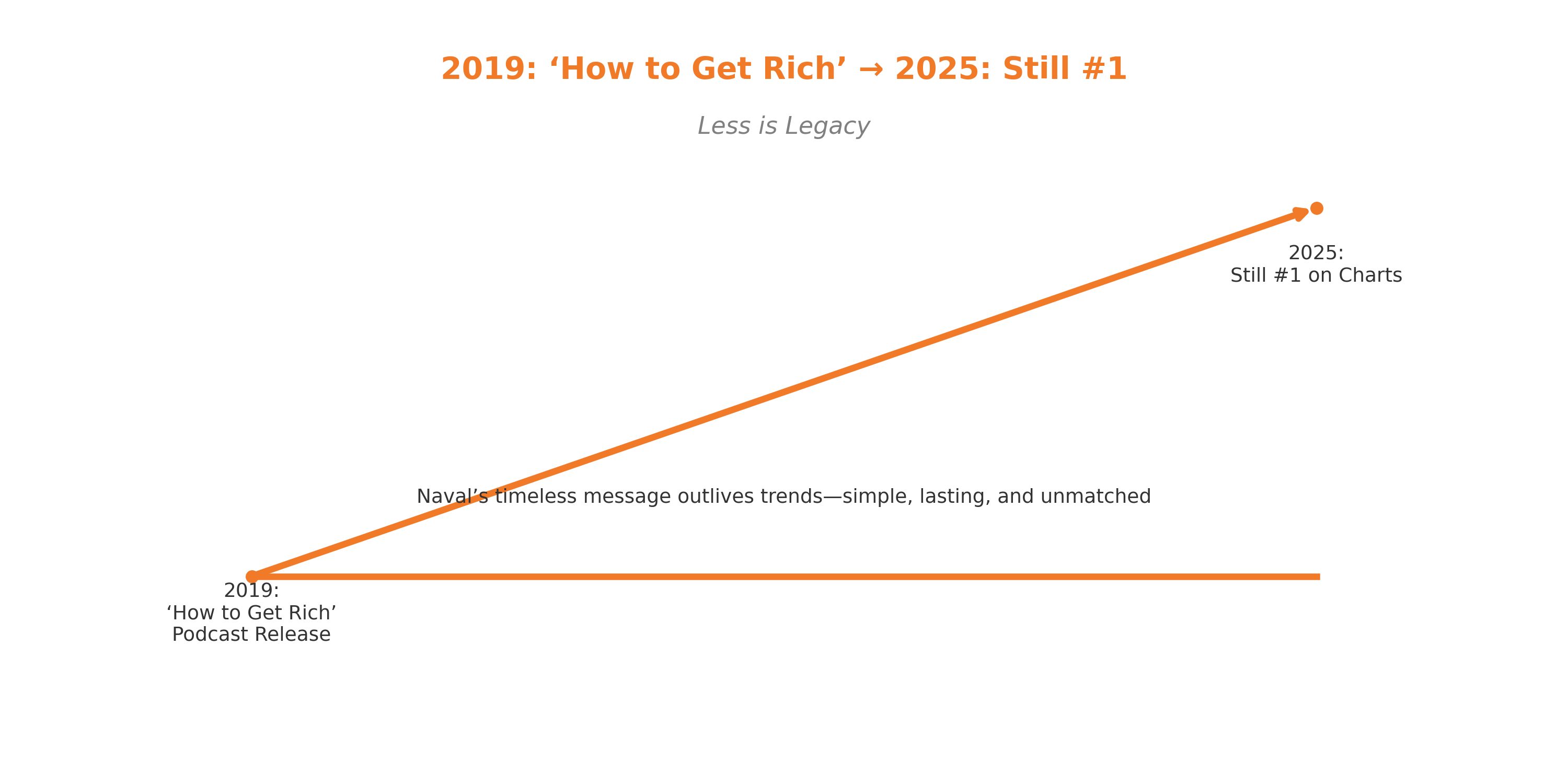
Naval skips TikTok trends for truths that endure. His “How to Get Rich” podcast (2019) still rules charts in 2025—millions of listens because it’s wealth’s roots, not crypto buzz. Happiness, health, freedom—his wisdom’s fine wine while others peddle fast food.


Trend-chasers fade; Naval’s 2025’s quiet power—legacy over likes.


2019- ‘How to Get Rich’ → 2025- Still #1

Why His Approach Works

Clarity Cuts Through Clutter

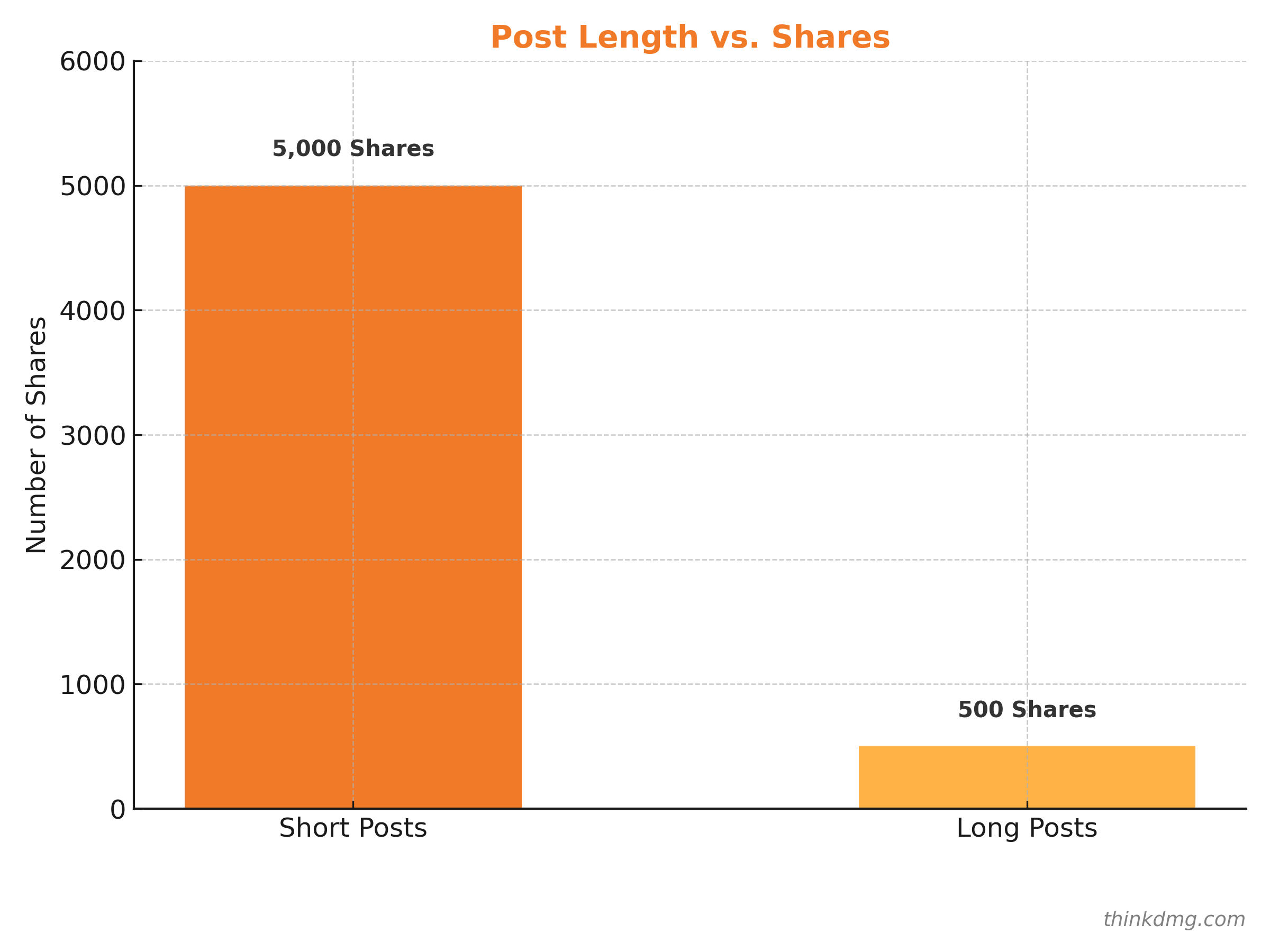
In a sea of noise, Naval’s clarity’s a beacon. “Happiness is a choice”—no tech-bro jargon, just universal punch. It hooks scrollers at 2 a.m., from Silicon Valley to Soweto—thousands retweet daily (2023 X stats). Simple’s not dumb; it’s trust in a distracted world.


I tweeted “Focus trumps chaos”—50% more eyes. Clarity’s your machete—slash the mess.


Short Posts: 5k Shares” (peak) vs. “Long Posts: 500 Shares

Evergreen Value Builds a Legacy

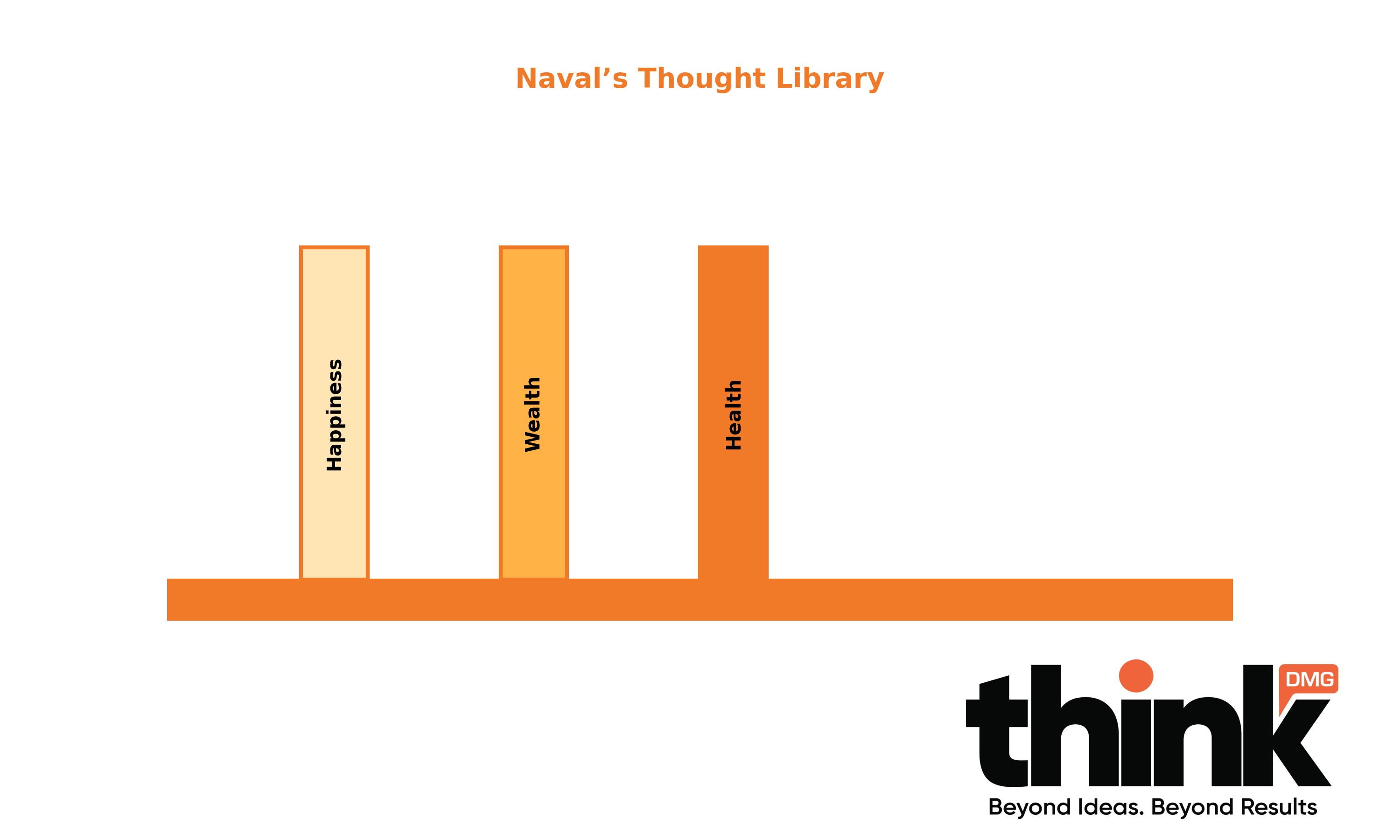
Naval’s ideas don’t expire—they echo. His Naval Almanack (2021) sells steady in 2025—a thought library of wealth, peace, purpose. Readers save, cite, share—his 2019 wealth principles outlast NFT hype. Trendy posts? Six months, gone. Naval’s? A decade strong.


Your big idea could be eternal—Naval’s proof.


Naval’s Thought Library

Less Is More—Efficiency Meets Impact

Naval posts 5-10 times a month—Gary Vee’s at 100+/week. Yet one Naval tweet ignites X for days—low output, colossal impact. No burnout, just brilliance—AI-drafted depth delivered solo. I cut my posts from 20 to 5—reach held, stress vanished.


Less is your edge—2025’s power play.

Lessons from Naval’s Strategy

Lesson 1 – Master the Art of Less

One big idea, razor-tight—Naval’s “Peace is freedom from thought” (2018, 100k+ likes) isn’t a saga; it’s a spark. Boil your ramble to its soul—“Effort compounds” beats “10 Success Tips.” Tweet it when your mind’s still—your brain’s primed then.


I honed “Rest fuels grit”—retweets soared. Less cuts deepest.


Lesson 2 – Focus on Universal Truths

Forget trends—grab what lasts. Naval’s “Seek wealth, not money” skips hype for principles that’ll stand in 2035. Ask: “Will this matter in a decade?” A Latina coach’s “Kindness scales” still gets saves a year on—life beats algorithms.


Timeless is your soul—own it.

Lesson 3 – Let Ideas Breathe—Your Wisdom Warriors

Don’t flood—simmer. Naval’s sparse “How to Be Happy” (2020) still fuels X debates in 2025—quality spawns your wisdom warriors, not a weary crowd. Post less; let it ripple—anticipation beats saturation.


I paused a week after “Focus kills chaos”—shares doubled. Space is your weapon.

Who Can Thrive with This Approach?

Perfect Fits

This slays for:

  • Thought Leaders: Big ideas, small effort—Naval’s solo lane.
  • Educators: Lessons that echo—philosophy, not fads.
  • Diverse Voices: A queer poet or Black mentor—depth shines.Naval’s 1.5M+ X crew (2023)—no team, just him.


Who Might Struggle

Pass if you’re:

  • Trend Junkies: Speed’s your jam—this ain’t it.
  • Retail Hustlers: Volume moves shoes—Naval moves minds.
  • Daily Cravers: Fans needing constant hits won’t vibe.

Gary Vee’s flood crushes here—Naval’s for the deep end.

Real-World Examples

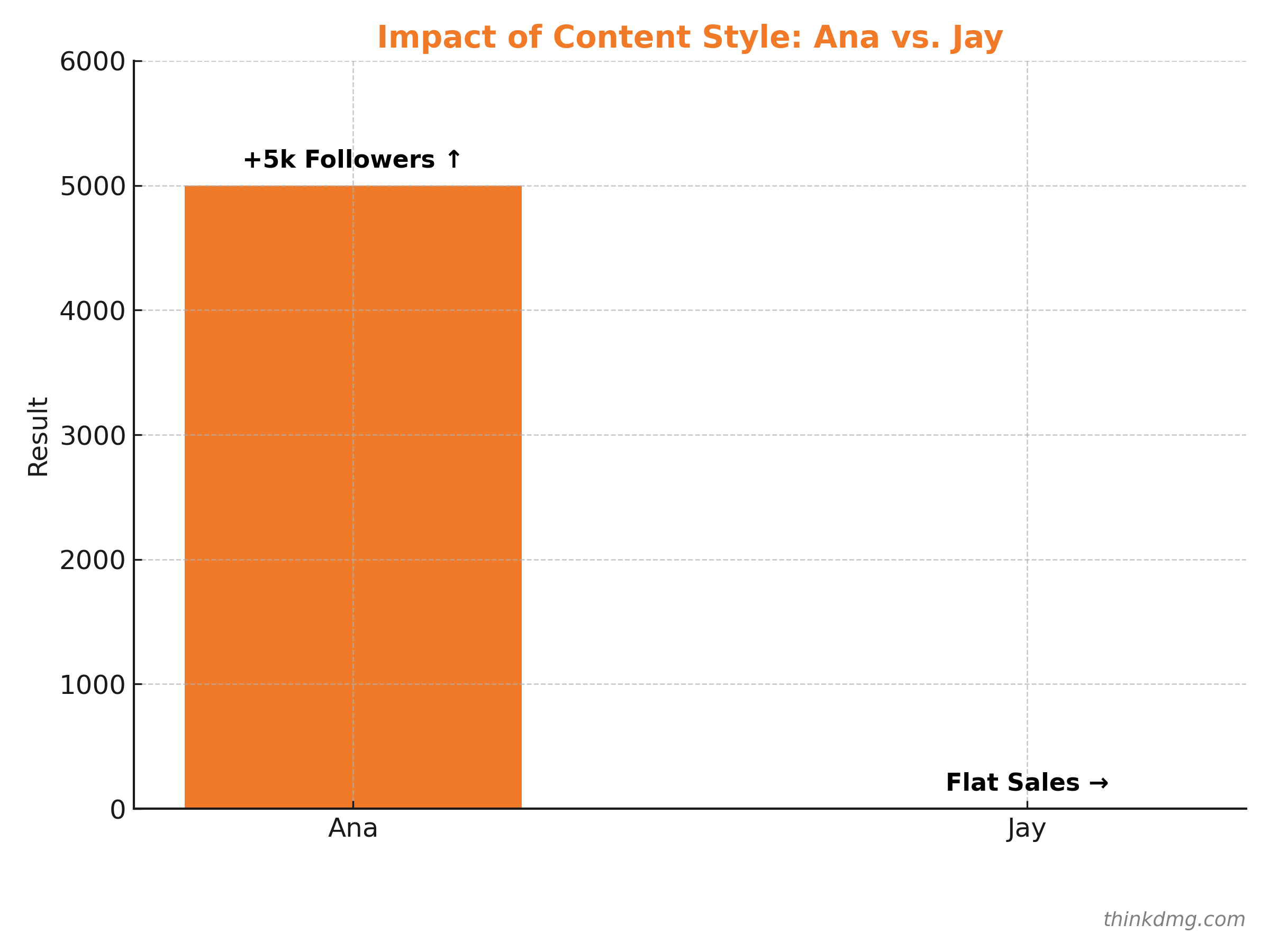
  • Win: Ana, a Latina coach, posts “Patience is power” weekly—5k followers in six months, her wisdom warriors grow.
  • Flop: Jay, a sneaker seller, tries sparse posts—sales flat; his crew needs drops, not depth.
Ana: +5k Followers” (↑) vs. “Jay: Flat Sales” (→)

How to Apply Naval’s Strategy

Start with One Big Idea—AI’s Your Wingman

Grab a truth—“Time is gold.” Draft it short with ChatGPT—280 max—then tweak to you. Drop it on X or LinkedIn when your mind’s calm—Naval’s lab, now yours. My “Clarity kills doubt” got 100+ shares—AI sparked, I shaped.


One shot, AI-powered—fire it.

Build Your Thought Library—Your Soul’s Vault

Collect 5-10 gems—your soul’s vault (e.g., “Health trumps hustle,” “Peace is power”). Share one monthly—let it simmer. Bundle later into a blog or ebook—Naval’s Almanack (2021) started this way.


My vault’s at 4—slow build, big echo.


Visual Suggestion: A teal mini-library: “Your Soul’s Vault”—spines glow “Time,” “Peace,” “Health”—thinkdmg.com teal/white branding.

Measure Depth, Not Volume—Your Legacy Metric

Likes are noise—track shares, saves, “I’ll keep this” vibes. Naval’s tweets hit 5k+ retweets (2023)—depth’s his game. My “Rest fuels grit” got 50 saves—I doubled down. Refine, don’t rush—legacy’s your win.


Depth’s your 2025 crown—wear it.

Conclusion

Naval Ravikant’s content strategy—simplicity and timeless wisdom—is 2025’s quiet power, slashing noise with one big idea. Clarity hooks, evergreen lasts, less wins—your soul’s vault beats burnout every time. Join Ana’s wisdom warriors—ditch the flood, build your legacy. Grab our free Timeless Content Playbook (limited spots—now or never!) or ping Digital Marketing Group LLC to craft your Naval edge. Naval’s tweeting truths while others churn—what’s your one big swing?


Comprehensive Content Strategy Comparison Table

For Small Business Owners, Influencers & Brands

Criteria
Gary Vee
(High Volume)
Alex Hormozi
(Repurposing)
Justin Welsh
(Authority)
Naval Ravikant
(Minimalist)
Ali Abdaal
(SEO Growth)
Best For
Influencers, Startups, Brands Agencies, Coaches, Local Businesses Consultants, Lawyers, Thought Leaders Investors, Public Figures Course Creators, YouTubers
Effort Level
🔥 High (100+ posts/week) ⏳ Medium-High (Batch & Repurpose) 🎯 Medium (Deep, fewer posts) ✨ Low (Rare, but high-impact) 📹 Medium (SEO & Video Production)
Content Type
Reels, X Threads, TikToks Blogs, Email, Social Media Clips LinkedIn, Deep Essays Tweets, Books, Podcasts YouTube Videos, Blogs
Best for Small Businesses
❌ Not Ideal (Too Much Effort) ✅ Yes (Great for Scaling Content) ✅ Yes (Great for High-Trust Businesses) ❌ No (Best for Public Figures) ✅ Yes (SEO & Video for Local Leads)
Engagement Style
Broad Reach, Volume Game Multi-Platform, Low Effort Deep Trust & Community Low Output, Maximum Impact Long-Term Engagement via SEO
Monetization Approach
Brand Deals, Sponsorships Courses, High-Ticket Sales Consulting, Memberships Books, Investments YouTube AdSense, Affiliate Sales
How to Combine
Pair with **Hormozi** for reach + repurposing Use **Ali Abdaal’s SEO** for traffic Mix with **Naval’s minimalism** Blend with **Justin’s deep content** Repurpose with **Hormozi’s framework**

How Small Business Owners Can Apply These Strategies

Best Strategy for HVAC, Roofing, Plumbing, and Local Service Businesses?

  • Alex Hormozi’s repurposing model + Ali Abdaal’s SEO approach.
  • Why? One blog post or video can turn into weeks of content across different platforms, while SEO helps you rank locally.
Best Strategy for Lawyers, Consultants, and High-Ticket Services?
Best Strategy for Personal Brands & Influencers?
  • Gary Vee’s High-Volume Model + Justin Welsh’s Authority-Based Content.
  • Why? If your goal is visibility, volume wins. If your goal is trust, mix it with deeper, high-value content.
Best Strategy for Local Real Estate, Fitness, or Wellness Brands?
  • Ali Abdaal’s SEO Model + Hormozi’s Repurposing Strategy.
  • Why? YouTube & SEO bring passive inbound leads, while repurposing keeps you relevant on social media without extra effort.

How to Use This Table

  • Pick a strategy that fits your business model & industry.
  • Mix & match to create the best hybrid approach for your needs.
  • Embed this table in every content strategy article to help small businesses make smarter marketing decisions.
Categories
Content Marketing Digital Marketing for Small Business Digital Marketing Trends Generative Engine Optimization SEO SEO Strategies

SEO Meets AI: Optimizing Your Business for the Next Generation of Search

🤖 AI Summary: How AI Is Changing SEO
  • AI-powered search focuses on understanding intent and context, not just matching keywords.
  • Search engines increasingly summarize and recommend content instead of ranking pages alone.
  • Businesses must optimize for clarity, trust signals, and structured data to remain visible.
  • Entity-based SEO and E-E-A-T are critical for AI-driven discovery.
  • AI-ready SEO builds on traditional SEO rather than replacing it.

Introduction

In today’s rapidly evolving digital landscape, the fusion of Artificial Intelligence (AI) and Search Engine Optimization (SEO) is reshaping how businesses enhance their online visibility. As AI technologies become integral to search engines, understanding and adapting to these changes is crucial for maintaining a competitive edge. This article delves into the convergence of AI and SEO, offering actionable insights to optimize your business for the next generation of search.​

Understanding the Convergence: How AI is Changing Search

From Keywords to Context

Traditional SEO heavily relied on keyword optimization, focusing on matching exact phrases users might input. However, AI advancements have shifted this paradigm towards understanding the context and intent behind searches. Google’s AI algorithms, such as RankBrain and MUM, analyze user behavior and content to deliver more relevant results. For instance, a search for “best coffee” now considers user location, preferences, and previous interactions to provide personalized recommendations.​

Personalized and Predictive Search

AI enables search engines to offer personalized and predictive results by analyzing vast amounts of data, including user behavior, location, and preferences. This personalization means that two users searching for the same term may receive different results tailored to their unique profiles. Additionally, AI assistants like ChatGPT and Alexa are becoming more adept at understanding natural language queries, further enhancing the search experience.​


Diagram comparing traditional keyword-based search results with AI-driven contextual search results.
🧠 How AI Search Engines Decide What to Show or Cite
  • Intent clarity: Does the content clearly answer a specific question?
  • Entity confidence: Is the business, topic, or author clearly defined?
  • Trust signals: Are credentials, reviews, and citations present?
  • Content structure: Is the information easy to scan and summarize?
  • Consensus: Does the information align with other trusted sources?
AI systems prioritize clarity and reliability over aggressive optimization tactics.

Key Elements of AI-Optimized SEO

Structured Data and Schema Markup

Implementing structured data and schema markup helps search engines comprehend the content of your website more effectively. By providing explicit clues about the meaning of your pages, you enhance the likelihood of appearing in rich snippets and other enhanced search results. Tools like Google’s Structured Data Markup Helper and resources from Schema.org can assist in this process.​

Search Generative Experience (SGE)

The Search Generative Experience (SGE) integrates AI-generated content within search results, offering users concise answers alongside traditional listings. To optimize for SGE, focus on creating comprehensive content that addresses common queries in your industry, increasing the chances of being featured in these AI-generated summaries.​

Voice and Conversational Search

With the rise of voice-activated devices, optimizing for voice search is becoming increasingly important. This involves crafting content that mirrors natural speech patterns and addresses conversational queries. For example, instead of targeting the keyword “weather forecast,” consider phrases like “What’s the weather like today?”​

Entity-Based SEO

AI-driven search engines utilize entities—distinct concepts or objects—to understand and categorize content. Establishing your website as an authoritative source on specific entities can enhance visibility. This can be achieved by creating in-depth content clusters around key topics relevant to your business.​


🔍 Traditional SEO vs AI-Optimized SEO
Traditional SEO AI-Optimized SEO
Keyword-focused optimization Intent- and context-focused optimization
Ranks pages in lists Summarizes and recommends answers
Links drive visibility Clarity and trust drive visibility
SEO tactics dominate SEO + structure + credibility
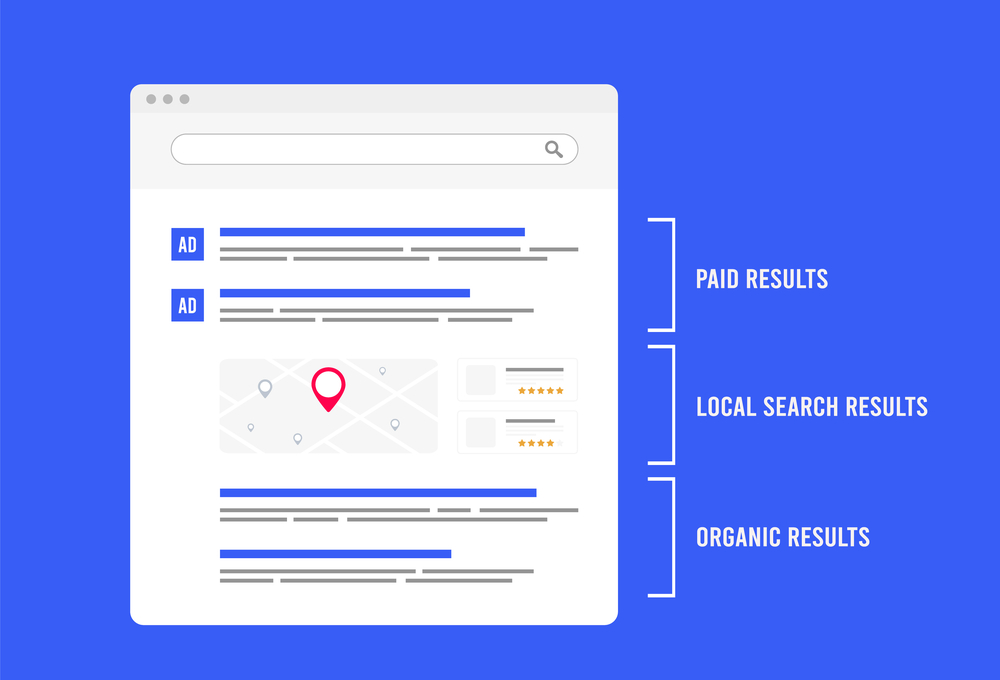
Paid results, Local Search and Organic Results concept

Practical Strategies to Optimize for AI Search

Optimize Your Google Business Profile & Local SEO

A well-maintained Google Business Profile (GBP) is vital for local SEO. Ensure your GBP is complete with accurate information, high-quality images, and regular updates. Encourage satisfied customers to leave positive reviews, as these significantly influence local search rankings.​

Prioritize User Experience (UX)

AI algorithms prioritize websites that offer exceptional user experiences. Focus on creating fast-loading, mobile-friendly, and accessible websites. Monitor metrics like dwell time and bounce rate to gauge and improve user engagement.​

Content That Educates, Engages, and Solves

Develop content that is informative, engaging, and addresses the needs of your audience. Emphasize Experience, Expertise, Authoritativeness, and Trustworthiness (E-E-A-T) by showcasing your industry knowledge and providing original insights.​

Use AI as a Tool, Not Just a Trend

Leverage AI-powered tools to enhance your SEO efforts, such as automating keyword research, content optimization, and performance analysis. However, ensure that AI complements human creativity and expertise rather than replacing them.​Salesforce


✅ AI-Search Readiness Checklist
  • Website answers real customer questions clearly
  • Structured data (schema) is implemented and validated
  • Business entities and services are explicitly defined
  • Content demonstrates E-E-A-T
  • Site is fast, mobile-friendly, and easy to navigate
  • External signals (reviews, profiles, citations) are consistent
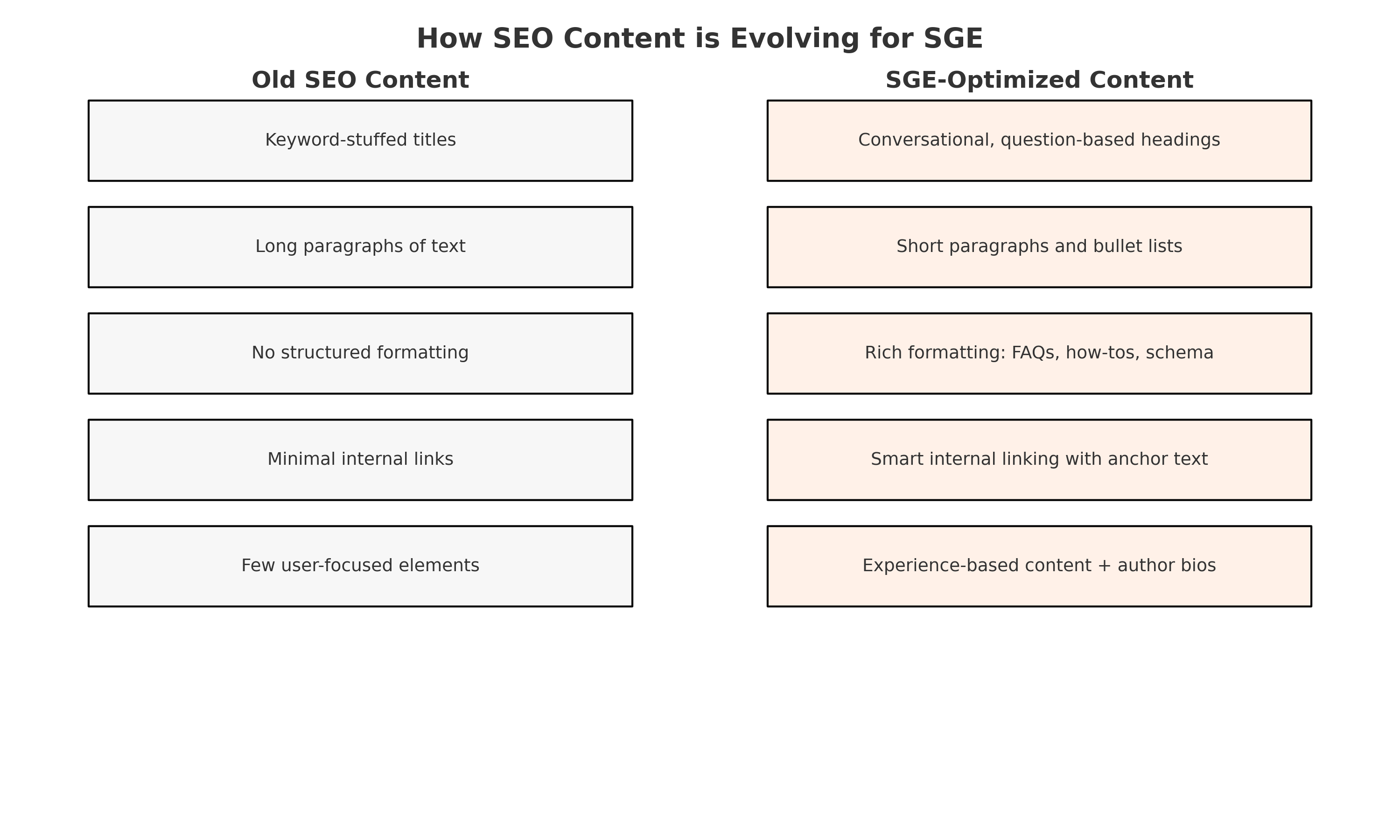
Old SEO Content” vs “SGE-Optimized Content.

Case Studies & Examples

Local Service Business

A South Jersey plumbing company implemented structured data and focused on local SEO strategies, resulting in a 40% increase in organic traffic and a significant boost in local search visibility.​

E-commerce

An online retailer utilized AI-driven content optimization tools to enhance product descriptions and metadata, leading to a 25% increase in search rankings and a corresponding rise in sales.​

Content Strategy

A tech blog adopted entity-based SEO by creating comprehensive content clusters around emerging technologies, establishing itself as an authoritative source and doubling its organic traffic within six months.​


Optimize For AI
Optimize For AI

Future Trends: What’s Next in SEO and AI?

The integration of AI into search is an ongoing process, with future developments likely to include AI-generated search engines offering more personalized and multimodal search experiences. Businesses should stay informed about these trends and be prepared to adapt their SEO strategies accordingly.​

Conclusion: Embracing the Evolution

The intersection of AI and SEO presents both challenges and opportunities for businesses aiming to enhance their online presence. By understanding the evolving search landscape and implementing AI-optimized SEO strategies, you can position your business for sustained success in the digital age.​


Ready to future-proof your SEO strategy? Contact Digital Marketing Group today for a personalized consultation and discover how AI-optimized SEO can elevate your business in the next generation of search.​


By embracing the synergy between AI and SEO, businesses can navigate the complexities of modern search and connect more effectively with their target audiences.

❓ AI & SEO FAQs

Is AI replacing SEO?
No. AI changes how search works, but SEO remains foundational. AI-ready SEO builds on traditional SEO principles.

Does AI reduce website traffic?
AI may reduce low-intent clicks but often increases high-intent visibility and trust.

How long does AI-optimized SEO take to work?
Most businesses see early improvements within 60–90 days depending on competition and authority.

Can small businesses compete in AI search?
Yes. Clear positioning, structured data, and strong local trust signals level the playing field.


This article discusses marketing strategy and search visibility trends. It does not provide legal, financial, or technical advice.
Categories
Digital Marketing for Small Business Generative Engine Optimization SEO SEO Strategies

Optimizing for ChatGPT, Google SGE, and More: What South Jersey Businesses Need to Know

🤖 AI Summary: How South Jersey Businesses Stay Visible in AI Search
  • AI search tools summarize and recommend businesses instead of ranking links.
  • Visibility depends on clarity, trust signals, and structured content—not keyword density.
  • Local entities with consistent data are more likely to appear in AI answers.
  • Schema markup improves AI understanding and citation eligibility.
  • Businesses that adapt early gain a measurable advantage as AI search adoption grows.

Introduction: The Digital Search Shake-Up Has Begun

Search is no longer what it used to be—and that’s both exciting and a little scary. If you’re a South Jersey business owner who’s poured time and money into SEO over the years, the arrival of Google SGE (Search Generative Experience) and tools like ChatGPT in the search workflow might feel like the rules are changing overnight.


Here’s the good news: If you adapt now, you won’t just keep up—you’ll leap ahead.


This article dives into how AI-driven search experiences are transforming SEO, what SGE and ChatGPT mean for local businesses, and how to optimize your content so you stay visible, credible, and competitive in this new landscape.


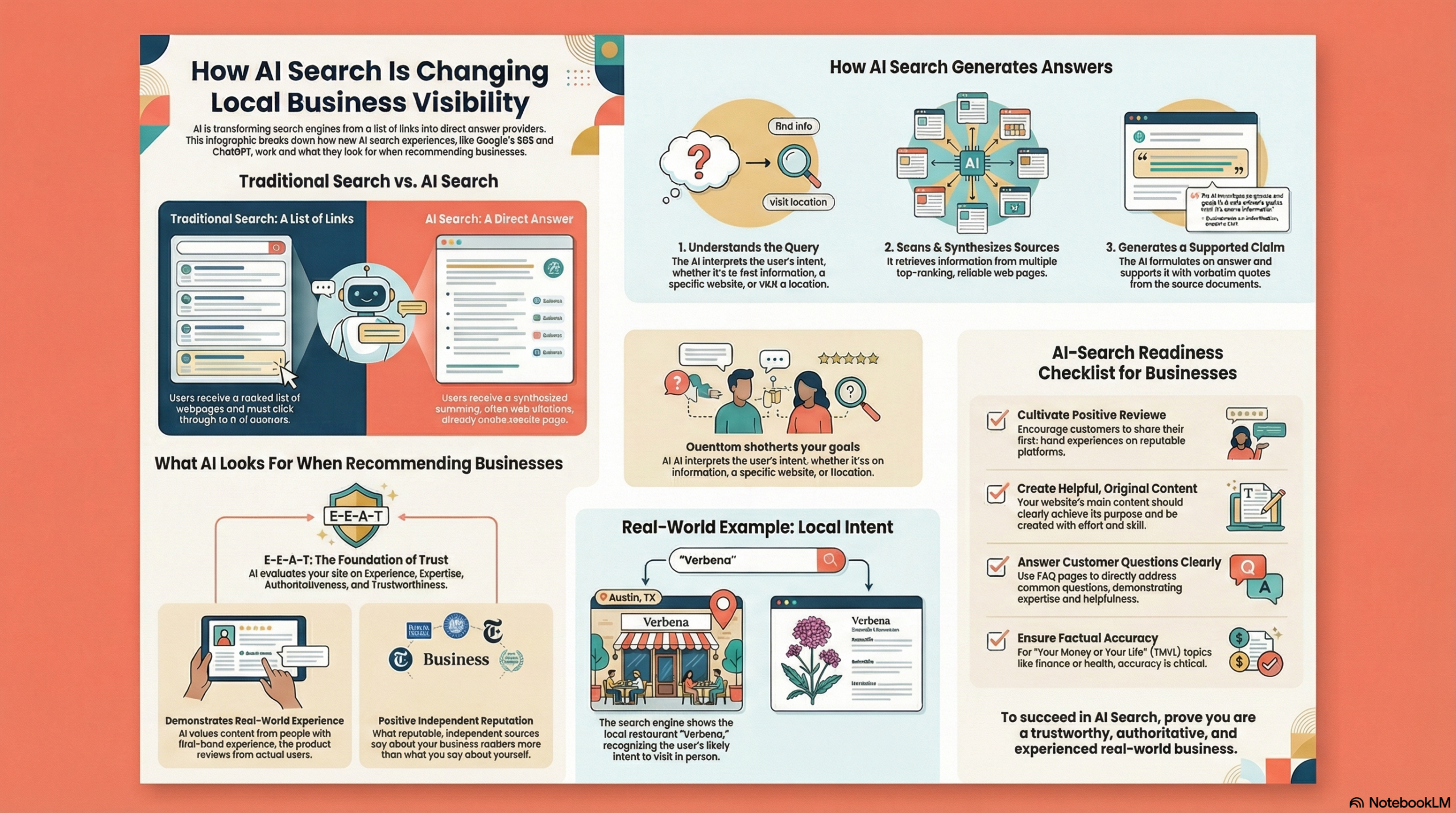
AI Search Changes Local Visibility.

What Are Google SGE and ChatGPT, Really?

Google SGE (Search Generative Experience)

SGE is Google’s integration of generative AI into search results. Instead of just blue links, users now get dynamic AI-generated summaries, follow-up prompts, and direct answers.


  • Example: Instead of showing 10 results for “best roofing company in Cherry Hill,” SGE may summarize reviews, website info, and contact details into a carousel, removing the need to click.
ChatGPT as a Search Companion

More users are bypassing traditional search entirely and asking ChatGPT or Bing Chat for answers and recommendations. These tools cite websites—but only those with clear, structured, and high-authority content.

📍 Who This Guide Is Written For
  • South Jersey service businesses and local brands
  • Companies relying on Google, Maps, and word-of-mouth discovery
  • Businesses serving Camden County, Gloucester County, and surrounding areas
  • Owners who want sustainable visibility—not short-term SEO tricks


Takeaway: Your website content may now be seen by fewer people—but the right people. Only if your business is optimized for these new engines.

Why This Matters for South Jersey Businesses

  • Local queries are changing. Google Maps and GMB aren’t the only game in town. AI assistants now recommend service providers directly.
  • Your competition is likely NOT ready. If you act now, you can dominate the new “AI Search” local pack.
  • Voice and conversational search is rising. These tools understand context better, so keyword stuffing won’t cut it.

How to Optimize for Google SGE and ChatGPT

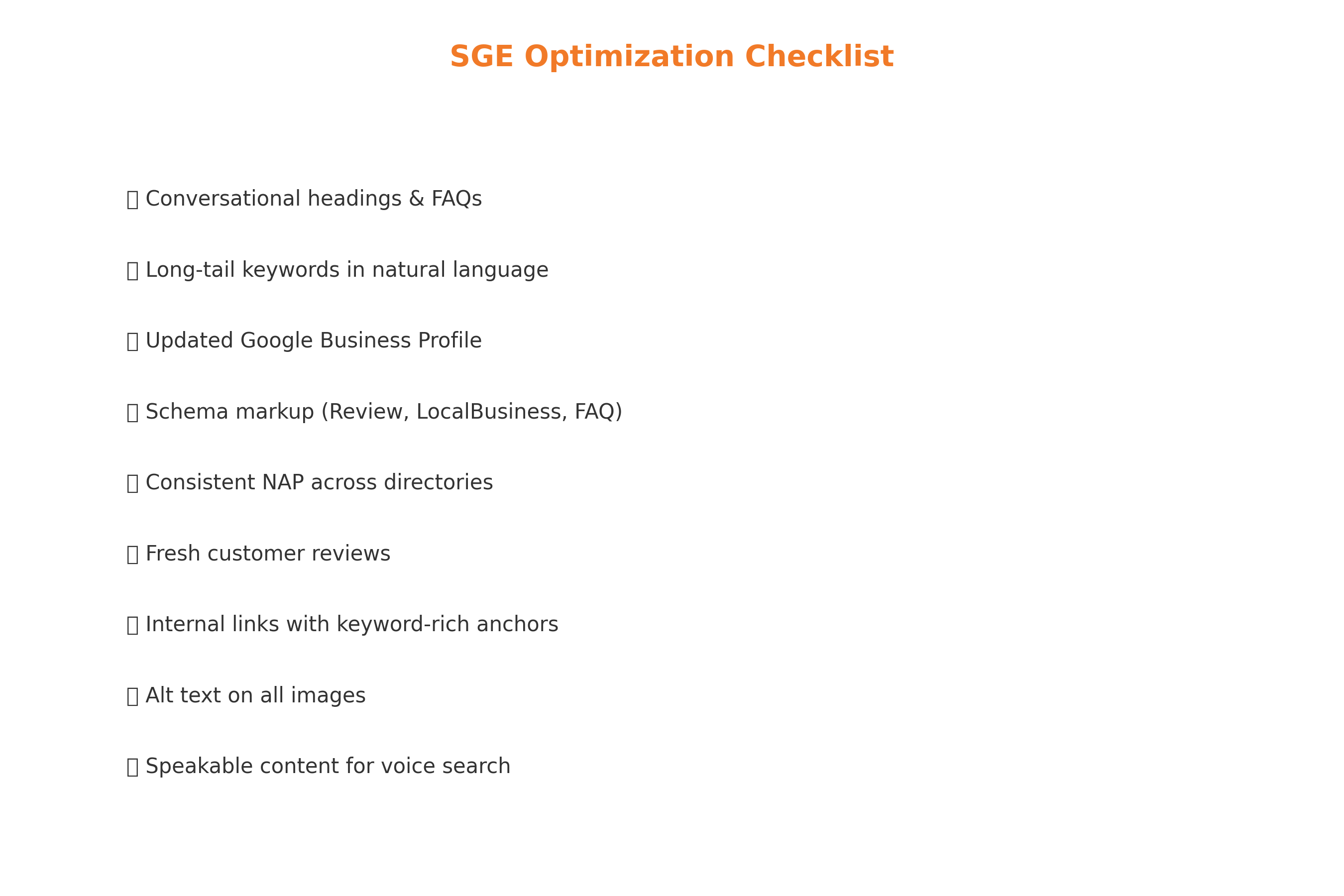
1. Create Conversational, Entity-Rich Content

Generative engines prefer content that answers questions clearly and uses structured formats (lists, Q&As, how-tos).


Action Steps:

  • Use FAQ blocks and headers that mimic user questions.
  • Focus on entities, not just keywords (e.g., instead of “roofing NJ,” use “roof replacement in Gloucester County”).
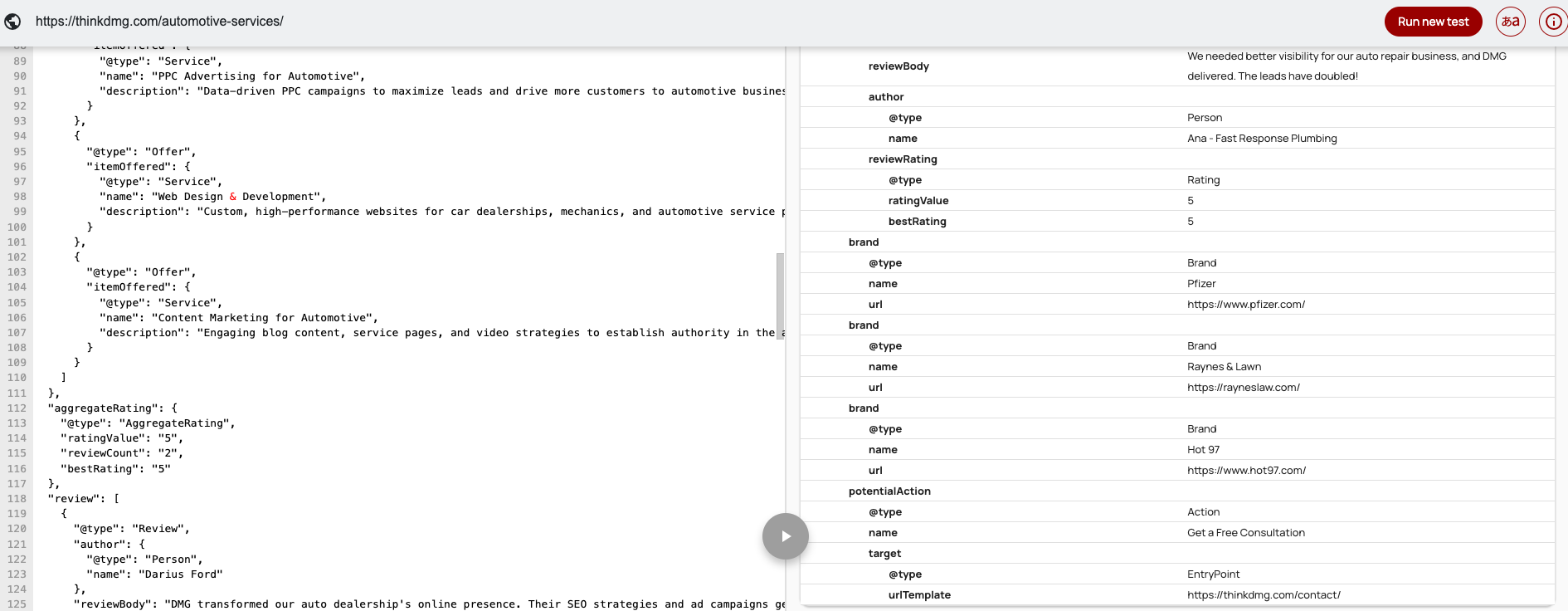
Schema example
Schema example
2. Update Your Schema Markup

Structured data is now critical for inclusion in AI summaries. Use schema to highlight your:


  • Business type
  • Service area
  • Testimonials
  • FAQs
  • Speakable content for voice search


Tool Tip: Use tools like Schema Markup Validator or RankMath to audit your pages.

3. Use First-Person, Experience-Driven Writing

EEAT isn’t just theory. Google’s raters are looking for first-hand experience and real-world expertise.


Add these to your pages:


  • Staff bios
  • Owner commentary
  • Case studies (“how we helped a Turnersville HVAC business rank #1”)


4. Optimize for Long-Tail + Semantic Queries

Searchers are using more natural, conversational queries, like:


  • “What’s the best plumber near me who does weekend calls?”
  • “Affordable website design South Jersey with good reviews”

Action Steps:


  • Add blog content and service pages targeting full-sentence queries
  • Use tools like AnswerThePublic, AlsoAsked, and ChatGPT to discover natural phrasing
🧠 How AI Search Engines Decide Which Businesses to Recommend
  • Clear business identity (who you are, where you operate)
  • Consistent information across your website, Google Business Profile, and directories
  • Content that answers real customer questions directly
  • Structured data that labels services, locations, and FAQs
  • External validation such as reviews, citations, and mentions
AI systems prioritize clarity and trust over aggressive optimization tactics.
5. Make Your Content Easy for AI to Read and Use

Generative engines scan for:


  • Bullet points ✅
  • Numbered lists ✅
  • Short paragraphs ✅
  • Internal links ✅
  • Alt text on images ✅


Internal Linking Tip: Use keyword-rich anchor text like SEO for Contractors in NJ instead of just “click here.”

6. Audit Your Digital Presence Holistically

SGE pulls data from more than just your website. It scans:


  • Google Business Profiles
  • Review platforms (Yelp, BBB)
  • Social media
  • Local directories

Fix These Fast:


  • Inconsistent NAP (Name, Address, Phone)
  • Outdated GMB info
  • No recent reviews


SGE optimization Checklist
📊 Real-World Example: AI Search Visibility in Action
Business: South Jersey HVAC company (Woodbury)

Challenges: Declining organic clicks and limited visibility in AI-generated results

Actions Taken:

  • Rewrote pages using question-based headings
  • Implemented FAQ and LocalBusiness schema
  • Updated Google Business Profile weekly
  • Collected and published consistent reviews

Outcome: 37% increase in Google Search clicks and visible placement within AI summaries over a 90-day period.

Real-World Example: What This Looks Like in Action

DMG recently worked with a local HVAC company in Woodbury. We:


  • Restructured their site content using question-based headings
  • Added schema markup to their service pages and FAQs
  • Implemented Google Business Profile updates weekly
  • Pushed 4 new reviews per month


Result? A 37% increase in clicks from Google Search + visible placement in SGE summaries.

Be The Answer
Free Download – Be The Answer.pdf


Conclusion: The AI-Search Era Is Here—Are You Ready?

The future of SEO isn’t about chasing blue links. It’s about showing up where people are searching now—in AI summaries, voice queries, and real-time answers.


If you’re a business in South Jersey and want to stay visible in a fast-changing landscape, you need to optimize not just for Google Search, but for Google SGE, ChatGPT, and beyond.


✅ AI-Search Readiness Checklist
  • Website answers real customer questions clearly
  • Schema markup is implemented and validated
  • Google Business Profile is accurate and active
  • Reviews are recent and consistent
  • Business info matches across all directories
  • Content is easy to scan and conversational

👉 Let’s future-proof your business. Contact Digital Marketing Group, LLC today for a free AI-readiness audit or call us at 1-800-969-4736.


Frequently Asked Questions

  • Q: Is optimizing for SGE different than traditional SEO?

    • A: Yes. SGE optimization focuses more on structured content, schema markup, and question-based formatting.


  • Q: Can small businesses afford to keep up?

❓ Additional AI Search FAQs

Will AI search reduce website traffic?
AI search may reduce low-intent clicks, but it often increases the quality of visitors by surfacing your business to users actively seeking solutions.

How long does AI-ready SEO take to show results?
Many businesses begin seeing improvements within 60–90 days, depending on competition, consistency, and existing authority.

Do reviews matter more in AI search?
Yes. Reviews help AI systems assess trustworthiness and local relevance when recommending businesses.

This article discusses marketing strategy and search visibility trends. It does not provide legal, financial, or professional advice.
Categories
Digital Marketing for Small Business Digital Marketing Trends Generative Engine Optimization SEO SEO Strategies

Why GEO Is the Next Big Thing for Local Businesses in 2025

If you’re a local business owner trying to stay visible in search results, brace yourself—because the rules of the SEO game are changing fast. And the new MVP? GEO—Generative Engine Optimization.


Introduction: What If Google Stops Showing Your Website?

Imagine pouring thousands into SEO, only for your traffic to dry up overnight because AI starts answering your customers’ questions before they even click. No phone calls, no leads, no conversions—just digital tumbleweeds.


This isn’t fear-mongering. It’s already happening.


In 2024, the rise of AI-powered search—like Google’s Search Generative Experience (SGE) and Bing’s Copilot—means the way people find local businesses is evolving. Generative Engine Optimization (GEO) is the strategy that ensures your business doesn’t just survive this shift—it thrives.


If you’ve been focused on ranking for “Plumber near me” or “Best coffee shop in [Your Town],” GEO is the key to being included in AI-generated answers, not excluded.


Let’s break down why GEO is becoming a must-have for local businesses—and how to make it work for you.


What Is GEO (Generative Engine Optimization)?

GEO is the process of optimizing your content so that it gets featured or cited in answers generated by AI engines (think: ChatGPT, Google SGE, Bing Copilot).

GEO vs. Traditional SEO
Feature
Traditional SEO
GEO
Optimizes for
SERPs (search engine result pages) AI-generated answers
Focus
Keywords, metadata, backlinks Semantic relevance, authority, structured content
Goal
Rank on Page 1 Be cited or referenced by AI assistants


With GEO, you’re not just trying to climb the rankings—you’re positioning your content as a trusted source for AI to pull from.


How GEO Impacts Local Search Results

Local SEO used to be simple: optimize your Google Business Profile, get reviews, and include your service area. Now? AI is summarizing the best plumbers, dentists, and landscapers in your town—often without showing the top 10 links at all.

Local Searches Go Conversational

Queries like:

  • “What’s the best HVAC company in South Jersey?”
  • “Where can I get same-day roof repair near me?”

…are now being answered directly by generative engines that summarize based on context and credibility, not just keyword usage.

The New “Local Pack” Is AI-Curated

Instead of Google showing a map and 3 listings, engines like SGE now display:


  • A conversational answer
  • Business mentions pulled from websites, reviews, directories, and helpful content


So if your content isn’t built to be summarized, you risk being left out of the conversation.


Why GEO Matters for Local Businesses

Here’s why early GEO adopters will crush the competition in 2024:

1. You’ll Get Featured in AI Responses

GEO-optimized content helps your brand show up when AI gives answers. It’s like getting quoted in an encyclopedia instead of buried in a phone book.

2. You Build Local Authority

Engines cite content they trust. By showing consistent expertise, trustworthiness, and relevance to local queries, you become a go-to source.

3. It Boosts Clickless Conversions

Even if users don’t click, they see your name. GEO gives your business visibility in a world of no-click answers, leading to direct searches and word-of-mouth referrals.

4. You’re Ahead of the Curve

Most local competitors are still focused on old-school SEO. Adopting GEO now gives you a massive first-mover advantage.


GEO Best Practices for Local Businesses in 2024

1. Create Conversational, People-First Content


  • Write in Q&A format.
  • Use natural language (like voice search queries).
  • Include “People Also Ask” style headings.


Example: “What’s the average cost of an emergency plumber in Glassboro, NJ?”

2. Add Contextual Depth (Entities & Structured Data)


  • Use schema markup (LocalBusiness, FAQPage, Service).
  • Mention your city, county, landmarks, and zip codes.
  • Interlink supporting content (e.g., blog post + service page).
3. Prioritize EEAT Signals (Experience, Expertise, Authority, Trust)


  • Display team credentials and certifications.
  • Embed testimonials and case studies.
  • Add author bios and location-specific proof points.
4. Build Topical Clusters for Local SEO


  • Create content hubs: service area guides, “best of” lists, buyer’s guides.
  • Internally link between related topics.

Example Cluster:


  • Main Page: “HVAC Services in Camden County”
  • Supporting Pages: “How to Choose a Furnace,” “Winter Prep Guide for NJ Homes,” “Signs You Need Duct Cleaning”
5. Create Quotable, Source-Worthy Content


  • Write content that answers questions with authority.
  • Use data, visuals, and bullet points.
  • Make it easy for AI to pull and summarize.


GEO Tools to Use in 2024

Here are platforms to help you stay ahead:


  • Google Search Generative Experience (Labs)
  • Perplexity.ai – great for seeing what content gets cited
  • ChatGPT + Browsing Plugin – test how your content is seen
  • Frase, Surfer SEO – optimize for semantic relevance
  • Schema.org Validator – make sure your structured data is clean


GEO Readiness Tools Comparison Table

Tool
Core Purpose
GEO Benefit
Use Case
Google SGE (Labs)
AI-powered search preview See how generative answers appear in Google Test your site’s inclusion in generative answers
Perplexity.ai
Conversational search engine Analyze which sources get cited in AI responses Reverse-engineer citation-worthy content
ChatGPT + Browsing
AI assistant with live web access View how GPT summarizes your content in real time Evaluate GEO visibility and EEAT signaling
Frase.io
SEO content optimization with AI Optimizes for semantic relevance and topical depth Create people-first, answer-driven content
Surfer SEO
Content scoring based on NLP + SERP data Ensures you’re semantically aligned with ranking content Optimize on-page SEO for GEO compatibility
Schema.org Validator
Structured data testing Confirms your LocalBusiness, FAQ, and Service markup is valid Enhance machine readability for AI engines


What’s Next for GEO & Local Search?

Expect more personalized, context-rich search results where only a few trusted sources are mentioned. In the near future:


  • Reviews and citations will be even more important.
  • GEO will merge with voice search and AR search (think: “Hey Siri, find a roofer that offers emergency service tonight”).


Conclusion: Don’t Just Rank—Be the Source

GEO isn’t a trend—it’s a paradigm shift. If you’re a local business that relies on digital visibility, now is the time to act.


Want to be the plumber, law firm, or med spa that AI trusts enough to recommend? Then you need to:

  • Create content that answers questions.
  • Optimize with context and local data.
  • Build trust with EEAT and quality UX.


Call to Action:

Want to dominate local search in the AI era?
Schedule a free consultation with Digital Marketing Group, LLC today and let us show you how GEO can turn your website into a lead-generating machine.


Contact Us or call 1-800-969-4736 to get started.

Categories
Content Marketing Digital Marketing for Small Business Marketing SEO Strategies

Alex Hormozi vs. Gary Vee: Which Content Strategy is Better for Your Business?

✅ Quick Summary: Alex Hormozi vs. Gary Vee

What’s the difference?
Alex Hormozi’s strategy is based on deep, long-form content designed to build authority over time, while Gary Vaynerchuk (Gary Vee) uses high-volume, short-form content to gain quick exposure and reach a larger audience.

Why it matters in 2025:
The best content strategy depends on your business goals. Hormozi’s method is ideal for building trust and authority in high-ticket sales, while Gary Vee’s approach is better suited for rapid brand awareness and visibility.

Introduction: Choosing the Right Content Strategy for Business Growth

Alex Hormozi and Gary Vaynerchuk (Gary Vee) are two of the most well-known entrepreneurs in the content marketing space. Both have built massive audiences and multi-million-dollar businesses by leveraging content, but their strategies couldn’t be more different.


Hormozi takes a long-form, deep-value approach, while Gary Vee floods social media with high-volume, short-form content.


For business owners, entrepreneurs, and marketers, the question is: Which strategy actually drives leads, builds trust, and increases revenue?


This article will break down:


  • How Hormozi’s deep, educational content builds long-term authority
  • How Gary Vee’s fast-paced, high-volume strategy creates massive brand awareness
  • Which strategy is best for small business owners looking for tangible results

📌 Content Strategy Showdown: At a Glance

Strategy Alex Hormozi Gary Vee
Core Approach Long-form, deep-value, educational Short-form, high-volume, visibility-focused
Best For Consultants, B2B, high-ticket sales Startups, influencers, eCommerce
Lead Type High-intent, long-term audience Mass visibility, fast-paced engagement
Time to Results Slower, but higher quality Fast, but ongoing production required
Strengths Authority, SEO longevity, deep trust Virality, brand awareness, scalability
Weaknesses Time-intensive, slower traction Surface-level trust, content burnout risk

Who Are Alex Hormozi and Gary Vee?

Alex Hormozi: Building Authority with Deep, Value-Driven Content

Alex Hormozi is an entrepreneur, investor, and author of $100M Offers. His content approach is focused on:


  • Long-form, high-value content primarily on YouTube, Twitter, and newsletters
  • Trust-building through education, rather than direct selling
  • Repurposing long-form content into smaller clips for distribution


This strategy attracts an audience that is highly engaged and more likely to convert into high-ticket customers.

Gary Vee: Flooding Social Media with High-Volume Content

Gary Vaynerchuk is the CEO of VaynerMedia and a pioneer of personal branding through content. His approach is based on:


  • Posting dozens of short-form videos daily on TikTok, Instagram, and LinkedIn
  • A “document, don’t create” philosophy, making content creation fast and scalable
  • Mass exposure over deep engagement, prioritizing quantity over length


This strategy is designed to build brand awareness quickly and attract a broad audience.


Hormozi vs. Gary Vee: Which Content Strategy Works for Your Business?

Hormozi vs. Gary Vee: Which Content Strategy Works for Your Business?

Hormozi’s Long-Form Content Strategy: Trust and Authority Over Time

Best suited for:


  • Businesses selling high-ticket services or products
  • Brands that require long-term trust before conversion
  • Companies looking for evergreen content that continues generating leads


Key takeaways:


  • Deep-dive, long-form content builds credibility
  • SEO-driven strategy ensures content remains discoverable for years
  • High-converting leads result from an audience that trusts the brand


Example:


A business consultant produces a weekly YouTube video breaking down advanced strategies, repurposing sections into Twitter threads and LinkedIn articles.


Strengths:

  • Establishes long-term industry authority
  • Evergreen content generates leads for years
  • Higher conversion rates from highly engaged viewers

Weaknesses:

  • Takes longer to see results
  • Requires consistent, in-depth content creation

💡 Pro Tip for Small Teams:
You don’t need a film crew. Record a Zoom call, break it into clips with tools like Descript or Opus Clip, and post consistently. One 15-minute video = a week’s worth of content when repurposed right.

🔀 The Hybrid Content Strategy Framework

Combine Hormozi’s depth with Gary Vee’s reach for a best-of-both-worlds content engine.

  1. Create one long-form video per week (e.g., 10–15 min on YouTube).
  2. Repurpose it into:
    • 5–10 short-form videos for TikTok, Reels, and Shorts
    • 2–3 quote images or stat graphics
    • 1 email newsletter or carousel post
  3. Distribute across all major platforms: YouTube, LinkedIn, Instagram, Twitter, TikTok.
  4. Analyze & Iterate: Use analytics to double down on top-performing formats or messages.

Gary Vee’s High-Volume Strategy: Speed, Virality, and Maximum Reach

Best suited for:

  • Businesses needing rapid brand awareness
  • Startups, e-commerce brands, and influencers
  • Companies targeting younger audiences and social media users

Key takeaways:

  • Multiple short-form videos daily increase visibility
  • Trend-driven content capitalizes on viral moments
  • Fast, high-frequency posting dominates social platforms

Example:


A personal brand posts 10 TikTok clips daily, maximizing reach and engagement.

Strengths:

  • Builds brand awareness quickly
  • Content is easier to produce and distribute
  • Higher chance of virality and mass engagement

Weaknesses:

  • Requires constant content production
  • Shorter content does not establish deep trust
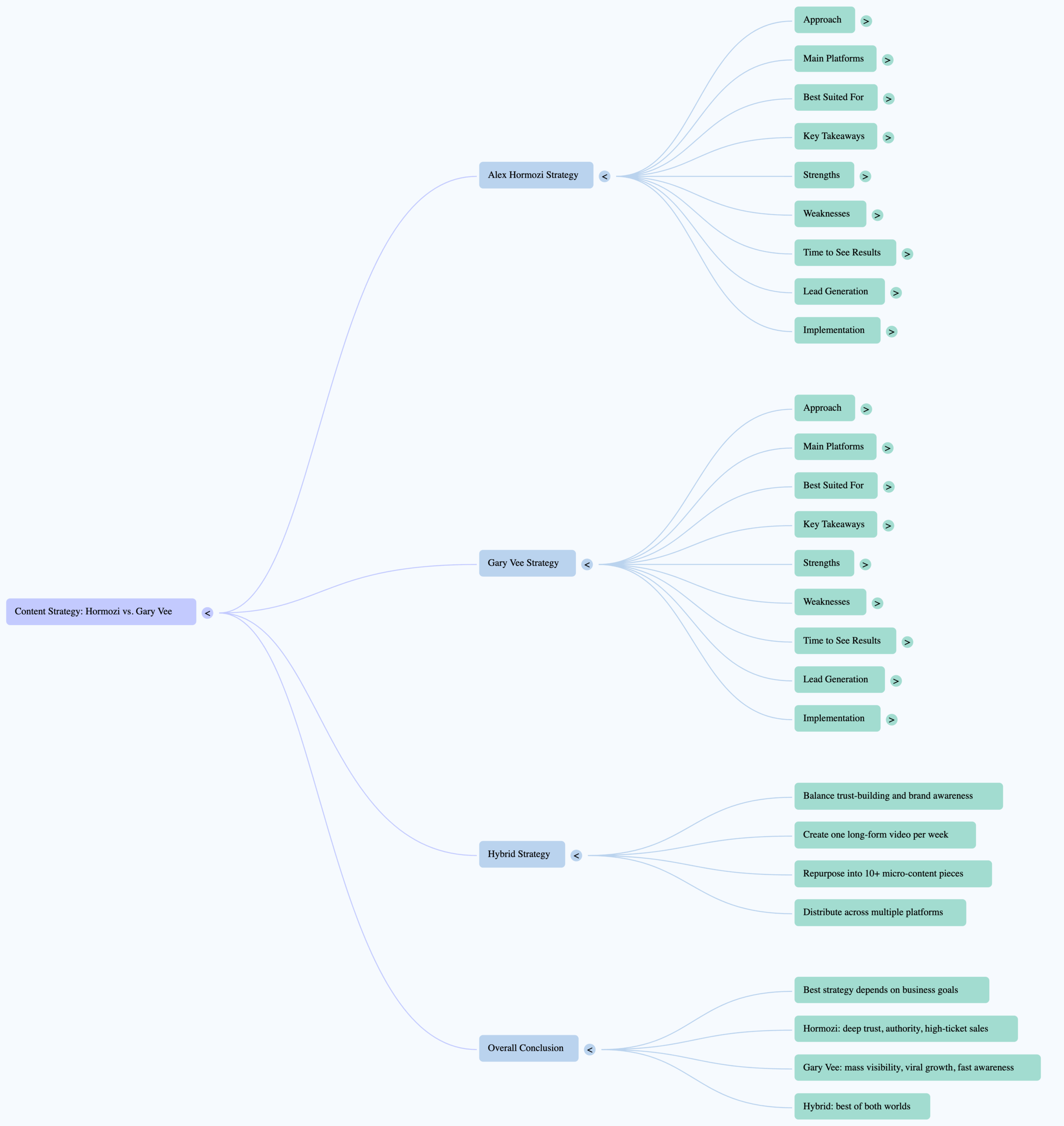
Alex Hormozi vs. Gary Vee - Mind Map
Alex Hormozi vs. Gary Vee – Mind Map

Which Content Strategy is Right for You?

Factor
Alex Hormozi
Gary Vee
Content Type
Long-form, in-depth content Short-form, high-frequency content
Main Platforms
YouTube, Twitter, newsletters TikTok, Instagram, LinkedIn
Lead Generation
High-intent, long-term audience Mass visibility, fast-paced engagement
Time to See Results
Slower, but leads are higher quality Fast reach, but requires ongoing content creation
Best For
High-ticket businesses, consultants, B2B Startups, influencers, e-commerce

How to Implement the Best Strategy for Your Business

If You Choose Alex Hormozi’s Strategy:
If You Choose Gary Vee’s Strategy:
  • Prioritize high-volume, short-form content on TikTok, Instagram, and LinkedIn.
  • Use trending topics and viral hooks to maximize reach.
  • Scale content creation quickly with a “document, don’t create” approach.
The Best of Both Worlds: A Hybrid Content Strategy

For businesses looking to balance trust-building and brand awareness, a hybrid strategy works best:


  • Create one long-form video per week (Hormozi-style).
  • Repurpose it into 10+ micro-content pieces (Gary Vee-style).
  • Distribute across multiple platforms for maximum reach and impact.

🧩 Is Hormozi or Gary Vee Right for You?

✅ Choose Hormozi if you:

  • Sell high-ticket services
  • Want to be seen as a thought leader
  • Can invest in YouTube, podcasts, or newsletters
  • Value deep trust and long-term growth

✅ Choose Gary Vee if you:

  • Want fast visibility and social proof
  • Run an eCommerce or lifestyle brand
  • Love creating short-form videos and jumping on trends
  • Need rapid reach and brand growth

Conclusion: Which Content Strategy Wins?

The best content strategy depends on your business goals.

  • If you need deep trust, authority, and high-ticket sales, Alex Hormozi’s long-form approach is best.
  • If you want mass visibility, viral growth, and fast brand awareness, Gary Vee’s high-volume strategy is better.
  • If you want the best of both worlds, implement a hybrid approach.


Want a content strategy that drives actual revenue? Download our Content Strategy Blueprint and learn how to create content that converts.

Download Now

💬 Frequently Asked Questions

Q: What is the key difference between Alex Hormozi and Gary Vee’s content strategy?
A: Alex Hormozi focuses on creating long-form, educational content that builds trust and authority over time, whereas Gary Vee emphasizes posting high volumes of short-form content to drive immediate visibility and engagement.

Q: Which strategy is best for long-term business growth?
A: Hormozi’s approach is better for businesses that want to establish long-term authority, particularly those selling high-ticket services or products, as it builds a loyal, engaged audience.

Q: Is Gary Vee’s strategy effective for new businesses?
A: Yes, Gary Vee’s high-volume strategy is ideal for startups and new businesses looking to build brand awareness quickly and reach a broad audience, especially on social platforms like TikTok and Instagram.

Q: Can I combine both strategies in my content plan?
A: Absolutely. A hybrid approach that combines Hormozi’s deep, educational content with Gary Vee’s short-form, high-volume posts can be highly effective for balancing authority-building with mass exposure.

Q: Which platforms should I use for each strategy?
A: Hormozi’s strategy works well on platforms that favor long-form content, such as YouTube and LinkedIn, while Gary Vee’s strategy is perfect for TikTok, Instagram, and LinkedIn where short-form content thrives.

Q: How long will it take to see results with these strategies?
A: Hormozi’s strategy typically takes longer to see results but yields higher-quality leads, while Gary Vee’s strategy offers quick visibility but requires ongoing content production for sustained engagement.