Categories
Content Marketing Digital Marketing for Small Business Digital Marketing Trends Generative Engine Optimization SEO SEO Strategies

SEO Meets AI: Optimizing Your Business for the Next Generation of Search

🤖 AI Summary: How AI Is Changing SEO
  • AI-powered search focuses on understanding intent and context, not just matching keywords.
  • Search engines increasingly summarize and recommend content instead of ranking pages alone.
  • Businesses must optimize for clarity, trust signals, and structured data to remain visible.
  • Entity-based SEO and E-E-A-T are critical for AI-driven discovery.
  • AI-ready SEO builds on traditional SEO rather than replacing it.

Introduction

In today’s rapidly evolving digital landscape, the fusion of Artificial Intelligence (AI) and Search Engine Optimization (SEO) is reshaping how businesses enhance their online visibility. As AI technologies become integral to search engines, understanding and adapting to these changes is crucial for maintaining a competitive edge. This article delves into the convergence of AI and SEO, offering actionable insights to optimize your business for the next generation of search.​

Understanding the Convergence: How AI is Changing Search

From Keywords to Context

Traditional SEO heavily relied on keyword optimization, focusing on matching exact phrases users might input. However, AI advancements have shifted this paradigm towards understanding the context and intent behind searches. Google’s AI algorithms, such as RankBrain and MUM, analyze user behavior and content to deliver more relevant results. For instance, a search for “best coffee” now considers user location, preferences, and previous interactions to provide personalized recommendations.​

Personalized and Predictive Search

AI enables search engines to offer personalized and predictive results by analyzing vast amounts of data, including user behavior, location, and preferences. This personalization means that two users searching for the same term may receive different results tailored to their unique profiles. Additionally, AI assistants like ChatGPT and Alexa are becoming more adept at understanding natural language queries, further enhancing the search experience.​


Diagram comparing traditional keyword-based search results with AI-driven contextual search results.
🧠 How AI Search Engines Decide What to Show or Cite
  • Intent clarity: Does the content clearly answer a specific question?
  • Entity confidence: Is the business, topic, or author clearly defined?
  • Trust signals: Are credentials, reviews, and citations present?
  • Content structure: Is the information easy to scan and summarize?
  • Consensus: Does the information align with other trusted sources?
AI systems prioritize clarity and reliability over aggressive optimization tactics.

Key Elements of AI-Optimized SEO

Structured Data and Schema Markup

Implementing structured data and schema markup helps search engines comprehend the content of your website more effectively. By providing explicit clues about the meaning of your pages, you enhance the likelihood of appearing in rich snippets and other enhanced search results. Tools like Google’s Structured Data Markup Helper and resources from Schema.org can assist in this process.​

Search Generative Experience (SGE)

The Search Generative Experience (SGE) integrates AI-generated content within search results, offering users concise answers alongside traditional listings. To optimize for SGE, focus on creating comprehensive content that addresses common queries in your industry, increasing the chances of being featured in these AI-generated summaries.​

Voice and Conversational Search

With the rise of voice-activated devices, optimizing for voice search is becoming increasingly important. This involves crafting content that mirrors natural speech patterns and addresses conversational queries. For example, instead of targeting the keyword “weather forecast,” consider phrases like “What’s the weather like today?”​

Entity-Based SEO

AI-driven search engines utilize entities—distinct concepts or objects—to understand and categorize content. Establishing your website as an authoritative source on specific entities can enhance visibility. This can be achieved by creating in-depth content clusters around key topics relevant to your business.​


🔍 Traditional SEO vs AI-Optimized SEO
Traditional SEO AI-Optimized SEO
Keyword-focused optimization Intent- and context-focused optimization
Ranks pages in lists Summarizes and recommends answers
Links drive visibility Clarity and trust drive visibility
SEO tactics dominate SEO + structure + credibility
Paid results, Local Search and Organic Results concept

Practical Strategies to Optimize for AI Search

Optimize Your Google Business Profile & Local SEO

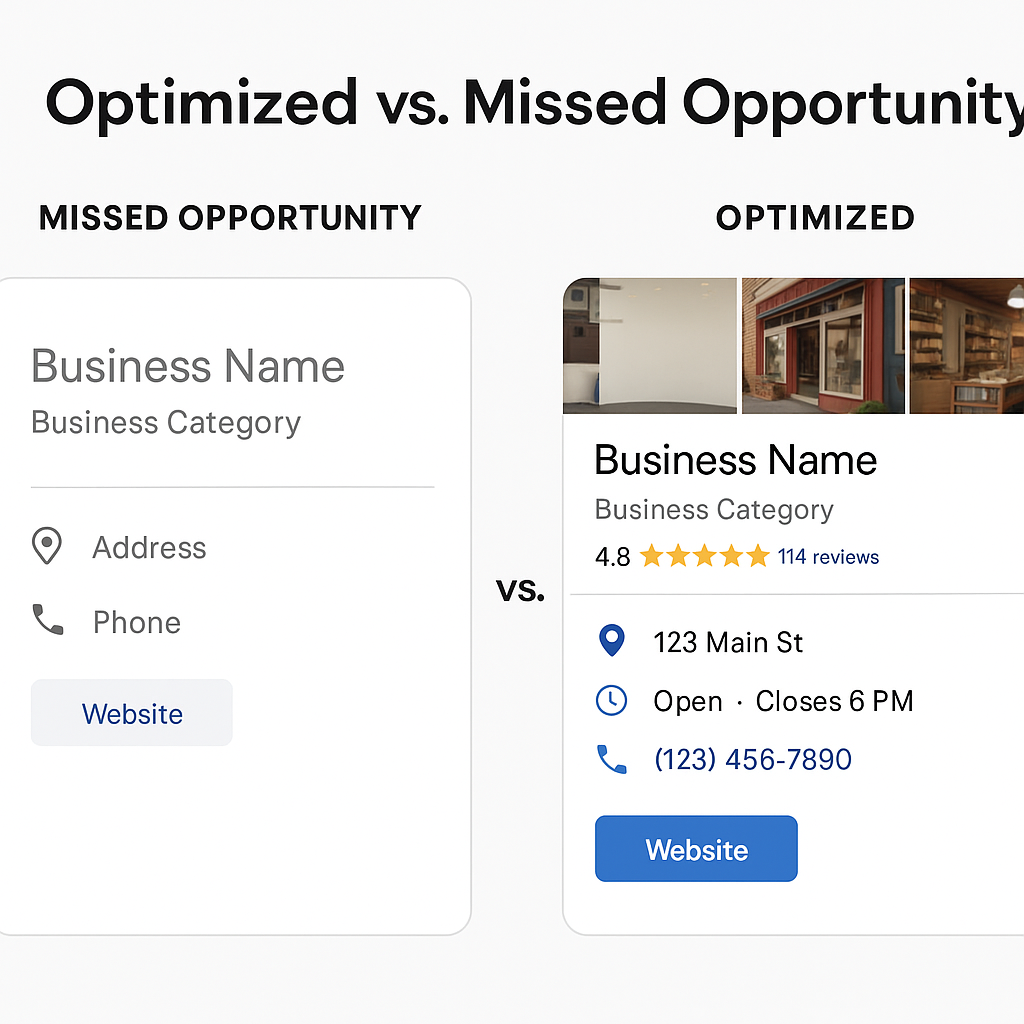
A well-maintained Google Business Profile (GBP) is vital for local SEO. Ensure your GBP is complete with accurate information, high-quality images, and regular updates. Encourage satisfied customers to leave positive reviews, as these significantly influence local search rankings.​

Prioritize User Experience (UX)

AI algorithms prioritize websites that offer exceptional user experiences. Focus on creating fast-loading, mobile-friendly, and accessible websites. Monitor metrics like dwell time and bounce rate to gauge and improve user engagement.​

Content That Educates, Engages, and Solves

Develop content that is informative, engaging, and addresses the needs of your audience. Emphasize Experience, Expertise, Authoritativeness, and Trustworthiness (E-E-A-T) by showcasing your industry knowledge and providing original insights.​

Use AI as a Tool, Not Just a Trend

Leverage AI-powered tools to enhance your SEO efforts, such as automating keyword research, content optimization, and performance analysis. However, ensure that AI complements human creativity and expertise rather than replacing them.​Salesforce


✅ AI-Search Readiness Checklist
  • Website answers real customer questions clearly
  • Structured data (schema) is implemented and validated
  • Business entities and services are explicitly defined
  • Content demonstrates E-E-A-T
  • Site is fast, mobile-friendly, and easy to navigate
  • External signals (reviews, profiles, citations) are consistent
Old SEO Content” vs “SGE-Optimized Content.

Case Studies & Examples

Local Service Business

A South Jersey plumbing company implemented structured data and focused on local SEO strategies, resulting in a 40% increase in organic traffic and a significant boost in local search visibility.​

E-commerce

An online retailer utilized AI-driven content optimization tools to enhance product descriptions and metadata, leading to a 25% increase in search rankings and a corresponding rise in sales.​

Content Strategy

A tech blog adopted entity-based SEO by creating comprehensive content clusters around emerging technologies, establishing itself as an authoritative source and doubling its organic traffic within six months.​


Optimize For AI
Optimize For AI

Future Trends: What’s Next in SEO and AI?

The integration of AI into search is an ongoing process, with future developments likely to include AI-generated search engines offering more personalized and multimodal search experiences. Businesses should stay informed about these trends and be prepared to adapt their SEO strategies accordingly.​

Conclusion: Embracing the Evolution

The intersection of AI and SEO presents both challenges and opportunities for businesses aiming to enhance their online presence. By understanding the evolving search landscape and implementing AI-optimized SEO strategies, you can position your business for sustained success in the digital age.​


Ready to future-proof your SEO strategy? Contact Digital Marketing Group today for a personalized consultation and discover how AI-optimized SEO can elevate your business in the next generation of search.​


By embracing the synergy between AI and SEO, businesses can navigate the complexities of modern search and connect more effectively with their target audiences.

❓ AI & SEO FAQs

Is AI replacing SEO?
No. AI changes how search works, but SEO remains foundational. AI-ready SEO builds on traditional SEO principles.

Does AI reduce website traffic?
AI may reduce low-intent clicks but often increases high-intent visibility and trust.

How long does AI-optimized SEO take to work?
Most businesses see early improvements within 60–90 days depending on competition and authority.

Can small businesses compete in AI search?
Yes. Clear positioning, structured data, and strong local trust signals level the playing field.


This article discusses marketing strategy and search visibility trends. It does not provide legal, financial, or technical advice.
Categories
Digital Marketing for Small Business Generative Engine Optimization SEO SEO Strategies

Optimizing for ChatGPT, Google SGE, and More: What South Jersey Businesses Need to Know

🤖 AI Summary: How South Jersey Businesses Stay Visible in AI Search
  • AI search tools summarize and recommend businesses instead of ranking links.
  • Visibility depends on clarity, trust signals, and structured content—not keyword density.
  • Local entities with consistent data are more likely to appear in AI answers.
  • Schema markup improves AI understanding and citation eligibility.
  • Businesses that adapt early gain a measurable advantage as AI search adoption grows.

Introduction: The Digital Search Shake-Up Has Begun

Search is no longer what it used to be—and that’s both exciting and a little scary. If you’re a South Jersey business owner who’s poured time and money into SEO over the years, the arrival of Google SGE (Search Generative Experience) and tools like ChatGPT in the search workflow might feel like the rules are changing overnight.


Here’s the good news: If you adapt now, you won’t just keep up—you’ll leap ahead.


This article dives into how AI-driven search experiences are transforming SEO, what SGE and ChatGPT mean for local businesses, and how to optimize your content so you stay visible, credible, and competitive in this new landscape.


AI Search Changes Local Visibility.

What Are Google SGE and ChatGPT, Really?

Google SGE (Search Generative Experience)

SGE is Google’s integration of generative AI into search results. Instead of just blue links, users now get dynamic AI-generated summaries, follow-up prompts, and direct answers.


  • Example: Instead of showing 10 results for “best roofing company in Cherry Hill,” SGE may summarize reviews, website info, and contact details into a carousel, removing the need to click.
ChatGPT as a Search Companion

More users are bypassing traditional search entirely and asking ChatGPT or Bing Chat for answers and recommendations. These tools cite websites—but only those with clear, structured, and high-authority content.

📍 Who This Guide Is Written For
  • South Jersey service businesses and local brands
  • Companies relying on Google, Maps, and word-of-mouth discovery
  • Businesses serving Camden County, Gloucester County, and surrounding areas
  • Owners who want sustainable visibility—not short-term SEO tricks


Takeaway: Your website content may now be seen by fewer people—but the right people. Only if your business is optimized for these new engines.

Why This Matters for South Jersey Businesses

  • Local queries are changing. Google Maps and GMB aren’t the only game in town. AI assistants now recommend service providers directly.
  • Your competition is likely NOT ready. If you act now, you can dominate the new “AI Search” local pack.
  • Voice and conversational search is rising. These tools understand context better, so keyword stuffing won’t cut it.

How to Optimize for Google SGE and ChatGPT

1. Create Conversational, Entity-Rich Content

Generative engines prefer content that answers questions clearly and uses structured formats (lists, Q&As, how-tos).


Action Steps:

  • Use FAQ blocks and headers that mimic user questions.
  • Focus on entities, not just keywords (e.g., instead of “roofing NJ,” use “roof replacement in Gloucester County”).
Schema example
Schema example
2. Update Your Schema Markup

Structured data is now critical for inclusion in AI summaries. Use schema to highlight your:


  • Business type
  • Service area
  • Testimonials
  • FAQs
  • Speakable content for voice search


Tool Tip: Use tools like Schema Markup Validator or RankMath to audit your pages.

3. Use First-Person, Experience-Driven Writing

EEAT isn’t just theory. Google’s raters are looking for first-hand experience and real-world expertise.


Add these to your pages:


  • Staff bios
  • Owner commentary
  • Case studies (“how we helped a Turnersville HVAC business rank #1”)


4. Optimize for Long-Tail + Semantic Queries

Searchers are using more natural, conversational queries, like:


  • “What’s the best plumber near me who does weekend calls?”
  • “Affordable website design South Jersey with good reviews”

Action Steps:


  • Add blog content and service pages targeting full-sentence queries
  • Use tools like AnswerThePublic, AlsoAsked, and ChatGPT to discover natural phrasing
🧠 How AI Search Engines Decide Which Businesses to Recommend
  • Clear business identity (who you are, where you operate)
  • Consistent information across your website, Google Business Profile, and directories
  • Content that answers real customer questions directly
  • Structured data that labels services, locations, and FAQs
  • External validation such as reviews, citations, and mentions
AI systems prioritize clarity and trust over aggressive optimization tactics.
5. Make Your Content Easy for AI to Read and Use

Generative engines scan for:


  • Bullet points ✅
  • Numbered lists ✅
  • Short paragraphs ✅
  • Internal links ✅
  • Alt text on images ✅


Internal Linking Tip: Use keyword-rich anchor text like SEO for Contractors in NJ instead of just “click here.”

6. Audit Your Digital Presence Holistically

SGE pulls data from more than just your website. It scans:


  • Google Business Profiles
  • Review platforms (Yelp, BBB)
  • Social media
  • Local directories

Fix These Fast:


  • Inconsistent NAP (Name, Address, Phone)
  • Outdated GMB info
  • No recent reviews


SGE optimization Checklist
📊 Real-World Example: AI Search Visibility in Action
Business: South Jersey HVAC company (Woodbury)

Challenges: Declining organic clicks and limited visibility in AI-generated results

Actions Taken:

  • Rewrote pages using question-based headings
  • Implemented FAQ and LocalBusiness schema
  • Updated Google Business Profile weekly
  • Collected and published consistent reviews

Outcome: 37% increase in Google Search clicks and visible placement within AI summaries over a 90-day period.

Real-World Example: What This Looks Like in Action

DMG recently worked with a local HVAC company in Woodbury. We:


  • Restructured their site content using question-based headings
  • Added schema markup to their service pages and FAQs
  • Implemented Google Business Profile updates weekly
  • Pushed 4 new reviews per month


Result? A 37% increase in clicks from Google Search + visible placement in SGE summaries.

Be The Answer
Free Download – Be The Answer.pdf


Conclusion: The AI-Search Era Is Here—Are You Ready?

The future of SEO isn’t about chasing blue links. It’s about showing up where people are searching now—in AI summaries, voice queries, and real-time answers.


If you’re a business in South Jersey and want to stay visible in a fast-changing landscape, you need to optimize not just for Google Search, but for Google SGE, ChatGPT, and beyond.


✅ AI-Search Readiness Checklist
  • Website answers real customer questions clearly
  • Schema markup is implemented and validated
  • Google Business Profile is accurate and active
  • Reviews are recent and consistent
  • Business info matches across all directories
  • Content is easy to scan and conversational

👉 Let’s future-proof your business. Contact Digital Marketing Group, LLC today for a free AI-readiness audit or call us at 1-800-969-4736.


Frequently Asked Questions

  • Q: Is optimizing for SGE different than traditional SEO?

    • A: Yes. SGE optimization focuses more on structured content, schema markup, and question-based formatting.


  • Q: Can small businesses afford to keep up?

❓ Additional AI Search FAQs

Will AI search reduce website traffic?
AI search may reduce low-intent clicks, but it often increases the quality of visitors by surfacing your business to users actively seeking solutions.

How long does AI-ready SEO take to show results?
Many businesses begin seeing improvements within 60–90 days, depending on competition, consistency, and existing authority.

Do reviews matter more in AI search?
Yes. Reviews help AI systems assess trustworthiness and local relevance when recommending businesses.

This article discusses marketing strategy and search visibility trends. It does not provide legal, financial, or professional advice.
Categories
Digital Marketing Trends Marketing SEO SEO Strategies User Experience (UX)

The YouTube SEO Formula: How to Optimize Videos for Maximum Growth

What if just one smart video could generate a steady stream of leads for your small business—without a studio setup or big marketing budget? That’s the power of YouTube SEO when done right.

In this guide, we’ll break down the YouTube SEO formula that creators like Ali Abdaal and Justin Welsh use to drive millions of views—then show you how to apply it to grow your business with zero fluff. Whether you run a café, service-based business, or local brand, this is your go-to playbook for turning videos into visibility, trust, and long-term customers.

Why the YouTube SEO Formula Works for Small Businesses

YouTube isn’t just for influencers—it’s the second-largest search engine in the world, with over 2.5 billion users. Even more powerful? 70% of its traffic is search- and recommendation-driven source.

That means your video titled “5 Café Profit Hacks” can work 24/7, attracting your ideal customers without spending a cent on ads.

Short-form videos (like Instagram Reels) often disappear in a day or two. But a YouTube video optimized with the right SEO can generate views, trust, and leads for years.

Step 1 – Choose the Right Keywords for Your Niche

Your keywords are the compass of your content. If you’re targeting “how to grow a coffee shop” or “plumbing business tips,” that’s what your customers are searching for.

Use tools like:

Look for keywords that:

  • Have strong search intent

  • Aren’t oversaturated

  • Include local or niche-specific angles

Example: Instead of “marketing tips,” try “Retail Marketing Tips for South Jersey”.

Learn more about video keyword research for small businesses.

Step 2 – Optimize Titles, Thumbnails, and Descriptions

Your title is your first impression. Keep it under 60 characters and include your keyword at the front.

Good Example:
“5 Retail Growth Tips for 2025”
“Café Profit Hacks That Actually Work”

Your thumbnail should:

  • Feature your brand colors

  • Include bold, readable text

  • Show your face or logo

Your description should:

  • Be at least 200 words

  • Include the focus keyword

  • Link to your website

  • Include a strong CTA

And don’t forget tags:

  • Use 5–10 tags: a mix of broad and niche

  • Examples: “small business marketing”, “how to start a bakery”, “retail SEO”

Engagement can increase trust by 33%

Step 3 – Use Tags and Hashtags to Expand Reach

Tags help YouTube understand your video context, while hashtags make it searchable on mobile.

Use:

  • 2–3 branded hashtags (#YourBusinessName)

  • 2–3 topical hashtags (#smallbiztips, #localSEO)

Combined with your tags, this strategy helps videos show up in both YouTube and Google search.


Step 4 – Increase Engagement to Build Trust

Engagement is critical for ranking in YouTube’s algorithm. The more people comment, like, or share, the more YouTube boosts your video.

How to build engagement:

  • Reply to the first 5–10 comments on every video

  • Ask viewers to answer a question in the comments

  • Use a pinned comment with a CTA

Step 5 – Create Evergreen Video Content

Trendy videos fade. Evergreen videos—like “How to Price Your Products”pull in leads for years.

Ali Abdaal’s 2020 video “Deep Work” still gets millions of views today. That’s the power of content that stays relevant.

For small business owners, try topics like:

  • “How to Start a Business in [Your Town]”

  • “Top 5 Ways to Attract Local Customers”

  • “Retail Survival Guide for 2025”

🟢 Bonus Tip: YouTube favors consistency. Even posting twice a month can build momentum.

Step 6 – Track Results and Tweak for Growth

YouTube gives you all the tools to measure your performance through YouTube Studio.

Watch these metrics:

  • CTR (Click-Through Rate)

  • Average View Duration

  • Audience Retention

If your video has a 40% drop-off in the first minute, trim your intro. If your thumbnail gets a low CTR, try brighter colors or clearer text.


The YouTube SEO Checklist

🟩 Pre-Upload:

  • Keyword research complete

  • Focus keyphrase in title

  • Tags and hashtags added

🟩 Design:

  • Thumbnail optimized

  • Video length matches topic

🟩 Post-Upload:

  • Description is 200+ words

  • Comments replied to

  • Performance tracked weekly

YouTube SEO Ready?
YouTube SEO Ready?

Conclusion – Turn YouTube into Your Growth Engine

The YouTube SEO formula is your competitive edge—especially if you’re a small business owner with limited time and budget. You don’t need expensive gear or daily uploads. You just need the right SEO foundation.

With the right keywords, titles, thumbnails, and a little engagement, you can turn one video into a long-term lead generator.

Ready to grow your YouTube channel?

Get your FREE YouTube SEO Kit for Small Businesses
or
Schedule a consultation with Digital Marketing Group, South Jersey’s local SEO experts.

📞 Call 1-800-969-4736 to get started today.

Categories
SEO Strategies

The Ultimate Guide to Ranking in Google’s Featured Snippets and AI Answers

🤖 AI Summary: Ranking in Featured Snippets & AI Answers
  • Featured Snippets and AI Answers prioritize clear, direct, well-structured responses.
  • Google selects snippet content based on relevance, clarity, trust, and formatting.
  • AI Answers rely on factual grounding, entity clarity, and consensus across trusted sources.
  • Answer-first writing increases eligibility for both snippets and AI-generated summaries.
  • Schema markup improves interpretability but does not replace high-quality content.

Introduction

Ever felt the frustration of your website content getting lost in the vast expanse of Google’s search results? Imagine the relief of not just ranking on the first page, but actually being featured prominently in those coveted Featured Snippets or AI Answers! It’s like getting the golden ticket in the search engine lottery.  


In this guide, we’ll reveal the secrets to achieving this prime real estate, helping you boost your visibility, drive more traffic, and establish your brand as an authority. But here’s the kicker: the rules of the game are changing with the rise of AI. We’ll explore how to adapt your strategy to not only win the snippet but also satisfy Google’s growing reliance on AI to deliver the best answers.  

Understanding Google’s Approach

Google’s primary goal is to provide users with helpful and reliable information. It’s not about tricking the algorithm; it’s about creating content that genuinely serves the user’s needs.  

Helpful, Reliable, People-First Content

Google’s ranking systems prioritize content created for people, not just search engines. Ask yourself: Does your content provide original information, insightful analysis, or a substantial description of the topic? Is it genuinely helpful? If not, it’s time to rethink your approach.  

📊 Featured Snippet & AI Answer Formats
Format Used For Best Content Structure
Paragraph Snippet Definitions & explanations 40–60 word direct answer
List Snippet Steps, tips, rankings Bulleted or numbered lists
Table Snippet Comparisons & data Simple, labeled tables
AI Answer Summary Complex queries Answer-first + supporting sections


E-E-A-T and Content Quality

Google’s E-E-A-T (Experience, Expertise, Authoritativeness, and Trustworthiness) is crucial. Demonstrate your expertise, build authority in your niche, and ensure your content is accurate and trustworthy. This is especially critical for AI Answers, where Google prioritizes reliable sources.  

Search Quality Rater Guidelines

Google uses Search Quality Raters to evaluate search results. These raters assess the quality of web pages, considering factors like content quality and website reputation. Understanding these guidelines can provide valuable insights into what Google considers high-quality content.  

On-Page Optimization for Snippets

On-page optimization is essential for both traditional search rankings and Featured Snippets.  

Content Structure

Structure your content logically with clear header tags (H1, H2, H3). This helps Google understand the hierarchy and relevance of your information, making it easier to extract snippets. Use concise paragraphs and bullet points to provide direct answers to common questions.  

Optimizing for Multiple Keywords

Don’t limit yourself to a single keyword. Identify related keywords and phrases that your target audience might use. Optimizing for multiple keywords can increase your chances of appearing in various search queries.  

Word Count and Content Depth

While there’s no magic word count, aim for comprehensive and in-depth content. Provide valuable information that fully addresses the user’s query. This signals to Google that your content is a valuable resource.  

Structured Markup and Featured Snippets

Structured markup (schema) helps Google understand the meaning of your content. Implementing relevant schema can increase your chances of ranking for Featured Snippets.  


🧠 How Google Selects Featured Snippets vs AI Answers
  • Featured Snippets extract concise answers from a single authoritative page.
  • AI Answers synthesize information across multiple trusted sources.
  • Snippet selection favors clarity and formatting.
  • AI Answers favor factual grounding, consensus, and trust signals.
  • Both rely heavily on E-E-A-T and page-level credibility.
Schema example
Schema example

Content Strategies for AI Answers

AI is changing how Google understands and presents information. To thrive in this new landscape, adapt your content strategy.  

Creating Original Information and Analysis

AI can synthesize existing information, but it values original insights. Provide unique perspectives, conduct original research, and offer in-depth analysis.  

Answering the “Why” Behind the Content

Go beyond simply stating facts; explain the “why.” Provide context, reasoning, and implications. This demonstrates a deeper understanding of the topic.  

✍️ Example: Answer-First Snippet Optimization

Question: What is a Google Featured Snippet?

Answer: A Google Featured Snippet is a highlighted search result that appears at the top of the search page, providing a direct answer to a user’s query extracted from a trusted webpage.

Humanizing AI Content

If you use AI to assist in content creation, humanize it.  


  • Use a Persona: Give your AI a “persona” to write from, such as an expert or a storyteller.  
  • Add Personal Experience: Weave in anecdotes or examples to make the content more relatable.  
  • Ensure Accuracy: AI can make mistakes, so always fact-check and verify information.  
  • Avoid Fluff: Eliminate unnecessary filler and get straight to the point.  

Technical SEO Considerations

Technical SEO provides the foundation for your content to be discovered and understood by search engines.  

Importance of Onsite SEO

Onsite SEO involves optimizing elements on your website to improve search engine rankings. This includes optimizing content, HTML code, and website structure.  

URL and Meta Data Optimization

Craft clear and concise URLs that include relevant keywords. Write compelling title tags and meta descriptions that accurately reflect your content and entice users to click.  

Schema Markup

Implement schema markup to provide search engines with more context about your content. This can enhance your chances of appearing in rich results and Featured Snippets.  

Link Building and Authority

Links from other reputable websites signal to Google that your content is trustworthy and authoritative.  

E-E-A-T as a Crucial Factor

E-E-A-T is closely tied to link building. Acquiring links from authoritative sources in your niche reinforces your expertise and trustworthiness.  

Authority Links

Focus on acquiring high-quality “authority links” from reputable websites. These links carry more weight and can significantly boost your rankings.  

Backlink Strategies

Develop a comprehensive backlink strategy that includes guest posting, link insertions, and other ethical link-building techniques.  


Backlink Strategies
Backlink Strategies

Staying Ahead of the Curve

The SEO landscape is constantly evolving.  

Algorithm Updates and Changes

Google frequently updates its algorithm. Stay informed about these changes and adapt your strategy accordingly.  

The Role of AI in Search

AI is playing an increasingly important role in search. Understanding how AI influences search results is crucial for future success.  

Conclusion

Ranking in Google’s Featured Snippets and AI Answers is a dynamic process that requires a deep understanding of SEO principles, a commitment to creating high-quality content, and the ability to adapt to the ever-changing search landscape. By focusing on providing value to users and staying ahead of the curve, you can increase your chances of achieving that coveted top spot.  

Ready to take your SEO to the next level? Contact Digital Marketing Group LLC today for a free consultation and discover how our expert team can help you dominate Google’s search results and drive unprecedented growth for your business.  

❓ Featured Snippets & AI Answers FAQs

Do Featured Snippets still matter with AI Answers?
Yes. Featured Snippets often serve as input sources for AI-generated summaries.

Can AI Answers replace Featured Snippets?
No. AI Answers complement snippets by summarizing multiple sources, not replacing them.

Does schema guarantee snippet rankings?
No. Schema improves understanding but content quality and clarity remain decisive.

How long does it take to win a Featured Snippet?
Results vary, but many pages see changes within 30–90 days after optimization.

This article discusses SEO strategy and search visibility trends. It does not provide legal, financial, or technical advice.
Categories
Digital Marketing for Small Business Digital Marketing Trends Generative Engine Optimization SEO SEO Strategies

Why GEO Is the Next Big Thing for Local Businesses in 2025

If you’re a local business owner trying to stay visible in search results, brace yourself—because the rules of the SEO game are changing fast. And the new MVP? GEO—Generative Engine Optimization.


Introduction: What If Google Stops Showing Your Website?

Imagine pouring thousands into SEO, only for your traffic to dry up overnight because AI starts answering your customers’ questions before they even click. No phone calls, no leads, no conversions—just digital tumbleweeds.


This isn’t fear-mongering. It’s already happening.


In 2024, the rise of AI-powered search—like Google’s Search Generative Experience (SGE) and Bing’s Copilot—means the way people find local businesses is evolving. Generative Engine Optimization (GEO) is the strategy that ensures your business doesn’t just survive this shift—it thrives.


If you’ve been focused on ranking for “Plumber near me” or “Best coffee shop in [Your Town],” GEO is the key to being included in AI-generated answers, not excluded.


Let’s break down why GEO is becoming a must-have for local businesses—and how to make it work for you.


What Is GEO (Generative Engine Optimization)?

GEO is the process of optimizing your content so that it gets featured or cited in answers generated by AI engines (think: ChatGPT, Google SGE, Bing Copilot).

GEO vs. Traditional SEO
Feature
Traditional SEO
GEO
Optimizes for
SERPs (search engine result pages) AI-generated answers
Focus
Keywords, metadata, backlinks Semantic relevance, authority, structured content
Goal
Rank on Page 1 Be cited or referenced by AI assistants


With GEO, you’re not just trying to climb the rankings—you’re positioning your content as a trusted source for AI to pull from.


How GEO Impacts Local Search Results

Local SEO used to be simple: optimize your Google Business Profile, get reviews, and include your service area. Now? AI is summarizing the best plumbers, dentists, and landscapers in your town—often without showing the top 10 links at all.

Local Searches Go Conversational

Queries like:

  • “What’s the best HVAC company in South Jersey?”
  • “Where can I get same-day roof repair near me?”

…are now being answered directly by generative engines that summarize based on context and credibility, not just keyword usage.

The New “Local Pack” Is AI-Curated

Instead of Google showing a map and 3 listings, engines like SGE now display:


  • A conversational answer
  • Business mentions pulled from websites, reviews, directories, and helpful content


So if your content isn’t built to be summarized, you risk being left out of the conversation.


Why GEO Matters for Local Businesses

Here’s why early GEO adopters will crush the competition in 2024:

1. You’ll Get Featured in AI Responses

GEO-optimized content helps your brand show up when AI gives answers. It’s like getting quoted in an encyclopedia instead of buried in a phone book.

2. You Build Local Authority

Engines cite content they trust. By showing consistent expertise, trustworthiness, and relevance to local queries, you become a go-to source.

3. It Boosts Clickless Conversions

Even if users don’t click, they see your name. GEO gives your business visibility in a world of no-click answers, leading to direct searches and word-of-mouth referrals.

4. You’re Ahead of the Curve

Most local competitors are still focused on old-school SEO. Adopting GEO now gives you a massive first-mover advantage.


GEO Best Practices for Local Businesses in 2024

1. Create Conversational, People-First Content


  • Write in Q&A format.
  • Use natural language (like voice search queries).
  • Include “People Also Ask” style headings.


Example: “What’s the average cost of an emergency plumber in Glassboro, NJ?”

2. Add Contextual Depth (Entities & Structured Data)


  • Use schema markup (LocalBusiness, FAQPage, Service).
  • Mention your city, county, landmarks, and zip codes.
  • Interlink supporting content (e.g., blog post + service page).
3. Prioritize EEAT Signals (Experience, Expertise, Authority, Trust)


  • Display team credentials and certifications.
  • Embed testimonials and case studies.
  • Add author bios and location-specific proof points.
4. Build Topical Clusters for Local SEO


  • Create content hubs: service area guides, “best of” lists, buyer’s guides.
  • Internally link between related topics.

Example Cluster:


  • Main Page: “HVAC Services in Camden County”
  • Supporting Pages: “How to Choose a Furnace,” “Winter Prep Guide for NJ Homes,” “Signs You Need Duct Cleaning”
5. Create Quotable, Source-Worthy Content


  • Write content that answers questions with authority.
  • Use data, visuals, and bullet points.
  • Make it easy for AI to pull and summarize.


GEO Tools to Use in 2024

Here are platforms to help you stay ahead:


  • Google Search Generative Experience (Labs)
  • Perplexity.ai – great for seeing what content gets cited
  • ChatGPT + Browsing Plugin – test how your content is seen
  • Frase, Surfer SEO – optimize for semantic relevance
  • Schema.org Validator – make sure your structured data is clean


GEO Readiness Tools Comparison Table

Tool
Core Purpose
GEO Benefit
Use Case
Google SGE (Labs)
AI-powered search preview See how generative answers appear in Google Test your site’s inclusion in generative answers
Perplexity.ai
Conversational search engine Analyze which sources get cited in AI responses Reverse-engineer citation-worthy content
ChatGPT + Browsing
AI assistant with live web access View how GPT summarizes your content in real time Evaluate GEO visibility and EEAT signaling
Frase.io
SEO content optimization with AI Optimizes for semantic relevance and topical depth Create people-first, answer-driven content
Surfer SEO
Content scoring based on NLP + SERP data Ensures you’re semantically aligned with ranking content Optimize on-page SEO for GEO compatibility
Schema.org Validator
Structured data testing Confirms your LocalBusiness, FAQ, and Service markup is valid Enhance machine readability for AI engines


What’s Next for GEO & Local Search?

Expect more personalized, context-rich search results where only a few trusted sources are mentioned. In the near future:


  • Reviews and citations will be even more important.
  • GEO will merge with voice search and AR search (think: “Hey Siri, find a roofer that offers emergency service tonight”).


Conclusion: Don’t Just Rank—Be the Source

GEO isn’t a trend—it’s a paradigm shift. If you’re a local business that relies on digital visibility, now is the time to act.


Want to be the plumber, law firm, or med spa that AI trusts enough to recommend? Then you need to:

  • Create content that answers questions.
  • Optimize with context and local data.
  • Build trust with EEAT and quality UX.


Call to Action:

Want to dominate local search in the AI era?
Schedule a free consultation with Digital Marketing Group, LLC today and let us show you how GEO can turn your website into a lead-generating machine.


Contact Us or call 1-800-969-4736 to get started.

Categories
SEO SEO Strategies

SEO Basics for South Jersey Business Owners: What You Need to Know

Introduction

Running a small business in South Jersey can feel like a constant hustle. You’re juggling customers, marketing, operations—and now everyone’s telling you that if you’re not showing up on Google, you’re losing business. Ouch. But what if understanding SEO (Search Engine Optimization) wasn’t as intimidating as it sounds? What if you could take a few key steps today to help more local customers find you online?


That’s what this guide is for. Whether you’re a boutique owner in Collingswood, a landscaper in Medford, or a dentist in Cherry Hill, mastering a few SEO basics for South Jersey business owners can seriously impact your growth. We’ll walk you through what SEO is, why it matters, and how to use it to stand out—right here in your community.

https://youtu.be/0BocmDsF7So

What is SEO? A Simple Explanation

Let’s break it down: SEO stands for Search Engine Optimization—the art and science of helping your website rank higher in search engine results, like Google.


Imagine someone types “best pizza in Mount Laurel.” The websites that appear on that first page didn’t get there by chance—they’re optimized.

Organic vs. Paid Results

You might’ve seen the “Ad” symbol next to some listings—those are paid ads. SEO is about the free, organic spots underneath. These listings earn their place by being relevant, trustworthy, and useful.


🔍 Pro Tip: Ranking high organically means long-term visibility without paying Google every time someone clicks.

SEO Guide for Local Businesses

How Search Engines Work (In Non-Tech Speak)

Google is basically a matchmaker. When someone searches, it wants to show the most helpful, trustworthy content first. Here’s a simplified process:


  1. Crawling: Google’s bots scan your website.
  2. Indexing: They store your pages based on what they’re about.
  3. Ranking: Based on hundreds of factors, your site is ranked in search results.


Search engines love:


  • Relevant keywords
  • Clear structure
  • Fast-loading pages
  • Trusted sources (like reviews or links)

The Core Components of SEO

A. On-Page SEO: The Words and Structure on Your Site

This is what you control directly:


  • Title tags: The headline that appears in search results.
  • Meta descriptions: A short summary underneath that tells people what your page is about.
  • Headings (H1, H2): Help organize your content.
  • Local keywords: Use terms like “South Jersey HVAC services” or “Mullica Hill bakery.”

B. Off-Page SEO: What Others Say About You

Think of this as your website’s reputation.


  • Backlinks: Links from other websites to yours (especially local news sites or business directories).
  • Social media presence
  • Google reviews and ratings

C. Technical SEO: Behind-the-Scenes Magic

You don’t need to be a developer—but you should know the essentials:


  • Is your website mobile-friendly?
  • Does it load in under 3 seconds?
  • Is your site secure (HTTPS)?
  • Do all your pages have proper URLs?


A simple infographic showing the three pillars of SEO (on-page, off-page, technical) as parts of a triangle

Why Local SEO is Critical in South Jersey

In places like South Jersey, people aren’t just Googling “plumber.” They’re Googling “plumber in Washington Township” or “emergency electrician near me.”


That’s where Local SEO kicks in.


  • Google Business Profile (GBP): Claiming and optimizing this is essential. It helps you appear in “Map Pack” results.
  • Local directories: Sites like Yelp, Angie’s List, and Nextdoor boost local relevance.
  • NAP consistency: Make sure your Name, Address, and Phone Number are identical across all platforms.


Map of South Jersey highlighting towns like Glassboro, Medford, and Deptford

Common SEO Mistakes South Jersey Businesses Make

Avoid these rookie errors:


  1. Not optimizing your Google Business Profile
  2. Using generic keywords like “restaurant” instead of “Italian restaurant in Moorestown”
  3. Not having a mobile-friendly site
  4. Ignoring or deleting negative reviews instead of replying and learning

Remember, SEO is about trust and user experience.

Strategic_Local_SEO

Simple SEO Tips Any Business Owner Can Implement Today

You don’t need to overhaul your entire website today—just start with these steps:

Optimize Your Google Business Profile

  • Add business hours, photos, and services
  • Post regular updates (“New lunch specials this week!”)
  • Respond to all reviews

Add Local Keywords

  • Include your town and county in your website copy
  • Example: “We serve homeowners throughout Burlington and Camden Counties.”

Request Reviews

  • Ask happy customers to leave a Google review.
  • Make it easy—send a direct link.

Make Your Site Mobile-Friendly

  • Use responsive design
  • Test it on your own phone
Side-by-side mobile vs. desktop version of a local website to show responsiveness

When to Hire an SEO Expert

You might be ready to bring in a pro if:


  • You’re seeing a drop in website traffic
  • You want to rank in multiple towns or counties
  • Your site is outdated or slow
  • You’re ready to scale
What to Look For:
  • Local SEO experience
  • Clear reporting and ROI tracking
  • Transparency in pricing and strategy


At Digital Marketing Group, we’ve been helping South Jersey businesses grow since 2010—through expert SEO, data-backed content, and web design that converts.

Conclusion

SEO doesn’t have to be overwhelming. Think of it as helping Google help your customers find you. With just a few focused efforts—like optimizing your Google Business Profile, using local keywords, and asking for reviews—you can start to see measurable results.


You’ve already built a great business. Let’s make sure people can find it.

Want help optimizing your SEO for South Jersey?

Schedule a FREE consultation with the local experts at Digital Marketing Group. We’ll audit your current visibility and show you quick wins to get more leads, more customers, and more growth.

📞 Call 1-800-969-4736 or visit thinkDMG.com to book your session.

Categories
Content Marketing Digital Marketing Trends Generative Engine Optimization Marketing SEO SEO Strategies

The Secret to Local Business Growth: Why SEO & YouTube Beat Social Media Every Time

Introduction: The Growth Strategy No One’s Telling You About

If you’re a local business owner, chances are you’ve poured time, money, and energy into social media. You’ve posted on Instagram, made Facebook updates, maybe even dabbled in TikTok. But despite the likes, shares, and emojis… the phone still isn’t ringing. Sound familiar?


You’re not alone.


Many local businesses fall into the “social media trap,” believing that constant posting equals growth. But what if the platforms you’re spending the most time on are giving you the least return?


Here’s the truth: If you want real, long-term local business growth, you need to focus on SEO and YouTube. These platforms aren’t just more powerful—they work harder, smarter, and longer than social media ever will.


In this article, we’ll unpack why SEO and YouTube are the best-kept secrets for local business success—and exactly how you can start using them today.

1. The Social Media Trap: High Effort, Low Return

Why Most Local Businesses Get Stuck Here

Social media promises visibility, connection, and “going viral.” But the reality?


  • Instagram’s organic reach is less than 9%
  • Facebook sits even lower—often under 5%
  • TikTok content disappears in days (if not hours)


You post today, and tomorrow it’s gone. You’re stuck in a loop of chasing attention—without building traction.

Why It Doesn’t Convert

Here’s the kicker: most people on social media aren’t looking for your service. They’re scrolling to be entertained. Unlike search engines, where users type in “best plumber in Marlton NJ,” social content rarely aligns with buyer intent.


bar graph comparing average post lifespan:
  • Instagram Story (24 hours)
  • Facebook Post (2 days)
  • YouTube Video (months+)
  • Blog Post (years)

2. Local SEO: The Silent Powerhouse Behind Local Growth

What Is Local SEO, Really?

Local SEO is how your business shows up when someone searches “near me” or uses location-based phrases like “best dentist in Cherry Hill.” It includes:


  • Optimizing your Google Business Profile
  • Targeting local keywords
  • Generating positive reviews
  • Creating helpful blog content about your services and community
Why It Works Better Than Social

Search = Intent. When someone Googles your service, they’re closer to making a decision than someone casually scrolling.


🔍 Stat: 78% of local mobile searches lead to an offline purchase within 24 hours (Google).

Real-World Example

An HVAC company in South Jersey optimized its site for “furnace repair Marlton NJ.” Within 3 months, they appeared in the Google 3-pack and saw a 60% increase in phone inquiries—without posting on Instagram even once.


3. YouTube: The 24/7 Salesperson You’re Ignoring

YouTube Is a Search Engine, Not Just a Video Platform

Most business owners treat YouTube like TikTok—but it’s actually the second-largest search engine in the world. YouTube content is searchable, evergreen, and often ranks on Google too.


And unlike Reels, a well-optimized YouTube video can generate leads for months or years.

What Kind of Videos Should Local Businesses Make?

You don’t need a film crew or viral idea. Here’s what works:


  • Explainer videos: “How to know if your roof needs replacing”
  • Local lists: “Top 5 cafés in Moorestown, NJ”
  • Customer testimonials
  • Service walk-throughs


These build trust, educate, and convert.

YouTube Supports SEO

Embed your videos in blog posts, service pages, or your Google Business Profile. Transcribe them for SEO. Link to them in emails. You’re building content that compounds.


🧠 Visual Suggestion:
Thumbnails of sample local business videos + an infographic showing “YouTube → Website → Local Rankings → Leads”

4. SEO + YouTube = A Local Growth Engine That Doesn’t Sleep

When you combine SEO and YouTube, you unlock a content strategy that:


  • Reaches people at the moment they need you
  • Builds credibility and visibility across search platforms
  • Continues generating leads long after it’s published


Let’s say you’re a personal injury lawyer. You write a blog titled “What to Do After a Car Accident in NJ,” embed a YouTube explainer, and link to your services. That content can rank for months—and bring in leads on autopilot.


💡 Pro Tip: Use tools like Ubersuggest or Keywords Everywhere to find local topics people are searching for, then create blog posts and videos around them.


A Venn diagram showing where SEO and YouTube intersect

5. But Isn’t Social Media Still Useful?

Yes—but not as your foundation.

Social media is a great place to:


  • Distribute your best content (from SEO/YouTube)
  • Share behind-the-scenes and build community
  • Retarget existing audiences with ads


It’s the icing, not the cake.


📢 Use it to promote your YouTube videos. Not as your primary content engine.


6. Your 30-Day Local Growth Plan

Here’s how to get started today:

Week 1: Foundation
  • Claim and optimize your Google Business Profile
  • Identify top local service keywords
Week 2: Create Your First Blog
  • Write a blog answering a common customer question
  • Optimize for search and location (e.g., “plumber Cherry Hill NJ”)
Week 3: Record & Publish Your First YouTube Video
  • Start simple: FAQs, service explanations, intro to your team
  • Add keyword-rich title and description
  • Link it back to your blog or service page
Week 4: Share + Track
  • Share your content on social media
  • Track results with Google Search Console and YouTube Analytics
  • Gather reviews to boost local trust


🧠 Visual Suggestion:
Printable checklist or interactive calendar titled “Your 30-Day SEO + YouTube Plan”

Conclusion: Growth Doesn’t Come from Chasing Algorithms

Social media has its place—but if you’re serious about growing your local business, the real ROI lies in SEO and YouTube.


They don’t just give you followers—they give you leads.
They don’t demand daily posts—they work while you sleep.
They don’t vanish—they compound over time.

Ready to stop posting and start growing?

👉 Contact Digital Marketing Group for a free Local Content Audit. We’ll show you how to attract more local leads—without burning out.


Categories
Content Marketing SEO SEO Strategies

How to Get Your Local Business Featured in AI-Generated Results (No Tech Skills Required)

Introduction: Why You Might Be Invisible (and How to Fix It)

Imagine this: A customer is standing a few blocks away from your storefront and says, “Hey Siri, find the best [your business type] near me.” You’re nearby. You’ve got glowing reviews. But your business doesn’t show up.


Meanwhile, a competitor with fewer reviews, higher prices, and a less convenient location pops up first. Why? Because they’ve figured out how to get their business into AI-generated local results—the smart suggestions shown by Google Maps, Siri, Alexa, and more.


Feeling frustrated? You’re not alone.


The good news? You can flip the script—without needing a tech degree or hours of free time. This guide breaks down how small businesses can optimize for AI-driven local results in simple, actionable steps.


Let’s help your business get found—and chosen.

What Are AI-Generated Local Results?

AI-generated local results are the curated suggestions that show up when someone searches for things like:


  • “Best coffee shop with free WiFi near me”
  • “24/7 emergency plumber in [city]”
  • “Top-rated florist open now”


Unlike traditional search results, which rank based on static keywords, these AI-powered tools use real-time data—like location, behavior patterns, reviews, and local authority—to decide what businesses to recommend.

Why They Matter

  • 50% of mobile local searches lead to a store visit within a day (Google).
  • AI-driven assistants (Google, Siri, Alexa) are becoming the default way people find businesses—especially Gen Z and Millennials.
  • The top 3 results get nearly all the traffic.


If your business isn’t optimized for these results, you’re likely invisible.


Optimize Your Google Business Profile (GBP)

Step 1: Optimize Your Google Business Profile (GBP)

Your Google Business Profile is the foundation of your local SEO and the #1 asset AI reads when deciding who shows up first.

Key Actions:


  • Complete your profile: Make sure your name, address, phone number, website, and hours are 100% accurate.
  • Upload quality photos: Show your storefront, your team, your best products or services.
  • Post updates weekly: Specials, promotions, events—AI rewards freshness.
  • Set attributes: Things like “Black-owned,” “Pet-friendly,” “Wheelchair accessible” help AI match your business to specific queries.

Case Study:

Sarah’s Flower Studio in South Jersey updated her GBP with holiday bouquets, added “LGBTQ-friendly” and “Same-Day Delivery,” and started showing up in voice searches like “flowers for anniversary near me.”


Step 2: Build and Leverage Authentic Customer Reviews

AI reads and understands reviews to determine quality, sentiment, and niche appeal.

Review Hacks:


  • Send a follow-up text or email:
    “Thanks for your visit! If you had a good experience, would you mind leaving a quick Google review? It helps so much.”
  • Make it frictionless: Use a short link to your Google review page.
  • Run a “Review & Win” campaign: Offer a freebie or entry to a monthly raffle.

Respond to Every Review:

Good or bad, replying shows engagement. This signals quality and trustworthiness to AI—and real customers.


review volume” vs. “local search visibility.

Step 3: Speak the Local Language in Your Content

AI favors businesses that sound local and relevant to the searcher’s intent.

Easy Localization Tips:


  • Mention neighborhoods, landmarks, or events in your content.
  • Use headings like “Why [Your Business] Loves Serving [City]” or “Top HVAC Tips for [Town].”
  • Tag local community hashtags in your social posts:
    #HaddonfieldEats, #CherryHillEvents, #MountLaurelHVAC


Sample blog post title: “5 Must Ask Questions When Selecting The Best Roofing Contractor In South Jersey.”

Step 4: Add Schema Markup (Without Writing Code)

Schema markup helps AI “understand” your business details—like your services, location, hours, and pricing.

How to Add It Easily:


  1. Visit Google’s Markup Helper
  2. Select “Local Business”
  3. Fill out the form with your business info
  4. Copy the code and give it to your website person (or paste it into your site’s header)


AI loves structured data—it’s like giving your business a highlighted cheat sheet.


Be Voice-Search Ready

Step 5: Be Voice-Search Ready

Voice searches are more conversational—and AI listens differently.

Actionable Tweaks:


  • Add an FAQ section to your website:
    • “What HVAC services do you offer in Glassboro?”
    • “Is your café pet-friendly?”
  • Write like people talk—avoid jargon, use natural phrasing.


Stat: 27% of global online population uses voice search on mobile (Statista, 2024).

Step 6: Get Local Backlinks (Borrow Local Trust)

AI favors businesses mentioned by other trusted local sources.

Ideas to Build Local Authority:


  • Sponsor a community event and ask for a link from the host.
  • Guest post or be featured on a local blog.
  • Cross-promote with a non-competing business (e.g., a salon linking to a boutique).


💡 Pro Tip: One link from your town’s chamber of commerce or a local paper is worth more than 50 low-quality backlinks.


Step 7: Use Social Media to Reinforce Your Local Presence

Social signals may not directly influence rankings—but AI sees engagement, locality, and relevance.

Quick Wins:


  • Tag your location in every post
  • Use Reels or TikTok to show what makes you local and unique
  • Share UGC (user-generated content) with branded hashtags


Example: A plumber’s TikTok showing “what not to flush” goes viral locally = more searches and calls.

Step 8: Embrace Inclusivity and Accessibility

AI increasingly rewards businesses that serve diverse audiences.

How to Show It:


  • List accessibility features: ramps, large print menus, etc.
  • Use inclusive language in your posts
  • Highlight multilingual services or cultural celebrations


Conclusion: Turn AI Into Your Competitive Edge

AI-generated local results aren’t the future—they’re the present. The businesses that win are the ones that understand how AI thinks and adjust their digital presence accordingly.


 your winning checklist:


  • Google Business Profile = optimized and active
  • Reviews = consistent, detailed, and responded to
  • Content = hyper-local and naturally written
  • Schema = added to your site
  • Voice = natural, question-based content
  • Links = local and credible
  • Inclusivity = baked into your brand

Ready to Dominate Local Search?

Don’t let your business be invisible. At Digital Marketing Group, LLC, we specialize in helping South Jersey businesses rise to the top of AI-powered local search.


👉 Book a free AI Local SEO Audit today
Call 1-800-969-4736 or visit ThinkDMG.com

Categories
SEO SEO Strategies

GEO vs. Traditional SEO: What’s the Difference and Why It Matters Locally

Introduction: The SEO Shift You Can’t Afford to Miss

Imagine pouring your marketing budget into traditional SEO—only to discover your competitors are already riding a new wave called GEO (Generative Engine Optimization). Suddenly, your “best HVAC in South Jersey” page is invisible to AI-powered searches like Google’s SGE or ChatGPT. Sound like a nightmare?


That’s because it is.


In 2024, the evolution from traditional SEO to GEO isn’t just a buzzword—it’s a strategic necessity for local businesses. In this guide, we’ll break down what GEO is, how it compares to traditional SEO, and what steps your South Jersey business can take right now to gain visibility in AI-powered search results.

✅ Quick Summary: GEO vs. Traditional SEO

What’s the difference?
Traditional SEO helps your site rank in the top 10 Google results. GEO (Generative Engine Optimization) helps you become the single AI-generated answer shown in tools like Google SGE, Bing Copilot, and ChatGPT.

Why it matters in 2025:
Search results are shrinking. AI delivers one answer, not ten. GEO ensures your business is the one users (and machines) trust.

What Is Traditional SEO?

The Basics

Traditional SEO focuses on optimizing websites to rank higher in organic search engine results—think Google’s 10 blue links. It involves:


  • On-page SEO: Keyword targeting, meta descriptions, headers, and internal linking.
  • Off-page SEO: Backlinks, social signals, citations.
  • Technical SEO: Site speed, mobile-friendliness, structured data.

Pros:


  • Time-tested and still relevant.
  • Great for long-term visibility and authority.
  • Familiarity across industries.

Cons:


  • Slow to deliver results.
  • Less adaptive to how AI search engines process information.
  • Relies heavily on user queries staying keyword-based.

What Is GEO (Generative Engine Optimization)?

The Next Evolution in SEO

GEO is about optimizing your digital presence for AI-driven platforms like Google’s Search Generative Experience (SGE), ChatGPT, Bing Copilot, and others that generate answers, not just links.

Key Components:


  • AI-friendly structured data (schema, FAQs).
  • Conversational, natural language content.
  • Entity-based SEO (making your brand part of a knowledge graph).
  • Contextual relevance—not just keywords, but intent.

Why This Matters:


AI is no longer pointing users to a list of links—it’s curating single answers. You don’t want to be just “page one.” You want to be the answer.

GEO vs. Traditional SEO: Head-to-Head Comparison

Feature
Traditional SEO
GEO (Generative Engine Optimization)
Focus
Keywords Entities & Context
Primary Goal
Rank higher in search results Be featured in AI-generated answers
Best for
Blogs, eCommerce, long-term SEO Local businesses, service providers
Content Style
Optimized but structured Conversational and natural
Tools Used
Yoast, SEMrush, Moz ChatGPT, Schema Markup, NLP analysis
Ranking Factors
Backlinks, on-page SEO, UX Trustworthiness, factual authority
Speed to Rank
Weeks to months Often quicker with proper structuring


Why GEO Matters for Local Businesses

1. AI Is Rewriting the “Near Me” Search

Searches like “best roofer near me” are now answered directly by AI summaries. If your business info isn’t structured correctly or lacks reviews, you’ll get skipped—even if your SEO is solid.


Tip: Use schema markup to help AI understand your location, services, and reviews.

Schema example
Schema example

2. Visibility Is Shrinking—Only One Business Wins

GEO-fueled results often highlight one business, not ten. That means second place is as good as invisible.


Action Step: Optimize your Google Business Profile with rich media, Q&As, and localized updates.

3. Contextual Relevance Is King

AI prioritizes “helpful, people-first content.” That means your site should mention things like “serving Moorestown & Marlton homeowners since 2010”—not just “roof repair.”


Human Touch: Add client stories or hyper-local blog posts (e.g., “Winter Roofing Tips for South Jersey Homes”).

How to Transition from Traditional SEO to GEO

Step 1: Rebuild Content Around Questions & Context

Traditional SEO says: “South Jersey HVAC Services.”
GEO says: “What’s the best HVAC company for emergency repair in Cherry Hill?”


Use tools like AlsoAsked or AnswerThePublic to find AI-style question queries.

Step 2: Implement Rich Snippets and Schema

Use schema.org for:


  • LocalBusiness
  • FAQPage
  • Service
  • Review


Use Google’s Structured Data Markup Helper or plugins like RankMath.

Step 3: Use Natural Language (Train for AI)

Write like you speak—because AI favors conversational tone. Include specific answers and common customer phrases in your service pages.


Instead of: “Our team provides gutter cleaning.”
Try: “We help South Jersey homeowners who need fast, affordable gutter cleaning—especially after a heavy rainstorm.”

Step 4: Build Entity Associations

Link your business to known local landmarks or events. Add mentions of “Washington Township,” “Glassboro,” or “Mullica Hill” in your site content and profiles.


Pro tip: Embed local maps, link to local news articles, or create “best-of” community guides.

Google Business Profile

Conclusion: The Future of Local Visibility Is Generative

GEO isn’t replacing traditional SEO—it’s refining it. But if you’re a local business in South Jersey and still clinging to old-school methods, you’re leaving visibility (and revenue) on the table.


By understanding the difference between GEO and traditional SEO—and acting on it—you can become the local favorite that AI search engines showcase.


Want to audit your GEO-readiness? Contact Digital Marketing Group, LLC for a free consultation. Let’s future-proof your local marketing today.


💬 Frequently Asked Questions About GEO

Q: What is GEO in digital marketing?
A: GEO (Generative Engine Optimization) is the practice of optimizing content to be picked up by AI-driven search engines that generate answers—not just display links. It focuses on schema markup, entity recognition, natural language, and local relevance.

Q: How does GEO differ from traditional SEO?
A: Traditional SEO focuses on keywords and backlinks to rank higher. GEO focuses on conversational language, schema, and context to help AI understand and recommend your business as the best answer.

Q: Is traditional SEO still relevant in 2025?
A: Yes, but it’s no longer enough on its own. Traditional SEO supports long-term visibility, while GEO gives you a shot at top placement in AI summaries and “zero-click” results.

Q: Who benefits most from GEO?
A: Local businesses like roofers, HVAC companies, attorneys, or med spas—especially those in South Jersey—who want to dominate “near me” and service-based queries.

Q: How do I optimize for GEO?
A:

  • Use schema markup (FAQ, LocalBusiness, Review, etc.)
  • Write in natural, question-based language
  • Mention local areas like Glassboro, Marlton, or Washington Township
  • Add PDF downloads, comparison tables, and client reviews
  • Train your content for AI comprehension, not just human scanning

Q: What tools do I need for GEO optimization?
A: Schema Pro, RankMath, ChatGPT, Google’s Structured Data Testing Tool, and AnswerThePublic are all powerful GEO tools.

Q: Will GEO replace SEO?
A: Not entirely. GEO enhances SEO by preparing your content for how AI reads, ranks, and responds. The best strategy? Combine both.

Categories
Content Marketing Digital Marketing for Small Business Marketing SEO Strategies

Alex Hormozi vs. Gary Vee: Which Content Strategy is Better for Your Business?

✅ Quick Summary: Alex Hormozi vs. Gary Vee

What’s the difference?
Alex Hormozi’s strategy is based on deep, long-form content designed to build authority over time, while Gary Vaynerchuk (Gary Vee) uses high-volume, short-form content to gain quick exposure and reach a larger audience.

Why it matters in 2025:
The best content strategy depends on your business goals. Hormozi’s method is ideal for building trust and authority in high-ticket sales, while Gary Vee’s approach is better suited for rapid brand awareness and visibility.

Introduction: Choosing the Right Content Strategy for Business Growth

Alex Hormozi and Gary Vaynerchuk (Gary Vee) are two of the most well-known entrepreneurs in the content marketing space. Both have built massive audiences and multi-million-dollar businesses by leveraging content, but their strategies couldn’t be more different.


Hormozi takes a long-form, deep-value approach, while Gary Vee floods social media with high-volume, short-form content.


For business owners, entrepreneurs, and marketers, the question is: Which strategy actually drives leads, builds trust, and increases revenue?


This article will break down:


  • How Hormozi’s deep, educational content builds long-term authority
  • How Gary Vee’s fast-paced, high-volume strategy creates massive brand awareness
  • Which strategy is best for small business owners looking for tangible results

📌 Content Strategy Showdown: At a Glance

Strategy Alex Hormozi Gary Vee
Core Approach Long-form, deep-value, educational Short-form, high-volume, visibility-focused
Best For Consultants, B2B, high-ticket sales Startups, influencers, eCommerce
Lead Type High-intent, long-term audience Mass visibility, fast-paced engagement
Time to Results Slower, but higher quality Fast, but ongoing production required
Strengths Authority, SEO longevity, deep trust Virality, brand awareness, scalability
Weaknesses Time-intensive, slower traction Surface-level trust, content burnout risk

Who Are Alex Hormozi and Gary Vee?

Alex Hormozi: Building Authority with Deep, Value-Driven Content

Alex Hormozi is an entrepreneur, investor, and author of $100M Offers. His content approach is focused on:


  • Long-form, high-value content primarily on YouTube, Twitter, and newsletters
  • Trust-building through education, rather than direct selling
  • Repurposing long-form content into smaller clips for distribution


This strategy attracts an audience that is highly engaged and more likely to convert into high-ticket customers.

Gary Vee: Flooding Social Media with High-Volume Content

Gary Vaynerchuk is the CEO of VaynerMedia and a pioneer of personal branding through content. His approach is based on:


  • Posting dozens of short-form videos daily on TikTok, Instagram, and LinkedIn
  • A “document, don’t create” philosophy, making content creation fast and scalable
  • Mass exposure over deep engagement, prioritizing quantity over length


This strategy is designed to build brand awareness quickly and attract a broad audience.


Hormozi vs. Gary Vee: Which Content Strategy Works for Your Business?

Hormozi vs. Gary Vee: Which Content Strategy Works for Your Business?

Hormozi’s Long-Form Content Strategy: Trust and Authority Over Time

Best suited for:


  • Businesses selling high-ticket services or products
  • Brands that require long-term trust before conversion
  • Companies looking for evergreen content that continues generating leads


Key takeaways:


  • Deep-dive, long-form content builds credibility
  • SEO-driven strategy ensures content remains discoverable for years
  • High-converting leads result from an audience that trusts the brand


Example:


A business consultant produces a weekly YouTube video breaking down advanced strategies, repurposing sections into Twitter threads and LinkedIn articles.


Strengths:

  • Establishes long-term industry authority
  • Evergreen content generates leads for years
  • Higher conversion rates from highly engaged viewers

Weaknesses:

  • Takes longer to see results
  • Requires consistent, in-depth content creation

💡 Pro Tip for Small Teams:
You don’t need a film crew. Record a Zoom call, break it into clips with tools like Descript or Opus Clip, and post consistently. One 15-minute video = a week’s worth of content when repurposed right.

🔀 The Hybrid Content Strategy Framework

Combine Hormozi’s depth with Gary Vee’s reach for a best-of-both-worlds content engine.

  1. Create one long-form video per week (e.g., 10–15 min on YouTube).
  2. Repurpose it into:
    • 5–10 short-form videos for TikTok, Reels, and Shorts
    • 2–3 quote images or stat graphics
    • 1 email newsletter or carousel post
  3. Distribute across all major platforms: YouTube, LinkedIn, Instagram, Twitter, TikTok.
  4. Analyze & Iterate: Use analytics to double down on top-performing formats or messages.

Gary Vee’s High-Volume Strategy: Speed, Virality, and Maximum Reach

Best suited for:

  • Businesses needing rapid brand awareness
  • Startups, e-commerce brands, and influencers
  • Companies targeting younger audiences and social media users

Key takeaways:

  • Multiple short-form videos daily increase visibility
  • Trend-driven content capitalizes on viral moments
  • Fast, high-frequency posting dominates social platforms

Example:


A personal brand posts 10 TikTok clips daily, maximizing reach and engagement.

Strengths:

  • Builds brand awareness quickly
  • Content is easier to produce and distribute
  • Higher chance of virality and mass engagement

Weaknesses:

  • Requires constant content production
  • Shorter content does not establish deep trust
Alex Hormozi vs. Gary Vee - Mind Map
Alex Hormozi vs. Gary Vee – Mind Map

Which Content Strategy is Right for You?

Factor
Alex Hormozi
Gary Vee
Content Type
Long-form, in-depth content Short-form, high-frequency content
Main Platforms
YouTube, Twitter, newsletters TikTok, Instagram, LinkedIn
Lead Generation
High-intent, long-term audience Mass visibility, fast-paced engagement
Time to See Results
Slower, but leads are higher quality Fast reach, but requires ongoing content creation
Best For
High-ticket businesses, consultants, B2B Startups, influencers, e-commerce

How to Implement the Best Strategy for Your Business

If You Choose Alex Hormozi’s Strategy:
If You Choose Gary Vee’s Strategy:
  • Prioritize high-volume, short-form content on TikTok, Instagram, and LinkedIn.
  • Use trending topics and viral hooks to maximize reach.
  • Scale content creation quickly with a “document, don’t create” approach.
The Best of Both Worlds: A Hybrid Content Strategy

For businesses looking to balance trust-building and brand awareness, a hybrid strategy works best:


  • Create one long-form video per week (Hormozi-style).
  • Repurpose it into 10+ micro-content pieces (Gary Vee-style).
  • Distribute across multiple platforms for maximum reach and impact.

🧩 Is Hormozi or Gary Vee Right for You?

✅ Choose Hormozi if you:

  • Sell high-ticket services
  • Want to be seen as a thought leader
  • Can invest in YouTube, podcasts, or newsletters
  • Value deep trust and long-term growth

✅ Choose Gary Vee if you:

  • Want fast visibility and social proof
  • Run an eCommerce or lifestyle brand
  • Love creating short-form videos and jumping on trends
  • Need rapid reach and brand growth

Conclusion: Which Content Strategy Wins?

The best content strategy depends on your business goals.

  • If you need deep trust, authority, and high-ticket sales, Alex Hormozi’s long-form approach is best.
  • If you want mass visibility, viral growth, and fast brand awareness, Gary Vee’s high-volume strategy is better.
  • If you want the best of both worlds, implement a hybrid approach.


Want a content strategy that drives actual revenue? Download our Content Strategy Blueprint and learn how to create content that converts.

Download Now

💬 Frequently Asked Questions

Q: What is the key difference between Alex Hormozi and Gary Vee’s content strategy?
A: Alex Hormozi focuses on creating long-form, educational content that builds trust and authority over time, whereas Gary Vee emphasizes posting high volumes of short-form content to drive immediate visibility and engagement.

Q: Which strategy is best for long-term business growth?
A: Hormozi’s approach is better for businesses that want to establish long-term authority, particularly those selling high-ticket services or products, as it builds a loyal, engaged audience.

Q: Is Gary Vee’s strategy effective for new businesses?
A: Yes, Gary Vee’s high-volume strategy is ideal for startups and new businesses looking to build brand awareness quickly and reach a broad audience, especially on social platforms like TikTok and Instagram.

Q: Can I combine both strategies in my content plan?
A: Absolutely. A hybrid approach that combines Hormozi’s deep, educational content with Gary Vee’s short-form, high-volume posts can be highly effective for balancing authority-building with mass exposure.

Q: Which platforms should I use for each strategy?
A: Hormozi’s strategy works well on platforms that favor long-form content, such as YouTube and LinkedIn, while Gary Vee’s strategy is perfect for TikTok, Instagram, and LinkedIn where short-form content thrives.

Q: How long will it take to see results with these strategies?
A: Hormozi’s strategy typically takes longer to see results but yields higher-quality leads, while Gary Vee’s strategy offers quick visibility but requires ongoing content production for sustained engagement.